
The Circulatory System – General Structure
📝 Introduction
- The circulatory system transports blood throughout the body.
- It carries oxygen, nutrients and hormones to body cells and removes carbon dioxide and other waste products.
- Humans have a double circulatory system, which means blood passes through the heart twice during one complete circulation.
- Different blood vessels connect the heart with important organs such as the lungs, liver and kidneys.
- Each blood vessel has a specific role in transporting blood to and from these organs.
❤️ Double Circulatory System
What is a Double Circulatory System?
A double circulatory system means that blood travels in two separate circuits:
- Pulmonary circulation – between the heart and lungs.
- Systemic circulation – between the heart and the rest of the body.
Why is it called “double”?
During one complete journey:
- Blood goes from the heart to the lungs and back to the heart.
- It is then pumped from the heart to the rest of the body and back again.
This means blood passes through the heart twice.
🫁 Pulmonary Circulation (Heart ↔ Lungs)
Function
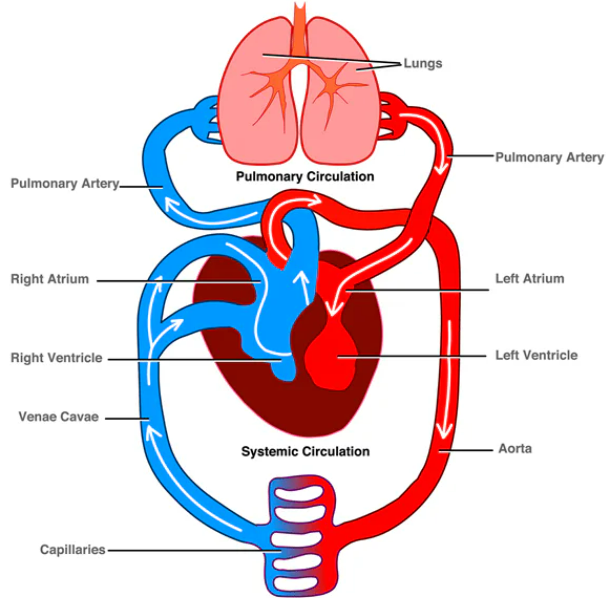
- Carries deoxygenated blood from the heart to the lungs.
- Gas exchange takes place in the lungs.
- Returns oxygenated blood back to the heart.
Pathway
Right ventricle → Pulmonary artery → Lungs → Pulmonary vein → Left atrium
Blood Vessels Involved
Pulmonary Artery
- Carries deoxygenated blood from the right ventricle to the lungs.
- Carbon dioxide is transported to the lungs to be removed.
Important: It is the only artery that carries deoxygenated blood.
Gas Exchange in the Lungs
In the alveoli:
- Oxygen diffuses into the blood.
- Carbon dioxide diffuses out of the blood.
The blood becomes oxygenated.
Pulmonary Vein
- Carries oxygenated blood from the lungs to the left atrium.
Important: It is the only vein that carries oxygenated blood.
🌍 Systemic Circulation (Heart ↔ Body)
Function
- Delivers oxygen and nutrients to all body tissues.
- Returns deoxygenated blood back to the heart.
Pathway
Left ventricle → Aorta → Body organs → Vena cava → Right atrium
Blood Vessels Involved
Aorta
- The largest artery in the body.
- Carries oxygenated blood from the left ventricle.
- Distributes blood to all body organs.
Vena Cava
There are two vena cavae:
- Superior vena cava – returns blood from the head, neck and arms.
- Inferior vena cava – returns blood from the lower part of the body.
Function
- Carry deoxygenated blood back to the right atrium.
🟤 Blood Supply to the Liver (Hepatic Circulation)
The liver receives blood from two different blood vessels because it performs many important functions.
Hepatic Artery
Function
- Carries oxygenated blood from the aorta to the liver.
- Supplies oxygen needed by liver cells for respiration.
Hepatic Portal Vein
Function
- Carries nutrient-rich blood from the small intestine to the liver.
- The blood contains absorbed glucose, amino acids and other nutrients.
Why does blood go to the liver first?
The liver:
- Stores excess glucose as glycogen.
- Processes absorbed nutrients.
- Removes harmful substances.
- Regulates the amount of nutrients entering the bloodstream.
Hepatic Vein
Function
- Carries blood away from the liver.
- Returns blood to the vena cava.
- The blood then flows back to the heart.
🟢 Blood Supply to the Kidneys (Renal Circulation)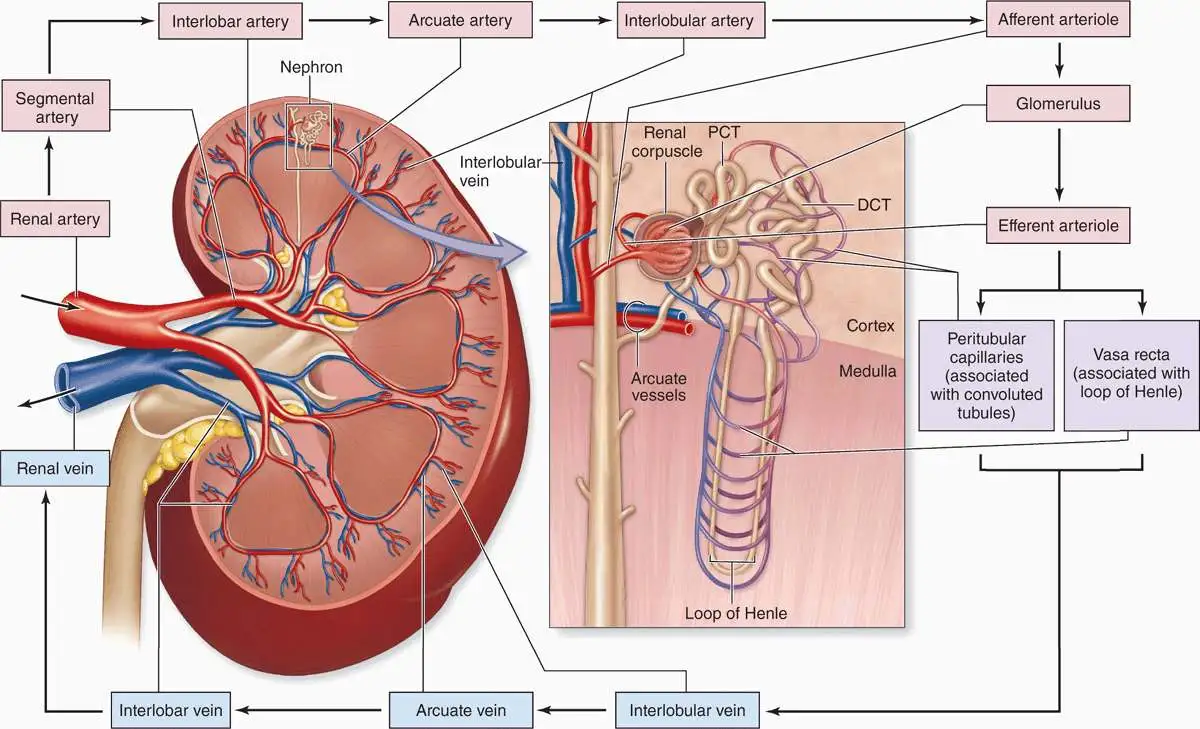
The kidneys receive a large blood supply because they continuously filter the blood.
Renal Artery
Function
- Carries oxygenated blood from the aorta to each kidney.
- Brings blood containing waste products such as urea.
What Happens in the Kidneys?
The kidneys:
- Filter the blood.
- Remove urea.
- Remove excess water.
- Remove excess mineral ions.
- Help maintain a stable internal environment.
Renal Vein
Function
- Carries filtered blood away from the kidneys.
- Returns the blood to the vena cava.
- The cleaned blood then returns to the heart.
🔄 Complete Blood Flow Through the Body
The overall pathway of blood circulation is:
Body → Vena cava → Right atrium → Right ventricle → Pulmonary artery → Lungs → Pulmonary vein → Left atrium → Left ventricle → Aorta → Body
This cycle repeats continuously throughout life.
📊 Blood Vessels Connected to Major Organs
| Organ | Artery Carrying Blood To the Organ | Vein Carrying Blood Away from the Organ | Main Function |
|---|---|---|---|
| Lungs | Pulmonary artery | Pulmonary vein | Gas exchange |
| Body tissues | Aorta | Vena cava | Transport oxygen, nutrients and wastes |
| Liver | Hepatic artery and Hepatic portal vein | Hepatic vein | Supplies oxygen and nutrients; processes absorbed food |
| Kidneys | Renal artery | Renal vein | Filters blood and removes waste products |
📊 Important Blood Vessels
| Blood Vessel | Type | Blood Carried | Destination |
|---|---|---|---|
| Aorta | Artery | Oxygenated | Body |
| Vena cava | Vein | Deoxygenated | Heart |
| Pulmonary artery | Artery | Deoxygenated | Lungs |
| Pulmonary vein | Vein | Oxygenated | Heart |
| Hepatic artery | Artery | Oxygenated | Liver |
| Hepatic portal vein | Vein | Nutrient-rich blood | Liver |
| Hepatic vein | Vein | Deoxygenated | Vena cava |
| Renal artery | Artery | Oxygenated | Kidneys |
| Renal vein | Vein | Filtered, deoxygenated | Vena cava |
🌟 Why Different Organs Need Their Own Blood Supply
- Lungs need blood for gas exchange.
- Liver needs blood to process nutrients and remove harmful substances.
- Kidneys need blood to filter waste products.
- Body tissues need oxygen and nutrients for respiration and growth.
Each organ receives blood through specific arteries and returns blood through specific veins, ensuring efficient transport throughout the body.
⚡ Quick Recap
Double circulation: Pulmonary (heart ↔ lungs) + Systemic (heart ↔ body).
Pulmonary artery: only artery with deoxygenated blood.
Pulmonary vein: only vein with oxygenated blood.
Liver: gets blood via hepatic artery & portal vein → sends out via hepatic vein.
Kidneys: renal arteries in, renal veins out.