
Structure of a Nephron
📝 Introduction
- The nephron is the functional unit of the kidney.
- It is the microscopic structure where blood is filtered and urine is formed.
- Each kidney contains about 1 to 1.5 million nephrons.
- Every nephron works continuously to remove waste products while returning useful substances to the blood.
- A nephron is made up of several specialised parts, and each part performs a specific function.
🌱 What is a Nephron?
- A nephron is a long, thin tube with different specialised regions.
- It begins with a filtering unit and ends with a collecting duct.
- As the filtered fluid passes through the nephron, useful substances are reabsorbed and waste products remain in the urine.
🧩 Main Parts of a Nephron
The nephron consists of the following main parts:
- Glomerulus
- Bowman’s capsule
- Proximal convoluted tubule (PCT)
- Loop of Henle
- Distal convoluted tubule (DCT)
- Collecting duct
1. Glomerulus
Structure
- The glomerulus is a ball-shaped network of tiny blood capillaries.
- It is located at the beginning of the nephron.
- It receives blood from the renal artery.
Function
- It is the site of filtration.
- Blood enters the glomerulus under high pressure.
- Small molecules are forced out of the blood through the capillary walls.
Small molecules filtered
- Water
- Glucose
- Amino acids
- Urea
- Mineral salts
Substances that remain in the blood
- Red blood cells
- White blood cells
- Platelets
- Plasma proteins
These substances are too large to pass through the filter.
2. Bowman’s Capsule
Structure
- Bowman’s capsule is a cup-shaped structure that surrounds the glomerulus.
- It forms the first part of the nephron.
Function
- Collects the fluid filtered from the glomerulus.
- Passes the filtered fluid into the proximal convoluted tubule.
The glomerulus and Bowman’s capsule work together as the filtration unit of the nephron.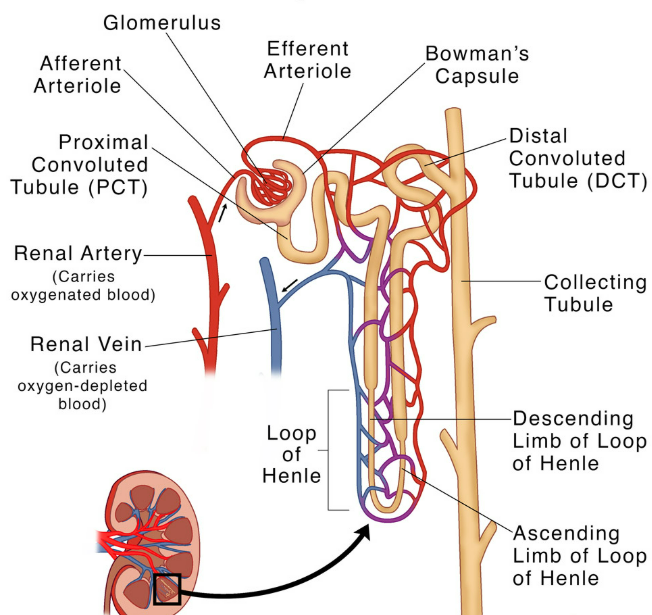
3. Proximal Convoluted Tubule (PCT)
Structure
- The PCT is the first coiled tube after Bowman’s capsule.
- Its lining contains many microvilli.
- The cells also contain many mitochondria.
Why are Microvilli Present?
Microvilli increase the surface area for absorption.
Function
This is the main site of selective reabsorption.
The PCT reabsorbs:
- All glucose
- All amino acids
- Most water
- Most mineral salts
These useful substances move back into the surrounding blood capillaries.
4. Loop of Henle
Structure
- The Loop of Henle is a U-shaped section of the nephron.
- It has:
- A descending limb
- An ascending limb
Function
- The Loop of Henle helps control the amount of water and salts in the body.
- It:
- Reabsorbs water.
- Reabsorbs mineral salts.
- Helps produce concentrated urine when the body needs to conserve water.
This is important for osmoregulation.
5. Distal Convoluted Tubule (DCT)
Structure
- The DCT is the second coiled tube of the nephron.
- It comes after the Loop of Henle.
Function
- The DCT makes the final adjustments to the composition of the filtrate.
- It:
- Reabsorbs some mineral salts.
- Helps maintain the correct ion balance in the blood.
- Works under the control of hormones.
This fine-tunes the composition of the urine before it enters the collecting duct.
6. Collecting Duct
Structure
- The collecting duct is the final part of the nephron.
- Several nephrons empty into one collecting duct.
Function
- The collecting duct:
- Collects urine from many nephrons.
- Reabsorbs water if needed.
- Its permeability is controlled by ADH (Antidiuretic Hormone).
If more ADH is present
- More water is reabsorbed.
- Urine becomes more concentrated.
If less ADH is present
- Less water is reabsorbed.
- Urine becomes more dilute.
The urine then flows into the renal pelvis, enters the ureter, and finally reaches the urinary bladder.
🌟 How a Nephron Forms Urine
The nephron forms urine through three main processes:
1. Filtration
- Occurs in the glomerulus and Bowman’s capsule.
- Small molecules are filtered from the blood.
2. Selective Reabsorption
- Occurs mainly in the proximal convoluted tubule.
- Useful substances are returned to the blood.
3. Water Regulation
- Occurs in the Loop of Henle, distal convoluted tubule, and collecting duct.
- The amount of water in the urine is adjusted according to the body’s needs.
📊 Parts of a Nephron and Their Functions
| Part | Structure | Main Function |
|---|---|---|
| Glomerulus | Ball of capillaries | Filters small molecules from the blood |
| Bowman’s capsule | Cup-shaped structure | Collects the filtrate from the glomerulus |
| Proximal convoluted tubule (PCT) | First coiled tubule with microvilli | Reabsorbs glucose, amino acids, most water and salts |
| Loop of Henle | U-shaped tube | Reabsorbs water and salts, helps concentrate urine |
| Distal convoluted tubule (DCT) | Second coiled tubule | Adjusts salt and ion balance |
| Collecting duct | Final straight tube | Reabsorbs water under ADH control and carries urine to the renal pelvis |
📊 Flow Through a Nephron
| Step | Part | What Happens? |
|---|---|---|
| 1 | Glomerulus | Blood is filtered |
| 2 | Bowman’s capsule | Filtrate is collected |
| 3 | Proximal convoluted tubule | Useful substances are reabsorbed |
| 4 | Loop of Henle | Water and salts are reabsorbed |
| 5 | Distal convoluted tubule | Salt balance is adjusted |
| 6 | Collecting duct | Water reabsorption is completed and urine is collected |
⚡ Quick Recap
Bowman’s capsule + Glomerulus → filter blood.
PCT → take back glucose, amino acids, water.
Loop of Henle → concentrates urine.
DCT → fine-tunes salt levels.
Collecting duct → final water control, urine sent out.
👉 Flow: Glomerulus → Bowman’s capsule → PCT → Loop of Henle → DCT → Collecting duct.