
Role of Phloem in Transporting Sucrose and Amino Acids
📝 Introduction
- Plants need to transport the food they produce from the leaves to other parts of the plant.
- During photosynthesis, leaves manufacture glucose, which is mainly converted into sucrose for transport.
- Plants also need to distribute amino acids, which are required for making proteins.
- Phloem is the specialised transport tissue responsible for moving these organic substances.
- This movement is called translocation and occurs throughout the plant.
🌱 What is Phloem?
Definition
- Phloem is a living vascular tissue that transports organic nutrients, mainly sucrose and amino acids, from one part of the plant to another.
- It forms part of the plant’s vascular bundle alongside the xylem.
- Unlike xylem, phloem transports food in both upward and downward directions, depending on where it is needed.
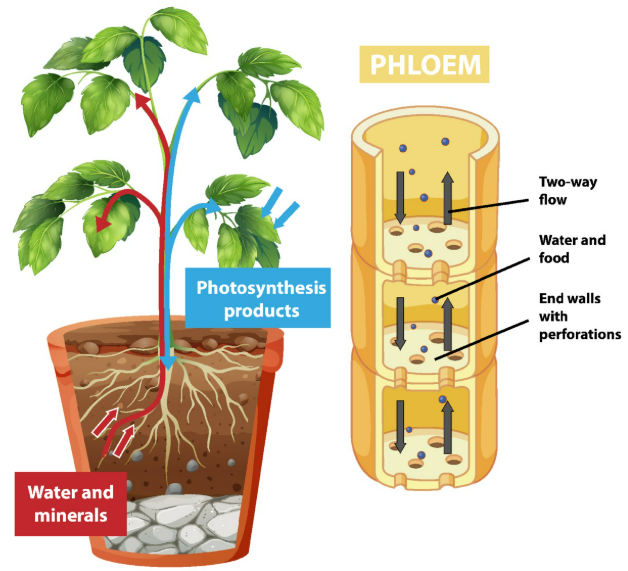
🌿 Structure of Phloem
- Phloem is made up of specialised living cells that work together to transport food.
Main Components
Sieve Tube Elements
- Long living cells joined end to end.
- Form continuous tubes through which food moves.
- End walls contain tiny pores called sieve plates.
- Mature sieve tube elements have very little cytoplasm, providing more space for transport.
Companion Cells
- Living cells located next to sieve tube elements.
- Contain a nucleus and many mitochondria.
- Supply energy needed for loading and unloading sucrose.
- Help maintain the sieve tube elements, which lack a nucleus at maturity.
🍃 What Does Phloem Transport?
- Phloem transports dissolved organic substances, including:
Sucrose
- Main sugar transported in plants.
- Produced from glucose made during photosynthesis.
- Travels in dissolved form through the phloem sap.
Amino Acids
- Produced from sugars and nitrate ions.
- Needed to make proteins.
- Transported to growing and developing tissues.
🔄 What is Translocation?
Definition
- Translocation is the movement of dissolved sugars (mainly sucrose) and amino acids through the phloem from one part of the plant to another.
Unlike diffusion:
- It is an organised transport process.
- It supplies food to tissues that cannot produce enough food themselves.
🌞 Source and Sink
Food moves in the phloem from a source to a sink.
Source
- A source is a part of the plant where sucrose is produced or released.
Examples:
- Photosynthesising leaves.
- Storage organs releasing stored food during germination.
At the source:
- Sucrose enters the phloem.
- It is transported to other parts of the plant.
Sink
- A sink is a part of the plant where sucrose or amino acids are used or stored.
Examples include:
- Growing roots.
- Shoot tips.
- Flowers.
- Developing fruits.
- Seeds.
- Storage organs such as tubers and bulbs.
At the sink:
- Sucrose is removed from the phloem.
- It is used for respiration, growth or converted into starch for storage.
🌿 Role of Phloem in Transporting Sucrose
- Sucrose transported by the phloem is used for many important functions.
It provides energy for:
- Respiration.
- Active transport.
- Cell division.
It supplies materials for:
- Growth of roots and shoots.
- Formation of flowers and fruits.
- Production of new leaves.
- Storage as starch in roots, stems or tubers.
Without phloem transport, only the leaves would have access to the food produced during photosynthesis.
🧬 Role of Phloem in Transporting Amino Acids
- Phloem also distributes amino acids throughout the plant.
Amino acids are needed for:
- Protein synthesis.
- Enzyme production.
- Growth of new tissues.
- Repair of damaged cells.
- Formation of seeds.
Growing regions depend on phloem to receive a continuous supply of amino acids.
↕️ Direction of Transport in Phloem
- Unlike xylem, phloem transport is bidirectional.
This means substances can move:
- Upwards from leaves to shoots or flowers.
- Downwards from leaves to roots.
- Between different storage organs and growing tissues.
The direction depends on where food is produced and where it is required.
🌟 Importance of Phloem
- Phloem is essential because it:
- Distributes food made during photosynthesis.
- Supplies energy to non-photosynthetic tissues.
- Supports growth and development.
- Transports amino acids for protein synthesis.
- Stores excess food in storage organs.
- Connects food-producing and food-using parts of the plant.
📊 Phloem Transport
| Substance Transported | Source | Destination (Sink) | Main Purpose |
|---|---|---|---|
| Sucrose | Leaves | Roots, stems, flowers, fruits, seeds | Respiration, growth and storage |
| Amino acids | Leaves | Growing tissues, seeds, roots | Protein synthesis and growth |
📊 Phloem vs Xylem
| Feature | Phloem | Xylem |
|---|---|---|
| Cells | Living | Dead at maturity |
| Main substances transported | Sucrose and amino acids | Water and mineral ions |
| Direction of transport | Both upwards and downwards | Mainly upwards |
| Process | Translocation | Transpiration stream |
⚡ Quick Recap
Phloem = food (sugars + amino acids), bidirectional, living cells.
Xylem = water + minerals, upwards only, dead lignified cells.
Both work together to keep plants alive, growing, and strong.
Role of Xylem in Transporting Water and Mineral Ions
📝 Introduction
- Plants need a constant supply of water and mineral ions to survive and grow.
- Water and minerals are absorbed from the soil by the roots.
- These substances must be transported to the stem, leaves and all other parts of the plant.
- Xylem is the specialised vascular tissue responsible for this transport.
- Besides transport, xylem also provides mechanical support to the plant.
🌱 What is Xylem?
Definition
- Xylem is a specialised vascular tissue that transports water and dissolved mineral ions from the roots to the stem, leaves and other parts of the plant.
- It forms one of the two main transport tissues in vascular plants, the other being phloem.
- Water moves through the xylem in a continuous stream known as the transpiration stream.
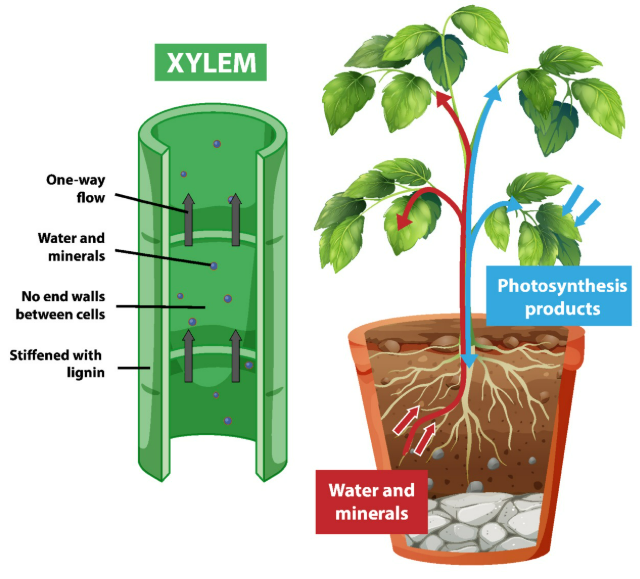
🌿 Structure of Xylem
- Xylem is made of specialised cells that are adapted for efficient water transport.
Main Features of Xylem Vessels
Dead Cells
- Mature xylem vessels are made of dead cells.
- They have no nucleus or cytoplasm.
- This leaves a hollow space for water to flow freely.
Hollow Tubes
- The end walls between neighbouring cells break down.
- This forms one long, continuous tube.
- Water and mineral ions can move upwards without interruption.
Thick, Lignified Walls
- The walls contain lignin, a strong waterproof substance.
- Lignin strengthens the vessels.
- It prevents the vessels from collapsing when water is being pulled upwards.
Narrow Tubes
- Xylem vessels are relatively narrow.
- This helps maintain a continuous column of water from the roots to the leaves.
💧 What Does Xylem Transport?
Xylem transports: Water
Water is needed for:
- Photosynthesis.
- Maintaining cell turgidity.
- Transporting dissolved substances.
- Cooling the plant during transpiration.
- Metabolic reactions inside cells.
Mineral Ions
Mineral ions absorbed from the soil include:
- Nitrate ions – used to make amino acids and proteins.
- Magnesium ions – needed to produce chlorophyll.
- Phosphate ions – required for ATP, DNA and cell membranes.
- Potassium ions – help enzyme activity and stomatal function.
These mineral ions dissolve in water and travel together through the xylem.
🌱 Direction of Transport in Xylem
- Unlike phloem, xylem transport is one-way.
Water moves only:
- Roots → Stem → Leaves
It does not move back down through the xylem.
This upward movement is driven mainly by transpiration.
🌬️ How Water Moves Through the Xylem
Step 1: Absorption by Roots
- Root hair cells absorb water from the soil by osmosis.
- Mineral ions are absorbed by active transport.
- Water follows the mineral ions into the root.
Step 2: Entry into the Xylem
- Water passes through the root tissues.
- It enters the xylem vessels in the root.
Step 3: Upward Transport
- Water moves upwards through the stem.
- The movement is caused by the transpiration pull, created when water evaporates from the leaves.
Step 4: Distribution to Leaves
- Water leaves the xylem and enters the leaf cells.
- Some water is used in photosynthesis.
- Most water evaporates from the leaf through the stomata.
🌟 Functions of Xylem
1. Transport of Water
- Carries water from the roots to all parts of the plant.
- Ensures every cell receives the water it needs.
2. Transport of Mineral Ions
- Delivers dissolved minerals absorbed from the soil.
- Supplies nutrients needed for healthy growth and metabolism.
3. Supports Photosynthesis
- Water transported by xylem is one of the raw materials needed for photosynthesis.
- Without xylem, leaves would not receive enough water to produce glucose.
4. Maintains Cell Turgidity
- Water helps plant cells remain firm and swollen.
- Turgid cells support leaves and young stems.
- This prevents wilting.
5. Mechanical Support
- Thick lignified walls make xylem vessels very strong.
- They help support stems and branches.
- Large plants and trees can remain upright because of this strength.
🌟 Importance of Xylem
Without xylem:
- Water could not reach the leaves.
- Photosynthesis would stop.
- Mineral ions would not reach growing tissues.
- Cells would lose turgidity and wilt.
- The plant would become weak and eventually die.
📊 Adaptations of Xylem Vessels
| Adaptation | How it Helps |
|---|---|
| Dead cells | No cytoplasm to block water flow |
| Hollow tubes | Continuous pathway for water movement |
| No end walls | Water moves freely through the vessel |
| Thick lignified walls | Prevent collapse and provide strength |
| Narrow vessels | Help maintain an unbroken water column |
📊 Xylem vs Phloem
| Feature | Xylem | Phloem |
|---|---|---|
| Cells | Dead at maturity | Living |
| Main substances transported | Water and mineral ions | Sucrose and amino acids |
| Direction of transport | Upwards only | Upwards and downwards |
| Process | Transpiration stream | Translocation |
| Additional function | Mechanical support | Food distribution |
⚡ Quick Recap
Xylem = water + minerals, upwards only, dead lignified cells.
Xylem is the vascular tissue that transports water and mineral ions.
Water moves from roots → stem → leaves.
Both work together to keep plants alive, growing, and strong.