
Water Absorption by Root Hair Cells
📝 Introduction
- Plants continuously lose water through transpiration, so they must constantly absorb more water from the soil.
- Water enters the plant through specialised cells called root hair cells.
- These cells are adapted to absorb water quickly and efficiently.
- The absorbed water is transported to the rest of the plant through the xylem.
- Water absorption occurs mainly by osmosis.
🌱 What are Root Hair Cells?
Definition
- Root hair cells are specialised epidermal cells found on young roots.
- Each cell has a long, thin projection called a root hair.
- They are the main site of water absorption from the soil.
- They also absorb dissolved mineral ions required for plant growth.
🌿 Location of Root Hair Cells
- Found on the outer surface of young roots.
- Located just behind the growing tip of the root.
- They grow between soil particles, allowing close contact with soil water.
🌟 Adaptations of Root Hair Cells for Water Absorption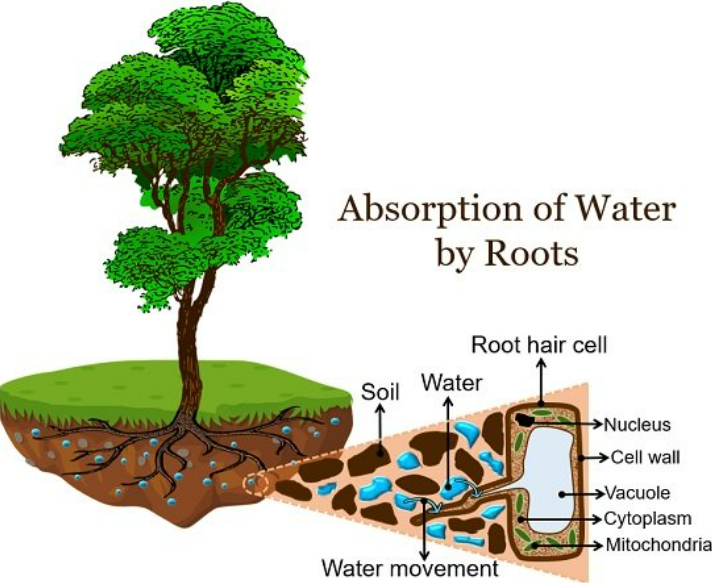
1. Long Hair-like Projection
- Each root hair extends into the spaces between soil particles.
- This greatly increases the surface area available for absorbing water.
Importance
- More water can enter the cell at one time.
- Increases the efficiency of absorption.
2. Large Surface Area
- Thousands of root hair cells cover each young root.
- Together they provide a very large surface area.
Importance
- Allows rapid absorption of water from the soil.
- Increases contact with soil water.
3. Thin Cell Wall
- The cell wall is very thin and permeable.
- Water can pass through it easily.
Importance
- Reduces the distance water must travel.
- Speeds up water movement into the cell.
4. Partially Permeable Cell Membrane
- The plasma membrane controls the movement of substances into the cell.
- Water passes through this membrane by osmosis.
Importance
- Allows selective movement of water into the cell.
5. Concentrated Cell Sap
- The vacuole contains concentrated cell sap with dissolved sugars and salts.
- This lowers the water potential inside the cell compared with the surrounding soil.
Importance
- Creates a water potential gradient.
- Water moves into the cell by osmosis.
6. Close Contact with Soil Particles
- Root hairs grow between moist soil particles.
- This ensures continuous contact with soil water.
Importance
- Provides a constant supply of water for absorption.
💧 What is Osmosis?
Definition
- Osmosis is the movement of water molecules from a region of higher water potential to a region of lower water potential through a partially permeable membrane.
In root hair cells:
- Soil water has a higher water potential.
- Cell sap has a lower water potential.
- Water therefore moves into the root hair cell by osmosis.
🔄 Process of Water Absorption
Step 1: Water Surrounds the Root Hair
- Rainwater and groundwater fill the spaces between soil particles.
- This water contains dissolved mineral ions.
Step 2: Osmosis into the Root Hair Cell
- The soil solution has a higher water potential than the root hair cell.
- Water passes through the cell wall.
- It then crosses the partially permeable cell membrane by osmosis.
- The vacuole fills with water, making the cell turgid.
Step 3: Movement Through the Root Cortex
- After entering the root hair cell, water moves across the root towards the xylem.
- Water moves from cell to cell because each neighbouring cell has a slightly lower water potential.
There are two pathways:
Symplast Pathway
- Water moves through the cytoplasm of living cells.
- It passes from one cell to another via plasmodesmata (tiny channels connecting cells).
Apoplast Pathway
- Water moves through the cell walls and spaces between cells.
- It does not cross cell membranes until it reaches the endodermis.
Step 4: Entry into the Xylem
- Water reaches the xylem vessels in the centre of the root.
- From here, it enters the transpiration stream.
Step 5: Transport to the Rest of the Plant
- Water is pulled upwards through the xylem by transpiration.
- It reaches the stem, leaves, flowers and other plant parts.
🌟 Why Do Root Hair Cells Absorb Water?
The absorbed water is used for many important functions.
Photosynthesis – Water is one of the raw materials needed to make glucose.
Transport – Water carries dissolved mineral ions through the xylem.
Maintaining Turgidity
- Water keeps plant cells firm and swollen.
- This supports leaves and young stems.
Cooling the Plant
- Water evaporates from the leaves during transpiration.
- This helps prevent overheating.
Metabolic Reactions – Many chemical reactions inside plant cells require water.
⚠️ Factors Affecting Water Absorption
Several factors influence the rate of water uptake.
Soil Moisture
- More water in the soil increases absorption.
- Dry soil reduces water uptake.
Water Potential Gradient
- A greater difference in water potential increases the rate of osmosis.
Root Hair Surface Area
- More root hairs provide more area for water absorption.
Rate of Transpiration
- Faster transpiration increases the pull on water in the xylem.
- This increases water absorption by the roots.
📊 Adaptations of Root Hair Cells
| Adaptation | Function |
|---|---|
| Long hair-like extension | Increases surface area for absorption |
| Large number of root hairs | Maximises contact with soil water |
| Thin cell wall | Short diffusion pathway |
| Partially permeable membrane | Allows osmosis |
| Concentrated cell sap | Creates a low water potential inside the cell |
| Close contact with soil | Provides continuous water supply |
📊 Pathway of Water Movement
| Step | Movement of Water |
|---|---|
| 1 | Soil water surrounds the root hair |
| 2 | Water enters the root hair cell by osmosis |
| 3 | Water moves through the cortex (symplast and apoplast pathways) |
| 4 | Water enters the xylem vessels |
| 5 | Water is transported upwards to the rest of the plant |
⚡ Quick Recap
Root hair cells absorb water by osmosis.
Adaptations → long projection, thin walls, large SA.
Water potential gradient: soil → root hair cell → cortex → xylem → leaves.
Essential for photosynthesis, cooling, transport, and turgidity.