Edexcel iGCSE Biology-3.6B & 3.7B Transpiration- Study Notes- New Syllabus
Edexcel iGCSE Biology-3.6B & 3.7B Transpiration- Study Notes- New syllabus
Edexcel iGCSE Biology-3.6B & 3.7B Transpiration- Study Notes -Edexcel iGCSE Biology – per latest Syllabus.
Key Concepts:
3.6B understand that transpiration is the evaporation of water from the surface of a plant
3.7B understand how the rate of transpiration is affected by changes in humidity, wind speed, temperature and light intensity
Transpiration – Evaporation of Water from the Surface of a Plant
📝 Introduction
- Plants continuously lose water to the atmosphere through a process called transpiration.
- Transpiration mainly occurs from the leaves, especially through tiny pores called stomata.
- It is a natural and continuous process that takes place whenever the stomata are open.
- Water lost by transpiration is replaced by water absorbed from the soil by the roots.
- Transpiration is essential for transporting water and minerals, cooling the plant and maintaining healthy growth.
💧 What is Transpiration?
Definition
- Transpiration is the loss of water vapour from the aerial parts of a plant, mainly through the stomata of the leaves, by evaporation and diffusion.
Key Points
- Water is lost as water vapour, not as liquid water.
- Most transpiration occurs through the stomata.
- A small amount of water is also lost through the cuticle and stems.
- It is a physical process and does not require energy from the plant.
🌿 Where Does Transpiration Occur?
Transpiration occurs mainly from:
- Leaves (largest amount)
- Young green stems (small amount)
Within the leaf, water evaporates from the moist surfaces of the mesophyll cells and then diffuses out through the stomata.
🔄 Process of Transpiration
Step 1: Water is Absorbed by the Roots
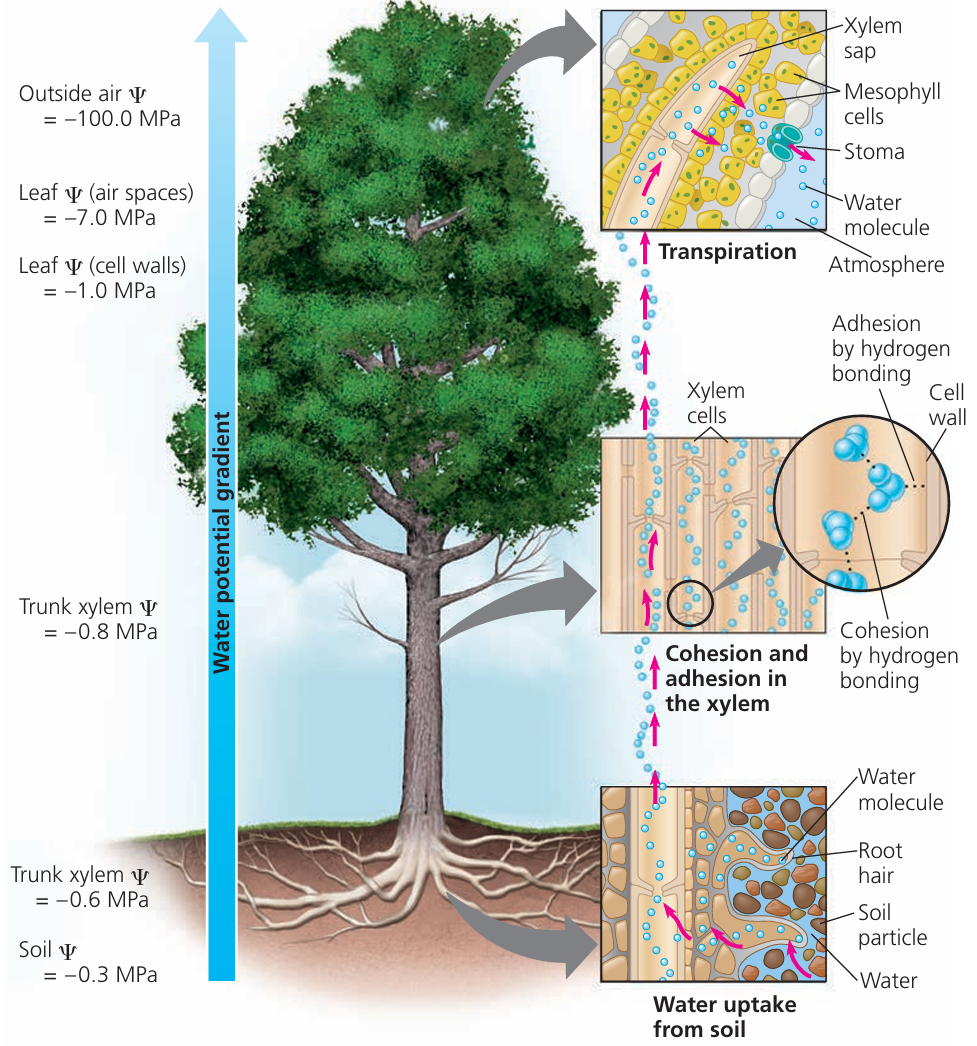
- Root hair cells absorb water from the soil by osmosis.
- Water enters the xylem vessels in the root.
Step 2: Water Moves Up the Xylem
- Water travels upwards through the xylem in the transpiration stream.
- It is transported from the roots to the stem and finally to the leaves.
Step 3: Water Reaches the Leaf Cells
- Water moves from the xylem into the mesophyll cells.
- These cells have moist cell walls.
Step 4: Evaporation from Mesophyll Cells
- Water evaporates from the moist cell walls into the air spaces inside the leaf.
- This changes liquid water into water vapour.
Step 5: Diffusion Through the Stomata
- The concentration of water vapour is higher inside the leaf than outside.
- Water vapour diffuses out through the open stomata into the atmosphere.
This continuous loss of water is called transpiration.
🌟 Why Does Transpiration Occur?
Transpiration occurs because:
- The inside of the leaf is moist.
- Water continuously evaporates from mesophyll cells.
- Water vapour concentration inside the leaf is higher than outside.
- Water vapour therefore diffuses out through the stomata.
🌿 Importance of Transpiration
1. Creates the Transpiration Pull
- As water evaporates from the leaves, it creates a pulling force.
- This pull draws more water upwards through the xylem.
- It helps transport water from the roots to the leaves.
2. Transports Mineral Ions
- Mineral ions dissolve in water.
- As water moves through the xylem, mineral ions are carried to all parts of the plant.
Examples include:
- Nitrate ions
- Magnesium ions
- Phosphate ions
- Potassium ions
3. Supplies Water for Photosynthesis
- Water transported to the leaves is used as a raw material in photosynthesis.
- Without transpiration, less water would reach the leaves.
4. Cools the Plant
- Evaporation removes heat from the leaf surface.
- This cools the plant, similar to how sweating cools the human body.
- It helps prevent overheating on hot days.
5. Maintains Cell Turgidity
- Continuous water movement helps keep plant cells full of water.
- Turgid cells support leaves and stems.
- This prevents the plant from wilting.
🌟 Factors That Increase Transpiration
Several environmental factors affect the rate of transpiration.
Light Intensity
- Bright light causes stomata to open.
- More water vapour escapes.
- Transpiration increases.
Temperature
- Higher temperatures increase evaporation.
- Water molecules move faster.
- Transpiration becomes faster.
Wind Speed
- Wind removes water vapour from around the leaf.
- This maintains a steep concentration gradient.
- Diffusion occurs more quickly.
Humidity
- Low humidity means the surrounding air contains little water vapour.
- Water vapour diffuses out more rapidly.
- High humidity slows transpiration.
⚠️ What Happens if Too Much Water is Lost?
If transpiration is faster than water absorption:
- Plant cells lose water.
- Cells become less turgid.
- Leaves begin to wilt.
- Photosynthesis slows down.
- Severe water loss may damage or kill the plant.
📊 Summary Table
| Feature | Description |
|---|---|
| Definition | Loss of water vapour from the aerial parts of the plant |
| Main site | Leaves |
| Main pores involved | Stomata |
| Water lost as | Water vapour |
| Transport tissue involved | Xylem |
| Main cause | Evaporation followed by diffusion |
| Main importance | Water transport, mineral transport, cooling and maintaining turgidity |
📊 Steps of Transpiration
| Step | Process |
|---|---|
| 1 | Water absorbed by root hair cells |
| 2 | Water enters the xylem |
| 3 | Water moves to the leaves |
| 4 | Water evaporates from mesophyll cells |
| 5 | Water vapour diffuses out through the stomata |
⚡ Quick Recap
Transpiration = evaporation of water from leaves (via stomata).
Rate depends on:
Wind → more wind = faster.
Temperature → higher = faster.
Light → open stomata = faster.
Humidity → higher = slower.
Factors Affecting the Rate of Transpiration
📝 Introduction
- The rate of transpiration is the speed at which a plant loses water vapour from its leaves.
- Transpiration does not occur at a constant rate throughout the day.
- Environmental conditions can either increase or decrease the amount of water lost.
- The four main factors affecting transpiration are humidity, wind speed, temperature and light intensity.
💧 What is the Rate of Transpiration?
Definition
- The rate of transpiration is the amount of water vapour lost by a plant over a given period of time.
- It depends on how quickly water evaporates from the leaf and diffuses through the stomata.
1. Effect of Humidity
What is Humidity?
- Humidity is the amount of water vapour present in the air.
- Air can have high humidity (moist air) or low humidity (dry air).
High Humidity
When the air already contains a lot of water vapour:
- There is only a small difference in water vapour concentration between the inside of the leaf and the surrounding air.
- Water vapour diffuses out of the leaf more slowly.
- Less water evaporates from the leaf.
Result: Transpiration rate decreases.
Low Humidity
When the air is dry:
- The difference in water vapour concentration between the leaf and the air is much greater.
- Water vapour diffuses out more quickly.
- Evaporation from the leaf increases.
Result: Transpiration rate increases.
2. Effect of Wind Speed
What Happens in Still Air?
- Water vapour builds up around the leaf.
- This forms a humid layer close to the stomata.
- The concentration gradient becomes smaller.
- Diffusion slows down.
Result: Lower transpiration rate.
What Happens in Windy Conditions?
- Wind blows away the humid air surrounding the leaf.
- Fresh, drier air replaces it.
- A steep concentration gradient is maintained.
- Water vapour diffuses out more rapidly.
Result: Higher transpiration rate.
3. Effect of Temperature
Low Temperature
- Water molecules have less kinetic energy.
- Evaporation from mesophyll cells is slower.
- Diffusion of water vapour also slows down.
Result: Lower transpiration rate.
High Temperature
- Water molecules move faster.
- More water evaporates from the mesophyll cells.
- Water vapour diffuses out through the stomata more quickly.
Result: Higher transpiration rate.
Very High Temperatures
- If water loss becomes excessive, the plant may begin to wilt.
- Guard cells lose water and become less turgid.
- Stomata close to reduce further water loss.
Result: Transpiration decreases after stomatal closure.
4. Effect of Light Intensity
Darkness or Low Light
- Photosynthesis slows down or stops.
- Guard cells lose turgidity.
- Most stomata close.
- Less water vapour escapes.
Result: Transpiration rate decreases.
Bright Light
- Photosynthesis increases.
- Guard cells become turgid.
- Stomata open wider.
- More water vapour diffuses out.
Result: Transpiration rate increases.
🌱 Why Do These Factors Affect Transpiration?
- All four factors change one or both of the following:
- The rate of evaporation from the moist surfaces of mesophyll cells.
- The rate of diffusion of water vapour through the stomata.
- When evaporation and diffusion are faster, transpiration increases. When they are slower, transpiration decreases.
🌿 Importance of Controlling Transpiration
- Plants must balance water loss with water uptake.
A suitable rate of transpiration helps to:
- Transport water from roots to leaves.
- Carry mineral ions through the xylem.
- Supply water for photosynthesis.
- Cool the plant.
- Maintain cell turgidity.
However, excessive transpiration can:
- Cause wilting.
- Reduce photosynthesis.
- Lead to dehydration if water loss exceeds water absorption.
📊 Summary Table
| Factor | When It Increases | Effect on Transpiration | Why? |
|---|---|---|---|
| Humidity | Low humidity | Increases | Steeper water vapour concentration gradient |
| Humidity | High humidity | Decreases | Smaller concentration gradient |
| Wind speed | Strong wind | Increases | Removes humid air around the leaf |
| Wind speed | Still air | Decreases | Humid air accumulates around the leaf |
| Temperature | High temperature | Increases | Faster evaporation and diffusion |
| Temperature | Low temperature | Decreases | Slower evaporation |
| Light intensity | Bright light | Increases | Stomata open wider |
| Light intensity | Darkness or low light | Decreases | Stomata close |
📦 Quick Recap
Humidity
High humidity → Lower transpiration
Low humidity → Higher transpiration
Wind Speed
Strong wind → Higher transpiration
Still air → Lower transpiration
Temperature
High temperature → Higher transpiration
Low temperature → Lower transpiration
Light Intensity
Bright light → Higher transpiration
Darkness or low light → Lower transpiration
