
DNA Molecule – Structure and Base Pairing
📝 Introduction
- DNA (Deoxyribonucleic Acid) is the molecule that carries all the genetic information of an organism.
- It contains the instructions needed to make proteins and control the activities of cells.
- DNA is found mainly inside the nucleus, where it forms chromosomes.
- Every living organism has DNA, and each person’s DNA is unique (except identical twins).
- The special structure of DNA allows it to store and pass genetic information accurately from one generation to the next.
🧬 What is DNA?
- DNA is the genetic material found in living organisms.
- It stores the instructions needed for growth, development, reproduction and cell activities.
- DNA is made up of many smaller units joined together to form a long molecule.
- The information in DNA is stored in the order of its bases.
Simple Definition: DNA is a long molecule that carries the genetic instructions needed to build and maintain a living organism.
Structure of a DNA Molecule
- A DNA molecule has a unique shape called a double helix.
What is a Double Helix?
- DNA is made of two long strands.
- The two strands twist around each other like a spiral staircase or twisted ladder.
- This twisted shape is called a double helix.
Key Features
- Two strands of DNA.
- Strands are coiled together.
- Strong but flexible structure.
- Helps protect genetic information.
Parts of the DNA Structure
Each DNA strand is made up of repeating units called nucleotides. Each nucleotide contains:
- A deoxyribose sugar
- A phosphate group
- One nitrogenous base
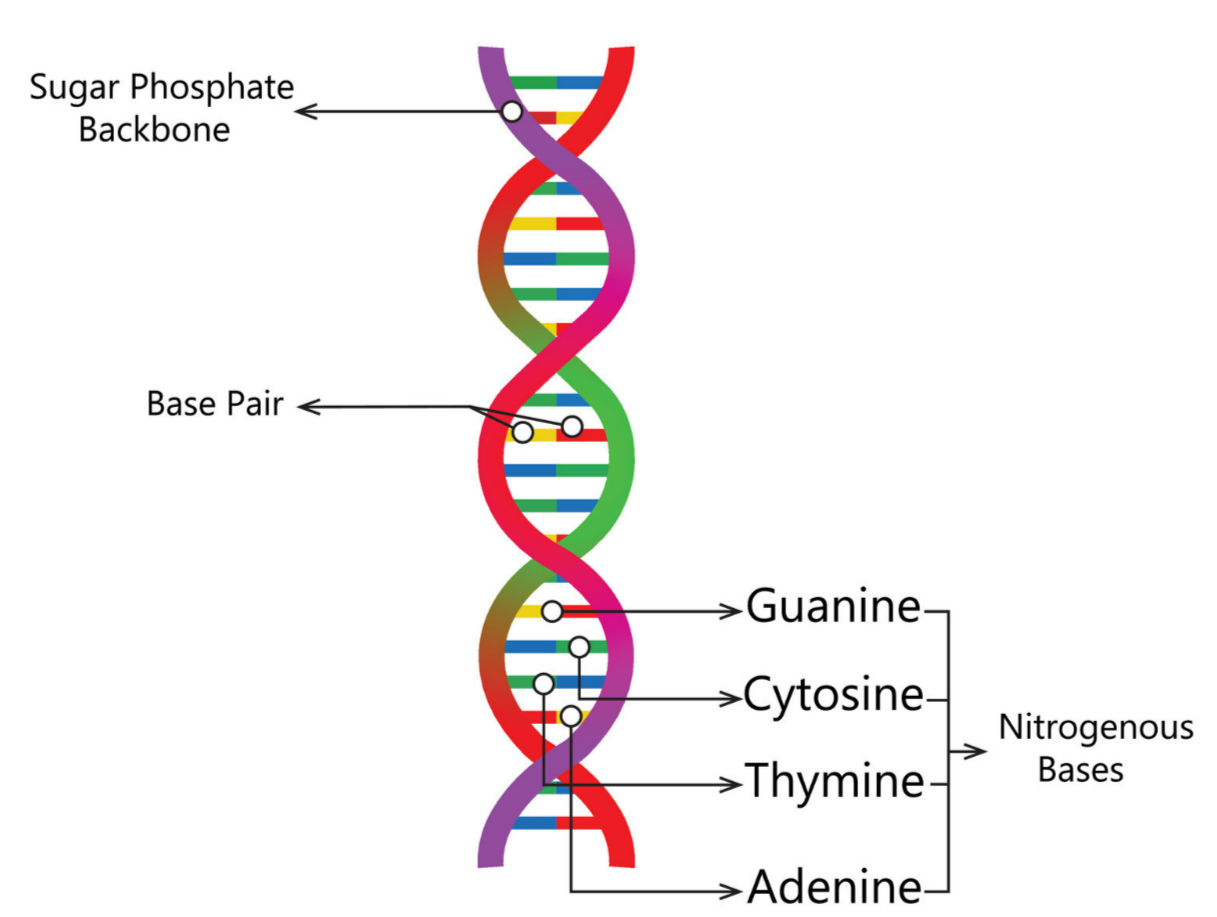
The sugar and phosphate join together to form the backbone of each DNA strand.
The bases point towards the centre of the DNA molecule.
The Four DNA Bases
DNA contains four different nitrogenous bases.
| Base | Symbol |
|---|---|
| Adenine | A |
| Thymine | T |
| Cytosine | C |
| Guanine | G |
These four bases store all the genetic information.
Base Pairing in DNA
- The two DNA strands are joined together by paired bases.
- The bases always pair in a fixed way.
Base Pairing Rules
- Adenine (A) always pairs with Thymine (T).
- Cytosine (C) always pairs with Guanine (G).
This is called complementary base pairing.
Remember
A ↔ T
C ↔ G
No other combinations are possible.
Why is Base Pairing Important?
Correct base pairing is essential because it:
- Keeps the DNA molecule stable.
- Allows DNA to be copied accurately during cell division.
- Ensures genetic information is passed correctly to new cells.
- Helps produce the correct proteins.
If the bases paired incorrectly, the genetic information could change.
🧩 DNA Looks Like a Twisted Ladder
The DNA molecule can be compared to a ladder.
| Part of the Ladder | DNA Structure |
|---|---|
| Two side rails | Sugar-phosphate backbone |
| Steps (rungs) | Paired nitrogen bases (A-T and C-G) |
| Twisted shape | Double helix |
This structure makes DNA both strong and flexible.
Why is the Double Helix Structure Important?
- The double helix structure allows DNA to:
- Store a large amount of genetic information.
- Fit inside the tiny nucleus of a cell.
- Protect the genetic code.
- Be copied accurately before cell division.
- Pass inherited characteristics from parents to offspring.
🧬 Relationship Between DNA, Genes and Chromosomes
The genetic material is organised in different levels.
- DNA forms long molecules.
- Sections of DNA are called genes.
- Many genes are found on one chromosome.
- Chromosomes are located inside the nucleus.
Simple Flow: Nucleus → Chromosomes → DNA → Genes → Proteins
📊 Summary Table
| Feature | Description |
|---|---|
| DNA | Genetic material of the cell |
| Shape | Double helix |
| Number of strands | Two |
| DNA bases | Adenine (A), Thymine (T), Cytosine (C), Guanine (G) |
| Base pairing | A pairs with T, C pairs with G |
| Backbone | Sugar and phosphate |
| Function | Stores genetic information and codes for proteins |
📊 Base Pairing Table
| Base | Pairs With |
|---|---|
| Adenine (A) | Thymine (T) |
| Thymine (T) | Adenine (A) |
| Cytosine (C) | Guanine (G) |
| Guanine (G) | Cytosine (C) |
Importance of Structure
- Stability: Double helix with strong backbone protects genetic code.
- Accuracy: Complementary base pairing ensures correct copying during replication.
- Information Storage: Sequence of bases codes for amino acids → proteins.
📌 Quick Recap
– DNA = double helix with sugar-phosphate backbone.
– Built from nucleotides (sugar + phosphate + base).
– A-T (2 H bonds) and C-G (3 H bonds).
– Encodes genes → proteins.
– Stable, but can unzip for replication and protein synthesis.
✨ Mnemonic: “Apple with Tree, Car with Garage” (A–T, C–G)