
RNA Molecule – Structure, Bases, and Function
📝 Introduction
- RNA (Ribonucleic Acid) is another important nucleic acid found in living cells.
- It works together with DNA to help make proteins.
- Although RNA is similar to DNA, its structure is simpler.
- RNA is single stranded and contains a different nitrogenous base called uracil (U) instead of thymine (T).
🧬 What is RNA?
- RNA stands for Ribonucleic Acid.
- It is a nucleic acid that carries genetic information needed for protein synthesis.
- RNA is made using DNA as a template.
- It carries the instructions from DNA to the parts of the cell where proteins are made.
Simple Definition: RNA is a single-stranded nucleic acid that helps in making proteins.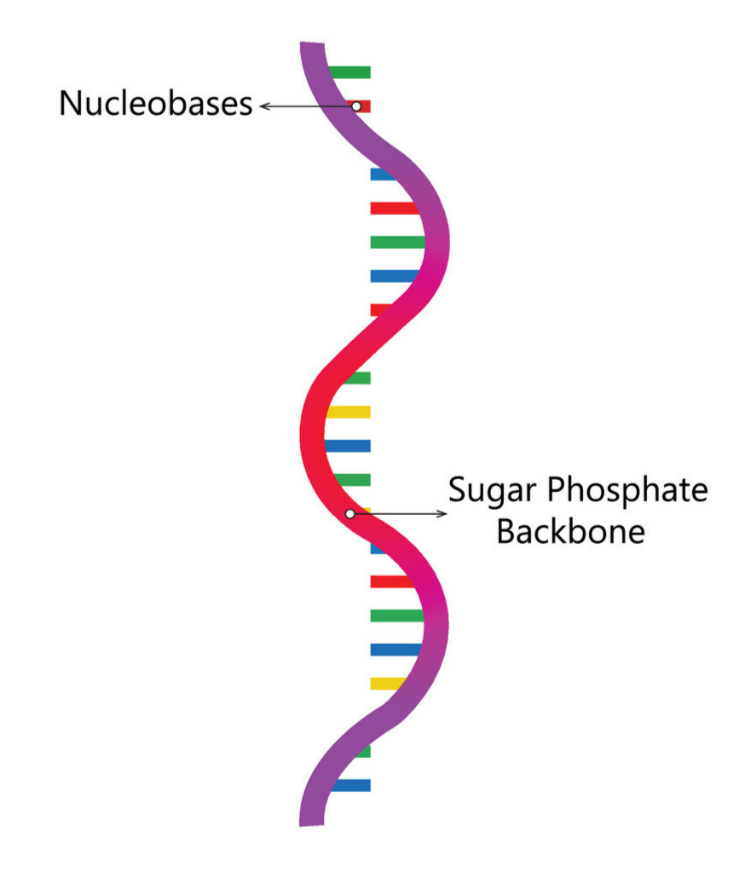
Structure of an RNA Molecule
- RNA has a much simpler structure than DNA.
Main Features
- Made of one strand only.
- Does not form a double helix.
- Contains a sugar called ribose.
- Has a phosphate backbone.
- Contains four nitrogenous bases.
Because RNA has only one strand, it is more flexible and can move easily inside the cell.
The Four Bases in RNA
RNA contains four nitrogenous bases.
| Base | Symbol |
|---|---|
| Adenine | A |
| Uracil | U |
| Cytosine | C |
| Guanine | G |
Important Point
- Unlike DNA, RNA does not contain thymine (T).
- Instead,
- Uracil (U) replaces thymine (T).
Base Pairing in RNA
When RNA is formed from DNA, the bases pair in a specific way.
Base Pairing Rules
- Adenine (A) pairs with Uracil (U).
- Uracil (U) pairs with Adenine (A).
- Cytosine (C) pairs with Guanine (G).
- Guanine (G) pairs with Cytosine (C).
Remember
A ↔ U
C ↔ G
Why Does RNA Contain Uracil Instead of Thymine?
- RNA molecules are short-lived and usually exist only for a short time.
- Uracil performs the same pairing function as thymine during protein synthesis.
- Replacing thymine with uracil makes RNA chemically different from DNA.
🌱 Functions of RNA
RNA plays an important role in protein production.
Its main functions are:
- Carries genetic instructions from DNA.
- Helps assemble amino acids into proteins.
- Ensures proteins are made in the correct order.
Without RNA, cells would not be able to produce proteins needed for growth and normal body functions.
🔍 Differences Between DNA and RNA
| Feature | DNA | RNA |
|---|---|---|
| Full name | Deoxyribonucleic Acid | Ribonucleic Acid |
| Number of strands | Two (double stranded) | One (single stranded) |
| Shape | Double helix | Single strand |
| Sugar present | Deoxyribose | Ribose |
| Bases | A, T, C, G | A, U, C, G |
| Thymine | Present | Absent |
| Uracil | Absent | Present |
| Main role | Stores genetic information | Helps make proteins |
Importance of RNA
- Temporary copy of the genetic code for protein synthesis.
- Ensures correct amino acids are added in the right order to make functional proteins.
- Supports rapid cellular responses, unlike DNA which is static storage.
📌 Quick Recap
– RNA = single-stranded, sugar = ribose, base U replaces T.
– Main function → transfer & translation of genetic code into proteins.
– Types: mRNA, tRNA, rRNA with specific roles.
– Less stable than DNA → temporary information transfer.
Mnemonic: “RNA = Single strand, U stands for You, helps make Proteins too.”