Home / Edexcel iGCSE / Edexcel iGCSE Biology / Edexcel iGCSE Biology-4.26 &4.27 Sex Chromosomes- Study Notes

Edexcel iGCSE Biology-4.26 &4.27 Sex Chromosomes- Study Notes- New Syllabus

Edexcel iGCSE Biology-4.26 &4.27 Sex Chromosomes- Study Notes- New syllabus

Edexcel iGCSE Biology-4.26 &4.27 Sex Chromosomes- Study Notes -Edexcel iGCSE Biology – per latest Syllabus.

Key Concepts:

4.26 understand how the sex of a person is controlled by one pair of chromosomes, XX in a female and XY in a male
4.27 describe the determination of the sex of offspring at fertilisation, using a genetic diagram

Edexcel iGCSE Biology-Concise Summary Notes- All Topics

Sex Determination in Humans

📝 Introduction

  • In humans, the sex of a baby is determined by one pair of chromosomes, called the sex chromosomes.
  • There are 23 pairs of chromosomes in every body cell, and one pair is responsible for determining whether a person is male or female.
  • Females have the sex chromosomes XX, while males have XY.
  • During fertilisation, the combination of sex chromosomes inherited from the parents determines the sex of the offspring.
  • There is an equal chance (50%) of having a male or a female child.

🧬 What are Sex Chromosomes?

  • Sex chromosomes are the pair of chromosomes that determine the biological sex of a person.
  • They are different from the other 22 pairs of chromosomes (autosomes), which carry genes for other body characteristics.
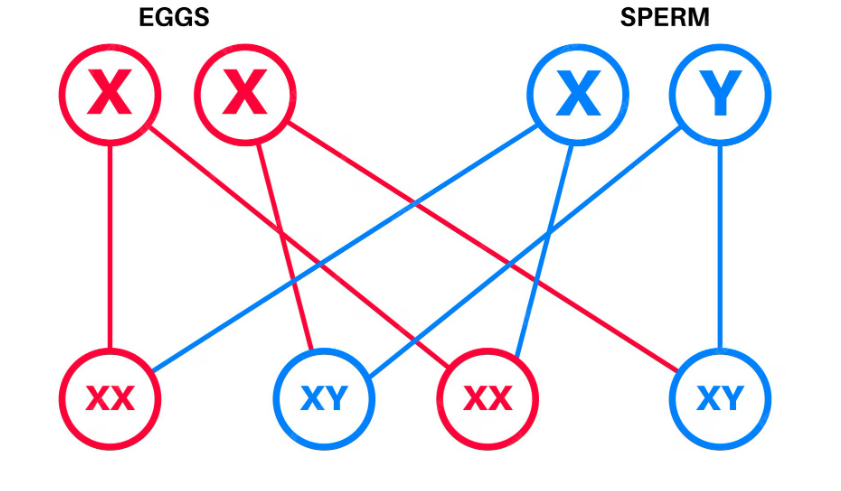
  • Humans have two types of sex chromosomes:
    • X chromosome
    • Y chromosome
  • Only one pair of these chromosomes determines whether an individual is male or female.

Female Sex Chromosomes (XX)

  • A female has two X chromosomes (XX).
  • Since both chromosomes are X, every egg cell produced by a female carries only an X chromosome.
  • Therefore, the mother always passes an X chromosome to her child.

Male Sex Chromosomes (XY)

  • A male has one X chromosome and one Y chromosome (XY).
  • During sperm formation, the two sex chromosomes separate.
  • As a result:
    • Half of the sperm carry an X chromosome.
    • The other half carry a Y chromosome.
  • This means the father can pass either an X chromosome or a Y chromosome to the child.

How is the Sex of a Baby Determined?

  • During fertilisation:
    • The egg always contributes an X chromosome.
    • The sperm contributes either an X chromosome or a Y chromosome.
  • The combination of these chromosomes determines the baby’s sex.
Egg ChromosomeSperm ChromosomeOffspringSex
XXXXFemale
XYXYMale

Probability of Having a Male or Female Child

  • Each fertilisation is a separate event.
  • There are two equally likely outcomes:
    • XX = Female
    • XY = Male
  • Therefore:
    • Probability of a female child = 1/2 (50%)
    • Probability of a male child = 1/2 (50%)
  • The sex of one child does not affect the sex of future children.

Why Does the Father Determine the Sex of the Child?

  • The mother’s egg always contains an X chromosome.
  • The father’s sperm may contain either an X chromosome or a Y chromosome.
  • Therefore, the chromosome contributed by the father decides whether the child will be XX (female) or XY (male).

Summary of Sex Determination

FeatureFemaleMale
Sex chromosomesXXXY
Gamete producedX onlyX or Y
Determines child’s sex?No (always contributes X)Yes (contributes X or Y)

📌 Quick Recap
– 23rd chromosome pair = sex chromosomes.
– XX = female, XY = male.
– Male sperm determines the sex → X = girl, Y = boy.
– Probability of male/female = 1:1.
💡 Tip: “Father decides the child’s sex.”

Sex Determination at Fertilisation

📝 Introduction

  • The sex of a baby is determined at the time of fertilisation.
  • Fertilisation is the process in which the nucleus of a sperm cell fuses with the nucleus of an egg cell to form a zygote.
  • The sex of the offspring depends on which sex chromosome is carried by the fertilising sperm.
  • A genetic diagram (Punnett square) is used to predict the possible sex of the offspring.
  • There is an equal probability (50%) of producing a male or a female child.

Sex Chromosomes in Humans

  • Humans have 23 pairs of chromosomes.
  • 22 pairs are called autosomes.
  • 1 pair consists of the sex chromosomes, which determine whether a person is male or female.
PersonSex Chromosomes
FemaleXX
MaleXY

Sex Chromosomes in Gametes

  • During meiosis, the chromosome pairs separate, so each gamete receives only one sex chromosome.

Female (XX)

  • Every egg cell receives only one X chromosome.
  • Therefore, all eggs are genetically the same for sex chromosomes.

Egg cells:

  • X
  • X

Male (XY)

  • Half of the sperm receive an X chromosome.
  • The other half receive a Y chromosome.

Sperm cells:

  • X
  • Y

🧬 Fertilisation and Sex Determination

  • During fertilisation:
  • The egg always contributes an X chromosome.
  • The sperm contributes either an X chromosome or a Y chromosome.
  • The combination of these chromosomes determines the sex of the offspring.
  • X egg + X sperm = XX (Female)
  • X egg + Y sperm = XY (Male)

Genetic Diagram (Punnett Square)

Parents

Female (XX) × Male (XY)

Gametes

  • Female → X, X
  • Male → X, Y

Punnett Square

 X (Sperm)Y (Sperm)
X (Egg)XXXY
X (Egg)XXXY

📊 Results of the Genetic Diagram

Genotypes

  • 2 XX
  • 2 XY

Genotype Ratio

1 XX : 1 XY

Phenotypes

  • 2 Females
  • 2 Males

Phenotype Ratio

1 Female : 1 Male

Probability of Each Sex

OffspringProbabilityPercentage
Female (XX)1/250%
Male (XY)1/250%

This means that every pregnancy has:

  • 50% chance of producing a female child.
  • 50% chance of producing a male child.

Why Does the Father Determine the Sex of the Child?

  • The mother always contributes an X chromosome because all her eggs contain only X.
  • The father contributes either an X chromosome or a Y chromosome through his sperm.
  • Therefore, the chromosome carried by the sperm determines whether the child is male or female.

🌟 Important Points About Sex Determination

  • Sex is determined at fertilisation, when the sperm joins with the egg.
  • The egg always carries an X chromosome.
  • The sperm may carry either an X chromosome or a Y chromosome.
  • If an X-bearing sperm fertilises the egg, the offspring will be XX (female).
  • If a Y-bearing sperm fertilises the egg, the offspring will be XY (male).
  • The chance of having a male or female child is equal (1 : 1).
  • The sex of one child does not affect the sex of future children because each fertilisation is an independent event.

📊 Summary Table

FeatureFemaleMale
Sex chromosomesXXXY
Sex chromosome in gametesX onlyX or Y
Chromosome contributed during fertilisationXX or Y
Possible offspringXXXY
Probability50%50%

⚡ Quick Recap
✔ Sex is determined at fertilisation.
✔ Females have XX chromosomes and males have XY chromosomes.
✔ Every egg carries an X chromosome.
✔ Sperm carry either an X or a Y chromosome.
✔ XX = Female and XY = Male.
✔ The father determines the sex of the child.
✔ The probability of having a male or female child is 50% (1 : 1).
✔ Each pregnancy is independent, so previous children do not affect future outcomes.

Scroll to Top