
Mitosis – Producing Identical Cells
📝 Introduction
- Mitosis is a type of cell division that produces two genetically identical daughter cells.
- It takes place in body (somatic) cells and is essential for growth, repair and replacement of worn-out or damaged cells.
- During mitosis, the number of chromosomes remains the same, so each daughter cell receives a complete set of chromosomes.
- The parent cell is diploid (2n), and the daughter cells formed are also diploid (2n).
- Mitosis ensures that genetic information is passed accurately from one cell to the next.
🧬 What is Mitosis?
- Mitosis is the process in which one diploid parent cell divides once to produce two diploid daughter cells that are genetically identical to each other and to the parent cell.
- Each daughter cell contains the same number and type of chromosomes as the original parent cell.
What Does Diploid Mean?
- A diploid (2n) cell is a cell that contains two complete sets of chromosomes.
- One set of chromosomes is inherited from the mother.
- The other set is inherited from the father.
- In humans:
- Diploid cells contain 46 chromosomes (23 pairs).
- Most body cells, such as skin cells, muscle cells and liver cells, are diploid.
Why is Mitosis Important?
- Mitosis is necessary because it:
- Increases the number of cells during growth.
- Replaces old, worn-out or dead cells.
- Repairs damaged tissues after injury.
- Maintains the same chromosome number in body cells.
- Produces genetically identical cells, ensuring body cells function normally.
- Allows some organisms, such as certain plants and simple animals, to reproduce asexually.
What Happens Before Mitosis?
- Before the cell divides, it prepares by copying its DNA.
DNA Replication
- Every chromosome makes an exact copy of itself.
- Each copied chromosome now consists of two identical sister chromatids joined together at a centromere.
- This ensures that enough genetic material is available for both daughter cells.
At this stage:
- The chromosome number does not increase.
- Only the amount of DNA has doubled.
⚙️ Stages of Mitosis
1. Chromosomes Become Visible
- The copied chromosomes become shorter and thicker.
- Each chromosome consists of two sister chromatids joined at the centromere.
- The nuclear membrane begins to break down.
2. Chromosomes Line Up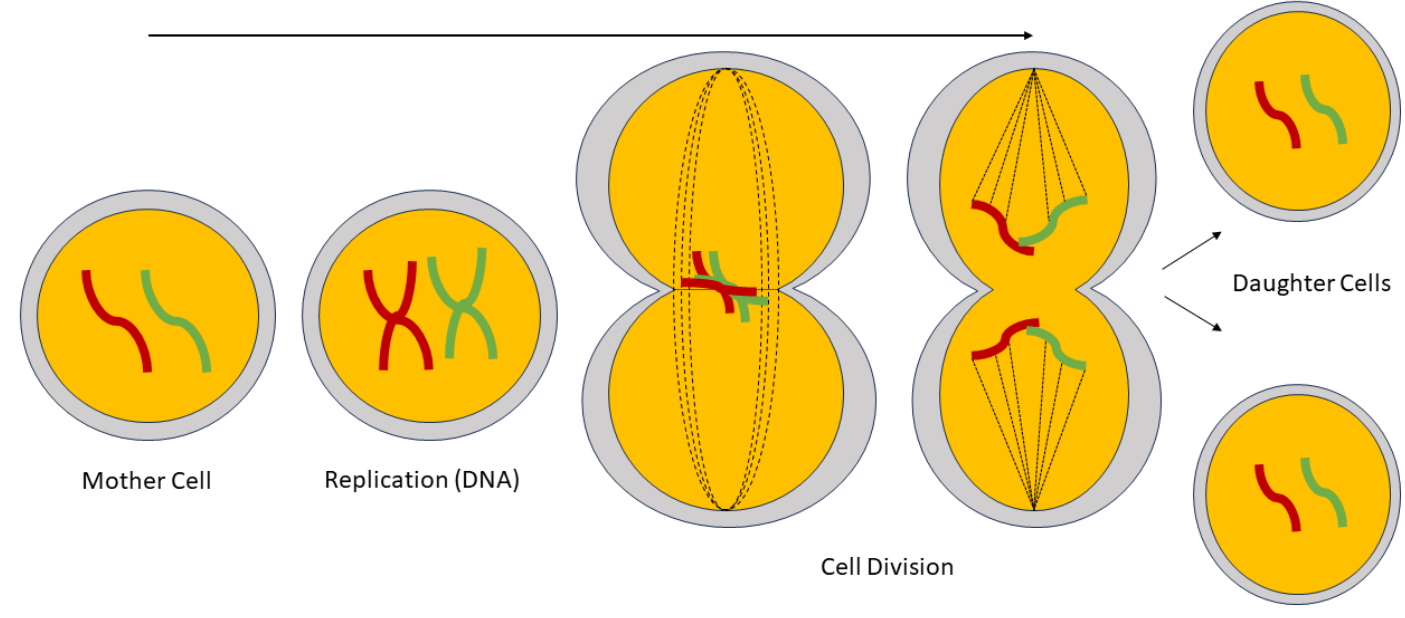
- The chromosomes move to the centre (equator) of the cell.
- Spindle fibres attach to the centromeres of each chromosome.
- This ensures that each chromatid can be pulled to opposite ends of the cell.
3. Sister Chromatids Separate
- The centromeres divide.
- Spindle fibres pull the sister chromatids apart.
- One chromatid moves to each end (pole) of the cell.
- Once separated, each chromatid is called a chromosome.
4. Formation of Two New Cells
- New nuclear membranes form around each set of chromosomes.
- The cytoplasm divides in a process called cytokinesis.
- Two separate daughter cells are produced.
Each daughter cell:
- Has the same chromosome number as the parent cell.
- Contains identical genetic information.
Result of Mitosis
| Parent Cell | Daughter Cells |
|---|---|
| Diploid (2n) | Diploid (2n) |
| One cell | Two cells |
| 46 chromosomes (human) | 46 chromosomes each |
| Normal body cell | Two genetically identical body cells |
🧬 Why Are Daughter Cells Genetically Identical?
The daughter cells are genetically identical because:
- DNA is copied accurately before cell division.
- Every chromosome is duplicated.
- Sister chromatids are separated equally.
- Each daughter cell receives one copy of every chromosome.
- No genetic information is lost or gained during mitosis.
🌟 Importance of Maintaining the Chromosome Number
If the chromosome number changed every time a body cell divided:
- Cells would not function properly.
- Important genetic information could be lost.
- Growth and repair would be affected.
Mitosis prevents this by ensuring:
- Each daughter cell receives a complete set of chromosomes.
- The chromosome number remains constant.
Functions of Mitosis
Growth
- In multicellular organisms, mitosis increases the number of cells.
- This allows the organism to grow from a single fertilised egg into an adult.
Repair of Damaged Tissues
- Damaged or injured cells are replaced by new cells produced through mitosis.
- This helps wounds heal.
Replacement of Worn-Out Cells
- Cells such as skin and intestinal cells wear out regularly.
- Mitosis replaces these old cells with new ones.
Asexual Reproduction
- Some organisms reproduce without fertilisation.
- Mitosis produces genetically identical offspring.
Examples include:
- Some plants
- Amoeba
- Yeast
🌟 Features of Mitosis
- Occurs in body (somatic) cells.
- Involves one cell division.
- Produces two daughter cells.
- Daughter cells are genetically identical.
- Chromosome number remains diploid (2n).
- Used for growth, repair and cell replacement.
📊 Summary Table
| Feature | Mitosis |
|---|---|
| Type of parent cell | Diploid body cell |
| Number of divisions | One |
| Number of daughter cells | Two |
| Chromosome number | Remains diploid (2n) |
| Genetic makeup | Daughter cells are genetically identical |
| Main functions | Growth, repair, replacement of cells and asexual reproduction |
📚 Importance of Mitosis
- Growth → more body cells.
- Repair → replaces damaged cells.
- Asexual reproduction → e.g., in plants (cuttings, runners).
- Genetic stability → no variation introduced.
📌 Quick Recap
Mitosis = 1 division → 2 identical diploid cells.
Maintains chromosome number.
Key uses: growth, repair, asexual reproduction.
Stages in order: IPMATC (Interphase → Prophase → Metaphase → Anaphase → Telophase → Cytokinesis).
💡 Mnemonic for stages: Interesting People Meet At The Café