Home / Edexcel iGCSE / Edexcel iGCSE Biology / Edexcel iGCSE Biology-4.34 – 4.37B Mutation & Mutation: Advanced- Study Notes

Edexcel iGCSE Biology-4.34 – 4.37B Mutation & Mutation: Advanced- Study Notes- New Syllabus

Edexcel iGCSE Biology-4.34 – 4.37B Mutation & Mutation: Advanced- Study Notes- New syllabus

Edexcel iGCSE Biology-4.34 – 4.37B Mutation & Mutation: Advanced- Study Notes -Edexcel iGCSE Biology – per latest Syllabus.

Key Concepts:

4.34 understand that mutation is a rare, random change in genetic material that can be inherited

4.35B understand how a change in DNA can affect the phenotype by altering the sequence of amino acids in a protein
4.36B understand how most genetic mutations have no effect on the phenotype, some have a small effect and rarely do they have a significant effect
4.37B understand that the incidence of mutations can be increased by exposure to ionising radiation (for example, gamma rays, x-rays and ultraviolet rays) and some chemical mutagens (for example, chemicals in tobacco)

Edexcel iGCSE Biology-Concise Summary Notes- All Topics

Mutation – A Source of Genetic Change

📝 Introduction

  • A mutation is a change in the genetic material (DNA) of an organism.
  • It is rare and random, meaning it happens by chance and not in a fixed pattern.
  • Mutations can affect how genes work because genes control the production of proteins.
  • If a mutation happens in reproductive cells, it can be passed to offspring (inherited).
  • Mutations are an important source of genetic variation in living organisms.

What is a Mutation?

  • A mutation is a permanent change in the DNA sequence of a gene or chromosome.
  • It can change the instructions in a gene, which may change the protein produced.
  • Even a small change in DNA can have a big effect on an organism.

Key Features of Mutation

  • Rare → does not happen often.
  • Random → occurs by chance, no specific reason or pattern.
  • Permanent → once it happens, the DNA is changed.
  • Heritable → can be passed to the next generation if it occurs in gametes.
  • Source of variation → creates new forms of genes (alleles).

Where Do Mutations Occur?

Mutations can occur in:

  • Body cells (somatic cells) → affects only the individual, not passed to offspring.
  • Sex cells (gametes) → can be inherited by offspring.

Only mutations in gametes are inherited.

🧬 How Mutation Affects Genes

  • Genes contain instructions to make proteins.
  • A mutation changes the DNA code.
  • This may lead to:
    • A different protein being made.
    • A non-functional protein.
    • Or sometimes no change at all.

Types of Mutation (Simple Idea)

Even though mutations are many types, at this level we understand them simply as:

  • Gene mutation → change in a single gene (most common idea in iGCSE).
  • Chromosome mutation → change in whole chromosome structure or number (less common but still important).

🌟Effects of Mutation

1. Neutral Effect

  • No change in protein function.
  • No visible effect on organism.

2. Harmful Effect

  • Protein does not work properly.
  • Can cause genetic disorders or diseases.

3. Beneficial Effect

  • New useful traits may appear.
  • Can help survival in changing environments.

Mutation and Inheritance

If mutation happens in gametes (sperm or egg):

  • It is passed to the offspring.
  • Offspring may show a new characteristic.

If mutation happens in body cells:

  • It affects only that individual.
  • It is not inherited.

Role of Mutation in Variation

  • Mutation creates new alleles of genes.
  • These new alleles increase variation in a population.
  • Variation is important because:
    • It helps species adapt to changing environments.
    • It supports evolution through natural selection.

⚠️ Causes of Mutation (Basic Idea)

Mutations can happen:

  • Naturally during DNA copying.
  • Due to environmental factors like:
    • Radiation (e.g., UV rays).
    • Certain chemicals.

📊 Summary Table

FeatureMutation
DefinitionChange in DNA sequence
OccurrenceRare and random
InheritanceOnly if in gametes
EffectMay be neutral, harmful or beneficial
RoleProduces genetic variation

📝 Quick Recap 
Mutation = rare, random change in DNA.
Inherited only if in gametes.
Can be beneficial, harmful, or neutral.
Source of genetic variation → drives evolution.

DNA Mutation → Protein → Phenotype

📝 Introduction

  • A gene is a section of DNA that contains the instructions for making a specific protein.
  • Proteins control the structure and functions of cells, so they play an important role in determining an organism’s characteristics (phenotype).
  • If the DNA sequence of a gene changes because of a mutation, the protein made may also change.
  • A change in the protein can change how cells work, which may lead to a change in the organism’s phenotype.
  • However, not every DNA change causes a visible change in phenotype.

🧬 Relationship Between DNA, Protein and Phenotype

A characteristic is produced through the following sequence:

DNA (Gene) → Amino Acid Sequence → Protein → Characteristic (Phenotype)

  • This means that the DNA sequence controls the order of amino acids in a protein, and the protein determines how a trait is expressed.

How Does DNA Control Protein Production?

  • Every gene contains a specific sequence of DNA bases.
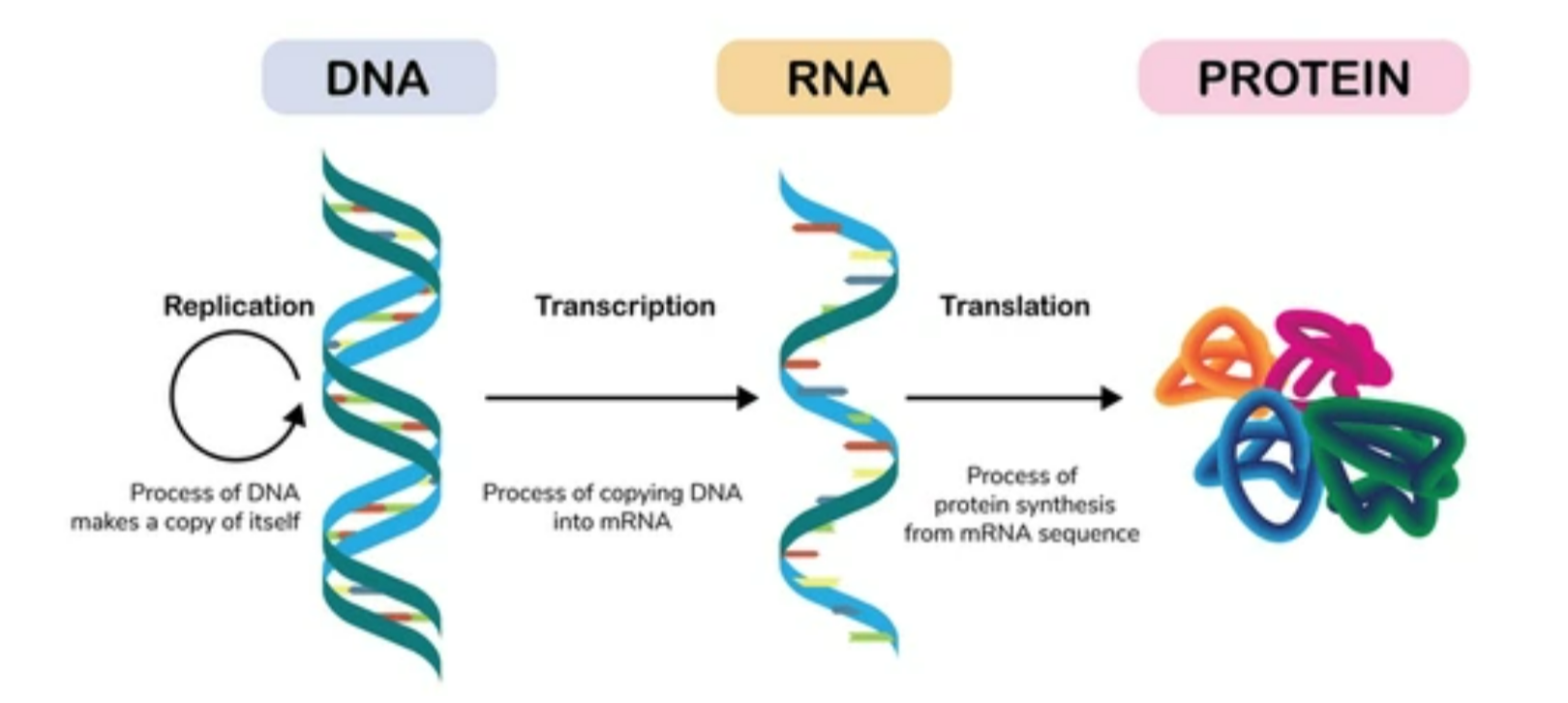
  • During protein synthesis, this DNA sequence is used to arrange amino acids in the correct order.
  • The amino acids join together to form a protein.
  • The order of amino acids determines the protein’s:
    • Shape
    • Structure
    • Function
  • If the amino acid sequence changes, the protein may not work properly.

🔄 What Happens When DNA Changes?

  • A mutation changes the sequence of DNA bases in a gene.
  • This can change the genetic instructions used to make a protein.

As a result:

  • A different amino acid may be added.
  • An amino acid may be missing.
  • The protein may become shorter than normal.
  • The protein may fold into a different shape.
  • Any of these changes can affect how the protein functions.

How Does a DNA Change Affect Phenotype?

The process happens step by step:

Step 1: Mutation Occurs

  • A mutation changes the DNA sequence of a gene.

Step 2: Protein Synthesis is Affected

  • The changed DNA produces a different mRNA sequence.
  • This may change the order of amino acids.

Step 3: Protein Changes

  • The protein produced may have a different shape or structure.
  • It may work less efficiently or stop working completely.

Step 4: Phenotype Changes

  • Since proteins control many characteristics, a change in the protein may cause a change in the organism’s phenotype.

🧬 Why Does the Amino Acid Sequence Matter?

  • Proteins are made from long chains of amino acids.
  • The sequence of amino acids is very important because it determines:
    • How the protein folds.
    • Its three-dimensional shape.
    • Its specific function.
  • Even a change in one amino acid can affect how the protein works.

Possible Effects of a DNA Mutation

1. No Effect

  • Sometimes the mutation does not change the amino acid sequence.
  • The protein remains normal.
  • The phenotype does not change.

2. Small Effect

  • The protein changes slightly.
  • It may still work, but less efficiently.
  • The phenotype may change only a little.

3. Large Effect

  • The protein is produced with an incorrect amino acid sequence.
  • It may fold incorrectly or fail to function.
  • This can cause a noticeable change in the phenotype.

🌟 Why Do Proteins Affect Phenotype?

  • Proteins perform many important jobs in the body.

They may act as:

  • Enzymes that control chemical reactions.
  • Structural proteins that build cells and tissues.
  • Hormones that regulate body functions.
  • Transport proteins that move substances.
  • Receptors that receive signals.
  • If these proteins change, the characteristic they control may also change.

🌸 Simple Example

Suppose a gene normally produces a protein that forms normal pigment in the skin.

  • Normal DNA → Normal amino acid sequence → Normal protein → Normal pigment.

If a mutation changes the DNA:

  • Mutated DNA → Different amino acid sequence → Changed protein → Different pigment.

As a result, the phenotype changes.

⚠️ Important Points

  • A mutation changes the DNA sequence, not the phenotype directly.
  • The phenotype changes because the mutation changes the protein.
  • The effect depends on how much the protein is altered.
  • Some mutations have no visible effect, while others can produce significant changes.

📝 Quick Recap 
DNA → Amino acids → Protein → Phenotype.
Mutation in DNA → may alter amino acid sequence → can change protein → may affect trait.
Effects can be harmful, beneficial, or neutral.
Key examples: Sickle cell anaemia, albinism.

Effects of Genetic Mutations on Phenotype

📝 Introduction

  • A mutation is a rare, random change in the DNA sequence of a gene.
  • Mutations can affect the proteins made by a cell, which may change an organism’s phenotype.
  • However, not all mutations produce visible changes.
  • In fact, most mutations have no effect, some cause only a small effect, and only a few have a significant effect on the phenotype.
  • The effect of a mutation depends on where it occurs in the DNA and how much it changes the protein.

🧬 Why Do Mutations Have Different Effects?

  • Genes contain the instructions for making proteins.

When a mutation changes the DNA sequence:

  • The protein may remain exactly the same.
  • The protein may change slightly.
  • The protein may change so much that it cannot function properly.
  • The greater the effect on the protein, the greater the chance of a change in the phenotype.

1. Most Mutations Have No Effect on the Phenotype

  • Most mutations are neutral (harmless).
  • This means the mutation does not produce any visible change in the organism.

Why do most mutations have no effect?

  • The mutation may occur in a part of DNA that does not affect protein production.
  • The change may not alter the amino acid sequence of the protein.
  • Even if one amino acid changes, the protein may still work normally.
  • Some proteins can continue to function even after a small DNA change.

As a result:

  • The protein works normally.
  • The organism shows no change in its characteristics (phenotype).

2. Some Mutations Have a Small Effect on the Phenotype

  • Sometimes a mutation changes the DNA enough to slightly alter the protein.
  • The protein still works, but not as efficiently as before.

As a result:

  • The change in phenotype is small.
  • The organism remains healthy, but one characteristic may be slightly different.
  • The effect may be difficult to notice.

In these cases:

  • Protein function is reduced slightly.
  • The phenotype changes only a little.

3. Rarely, Mutations Have a Significant Effect on the Phenotype

  • Only a small number of mutations produce a major change.
  • These mutations greatly alter the DNA sequence, causing a large change in the protein.

As a result:

  • The protein may fold incorrectly.
  • The protein may lose its normal shape.
  • The protein may stop working completely.
  • An important body process may be affected.

This can lead to:

  • A noticeable change in the phenotype.
  • Genetic disorders.
  • Serious health problems.

🔄 From Mutation to Phenotype

A mutation affects the phenotype in a series of steps:

DNA Mutation
↓
Gene Instructions Change
↓
Amino Acid Sequence May Change
↓
Protein Structure or Function May Change
↓
Phenotype May Change

  • The amount of phenotype change depends on how much the protein is affected.

🌟 Factors That Affect the Size of the Effect

The effect of a mutation depends on:

  • Which gene is affected.
  • Where the mutation occurs in the DNA sequence.
  • Whether the amino acid sequence changes.
  • Whether the protein can still function normally.
  • The importance of that protein in the body.

📊 Types of Mutation Effects

Type of EffectWhat Happens to the Protein?Effect on Phenotype
No effectProtein remains unchanged or still functions normallyNo visible change
Small effectProtein changes slightly but still worksSlight change in characteristic
Significant effectProtein is greatly altered or stops functioningMajor change in phenotype or genetic disorder

Why Are Most Mutations Harmless?

Most mutations do not cause noticeable changes because:

  • Many DNA changes do not affect important parts of a gene.
  • Some DNA changes produce the same amino acid.
  • Many proteins can still function after a small change.
  • Cells have mechanisms that reduce the effects of some mutations.

Therefore, only a small number of mutations cause obvious changes in phenotype.

🌟 Importance of Mutation

Although some mutations are harmful, mutations are also important because they:

  • Create new alleles.
  • Increase genetic variation.
  • Provide the variation needed for natural selection and evolution.
  • Allow populations to adapt to changing environments over time.

📊 Summary Table

FeatureDescription
MutationRare, random change in DNA
Most mutationsNo effect on phenotype
Some mutationsCause a small change in phenotype
Rare mutationsCause a significant change in phenotype
ReasonDepends on how much the protein is affected

📝 Quick Recap
Most mutations → no effect (silent).
Some mutations → small effect → minor protein/trait changes.
Rare mutations → significant effect → major change in phenotype (harmful or beneficial).
Effect depends on mutation location in DNA and protein change.

Factors Increasing Mutation Rate

📝 Introduction

  • A mutation is a rare, random and permanent change in the DNA of an organism.
  • Although mutations happen naturally, their frequency can be increased by certain environmental factors called mutagens.
  • Mutagens damage the DNA inside cells, increasing the chance that mistakes will occur when DNA is copied.
  • The main mutagens you need to know are ionising radiation and chemical mutagens.
  • Increased mutation rates can sometimes lead to genetic disorders or cancer, although many mutations have little or no effect.

What is a Mutagen?

  • A mutagen is any factor that increases the chance (incidence) of mutations occurring in DNA.
  • Mutagens do not always cause mutations, but they make mutations more likely to happen.
  • There are two main types of mutagens:
    • Physical mutagens (ionising radiation)
    • Chemical mutagens

☢️ Ionising Radiation

What is Ionising Radiation?

  • Ionising radiation is high-energy radiation that can pass through living cells and damage DNA.
  • When DNA is damaged, mistakes may occur during DNA replication, increasing the chance of mutations.

Examples of Ionising Radiation

1. Gamma Rays

  • Very high-energy radiation.
  • Can pass deeply into body tissues.
  • May damage DNA inside cells.
  • Increase the chance of mutations.

2. X-rays

  • Used in hospitals to examine bones and internal organs.
  • High doses or frequent exposure can damage DNA.
  • Medical X-rays are carefully controlled to reduce unnecessary exposure.

3. Ultraviolet (UV) Rays

  • UV rays come mainly from the Sun.
  • They can also be produced by tanning lamps.
  • Long-term exposure to UV rays can damage the DNA in skin cells.
  • This increases the risk of mutations and skin cancer.

🧪 Chemical Mutagens

What are Chemical Mutagens?

  • Chemical mutagens are chemicals that can damage DNA, making mutations more likely.

They may enter the body through:

  • Breathing
  • Eating
  • Drinking
  • Skin contact

Example: Chemicals in Tobacco Smoke

  • Tobacco smoke contains many harmful chemicals.

These chemicals can:

  • Damage the DNA in body cells.
  • Increase the mutation rate.
  • Raise the risk of developing cancers, especially lung cancer.
  • This is one of the main reasons why smoking is harmful.

🔄 How Mutagens Cause Mutations

The process can be explained step by step:

Exposure to a mutagen
↓
DNA becomes damaged
↓
Mistakes occur when DNA is copied
↓
Mutation forms
↓
The mutation may affect protein production
↓
The phenotype may change

Possible Effects of Increased Mutations

An increased mutation rate may lead to:

No Effect

  • Many mutations do not affect how a cell works.
  • The phenotype remains unchanged.

Small Effect

  • The protein changes slightly.
  • The phenotype changes only a little.

Significant Effect

  • The protein is greatly altered or does not work properly.
  • This may cause a genetic disorder or increase the risk of cancer.

⚠️ Why is DNA Damage Dangerous?

  • DNA contains the instructions for making proteins.

If DNA is damaged:

  • Incorrect proteins may be produced.
  • Cells may not function properly.
  • Some cells may begin dividing uncontrollably.
  • This can lead to diseases such as cancer.

Reducing Exposure to Mutagens

The risk of mutations can be reduced by:

  • Avoiding smoking and tobacco products.
  • Limiting unnecessary exposure to X-rays.
  • Protecting the skin from excessive sunlight by using sunscreen and protective clothing.
  • Following safety rules when working with radiation or harmful chemicals.

📊 Summary Table

MutagenExampleHow it Increases Mutations
Ionising radiationGamma raysDamages DNA inside cells
Ionising radiationX-raysCan damage DNA if exposure is excessive
Ionising radiationUltraviolet (UV) raysDamages DNA in skin cells
Chemical mutagenChemicals in tobacco smokeDamage DNA and increase mutation rate

📊 Ionising Radiation vs Chemical Mutagens

FeatureIonising RadiationChemical Mutagens
What it isHigh-energy radiationHarmful chemicals
ExamplesGamma rays, X-rays, UV raysChemicals in tobacco smoke
Effect on DNADamages DNA directlyDamages DNA through chemical reactions
ResultIncreased chance of mutationsIncreased chance of mutations

📝 Quick Recap
Mutagens increase mutation rate.
Radiation → DNA strand breaks (gamma, X, UV rays).
Chemicals → DNA sequence changes (tobacco, pesticides).
Mutation effects can be silent, minor, or significant.

Scroll to Top