Home / Edexcel iGCSE / Edexcel iGCSE Biology / Exam Style Questions

Edexcel iGCSE Biology 4BI1 - Paper 1B -Cloning- Exam Style Questions- New Syllabus

Question

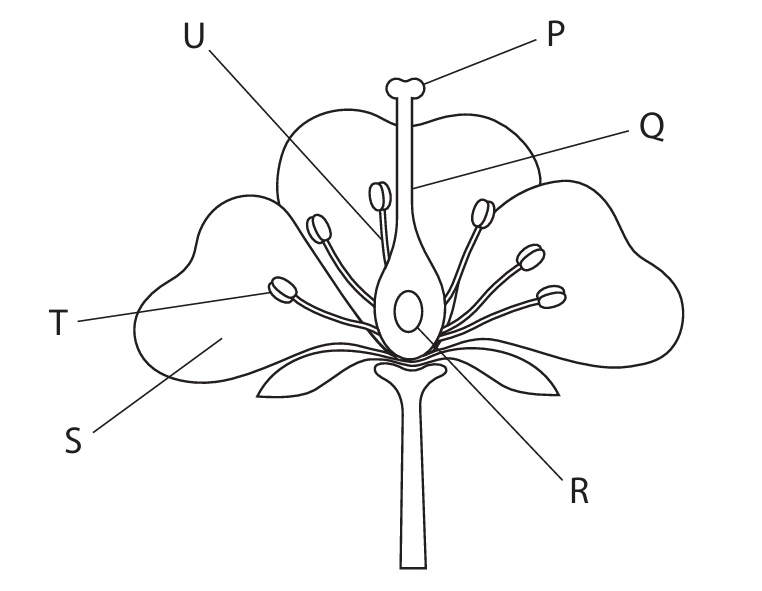
The diagram shows an insect-pollinated flower with some structures labelled.

(a) (i) Which structures are the male parts of the flower?

A) P and Q
B) P and R
C) S and T
D) T and U

(ii) On which structure does the pollen grain germinate?

A) P
B) R
C) S
D) T

(iii) Which structure becomes the seed after fertilisation?

A) P
B) Q
C) R
D) T

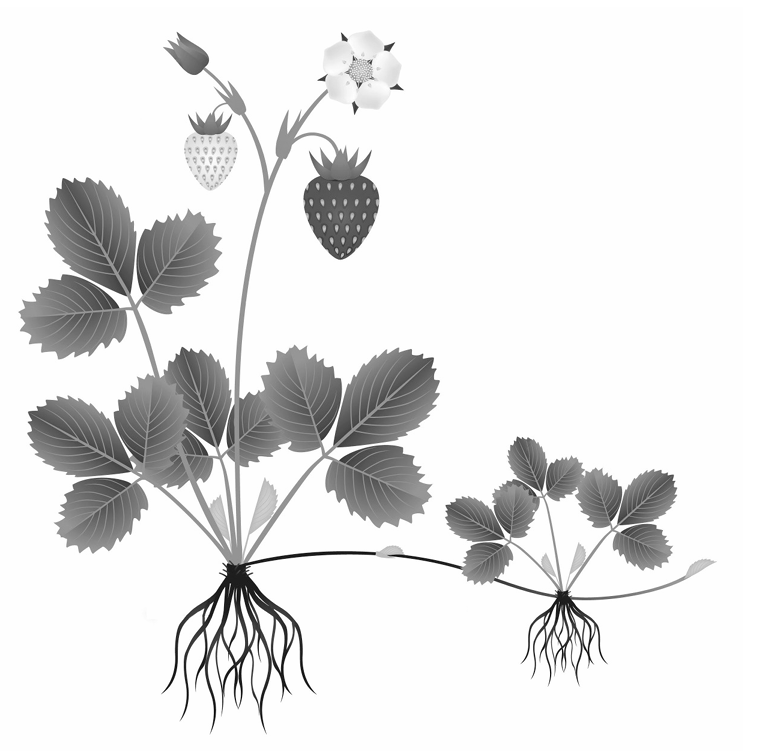
(b) The picture shows a strawberry plant. This plant can reproduce sexually using its flowers, or asexually.

(i) Describe how a strawberry plant reproduces asexually.
(ii) A farmer wants to produce a plant that has strawberries with a different flavour. He then wants to produce large numbers of these plants. Discuss how he can use sexual and asexual reproduction to achieve this.

Most-appropriate topic codes (Edexcel IGCSE Biology):

3(a): Reproduction (Flowering plants) — parts (a)(i), (a)(ii), (a)(iii), (b)(i), (b)(ii)
5(d): Cloning — part (b)(i), (b)(ii)
3(a): Differences between sexual and asexual reproduction — part (b)(ii)
▶️ Answer/Explanation
Solution

(a)(i) D (T and U)
A is not the answer as P and Q are not both the male parts
B is not the answer as P and R are not both the male parts
C is not the answer as S and T are not both the male parts

(a)(ii) A (P)
B is not the answer as pollen grains do not germinate on R
C is not the answer as pollen grains do not germinate on S
D is not the answer as pollen grains do not germinate on T

(a)(iii) C (R)
A is not the answer as P does not become the seed
B is not the answer as Q does not become the seed
D is not the answer as T does not become the seed

(b)(i) A description that makes reference to two of the following:
• uses runners / stolons / eq (1)
• stem / shoot (grows along ground) / eq (1)
• breaks off / grows roots / produces new plant / clone / eq (1)

(b)(ii) An answer that makes reference to four of the following:
1. (use sexual reproduction) cross with different variety / different plant / selective breeding / eq (1)
2. transfer pollen / cross pollinate / eq (1)
3. to produce different flavour / new flavour / desired flavour / variation / eq (1)
4. (use asexual) / runners / cuttings / micropropagation / eq (1)
5. produces genetically identical plants / clones / eq (1)
6. many offspring produced / large numbers / eq (1)
Question

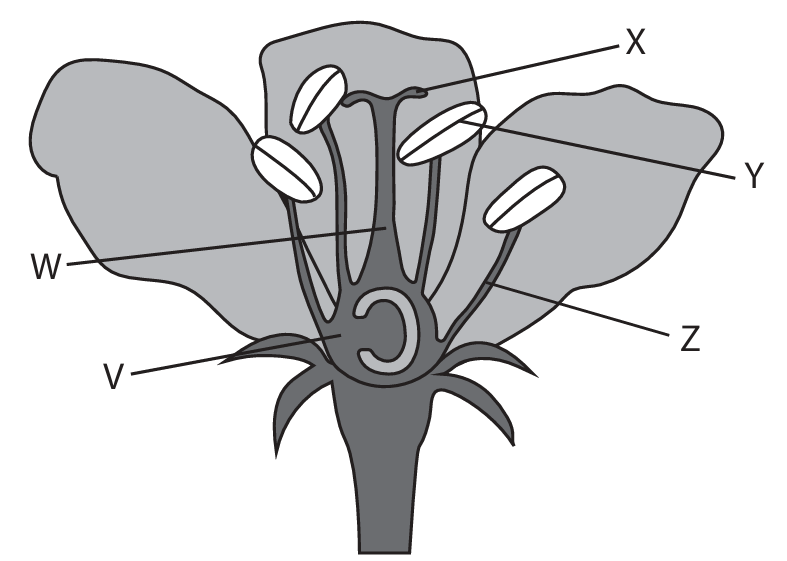
The diagram shows the structure of an insect pollinated flower.

(a)(i) Which part of the flower produces pollen?

A) V
B) X
C) Y
D) Z

(ii) Which part of the flower becomes a fruit?

A) V
B) W
C) X
D) Y

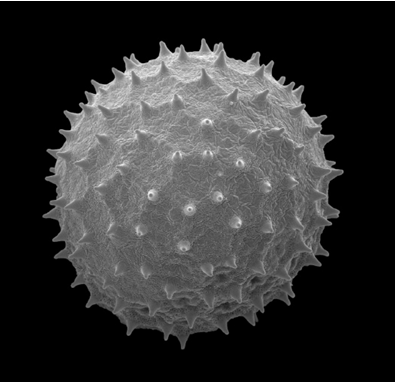
(b) The image shows a pollen grain produced by the plant.

(i) The diameter of the pollen grain in the image is 30 mm. The pollen grain has an actual diameter of 313 \( \mu m \).

Calculate the magnification of the pollen grain in the image. Give your answer to the nearest whole number.
[1 mm = 1000 \( \mu m \)]

(ii) State how the structure of the pollen grain is adapted to ensure insect pollination.

(c) Gardeners often reproduce plants by taking cuttings. Explain why gardeners often reproduce plants by taking cuttings instead of growing the plants from seeds.

Most-appropriate topic codes (Edexcel IGCSE Biology):

4(a): Reproduction — parts (a)(i), (a)(ii), (b)(ii), (c)
2(b): Cell structure — part (b)(i) (magnification calculation)
6(d): Cloning (via asexual reproduction) — part (c)
▶️ Answer/Explanation
Solution

(a)(i) C (Y)
A is incorrect because V is the ovary.
B is incorrect because X is the stigma.
D is incorrect because Z is the filament.

(a)(ii) A (V)
B is incorrect because W does not become a fruit.
C is incorrect because X does not become a fruit.
D is incorrect because Y does not become a fruit.

(b)(i) 96 (\( \times \))
Stages of calculation:
• Convert mm to \( \mu m \): 30 mm = \( 30 \times 1000 = 30000 \) \( \mu m \).
• Magnification = \( \frac{\text{image size}}{\text{actual size}} = \frac{30000}{313} \).
• Calculation: \( \frac{30000}{313} \approx 95.85 \).
• To nearest whole number = 96.

(b)(ii) • spikes / hooks / sticky / eq (1)

(c) An answer that makes reference to two of the following:
• asexual reproduction (1)
• cuttings are genetically identical / have same alleles / same genes / are clones / eq (1)
• faster / can be produced at any time of year / can be done from only one plant / no need to have insects / eq (1)
Question

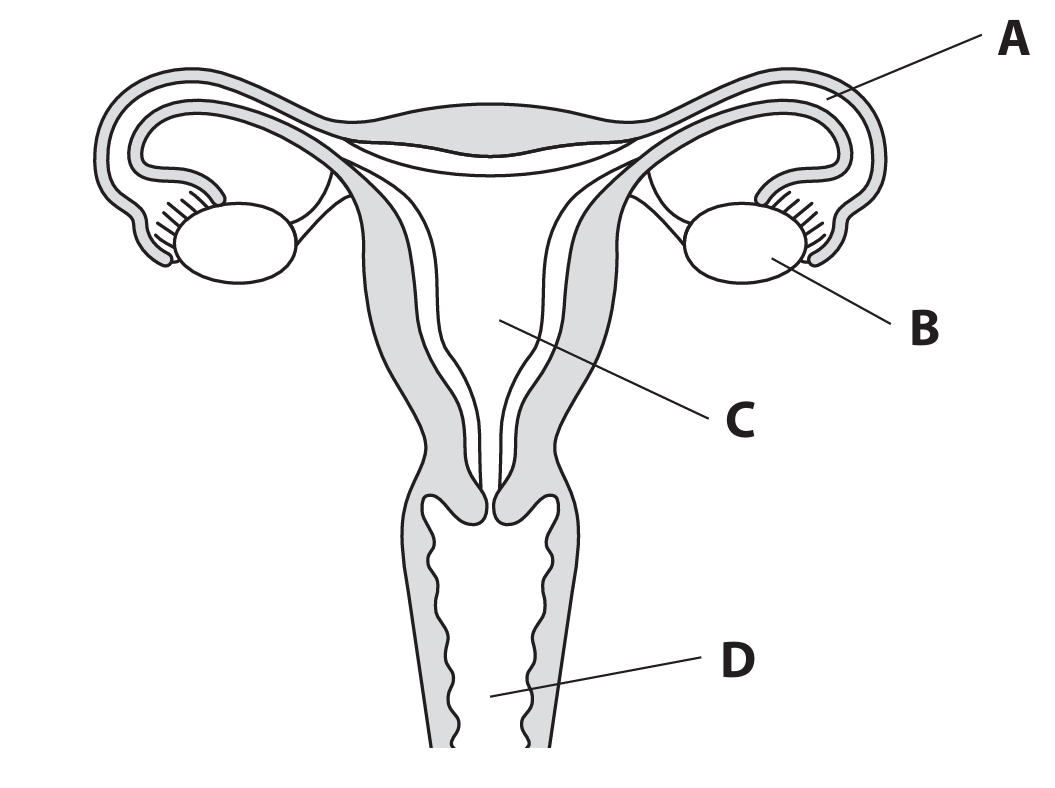
The diagram shows the human female reproductive system.

(a) (i) Where does fertilisation normally occur?

  • A
  • B
  • C
  • D

(a) (ii) State how oestrogen and progesterone affect structure C during the menstrual cycle.

(b) In vitro fertilisation (IVF) is used to help some people have children.
Eggs are mixed with sperm in a laboratory.
Embryos are then transferred into a uterus.

(b) (i) Describe how an embryo forms after the eggs and sperm have been mixed together.

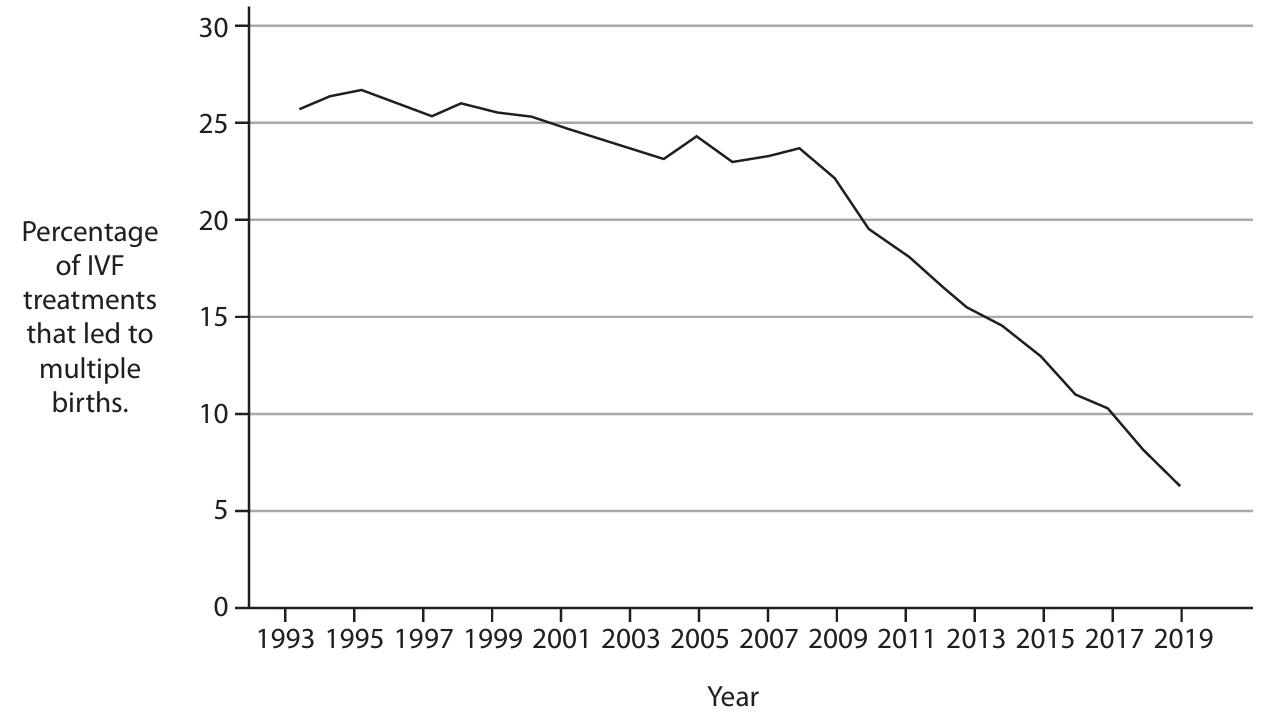
(b) (ii) If more than one embryo is transferred to a uterus, IVF can result in multiple births, such as twins or triplets. Pregnancies that produce more than one baby can be a health risk.
In the United Kingdom, since 2007, the recommendations for the number of embryos transferred are
– a person under 40 should have only one embryo placed into their uterus
– a person over 40 may have two embryos placed into their uterus
The graph shows the percentage of IVF treatments that led to multiple births from 1993 to 2019.

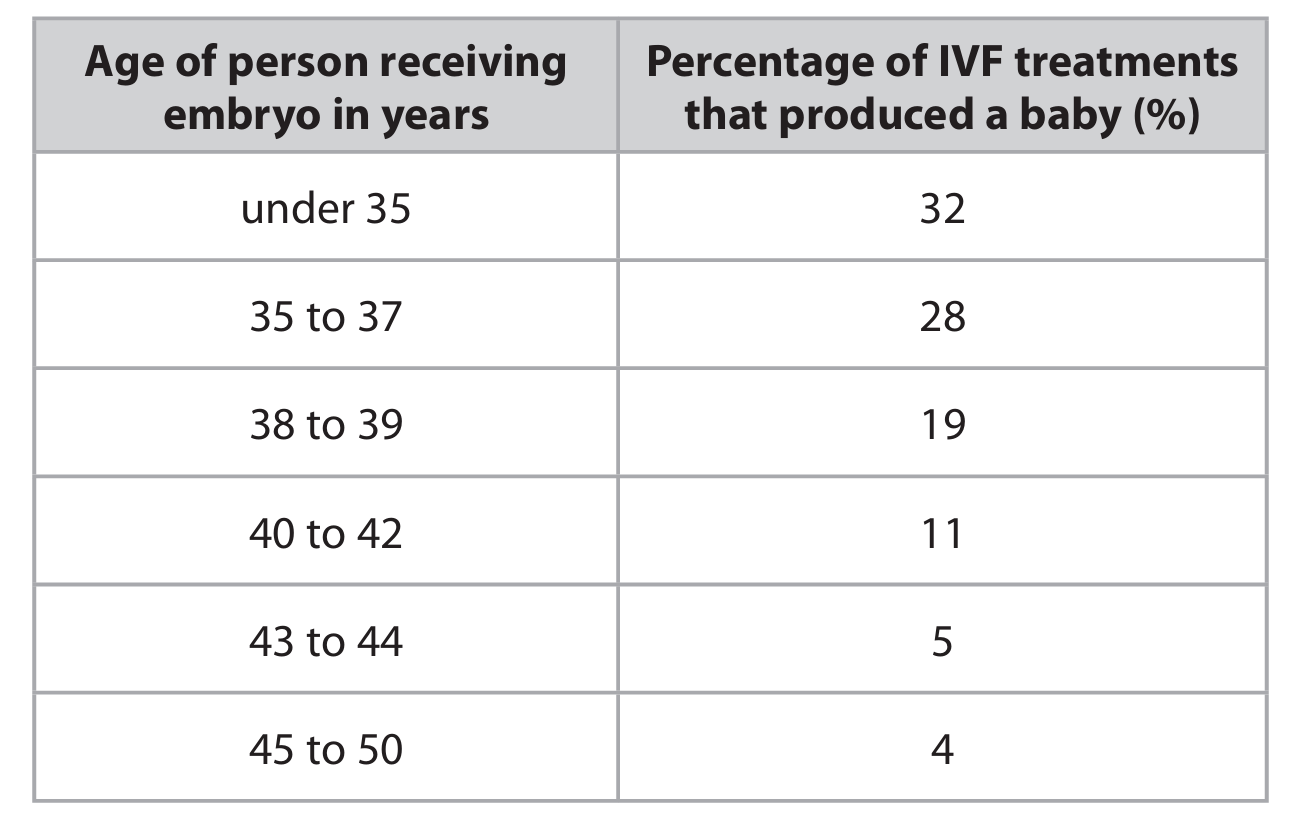
The table shows the success rates for IVF in the United Kingdom in 2019 for people of different age groups.

Discuss the effects of limiting the number of embryos transferred.
Use the information in the table and the graph to support your answer.

Most-appropriate topic codes (Edexcel IGCSE Biology):

3(a): Reproduction — parts (a)(i), (a)(ii), (b)(i)
3(b): Inheritance — part (b)(i)
5(d): Cloning — part (b)(ii)
Appendix 5: Command word taxonomy — part (b)(ii) “Discuss”
▶️ Answer/Explanation
Solution

(a)(i) A

Explanation: Fertilisation, the fusion of a sperm cell nucleus with an egg cell nucleus to form a zygote, normally occurs in the oviduct, also known as the Fallopian tube. This is the structure labelled A in the diagram. The ovary (B) is where eggs are produced and released, the uterus (C) is where the embryo implants and develops, and the vagina (D) is the birth canal.

(a)(ii) Oestrogen: Repairs / thickens the lining. Progesterone: Maintains / retains the lining.

Explanation: Oestrogen, produced by the developing follicles in the ovary, causes the repair and proliferation of the endometrium (the lining of the uterus, structure C) after menstruation. Progesterone, secreted by the corpus luteum after ovulation, maintains this thickened, blood vessel-rich lining, making it suitable for the implantation of a fertilised egg. A drop in progesterone levels at the end of the cycle is what triggers the shedding of this lining, leading to menstruation.

(b)(i) A sperm cell fuses with an egg cell to form a zygote. The zygote then undergoes a series of mitotic cell divisions to form a ball of cells called an embryo.

Explanation: During IVF, eggs are collected and mixed with sperm in a Petri dish. If successful, a single sperm will penetrate the egg’s outer layers, and their nuclei will fuse. This single-celled fertilised egg is called a zygote. The zygote does not increase in size but divides repeatedly by mitosis – first into 2 cells, then 4, then 8, and so on. This process of cell division forms a multicellular structure which, by the time it is transferred to the uterus, has developed into an embryo.

(b)(ii) Limiting embryos has significantly reduced multiple births (as shown by the graph’s steep decline post-2007), making IVF safer by reducing health risks for both parent and babies. However, the table shows success rates decrease with age. For older individuals with lower success rates, transferring two embryos balances the higher risk of twins against the low chance of success with one embryo. For younger people with high success rates, one embryo minimizes risk without drastically reducing their chance of pregnancy.

Explanation: This answer requires an evaluation of the policy based on the provided data. The graph provides clear evidence that the policy was effective in its primary goal: reducing multiple births. The table provides the rationale for the age-specific nature of the policy. The discussion balances the benefit (reduced health risks) with a drawback (potentially lower success rates for older recipients) and uses the data to justify why the age limit is set where it is.

Question

Plants can be genetically modified (GM) to produce insect poison.

They are modified using a bacterium called Agrobacterium.

This bacterium has a plasmid that contains recombinant DNA.

(a) Describe how the plasmid is modified to contain recombinant DNA.

(b) A farmer can use either of these methods to improve his crop yield.

● grow GM plants that produce the insect poison

● grow non-GM plants and use pesticides

The farmer decides to grow the GM plants rather than using pesticides.

Discuss the decision made by the farmer.

Most-appropriate topic codes (Edexcel IGCSE Biology):

6(c): Genetic modification (genetic engineering) — part (a)
6(a): Food production — part (b)
6(d): Cloning — context of plant biotechnology (implied)
▶️ Answer/Explanation
Solution

(a)

Answer: The plasmid is modified by using the same restriction enzyme to cut both the plasmid and the target gene, creating complementary sticky ends. The gene for making the insect poison is then inserted into the plasmid. Finally, the ligase enzyme is used to join the gene into the plasmid, forming recombinant DNA.

Detailed Explanation:

The process of creating recombinant DNA involves several key steps. First, scientists use a specific restriction enzyme to cut open the plasmid from the Agrobacterium bacterium. This same enzyme is also used to cut out the target gene from another organism – in this case, the gene that codes for the insect poison. The restriction enzyme creates what are called “sticky ends” on both the plasmid and the target gene, which are complementary in shape.

Next, the target gene containing the insect poison code is inserted into the opened plasmid. The complementary sticky ends allow the gene to fit precisely into the plasmid. Finally, an enzyme called ligase is used to permanently join the gene into the plasmid, essentially “gluing” the pieces together. This creates what we call recombinant DNA – DNA that contains genetic material from different sources.

(b)

Answer: The farmer’s decision can be supported because GM plants are specific in killing only target insects, reduce the need for pesticide application, and avoid issues like pesticide resistance and environmental contamination. However, concerns include potential cross-pollination with other species, possible harm to beneficial insects, development of insect resistance to the GM poison, consumer reluctance to buy GM crops, and dependence on seed companies due to patents.

Detailed Explanation:

The farmer’s decision to grow GM plants instead of using pesticides has both advantages and disadvantages that need careful consideration.

Arguments supporting the decision: GM plants that produce their own insect poison are highly specific – they typically target only the particular insect pests that damage that crop, unlike broad-spectrum pesticides that can kill beneficial insects too. This specificity helps preserve the ecosystem balance in the farm environment. GM plants also significantly reduce the need for repeated pesticide applications, saving the farmer time, labor, and money. Since the plants continuously produce the insect poison, there’s no need for frequent respraying. Additionally, insects can develop resistance to conventional pesticides over time, requiring stronger or different chemicals, whereas GM plants offer a different mode of action. Pesticides can also contaminate soil and water systems and enter food chains through bioaccumulation, potentially causing health problems for humans and wildlife.

Arguments against the decision: There are valid concerns about GM crops. The pollen from GM plants could potentially cross-pollinate with related wild species or non-GM crops, spreading the modified genes unintentionally. The insect poison produced by GM plants might harm beneficial insect pollinators like bees if they come into contact with the pollen. Just as with pesticides, insects could eventually develop resistance to the poison produced by GM plants. Many consumers are hesitant to buy GM products due to health or environmental concerns, which could affect marketability. Furthermore, GM seeds are often patented, making farmers dependent on seed companies for their supply each planting season.

In conclusion, while GM crops offer significant advantages in pest control efficiency and reduced chemical use, the farmer must carefully weigh these benefits against the potential environmental and market concerns.

Scroll to Top