
▶️ Answer/Explanation
(a) An allele that is only expressed in the homozygote / only shown in phenotype if two copies are present / not expressed in the heterozygote / not expressed if a dominant allele is present. (1 mark)
(b)(i)
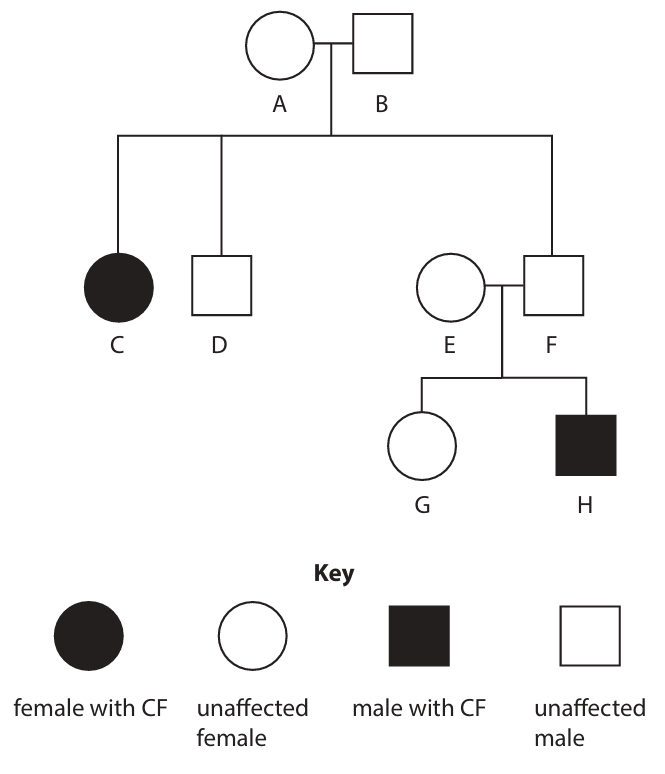
A: Ff (heterozygous) (1)
B: Ff (heterozygous) (1)
C: ff (homozygous recessive) (1)
(Total 3 marks)
(b)(ii) A genetic diagram showing:
• Parental genotypes: Ff and Ff (1)
• Gametes: F and f from each parent (1)
• Offspring genotypes and phenotypes: FF (unaffected), Ff (unaffected), Ff (unaffected), ff (affected) OR correct phenotype ratio (1)
(Total 3 marks)
(c)(i) An explanation that refers to three of the following:
• Pancreas produces/releases amylase/proteases/lipases. (1)
• No/less digestion of starch to maltose. (1)
• No/less digestion of proteins to amino acids. (1)
• No/less digestion of lipids to fatty acids and glycerol. (1)
• Less absorption of smaller/soluble molecules (e.g., amino acids, glucose, fatty acids). (1)
(Total 3 marks)
(c)(ii) An explanation that refers to two of the following:
• Reduces likelihood of pregnancy / less likely to conceive. (1)
• Sperm/semen cannot enter the fallopian tube/oviduct. (1)
• Fertilisation less likely / no fusion of gametes. (1)
(Total 2 marks)

▶️ Answer/Explanation
(a)(i) Peristalsis. Waves of muscular contractions.
Explanation: Food is moved down the oesophagus by a process called peristalsis. This involves rhythmic, wave-like contractions of the muscular walls of the oesophagus. These contractions squeeze the food bolus, pushing it along the digestive tract towards the stomach.
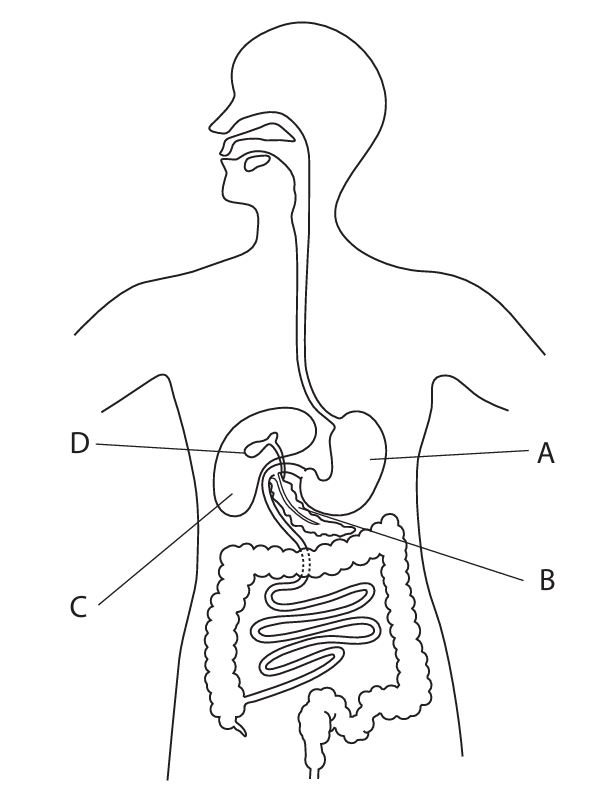
(a)(ii) C
Explanation: Bile is produced by the liver. In the diagram, structure C is labelled as the liver. The other structures are incorrect: A is the stomach, B is the pancreas, and D is the gall bladder (which stores and concentrates bile but does not produce it).
(a)(iii) Bile neutralises stomach acid and emulsifies fats.
Explanation: Bile has two main roles in digestion. First, it is alkaline and neutralises the hydrochloric acid from the stomach, creating the optimum alkaline pH for pancreatic enzymes to work in the small intestine. Second, bile salts emulsify lipids (fats). This means they break large fat globules into tiny droplets, massively increasing the surface area for the lipase enzymes to work on, which speeds up the digestion of fats.
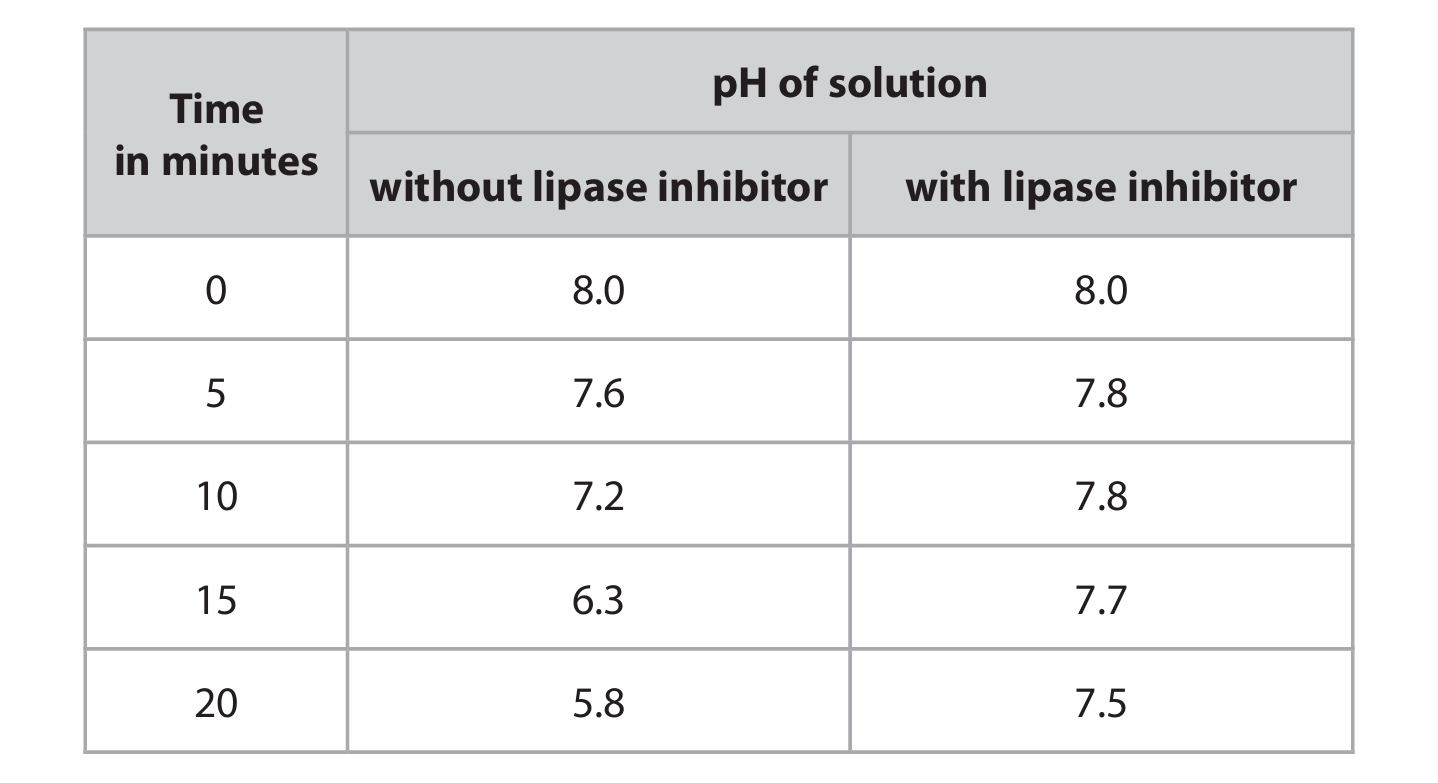
(b)(i) 0.11 per minute
Explanation: The mean rate of pH change is calculated by finding the total change in pH and dividing it by the total time. The pH without inhibitor changed from 8.0 to 5.8, a total change of \(8.0 – 5.8 = 2.2\). This change happened over 20 minutes. Therefore, the mean rate is \(2.2 \div 20 = 0.11\) pH units per minute.
(b)(ii) The pH falls faster in the solution without the inhibitor because fats are broken down into fatty acids.
Explanation: Lipase enzymes break down lipids (fats) into fatty acids and glycerol. Fatty acids are acidic, so their production causes the pH of the solution to decrease. In the test tube without the inhibitor, lipase is active, leading to rapid fat digestion and a significant drop in pH. In the test tube with the inhibitor, the lipase enzyme is blocked from working effectively. Therefore, far fewer fatty acids are produced, and the pH remains much higher and changes more slowly.
(b)(iii) Discussion points include lower blood lipid levels with the inhibitor, potential side effects, and limitations of the study.
Explanation: The data suggests the lipase inhibitor could be a useful treatment for obesity. The blood lipid concentration increased much less in the volunteers who took the inhibitor (to 38, 42, 43 mg/dm³) compared to two of the three volunteers who did not take it (62, 64 mg/dm³). This indicates that the inhibitor successfully reduced the amount of fat absorbed from the olive oil into the bloodstream. Since less fat is absorbed, less fat would be stored in the body, potentially leading to weight loss.
However, there are significant drawbacks and limitations. Two out of the three volunteers taking the inhibitor reported abdominal pains, suggesting it may cause unpleasant side effects. It’s also important to note that one volunteer without the inhibitor also had a relatively low final lipid reading (45 mg/dm³), showing there can be natural variation.
The study itself is very small, with only three people in each group, so its results are not very reliable. Other factors like the volunteers’ age, sex, overall diet, and activity levels were not controlled, and these could all influence obesity. The experiment only measured short-term fat absorption after a single large dose of oil; it did not actually measure long-term weight loss, which is the ultimate goal of an obesity treatment.
In conclusion, while the inhibitor shows promise in reducing fat absorption, its side effects and the need for much more extensive, long-term research mean it cannot be confidently recommended as a treatment based on this data alone.