
▶️ Answer/Explanation
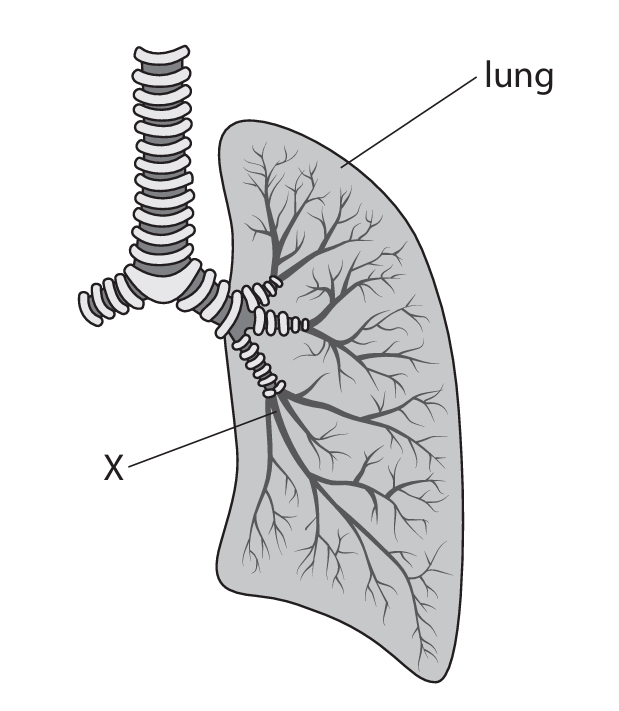
(a)(i) B (bronchiole)
A is incorrect as it is not an alveolus
C is incorrect as it is not a bronchus
D is incorrect as it is not a trachea
(a)(ii) An answer that makes reference to the following:
• it has more than one tissue / is a group of tissues / is a collection of tissues / made of multiple tissues (1)
(a)(iii) An explanation that makes reference to the following:
• diaphragm moves down / flattens (1)
• (chest / thorax) volume increases (1)
• (chest / thorax) pressure decreases / air flows from high pressure to low pressure / down a pressure gradient (1)
(b)(i) • \(35 \times 70 \times 30 = 73,500\) cm³ (2)
One mark for ×35 or ×70 or ×30 or 2450 or 1050 or 2100
Accept 74,000 or 73,000 for two marks
Correct answer gains both marks
(b)(ii) An explanation that makes reference to three of the following:
1. oxygen use lower in smokers / lower rate of oxygen use (1)
2. tar (in cigarettes) (1)
3. causes emphysema / mucus builds up / mucus not removed / cilia damaged (1)
4. less surface area (of alveoli) (1)
5. less diffusion of oxygen (into blood) (1)
6. carbon monoxide binds to haemoglobin (reducing oxygen) (1)
7. causes narrowing of arteries / blocks blood vessels (reducing flow of oxygenated blood) (1)
▶️ Answer/Explanation
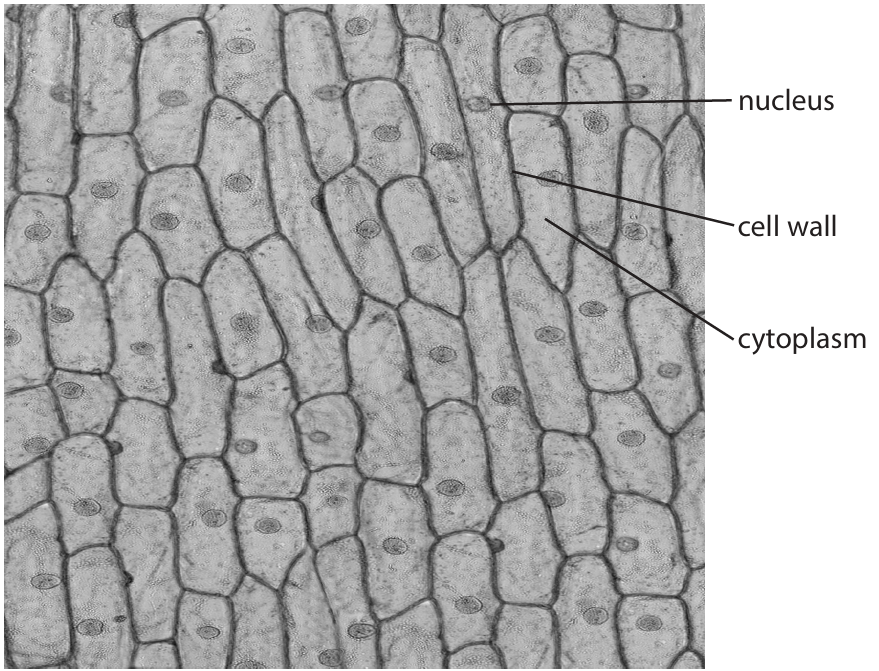
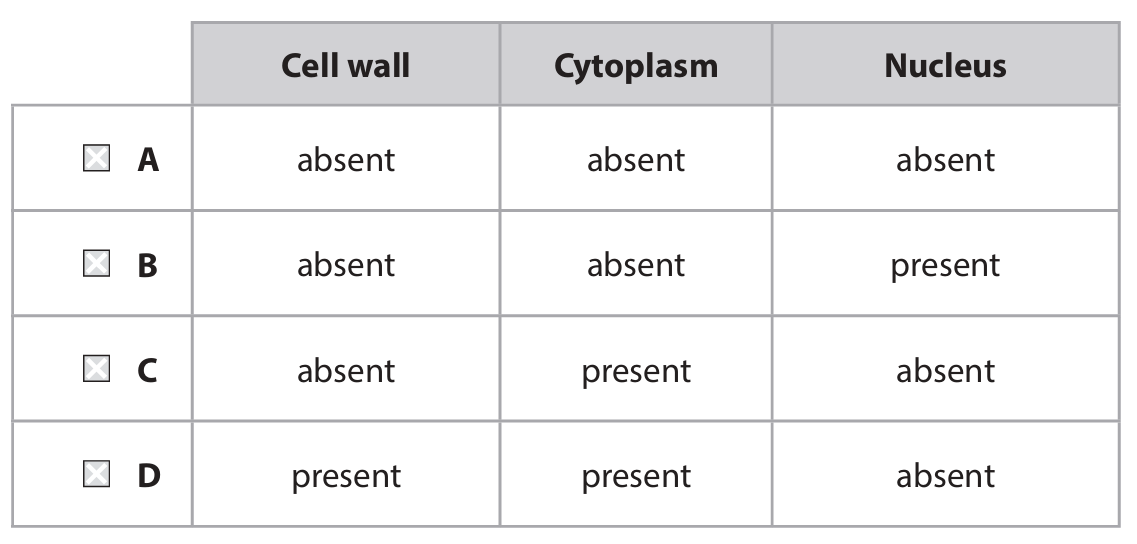
(a)(i) C (absent, present, absent)
A is incorrect because red blood cells have cytoplasm.
B is incorrect because human red blood cells do not have a nucleus.
D is incorrect because red blood cells do not have a cell wall.
(a)(ii) D (tissue)
A is incorrect because organs have more than one cell type.
B is incorrect because organisms have more than one cell type.
C is incorrect because systems have more than one cell type.
(b)(i) A description that makes reference to the following:
• use a syringe / pipette / beaker / (measuring) cylinder / eq (1)
• mix 5 cm\(^3\) of (10%) sucrose solution with 5 cm\(^3\) water / eq (1)
Accept other correct measuring apparatus.
Accept take 5 cm\(^3\) sucrose and make up to 10 cm\(^3\) with water / add equal volumes of water and sucrose and use 10 cm\(^3\) / eq.
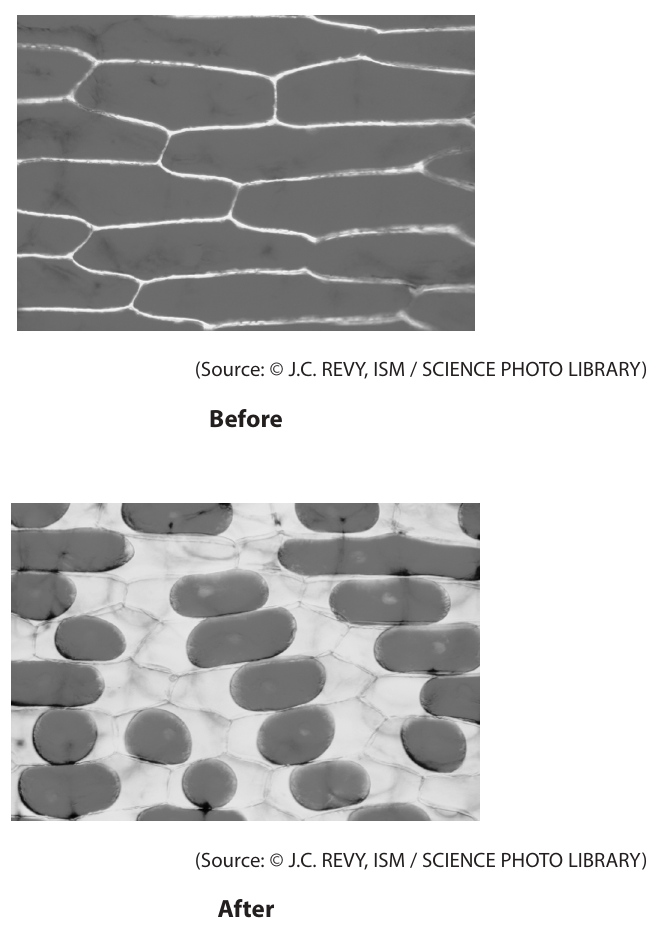
(b)(ii) An explanation that makes reference to three of the following:
• water leaves (the cells) / eq (1)
• by osmosis (1)
• from a high(er) water potential to a lower water potential / from higher water concentration to lower water concentration / from dilute solution to concentrated solution / eq (1)
• membrane detaches from cell wall / cell is flaccid / cytoplasm shrinks / cytoplasm volume decreases / cells are plasmolysed / eq (1)
Accept lose water.
Accept water moves from a high concentration to a low concentration.
Ignore cell shrinks.
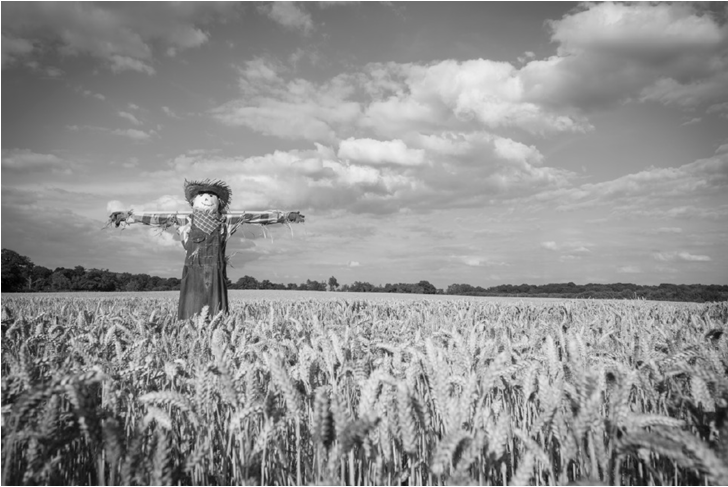
▶️ Answer/Explanation
Answer that makes reference to six of the following points:
- C (Change): Change the colour of the scarecrow’s clothes (e.g., use red, blue, yellow, green, etc.) as the independent variable.
- O (Other variables controlled): Keep the type/size of scarecrow, fabric, clothing size, and position in the field the same.
- R (Repeat/Reliability): Repeat the experiment multiple times for each colour and calculate averages to ensure reliability.
- M1 (Measurement 1): Measure the dependent variable, e.g., count the number of birds in the field, or measure the mass of crop eaten/remaining.
- M2 (Measurement 2): Carry out measurements over a stated, consistent period of time (e.g., one week per colour).
- S1 (Standardization 1): Control environmental factors such as time of year, weather, time of day, wind speed, and light intensity.
- S2 (Standardization 2): Use the same crop type, field area, soil quality, and avoid using pesticides or fertilisers during the experiment.
Example full-sentence answer structure:
“I would use several identical scarecrows and dress them in clothes of different colours (e.g., red, blue, yellow, green). I would place each scarecrow in a separate but identical field plot growing the same crop, at the same time of year, for one week. I would count the number of birds seen in each plot at the same time each day and also measure the mass of crop remaining at the end of the week. I would repeat the experiment with each colour three times and calculate an average. All other factors like scarecrow size, weather conditions, and field size would be kept the same to make it a fair test.”
▶️ Answer/Explanation
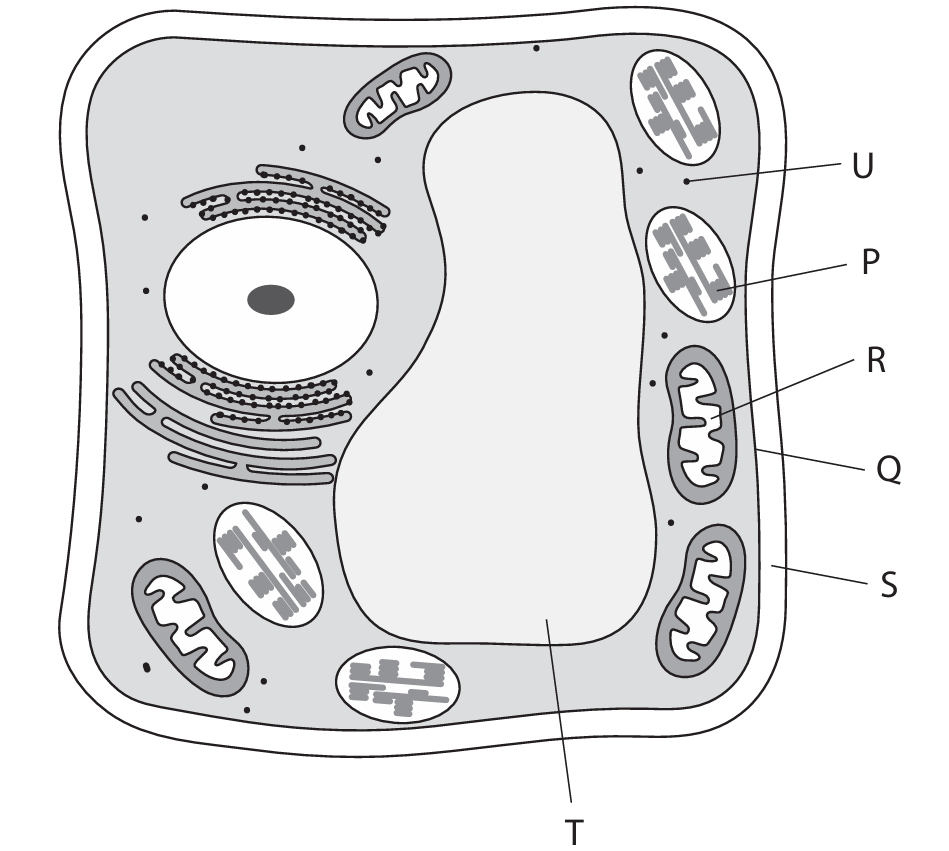
(a)(i) D (T)
The vacuole is a large, permanent organelle in plant cells, typically the largest visible structure.
(a)(ii) A (P)
Photosynthesis occurs in chloroplasts, which are shown as oval structures labelled P.
(a)(iii) C (S)
The cell wall is the rigid outer layer surrounding the cell membrane, labelled S.
(a)(iv) C (ribosome)
Ribosomes are the site of protein synthesis.
(b) 113 : 1
Surface area = \(6 \times (0.053)^2 = 0.016854 \, \text{mm}^2\)
Volume = \((0.053)^3 = 0.000148877 \, \text{mm}^3\)
Ratio = \( \frac{0.016854}{0.000148877} \approx 113.2 \) → 113 : 1
(c)(i) Water enters the red blood cell by osmosis because distilled water has a higher water potential. The cell lacks a cell wall, so it swells and bursts (haemolysis).
(c)(ii) Water leaves the red blood cell by osmosis because the salt solution has a lower water potential. Without a cell wall, the cell shrinks and shrivels (crenation).
▶️ Answer/Explanation
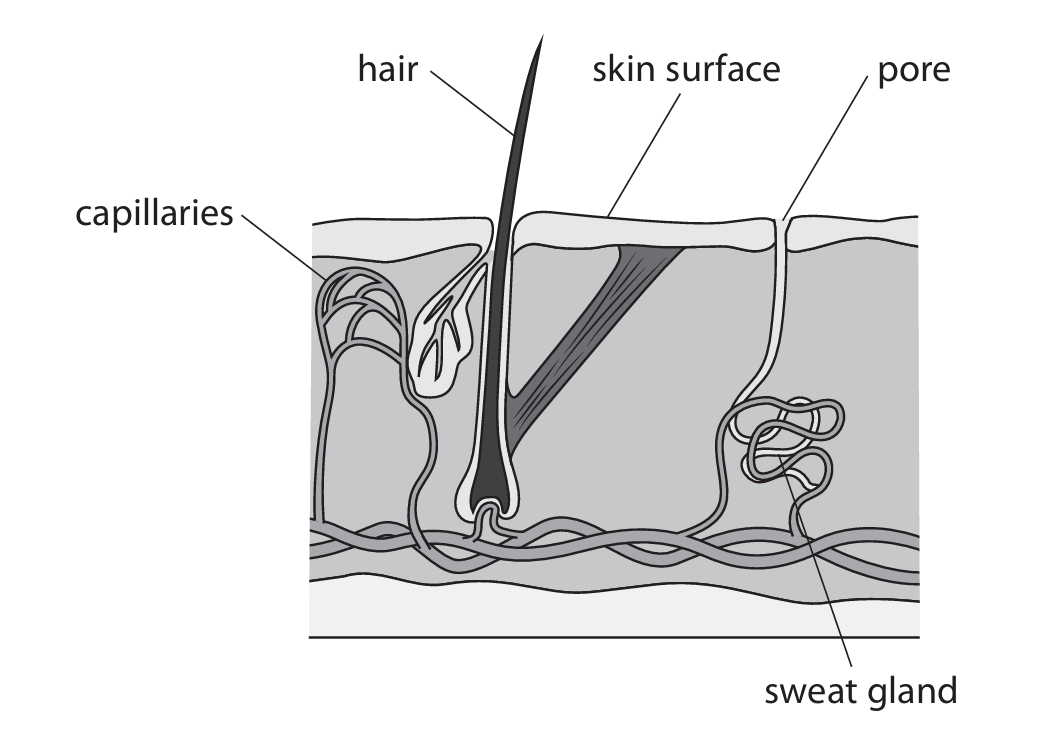
(a) The skin is described as an organ because it is made up of different tissues working together to perform specific functions.
Explanation: An organ is defined as a structure composed of at least two different types of tissues that work together to perform a particular function. The skin includes epithelial tissue (epidermis), connective tissue (dermis), nervous tissue (sensory receptors), and muscular tissue (arrector pili muscles), all collaborating in roles like protection, sensation, and temperature regulation.
(b)(i) When body temperature increases, the skin capillaries help regulate temperature through a process called vasodilation.
Explanation: Here’s a step-by-step explanation of the process:
- The arterioles leading to the skin capillaries widen (vasodilation).
- This allows more blood to flow through the capillaries near the skin surface.
- As blood is warmer than the external environment, heat is transferred from the blood to the environment.
- This heat loss occurs primarily through radiation (and some convection).
- The result is a lowering of the blood temperature, which helps cool the entire body.
This mechanism is crucial for maintaining a constant internal body temperature, especially during exercise or in hot environments.
(b)(ii) A suitable investigation would be carefully controlled to test the hypothesis.
Explanation: Here is a detailed experimental design:
Aim: To determine if drinking a warm drink increases the rate of sweat production compared to drinking a cold drink.
Variables:
- Independent Variable: The temperature of the drink (e.g., warm water at 50°C vs. cold water at 5°C).
- Dependent Variable: The rate of sweat production.
- Control Variables: These must be kept constant to ensure a fair test.
- Volume of drink consumed (e.g., 250 cm³).
- Type of drink (e.g., plain water).
- The individual’s activity level before and during the test (e.g., resting).
- Room temperature and humidity.
- Clothing worn by the individual.
- The time of day.
- The initial body temperature of the individual.
Method:
- Select a group of healthy participants of similar age, fitness, and body mass.
- Ensure they rest in a room with a constant, comfortable temperature for 20 minutes before starting.
- For the test, one participant will drink the warm water, and another (or the same participant on a different day) will drink the cold water.
- Immediately after drinking, a pre-weighed piece of absorbent cotton wool or a small, dry cloth is placed on a specific part of the skin (e.g., the forearm).
- After a fixed time period (e.g., 10 minutes), the cotton wool/cloth is removed and immediately weighed.
- The increase in mass is calculated, which represents the mass of sweat produced in that area over that time.
- The rate of sweat production can then be calculated (e.g., mass of sweat per minute).
- The experiment is repeated with the other temperature of drink.
- The entire investigation should be repeated with multiple participants to improve reliability.
Conclusion: The average rate of sweat production after drinking the warm drink is compared to the average rate after drinking the cold drink. If the warm drink causes a significantly higher rate, it would support the suggestion.

▶️ Answer/Explanation
(a)
Answer: A description that makes reference to three of the following points:
- cross / breed / mate / allow to self-pollinate parent plant(s) with (grains) with highest mass / yield / desired characteristics (1)
- select offspring plants with (grains) with highest mass / yield / desired characteristics (1)
- repeat for more / many generations (1)
Detailed Explanation:
Selective breeding is a process used by scientists to develop plants or animals with desirable traits. To increase wheat yield, scientists would first identify parent plants that already show high yield characteristics, such as producing heavy grains or a large number of grains per plant. These selected parent plants are then cross-bred, either by allowing them to mate naturally or through controlled pollination. From the resulting offspring, the scientists would again select those individual plants that exhibit the highest yield. This cycle of selection and breeding is repeated over many generations. Over time, this reinforces the genes responsible for high yield, leading to a new variety of wheat that consistently produces a greater harvest.
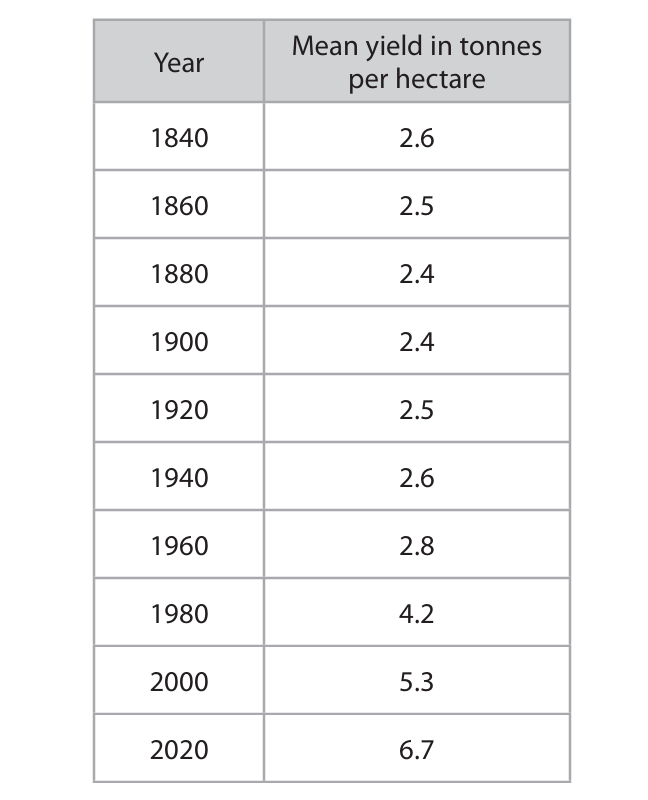
(b)(i)
Answer: The graph should have:
- Scale half grid and linear (1)
- Lines straight and through all points (1)
- Axes correct way round (Year on x-axis, Yield on y-axis) (1)
- Points correctly plotted within half a small square (1)
Detailed Explanation:
To plot this graph, you would first draw two perpendicular axes. The horizontal x-axis should be labeled “Year” and span from 1840 to 2020. The vertical y-axis should be labeled “Mean yield (tonnes per hectare)” and have a suitable scale, for example, from 0 to 8 tonnes. Each data point from the table is then plotted accurately at the intersection of its year and yield value. For instance, the point for 1840 would be at (1840, 2.6). Once all points are plotted, you use a ruler to draw straight lines connecting them sequentially from 1840 to 2020. This line graph will visually show the trend in wheat yield over this 180-year period.
(b)(ii)
Answer: 2.3% (allow 2.32, 2.321, etc.)
Calculation Steps:
1. Find the total increase in yield from 1960 to 2020: \( 6.7 – 2.8 = 3.9 \) tonnes/hectare.
2. Calculate the percentage increase over this period: \( \frac{3.9}{2.8} \times 100 = 139.29\% \).
3. Find the number of years between 1960 and 2020: \( 2020 – 1960 = 60 \) years.
4. Calculate the average percentage change per year: \( \frac{139.29}{60} = 2.3215\% \) per year.
Rounded to a sensible figure, this is 2.3% per year.
Detailed Explanation:
This calculation shows the dramatic improvement after the introduction of the dwarf variety. The yield didn’t just increase; it increased at an average rate of about 2.3% every single year for 60 years. This is a much faster rate of improvement compared to the 0.06% per year seen with the old variety before 1960, highlighting the significant impact of the new dwarf wheat.
(b)(iii)
Answer: An explanation that makes reference to three of the following points:
- less energy used to grow tall (1)
- more energy available for grain (1)
- higher yield / harvest / more grain(s) / grains heavier (1)
- less likely to fall over / less likely to be damaged by wind and rain (1)
- easier to harvest (1)
Detailed Explanation:
The shorter, thicker stem of dwarf wheat offers several key advantages. Firstly, because the plant doesn’t need to invest as much energy and resources into growing a tall stem, it can redirect that energy into producing more and heavier grains, directly increasing the yield. Secondly, the shorter and sturdier stem makes the plant much less likely to fall over, a problem known as “lodging.” Taller plants can be knocked over by wind and rain, which damages the crop and makes harvesting difficult or impossible. The dwarf wheat stands firm, protecting the valuable grain. Finally, the uniform, shorter height makes the plants easier and more efficient for machinery to harvest, reducing waste and saving time and money for the farmer.

▶️ Answer/Explanation
(a) C Y
Explanation: The adrenal gland is correctly identified as structure Y in the diagram. The other options are incorrect because:
- A (W) is not the adrenal gland
- B (X) is not the adrenal gland
- D (Z) is not the adrenal gland
The adrenal glands are located above the kidneys and are responsible for producing adrenaline and other hormones.
(b) An organ is several/different tissues carrying out a particular function/purpose.
Explanation: An organ is defined as a structure composed of multiple different types of tissues that work together to perform a specific function or purpose in the body. In this case, the adrenal gland contains various tissues that collectively produce and secrete adrenaline and other hormones.
(c) The advantages include:
- Dilation of the pupil allows more light to enter the eye, improving vision and making the person more aware of their surroundings to better detect danger.
- Increased heart rate pumps more blood to vital organs, particularly the lungs and muscles, ensuring they receive adequate oxygen and nutrients.
- Narrowing small arteries in the intestine redirects blood flow away from digestion and toward the muscles, which are needed for physical response.
- Conversion of glycogen to glucose in the liver increases blood sugar levels, providing more immediate energy for muscle cells through respiration.
- These combined effects increase oxygen delivery to muscles, enhance glucose availability for energy production, support higher rates of respiration, reduce reliance on anaerobic respiration (which produces lactic acid), and ultimately help the person run faster or escape danger more effectively.
Detailed Explanation: When adrenaline is released during a dangerous situation, it triggers the “fight or flight” response. The pupil dilation enhances visual awareness, allowing the person to better assess threats. The increased heart rate ensures that oxygenated blood reaches critical areas like the brain and muscles more quickly. By diverting blood from the digestive system to the muscles, the body prioritizes immediate physical action over digestion. The conversion of stored glycogen into glucose provides a rapid energy source for muscle contraction. All these physiological changes work together to prepare the body for intense physical activity, whether that means fighting the threat or fleeing from it.