

▶️ Answer/Explanation
(a)(i) B (Q)
A is not the answer as P is not the style
C is not the answer as S is not the style
D is not the answer as T is not the style
(a)(ii) D (U)
A is not the answer as P does not release pollen
B is not the answer as R does not release pollen
C is not the answer as T does not release pollen
(a)(iii) A (P)
B is not correct as pollen grains do not germinate on R
C is not correct as pollen grains do not germinate on S
D is not correct as pollen grains do not germinate on U
(b) A description that makes reference to the following:
• P feathery / large surface area / outside flower / exposed / eq (1)
• R absent / smaller / not coloured / green / eq (1)
• T longer / hinged / outside flower / exposed / eq (1)
(c)(i) • runners / bulbs / corms / tubers / rhizomes / eq (1)
(c)(ii) • cuttings / grafting / layering / tissue culture / micropropagation / eq (1)
Note: Reject ‘cloning’.
(d) An answer that makes reference to the following:
Allow two / three in one numbered line
• no gametes produced in asexual / no meiosis in asexual / gametes produced in sexual / meiosis in sexual / one parent cell (1)
• no fusion or fertilisation in asexual / present in sexual (1)
• offspring are clones / show no genetic variation in asexual / genetic variation in sexual / eq (1)
• asexual faster / shorter time / sexual slower / longer time / eq (1)
Note: Only mitosis in asexual. Ignore reference to number of parents. ‘Sexual involves fusion of gametes’ scores marking point 1 and marking point 2.
(e) An explanation makes reference to three of the following:
• selective breeding / artificial selection (1)
• cross red (flower) / unscented (flower) with white (flower) / scented (flower) / eq (1)
• select / breed / offspring with red and scent / eq (1)
• repeat / for many generations eq (1)
Note: Ignore reference to GM as it is the farmer. ‘Cross varieties / the plants’ is acceptable. Ignore ‘desired characteristics’ alone.

▶️ Answer/Explanation
(a)(i) Brain or Spinal Cord.
Explanation: The Central Nervous System (CNS) is composed of two main parts: the brain and the spinal cord. These structures are responsible for processing information and coordinating responses throughout the body.
(a)(ii) A description including four of the following points:
- A receptor in the skin detects the sharp object/stimulus.
- This generates an electrical impulse.
- The impulse travels along a sensory neurone to the CNS (spinal cord).
- In the spinal cord, the impulse may pass via a relay neurone across a synapse (using neurotransmitters).
- The impulse is then passed to a motor neurone.
- The motor neurone carries the impulse to an effector (a muscle in the leg).
- The muscle contracts, causing the foot to be withdrawn.
Explanation: This is an automatic, rapid, protective response called a reflex arc. It bypasses the brain to save time. The sensory neurone carries information towards the CNS, and the motor neurone carries the instruction away from the CNS to the muscle (the effector) which performs the action. Synapses ensure the impulse travels in one direction only.
(b)(i) B (XY)
Explanation: In mammals like dogs and humans, sex is determined by the X and Y chromosomes. Females have two X chromosomes (XX), and males have one X and one Y chromosome (XY). The Y chromosome carries genes that trigger male development.
(b)(ii) D (6)
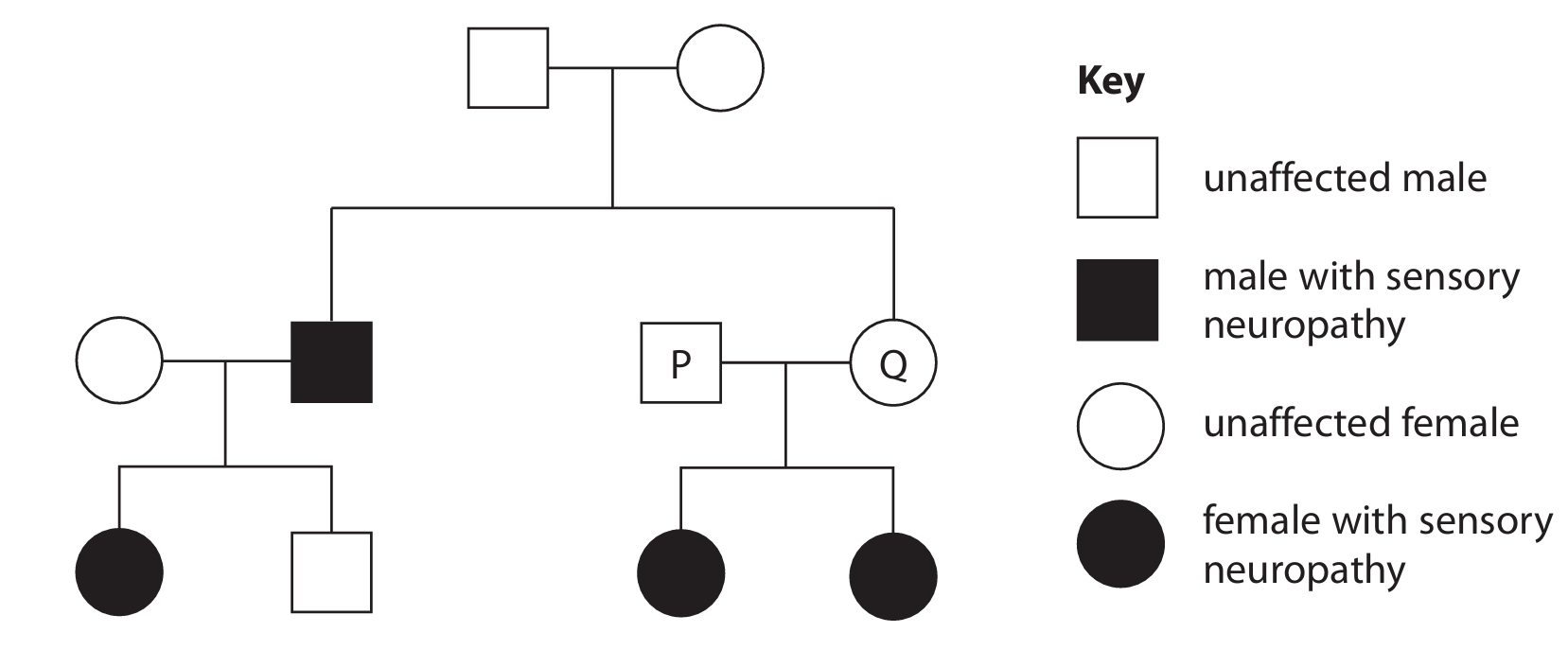
Explanation: Sensory neuropathy is recessive (nn). Unaffected individuals must have at least one dominant allele (N). Any unaffected individual that has an affected offspring (nn) must be a carrier (heterozygous, Nn) because they had to pass on an ‘n’ allele to their affected child. By analyzing the pedigree, we can identify 6 such carriers (Nn).
(b)(iii) Probability = 1/8 or 0.125 or 12.5%
Genetic Diagram:
Parents: Nn (P) × Nn (Q)
Gametes: P produces N or n; Q produces N or n.
Q Gametes ↓ P → | N | n | +-------+-------+ N | NN | Nn | +-------+-------+ n | Nn | nn | +-------+-------+
Explanation: The Punnett square shows the cross between two heterozygous parents (Nn × Nn). The genotypic ratio of the offspring is 1 NN : 2 Nn : 1 nn. Therefore, the probability of an offspring having sensory neuropathy (nn) is 1/4. Sex determination is independent of this autosomal gene. The probability of an offspring being male is 1/2. To find the combined probability of being male AND having nn, we multiply the independent probabilities: (1/4) × (1/2) = 1/8.
(b)(iv) Selective breeding, also known as artificial selection, could be used to remove the harmful ‘n’ allele by carefully choosing which dogs breed together.
The process would involve:
- Testing: First, all potential breeding dogs would be genetically tested to determine their genotype for the sensory neuropathy gene (NN, Nn, or nn).
- Selection of Parents: Only dogs that are confirmed to be homozygous dominant (NN) – meaning they do not carry the harmful allele – would be selected as breeding stock. Dogs with the genotype Nn (carriers) or nn (affected) would be prevented from breeding.
- Repetition over Generations: This selective process would be repeated over many generations. By never allowing the ‘n’ allele to be passed on, its frequency in the population’s gene pool would decrease.
- Goal: Over time, the aim would be to eliminate the ‘n’ allele entirely from the breeding population, resulting in a population where all individuals are NN and therefore cannot have or pass on sensory neuropathy.
Potential Challenge: A significant challenge is that carriers (Nn) are phenotypically normal (unaffected). Without genetic testing, breeders might accidentally select carriers for breeding, which would perpetuate the allele in the population. Therefore, reliable genetic testing is crucial for this strategy to be successful.
▶️ Answer/Explanation
(a)
Answer: A description that makes reference to three of the following points:
- cross / breed / mate / allow to self-pollinate parent plant(s) with (grains) with highest mass / yield / desired characteristics (1)
- select offspring plants with (grains) with highest mass / yield / desired characteristics (1)
- repeat for more / many generations (1)
Detailed Explanation:
Selective breeding is a process used by scientists to develop plants or animals with desirable traits. To increase wheat yield, scientists would first identify parent plants that already show high yield characteristics, such as producing heavy grains or a large number of grains per plant. These selected parent plants are then cross-bred, either by allowing them to mate naturally or through controlled pollination. From the resulting offspring, the scientists would again select those individual plants that exhibit the highest yield. This cycle of selection and breeding is repeated over many generations. Over time, this reinforces the genes responsible for high yield, leading to a new variety of wheat that consistently produces a greater harvest.
(b)(i)
Answer: The graph should have:
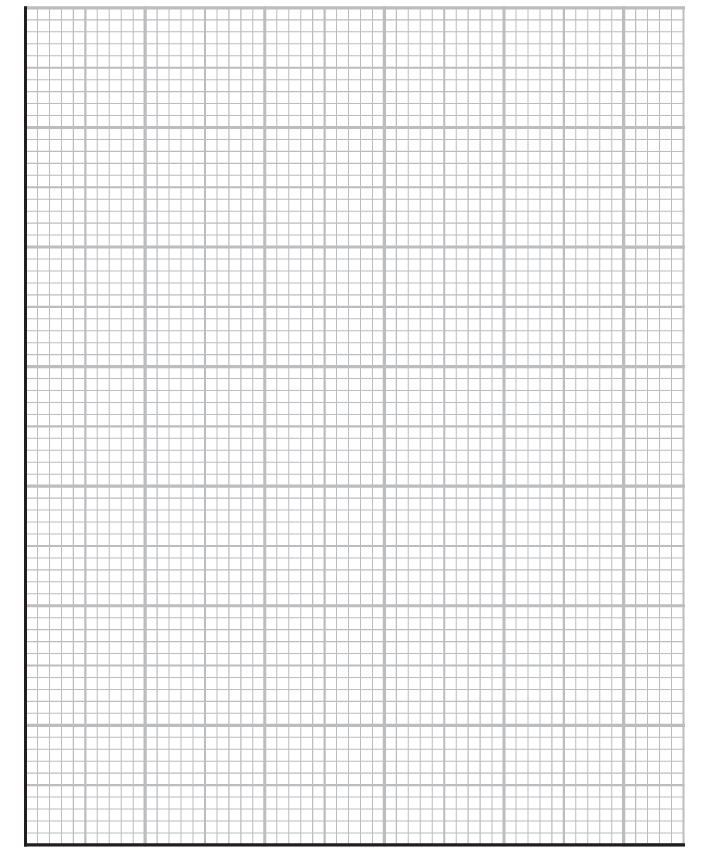
- Scale half grid and linear (1)
- Lines straight and through all points (1)
- Axes correct way round (Year on x-axis, Yield on y-axis) (1)
- Points correctly plotted within half a small square (1)
Detailed Explanation:
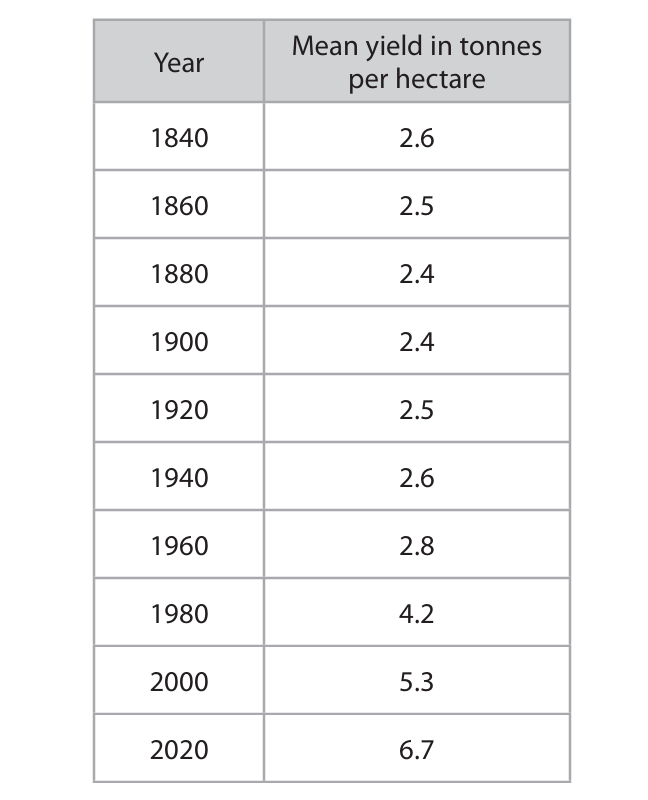
To plot this graph, you would first draw two perpendicular axes. The horizontal x-axis should be labeled “Year” and span from 1840 to 2020. The vertical y-axis should be labeled “Mean yield (tonnes per hectare)” and have a suitable scale, for example, from 0 to 8 tonnes. Each data point from the table is then plotted accurately at the intersection of its year and yield value. For instance, the point for 1840 would be at (1840, 2.6). Once all points are plotted, you use a ruler to draw straight lines connecting them sequentially from 1840 to 2020. This line graph will visually show the trend in wheat yield over this 180-year period.
(b)(ii)
Answer: 2.3% (allow 2.32, 2.321, etc.)
Calculation Steps:
1. Find the total increase in yield from 1960 to 2020: \( 6.7 – 2.8 = 3.9 \) tonnes/hectare.
2. Calculate the percentage increase over this period: \( \frac{3.9}{2.8} \times 100 = 139.29\% \).
3. Find the number of years between 1960 and 2020: \( 2020 – 1960 = 60 \) years.
4. Calculate the average percentage change per year: \( \frac{139.29}{60} = 2.3215\% \) per year.
Rounded to a sensible figure, this is 2.3% per year.
Detailed Explanation:
This calculation shows the dramatic improvement after the introduction of the dwarf variety. The yield didn’t just increase; it increased at an average rate of about 2.3% every single year for 60 years. This is a much faster rate of improvement compared to the 0.06% per year seen with the old variety before 1960, highlighting the significant impact of the new dwarf wheat.
(b)(iii)
Answer: An explanation that makes reference to three of the following points:
- less energy used to grow tall (1)
- more energy available for grain (1)
- higher yield / harvest / more grain(s) / grains heavier (1)
- less likely to fall over / less likely to be damaged by wind and rain (1)
- easier to harvest (1)
Detailed Explanation:
The shorter, thicker stem of dwarf wheat offers several key advantages. Firstly, because the plant doesn’t need to invest as much energy and resources into growing a tall stem, it can redirect that energy into producing more and heavier grains, directly increasing the yield. Secondly, the shorter and sturdier stem makes the plant much less likely to fall over, a problem known as “lodging.” Taller plants can be knocked over by wind and rain, which damages the crop and makes harvesting difficult or impossible. The dwarf wheat stands firm, protecting the valuable grain. Finally, the uniform, shorter height makes the plants easier and more efficient for machinery to harvest, reducing waste and saving time and money for the farmer.