Home / Edexcel iGCSE / Edexcel iGCSE Biology / Exam Style Questions

Edexcel iGCSE Biology 4BI1 - Paper 2B -Gas exchange- Exam Style Questions- New Syllabus

Question

The lungs and the kidneys are excretory organs.

(a) (i) Which substances are excreted by the lungs?

A) carbon dioxide and urea
B) carbon dioxide and water
C) carbon dioxide, urea, and water
D) urea and water

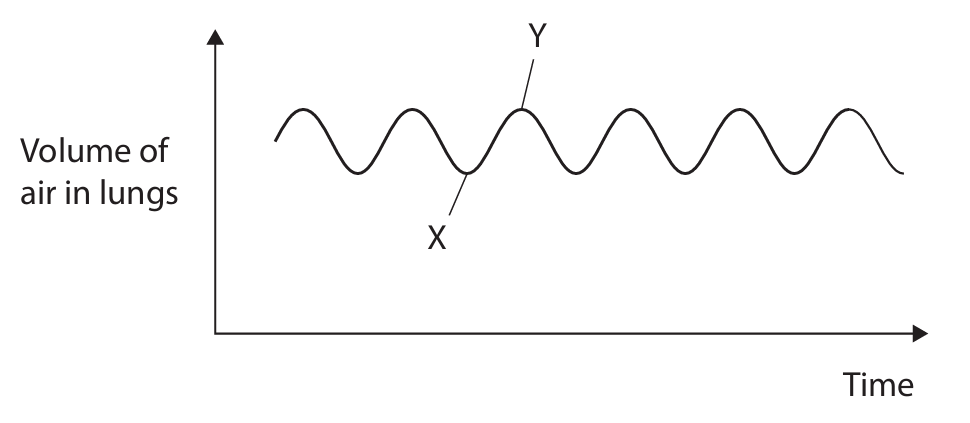
(ii) The graph shows how the volume of air in the lungs changes over time.

Explain the change in volume of air in the lungs from point X to point Y.

(b) People with a condition called diabetes often have very high blood sugar.

Urine from people with diabetes attracts ants but urine from people without diabetes does not attract ants.

Ants are insects that are attracted to glucose.

Explain why people with diabetes produce urine that can attract ants.

Most-appropriate topic codes (Edexcel IGCSE Biology):

2(i): Excretion — part (a)(i)
2(g): Gas exchange — part (a)(ii)
2(i): Excretion — part (b)
2(h): Transport — part (b)
▶️ Answer/Explanation
Solution

(a)(i) B (carbon dioxide and water)
A is not the answer as lungs do not excrete urea
C is not the answer as lungs do not excrete urea
D is not the answer as lungs do not excrete urea

(a)(ii) An explanation that makes reference to three of the following points:

  • volume increases / inhalation occurs / air drawn in (1)
  • diaphragm / intercostal muscles contract (1)
  • diaphragm moves down / flattens (1)
  • ribcage expands (1)
  • pressure decreases (inside thorax / lungs) (1)

Accept: internal intercostal muscles relax; ribs move up / move out; thorax / chest expands; pressure higher outside

(b) An explanation that makes reference to three of the following points:

  • glucose in urine (1)
  • glucose released by ultrafiltration (into filtrate) (1)
  • glucose not reabsorbed / too much glucose (in filtrate) to reabsorb (1)
  • in the proximal convoluted tubule / PCT / first convoluted tubule (1)
  • by active transport (1)

Accept: glucose not absorbed into blood; some glucose not reabsorbed
Reject: if active transport pumping glucose into filtrate
Question

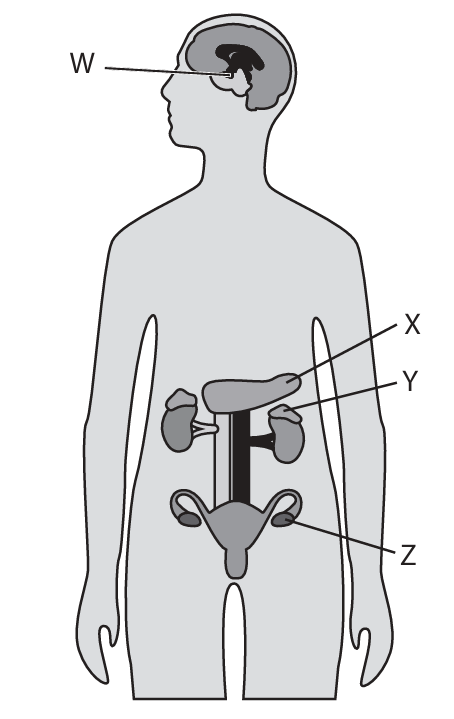
The diagram shows four glands in the human body labelled W, X, Y and Z.

(a) LH is a hormone involved in the menstrual cycle.

(i) Which labelled gland produces LH?

A) W
B) X
C) Y
D) Z

(ii) Describe the functions of LH during the menstrual cycle.

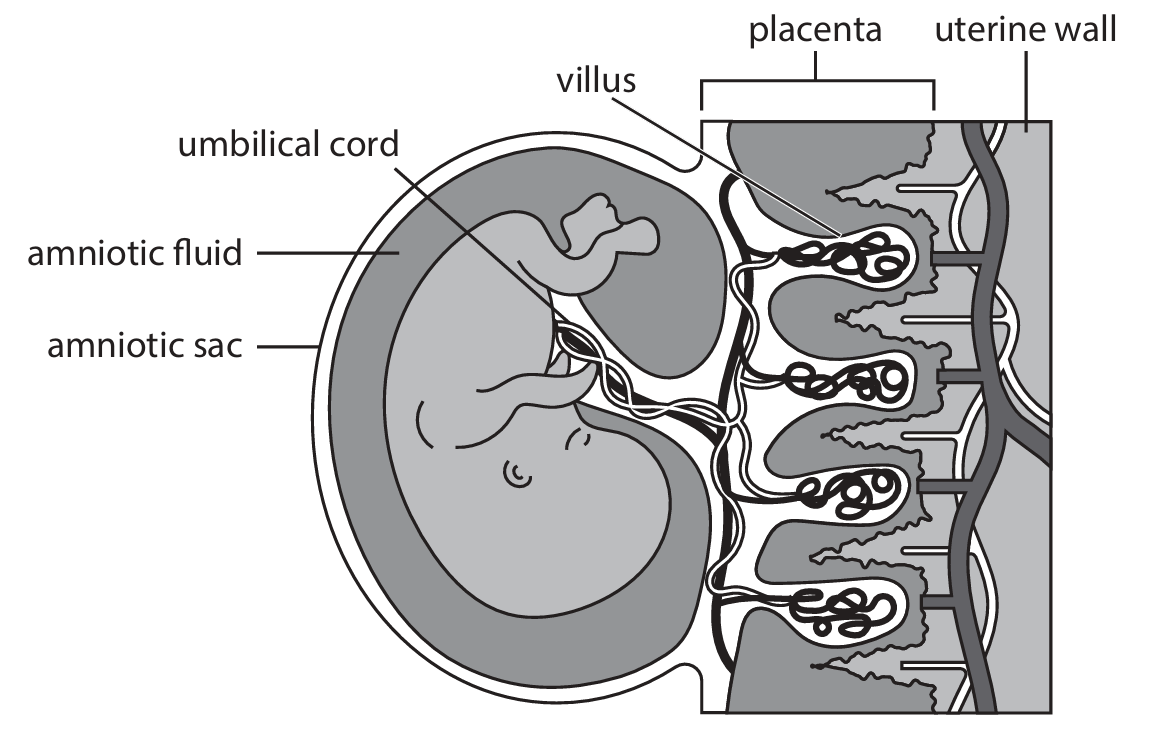
(b) The diagram shows a fetus developing in a uterus.

Explain how the amniotic fluid and placenta enable the safe growth of the fetus.

(c) Scientists investigated the effects of tobacco smoking and taking mineral ion supplements on the growth of developing babies during pregnancy.

The scientists looked at four groups of mothers.

  • Group A non-smokers taking mineral ion supplements
  • Group B non-smokers not taking mineral ion supplements
  • Group C smokers taking mineral ion supplements
  • Group D smokers not taking mineral ion supplements

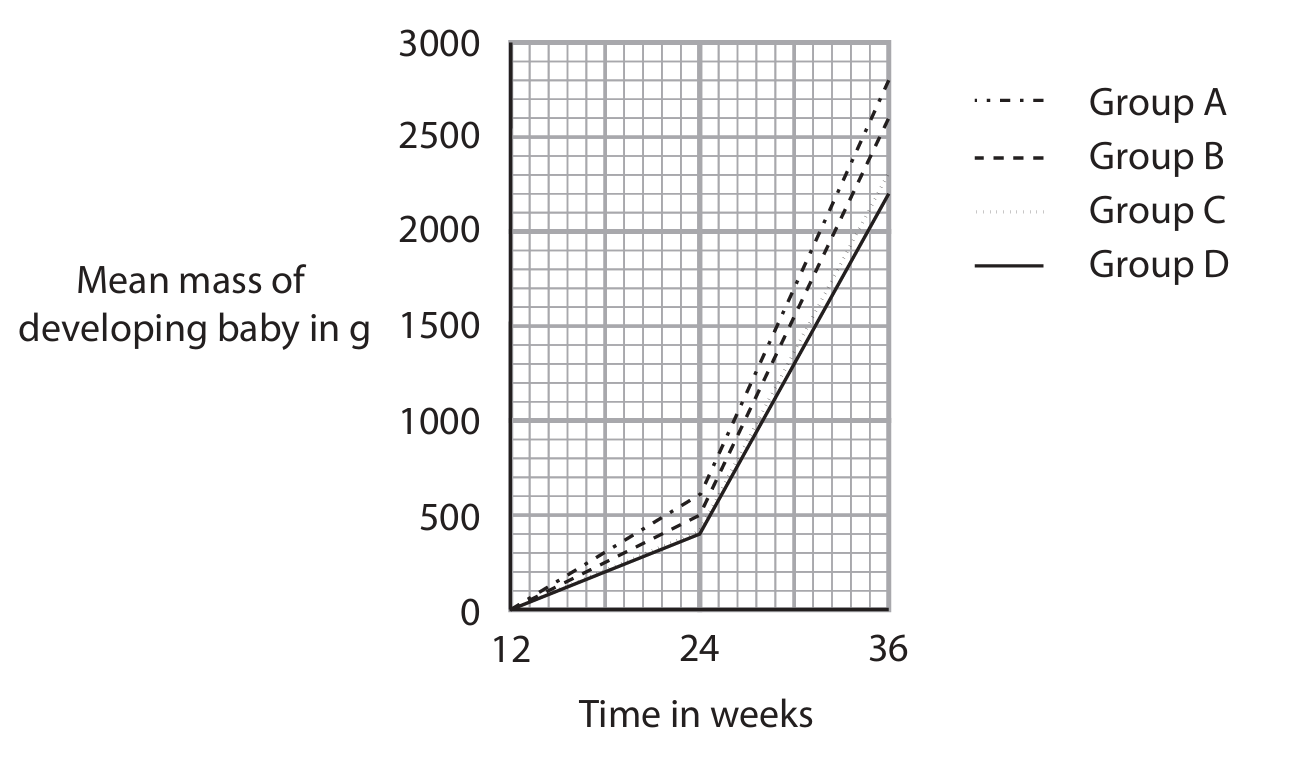
The graph shows the mean masses of developing babies at 12 weeks of pregnancy, at 24 weeks of pregnancy and at birth (36 weeks).

(i) Calculate the percentage difference at 36 weeks of the mean mass of babies from mothers in group A compared with the mean mass of babies from mothers in group D.
Give your answer to the nearest whole number.

(ii) Comment on the effect of smoking and the effect of taking mineral ion supplements on the growth of babies. Use the graph and your own knowledge to help your answer.

Most-appropriate topic codes (Pearson Edexcel IGCSE Biology):

3(a): Reproduction (Humans) — parts (a)(i), (a)(ii)
3(a): Reproduction (Humans) — part (b)
2(e): Nutrition (Humans) — part (c)(ii) – mineral function
2(g): Gas exchange (Humans) — part (c)(ii) – smoking effects
Mathematical skills — part (c)(i)
▶️ Answer/Explanation
Solution

(a)(i) A (W) — the pituitary gland.
B is incorrect as X (the pancreas) does not release LH.
C is incorrect as Y (the adrenal) does not release LH.
D is incorrect as Z (the ovary) does not release LH.

(a)(ii) A description that makes reference to the following:
• ovulation / release of egg / oocyte (1)
• (stimulates) progesterone release (1)
Accept: stimulates oestrogen release.

(b) An explanation that makes reference to the following:
• (amniotic fluid) prevents physical damage / bumps / equalizes pressure / acts as a shock absorber / cushioning (1)
and two from:
• (placenta) allows diffusion / active transport (1)
• gives the fetus amino acids / glucose / oxygen / antibodies / vitamins / minerals (1)
• removes from the fetus urea / carbon dioxide (1)
• makes sure mother’s and baby’s blood do not mix (1)

(c)(i) • 27% (3 marks)
Working:
Mass difference = \(2800 – 2200 = 600\) g
Percentage difference = \(\frac{600}{2200} \times 100 = 27.27…\%\) ≈ 27% (nearest whole number)
One mark for (2800 – 2200) or 600; one mark for division by 2200; one mark for correct answer.

(c)(ii) An answer that makes reference to four of the following points (4 marks):
1. smoking results in slower growth / lower mass (1)
2. taking minerals results in faster growth / higher mass (1)
3. biggest increase in mass / fastest growth is non-smokers with minerals (Group A) (1)
4. smoking has a bigger (negative) impact than not taking mineral supplements (1)
5. carbon monoxide (in smoke) binds to haemoglobin / reduces oxygen transport (1)
6. less respiration / energy release for growth (1)
7. minerals (e.g., iron) are needed for haemoglobin / red blood cells (1)
8. minerals (e.g., calcium) are needed for bone growth (1)
Accept converse statements for points 1-3.
Question

Transpiration (water loss) is affected by several environmental factors.

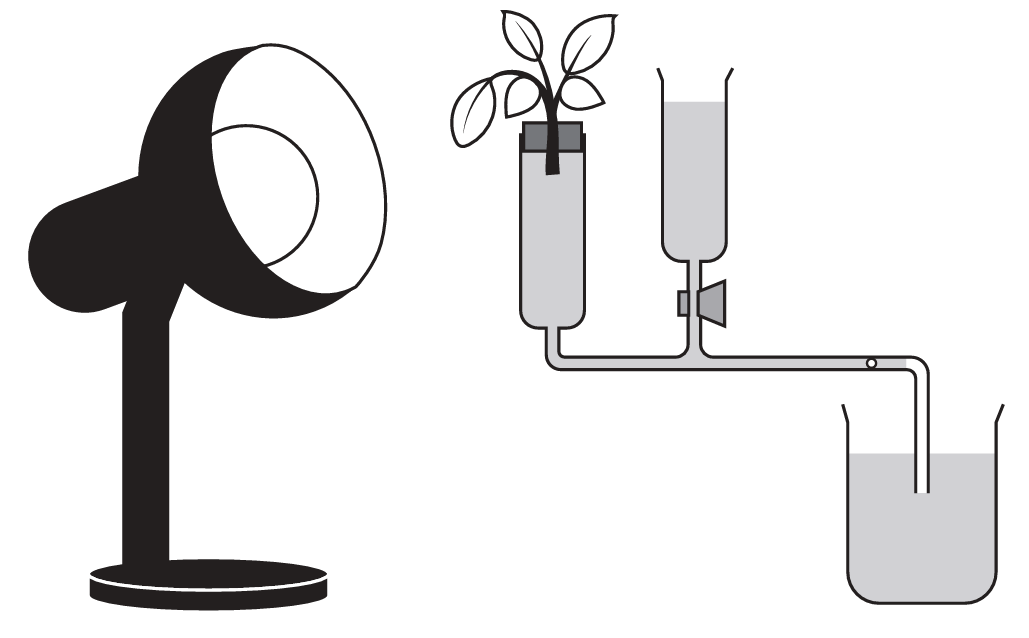
A student investigates the effect of light intensity on water loss from a plant shoot. The diagram shows some of the apparatus the student uses.

The student predicts that water loss from a plant shoot will increase as light intensity increases.

(a) (i) Describe how to set up and use the student’s apparatus to test this prediction. 
(ii) State the dependent variable in this investigation.

(b) Another student uses the apparatus to collect and process the data. Table 1 shows their results.

Light intensity in arbitrary unitsMean volume of water lost by shoot in 10 minutes in mm3
02
58
1012
1512
Table 1

(i) Explain why light intensity changes the mean volume of water lost by the shoot.

(ii) The student repeats the experiment with a plant that is adapted to live in desert environments. Table 2 shows the results for this desert plant.

Light intensity in arbitrary unitsMean volume of water lost by shoot in 10 minutes in mm3
06
54
100
150
Table 2

The desert plant has adaptations to survive in desert environments where not much water is available.

Explain why the results for this desert plant, in table 2, are different from the results in table 1.

Most-appropriate topic codes (Edexcel IGCSE Biology):

2(h): Transport — parts (a)(i), (a)(ii), (b)(i), (b)(ii) [focus on transpiration]
2(g): Gas exchange in plants — parts (b)(i), (b)(ii) [link to stomatal behavior]
3(b): Structure and functions in living organisms: Part 1 (Nutrition in plants) — implicit link to water uptake
4(a): Ecology and the environment — part (b)(ii) [adaptations to environment]
▶️ Answer/Explanation
Solution

(a)(i) Mark Scheme Summary: A description that makes reference to four of the following points (1 mark each):

  1. Cut shoot underwater / cut shoot diagonally.
  2. Ensure apparatus is airtight (e.g., dry leaves, check seals, use petroleum jelly).
  3. Measure distance bubble moves / distance water moves in capillary tube.
  4. Measure this movement over a set time.
  5. Place lamp at different distances from the shoot (to vary light intensity).
  6. Control other variables (e.g., temperature, humidity).
  7. Repeat readings / use reservoir to reset bubble.

(a)(ii) Water loss / distance moved by bubble / volume of water taken up / time taken to move bubble / rate of bubble movement.
Accept: water uptake / transpiration speed.

(b)(i) An explanation that makes reference to two of the following (1 mark each):

  1. More water loss as light intensity increases (more transpiration/evaporation).
  2. Because (more) stomata open / stomata open wider.
  3. Until all stomata are open (completely) / until stomata are fully open.

(b)(ii) An explanation that makes reference to three of the following (1 mark each):

  1. Desert plant loses less water in total / retains/conserves water.
  2. Water is lost in low light / water is not lost in high light (water loss decreases as light intensity increases for desert plant).
  3. Stomata close in light/day / stomata open in dark/night (reverse of normal plants).
  4. Desert plants have fewer stomata.
  5. This adaptation reduces wilting / stops plant going flaccid.
Question

A teacher investigates gas exchange in different conditions.

They use orange hydrogen-carbonate indicator solution, which changes colour depending upon the concentration of carbon dioxide in the tube.

This is their method.

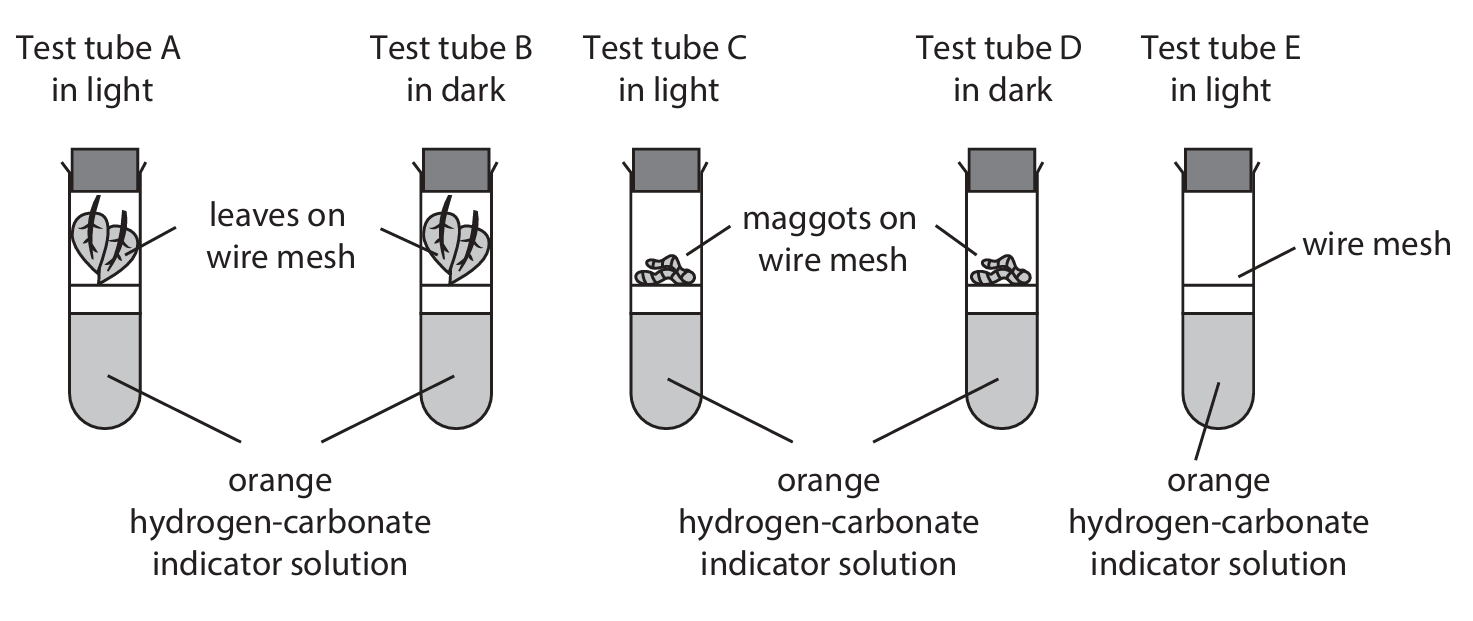
Step 1:   put \(5\ cm^{3}\) of hydrogen-carbonate indicator solution into each of five test tubes A, B, C, D and E
Step 2:   place a wire mesh and two green leaves in test tube A
Step 3:   set up tubes A to D so that they contain leaves or maggots as shown in the diagrams
Step 4:   set up tube E without leaves or maggots
Step 5:   place test tubes A, C and E in bright light for two hours
Step 6:   place test tubes B and D in the dark for two hours
Step 7:   observe the colour of the indicator in each test tube

(a) (i) State the dependent variable in this investigation.
(ii) Give the function of the wire mesh in the test tubes.
(iii) State one variable that the teacher has controlled in their investigation.

(b) The table shows the results of this investigation.

TubeContents of test tubeLight conditionColour of indicator after two hours
Aleaveslightdark red
Bleavesdarkyellow
Cmaggotslightyellow
Dmaggotsdarkyellow
Eemptylightorange

Explain the relationship between the test tube contents, the light condition and the colour of the indicator after two hours. 

(c) The teacher sets up another test tube that contains leaves and maggots. They put the test tube in the light for two hours.

The colour of the indicator after two hours remains orange.

Explain why the indicator remains orange.

Most-appropriate topic codes (Edexcel IGCSE Biology):

2(g): Gas exchange — Flowering plants (2.44B, 2.45B) — parts (a), (b), (c)
2(f): Respiration — (2.36, 2.39) — part (b)
3: Experimental skills and analysis — parts (a)(i), (a)(ii), (a)(iii)
▶️ Answer/Explanation
Solution

(a)(i) • colour of indicator / carbon dioxide concentration / eq (1)

(a)(ii) • stops leaves / maggots falling in indicator / hold organisms in place / separates organism from solution/ eq (1)

(a)(iii) • volume of indicator / volume of solution / time in tube / size of tube / eq (1)

(b) An explanation that makes reference to four of the following points:
1. tube C / tube D / maggots produce \(CO_{2}\) / \(CO_{2}\) increases (light and dark) / eq (1)
2. by respiration / eq (1)
3. tube B / leaves produce \(CO_{2}\) in dark / \(CO_{2}\) increases / eq (1)
4. tube A / leaves absorb \(CO_{2}\) in the light / \(CO_{2}\) decreases/ eq (1)
5. for photosynthesis /eq (1)
6. tube E no change in \(CO_{2}\) / no gain or loss of \(CO_{2}\) / eq (1)

(c) An explanation that makes reference to two of the following points:
1. carbon dioxide concentration is unchanged / \(CO_{2}\) released and \(CO_{2}\) absorbed / eq (1)
2. respiration and photosynthesis / eq (1)
3. reaction rate is reduced / \(CO_{2}\) increased / eq (1)
Question

(a) Using the recommended amount of fertiliser on a crop increases crop yield. Some farmers think that adding extra fertiliser will give an even greater crop yield.

(i) Give a reason why adding extra fertiliser does not result in an even greater crop yield.

(ii) Some farmers apply more nitrogen fertiliser and more water to their fields than are needed.

Explain the biological consequences of applying more nitrogen fertiliser and more water than needed.

(b) The atmosphere can be polluted by gases such as carbon monoxide released from industry.

Describe the effects of carbon monoxide on the human body.

(c) Which of these is not a greenhouse gas?

  • A. carbon dioxide
  • B. methane
  • C. nitrogen
  • D. nitrous oxide

Most-appropriate topic codes (Edexcel IGCSE Biology):

5(a): Food production – Crop plants – effects of fertiliser on yield (parts a(i), a(ii))
4(d): Human influences on the environment – eutrophication (part a(ii))
4(d): Human influences on the environment – air pollution (part b)
2(g): Gas exchange – effects of carbon monoxide on gas transport (part b)
4(d): Human influences on the environment – greenhouse gases (part c)
▶️ Answer/Explanation
Solution

(a)(i) Excess fertiliser is not absorbed by the plants / some is washed away.

Explanation: Plants can only absorb a certain amount of nutrients from the soil. When fertiliser is applied beyond the recommended amount, the plant roots become saturated and cannot take up any more minerals. The excess fertiliser remains in the soil where it can be easily washed away by rainwater through a process called leaching. This means the extra fertiliser doesn’t contribute to plant growth and is essentially wasted.

(a)(ii) Applying excess nitrogen fertiliser and water leads to waterlogging of soil, leaching, eutrophication, oxygen depletion in water bodies, and death of aquatic organisms.

Explanation: When farmers apply more water than needed, the soil becomes waterlogged. Water fills the air spaces in the soil, creating anaerobic conditions where oxygen is lacking. Plant root cells need oxygen to perform active transport for mineral uptake, so they cannot absorb nutrients effectively in waterlogged conditions.

Excess nitrogen fertiliser gets washed away (leached) into nearby rivers and lakes through runoff. This extra nitrogen acts as a nutrient source for algae, causing rapid algal growth known as algal bloom. The algae form a thick layer on the water surface, blocking sunlight from reaching underwater plants. Without sunlight, these plants cannot photosynthesize and eventually die.

The dead plants and algae are decomposed by bacteria, which respire and consume large amounts of oxygen in the water. This leads to oxygen depletion (anoxic conditions), causing fish and other aquatic organisms to suffocate and die. This entire process of nutrient overload leading to ecosystem collapse is called eutrophication.

(b) Carbon monoxide combines with haemoglobin to form carboxyhaemoglobin, preventing oxygen transport in the blood.

Explanation: When inhaled, carbon monoxide binds to haemoglobin in red blood cells with a much greater affinity than oxygen, forming carboxyhaemoglobin. This prevents haemoglobin from carrying oxygen to body tissues. As a result, cells throughout the body receive less oxygen, leading to reduced respiration and energy production. In severe cases, this oxygen deprivation can cause headaches, dizziness, unconsciousness, and even death. The body may also resort to anaerobic respiration, producing lactic acid which can lead to muscle fatigue and pain.

(c) C (nitrogen)

Explanation: While nitrogen (N₂) makes up about 78% of the atmosphere, it is not considered a greenhouse gas because it is largely transparent to infrared radiation and does not significantly contribute to the greenhouse effect. In contrast, carbon dioxide (A), methane (B), and nitrous oxide (D) are all potent greenhouse gases that trap heat in the atmosphere and contribute to global warming.

Question

Read the passage below. Use the information in the passage and your own knowledge to answer the questions that follow.

Antitranspirants

Antitranspirants are substances applied to plants to reduce water loss. There are three types of antitranspirant, film-forming compounds, stomatal regulators and reflective compounds.

The first type of antitranspirant contains film-forming compounds. These compounds are oils or waxes that are mixed with water to form an emulsion. This emulsion is then sprayed onto the leaves of plants. The emulsion forms a physical barrier that covers the stomata. The film is designed to prevent water loss but allow gas exchange. Scientists have found that that the film-forming antitranspirant is effective in increasing yield and increasing photosynthesis in drought conditions. The increased leaf turgor in plants sprayed with film, compared to control plants, shows that the film decreases water loss and maintains turgor in drought conditions.

Film-forming antitranspirants are used in horticulture to reduce water stress. This can occur during storage, transport and planting of container grown plants. Application of the antitranspirant before transplanting, helps the plant survive until the root system is established. The film-forming compounds are used to reduce drying out in rolled turf and in transporting flowering plants and trees with root balls.

The second type of antitranspirants are stomatal regulators that reduce the size of the stomatal pore. Stomatal pores affect diffusion as well as transpiration. Therefore, photosynthesis and growth may change when stomatal regulators are applied to leaf surfaces. If the stomatal pores close completely this will stop photosynthesis. However, if stomatal openings are only reduced in size, transpiration will be reduced but some photosynthesis will continue.

The third type of antitranspirants are reflective compounds. These work by adding a white coating to leaves. This changes the amount of light that is reflected by the leaf surface. The coating is only applied to the upper surface of leaves so does not block the stomatal pores. Coating a leaf with a reflective chemical can reduce leaf temperature, transpiration rate and also increase the efficiency of water use. Experiments show that transpiration rate can be reduced by up to 30% and leaf temperature reduced from 40°C to 30°C after a coating of reflective compound is applied to leaf surfaces.

Crops depend on photosynthesis for growth and final yield. Therefore, it is unlikely that currently available antitranspirants would increase the yield of a crop unless the crop suffers from a low water supply or very high rates of evaporation. Spraying film-forming or stomata regulating antitranspirants on a field-grown cereal crop under drought conditions, produced a grain yield increase of 17%. Experiments also show that any effect that antitranspirants have on the minerals supplied to the leaves has little effect on plant growth.

(a) Explain why plants that have been dug up and transported are at most risk of drying out.

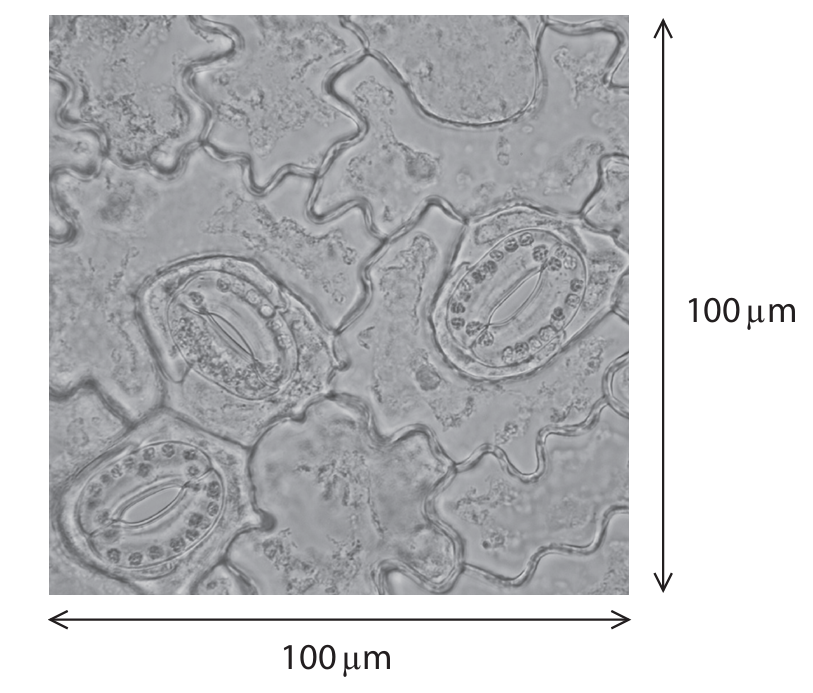
(b) The photograph shows some stomata on a leaf surface.

Use the photograph to determine the number of stomata per mm² on this leaf surface. [1 mm = 1000 μm]

(c) Explain why stomatal regulators reduce photosynthesis.

(d) (i) Explain why reflective compounds should only be applied to the upper surface of a leaf.

(ii) Explain why reducing leaf temperature reduces transpiration rate.

(e) Describe the role of one named mineral ion in plant growth.

(f) Describe how water is transported from the soil to the leaves in plants.

Most-appropriate topic codes (Edexcel IGCSE Biology):

2(e): Nutrition — Flowering plants — parts (e), (f)
2(g): Gas exchange — Flowering plants — parts (c), (d)(i), (d)(ii)
2(h): Transport — Flowering plants — parts (a), (f)
4(a): The organism in the environment — part (b)
4(c): Cycles within ecosystems — part (e)
▶️ Answer/Explanation
Solution

(a) Plants that have been dug up and transported are at most risk of drying out because their roots (and root hair cells) are damaged or not in soil/exposed. This means water cannot be absorbed or taken up effectively. Additionally, water continues to be lost through transpiration or evaporation from the leaves, creating a water deficit that the damaged root system cannot replenish.

(b) number of stomata per mm² = 300

Explanation: The photograph shows an area of 100 μm × 100 μm, which contains 3 stomata. To find the number per mm²:
1 mm = 1000 μm, so 1 mm² = 1000 μm × 1000 μm = 1,000,000 μm².
The area of the photograph is 100 μm × 100 μm = 10,000 μm².
So, the number of stomata per mm² = (number in photo ÷ area of photo) × area of 1 mm² = (3 ÷ 10,000) × 1,000,000 = 300.

(c) Stomatal regulators reduce photosynthesis because they cause the stomatal pores to close or become smaller. This reduces the amount of carbon dioxide that can diffuse into the leaf. Since carbon dioxide is a key reactant in photosynthesis, a reduced supply limits the rate at which photosynthesis can occur.

(d)(i) Reflective compounds should only be applied to the upper surface of a leaf because the stomata are mainly or only located on the lower surface in most plants. Applying the coating only to the upper surface ensures the stomatal pores are not blocked, allowing gas exchange (carbon dioxide absorption and oxygen release) to continue uninterrupted. Additionally, the upper surface receives the most direct sunlight, so applying the reflective coating there is most effective at reducing heat absorption.

(d)(ii) Reducing leaf temperature reduces the transpiration rate because lower temperatures decrease the kinetic energy of water molecules. With less energy, water molecules move more slowly and are less likely to evaporate from the leaf surface (especially from the stomata). This reduces the rate of diffusion of water vapor out of the leaf, thereby lowering the transpiration rate.

(e) Nitrate ions (NO₃⁻) play a crucial role in plant growth. They are absorbed from the soil and are used by the plant to synthesize amino acids. These amino acids are then built up into proteins, which are essential for growth (e.g., enzymes for metabolic reactions, structural proteins for cell walls) and development.

Alternatively, magnesium ions (Mg²⁺) are a key component of chlorophyll, the pigment that absorbs light energy for photosynthesis. Without sufficient magnesium, chlorophyll production is impaired, leading to reduced photosynthesis and stunted growth.

(f) Water is transported from the soil to the leaves through the following process:
1. Water is absorbed from the soil by root hair cells through osmosis. Root hairs increase the surface area for absorption.
2. Osmosis occurs because the soil water is a dilute solution (higher water potential) compared to the concentrated cell sap inside the root hair cells (lower water potential).
3. Once inside the root, water moves across the cortex and into the xylem vessels.
4. Water is then transported upwards through the xylem to the leaves due to transpiration pull. This is a suction force created by the evaporation of water from the surfaces of mesophyll cells in the leaves and its subsequent diffusion out of the stomata.
5. The cohesion (water molecules sticking together) and adhesion (water molecules sticking to the xylem walls) properties of water help maintain a continuous column of water from the roots to the leaves.
Question

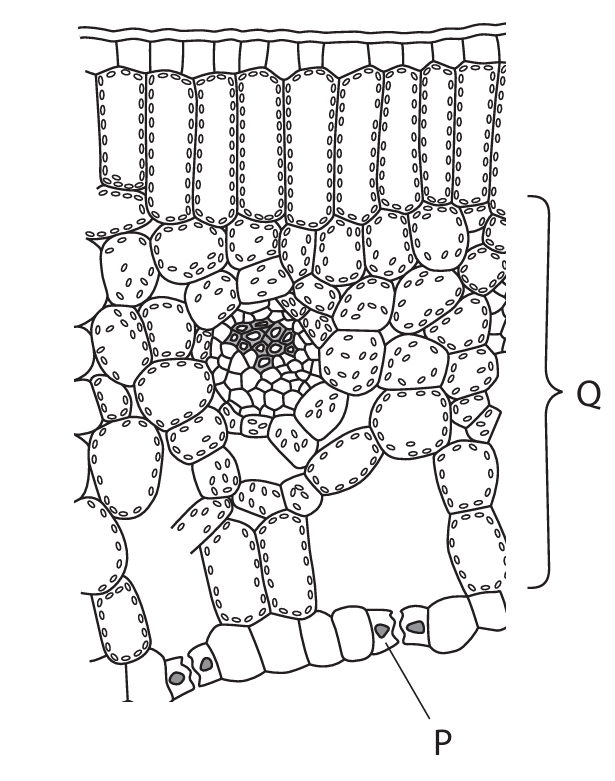
(a) The diagram shows a cross-section through part of a plant leaf.

(i) What is the name of the cell labelled P?

  • A. cuticle
  • B. guard
  • C. palisade
  • D. stoma

(ii) Explain how part Q is adapted for photosynthesis in the leaf.

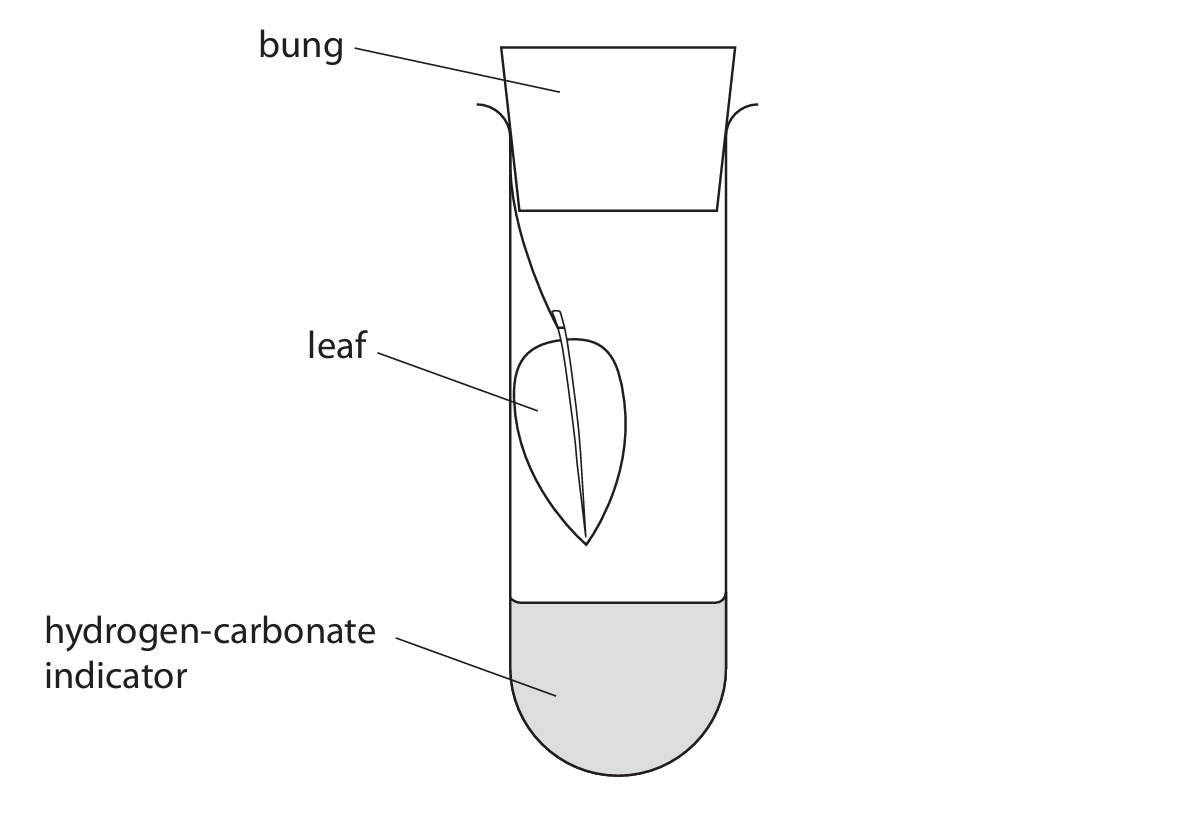
(b) A student uses this method to investigate the effect of temperature on the rate of gas exchange in leaves.

  • pour 10 cm³ of hydrogen-carbonate indicator into each of six test tubes
  • hang a leaf in five of the test tubes
  • place a bung in each test tube
  • place the five tubes with leaves into separate water baths at temperatures of 15°C, 20°C, 25°C, 30°C, 35°C, and 40°C
  • place the tube with no leaf in a water bath at 25°C
  • place all tubes in bright sunlight
  • record the time taken for each of the hydrogen-carbonate indicator solutions to change from orange to red

The student repeats the experiment two more times.

The diagram shows one of the tubes with a leaf.

(i) State the independent variable.

(ii) The species and size of leaf were the same in each tube.

Give a reason for controlling one other named factor.

(iii) State the function of the tube with no leaf.

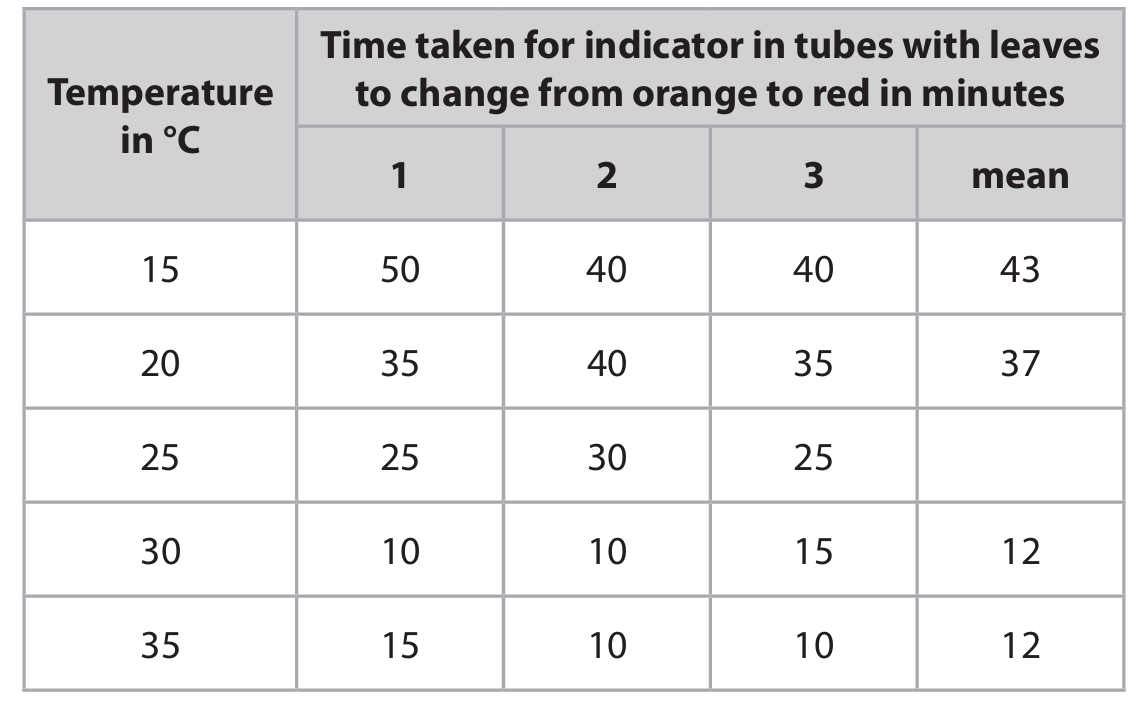
(c) The table shows the student’s results.

(i) Calculate the mean time taken for the indicator to change from orange to red at 25°C.

Give your answer to two significant figures.

(ii) Explain the effect of increasing the temperature on the mean time taken for the indicator to change from orange to red.

(d) In another experiment, the student places a test tube containing a leaf and hydrogen-carbonate indicator in a 25°C water bath.

The student then places all this apparatus in the dark for one hour.

Explain why the indicator solution changes from orange to yellow.

Most-appropriate topic codes (Edexcel IGCSE Biology):

2(e): Nutrition (Flowering plants) — parts (a)(i), (a)(ii)
2(g): Gas exchange (Flowering plants) — parts (a)(ii), (b), (c)(ii), (d)
2(b): Cell structure — part (a)(i)
Appendix 4: Mathematical skills — part (c)(i)
2(f): Respiration — part (d)
Assessment information: Experimental skills — parts (b)(i), (b)(ii), (b)(iii), (c)(ii)
▶️ Answer/Explanation
Solution

(a)(i) Answer: B (guard)

Explanation: The cell labelled P is a guard cell. Guard cells are specialized cells that surround the stomata (pores) in the leaf epidermis. They control the opening and closing of the stomata, which regulates gas exchange (carbon dioxide in, oxygen out) and water loss through transpiration.

(a)(ii) Answer: Part Q is the spongy mesophyll layer.

Explanation: The spongy mesophyll layer is highly adapted for photosynthesis in several ways. Firstly, it contains numerous air spaces between the cells, which creates a large surface area for the efficient diffusion of gases. Carbon dioxide, which is needed for photosynthesis, can diffuse easily from the stomata through these air spaces to reach the palisade mesophyll cells where most photosynthesis occurs. Similarly, oxygen produced as a byproduct of photosynthesis can diffuse out. Secondly, the cells in the spongy mesophyll contain chloroplasts, although fewer than in the palisade layer, and thus can also carry out photosynthesis. The loose arrangement of cells maximizes the exposure to these gases and facilitates their movement throughout the leaf.

(b)(i) Answer: Temperature (of the water bath)

Explanation: The independent variable is the factor that is deliberately changed or manipulated by the investigator. In this experiment, the student places the tubes into water baths at different temperatures (15°C, 20°C, 25°C, 30°C, 35°C, 40°C). Therefore, temperature is the independent variable.

(b)(ii) Answer: Example factor: Light intensity
Reason: To ensure that light intensity is not a limiting factor for photosynthesis, which would affect the rate of gas exchange and thus the time for the indicator to change color. By keeping it constant and bright, any changes in the rate are due to the temperature and not variations in light.

OR

Answer: Example factor: Volume/concentration of hydrogen-carbonate indicator
Reason: Different volumes or concentrations would absorb or release different amounts of carbon dioxide, which would directly affect the time it takes for the color to change, making comparisons between temperatures invalid.

(b)(iii) Answer: It acts as a control.

Explanation: The tube with no leaf serves as a control experiment. Its purpose is to show that any observed color change in the indicator in the other tubes is due to the presence and activity of the leaf (specifically, its effect on carbon dioxide levels through photosynthesis and respiration) and not due to some other factor, such as the temperature affecting the indicator solution itself.

(c)(i) Answer: 27 minutes

Explanation: To calculate the mean time at 25°C, add the three recorded times together and divide by 3: (25 + 30 + 25) / 3 = 80 / 3 = 26.666… minutes. Rounding this to two significant figures gives 27 minutes.

(c)(ii) Explanation: As the temperature increases from 15°C to 30°C, the mean time taken for the indicator to change color decreases. This indicates that the rate of the process causing the color change (removal of carbon dioxide by photosynthesis) is increasing. This is because temperature increases the kinetic energy of molecules, leading to more frequent collisions between enzymes and substrates involved in photosynthesis, thus speeding up the reaction. However, between 30°C and 35°C, the mean time stops decreasing and remains at 12 minutes. This suggests that the rate of photosynthesis is no longer increasing with temperature, likely because another factor (such as enzyme denaturation or the availability of another substrate like carbon dioxide or light) has become the limiting factor.

(d) Explanation: In the dark, photosynthesis cannot occur as it requires light. However, respiration continues in the leaf cells. Respiration consumes oxygen and produces carbon dioxide. The increase in carbon dioxide concentration in the test tube causes the hydrogen-carbonate indicator to change from orange (at atmospheric CO₂ levels) to yellow (which indicates a high concentration of CO₂). This shows that in the absence of light, the net gas exchange is dominated by the release of carbon dioxide from respiration.
Question

Smoking cigarettes has harmful effects on the body.

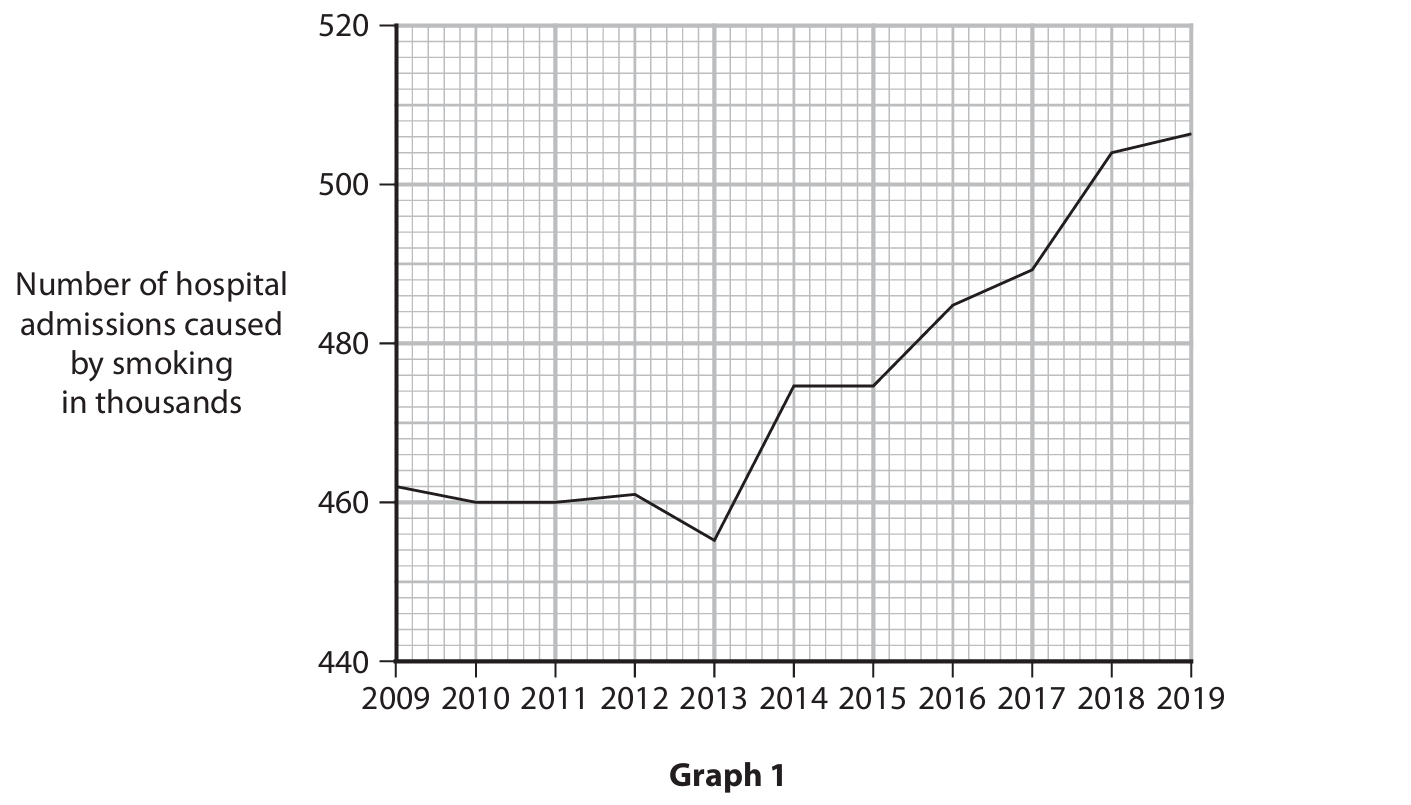
Graph 1 shows the number of hospital admissions in thousands due to conditions caused by smoking each year from 2009 to 2019.

(a) Using information from Graph 1, calculate the percentage increase in the number of hospital admissions caused by smoking in 2019 compared with 2009.

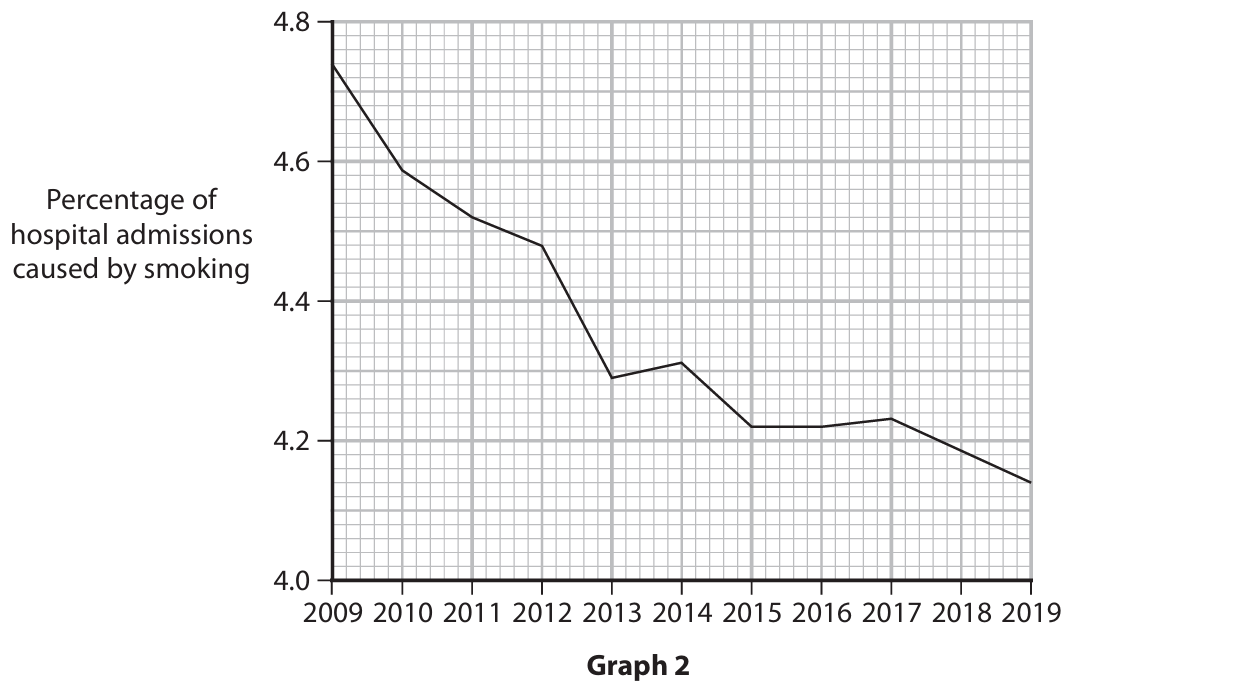
(b) Graph 2 shows the percentage of all hospital admissions that were due to conditions caused by smoking each year from 2009 to 2019.

Comment on the changes in the number of hospital admissions caused by smoking and the percentage of all hospital admissions that were caused by smoking.
Use data from graph 1 and graph 2 in your answer.

(c) Smoking causes harmful effects on the lungs.

Describe the consequences of smoking cigarettes for the functioning of the lungs.

Most-appropriate topic codes (Edexcel IGCSE Biology):

2(g): Gas exchange — part (c)
2(h): Transport — part (c)
4(d): Human influences on the environment — implicit in smoking as pollution
Appendix 4: Mathematical skills — parts (a) and (b) (data interpretation, percentage calculation)
▶️ Answer/Explanation
Solution

(a)

Percentage increase ≈ 9.52%

Explanation:

To calculate the percentage increase, we first need the number of admissions for the start year (2009) and the end year (2019) from Graph 1.

From the graph, the number in 2009 is approximately 462 (thousand). The number in 2019 is approximately 506 (thousand).

The actual increase is calculated as: 506 – 462 = 44 (thousand).

The percentage increase is calculated using the formula:

\[ \text{Percentage Increase} = \left( \frac{\text{Change}}{\text{Original}} \right) \times 100 = \left( \frac{44}{462} \right) \times 100 \]

Performing the calculation: (44 ÷ 462) ≈ 0.095238. Multiplying by 100 gives approximately 9.52%.

Therefore, the percentage increase in hospital admissions caused by smoking from 2009 to 2019 was about 9.52%.

(b)

Comment:

Explanation:

Analyzing the data from both graphs reveals important trends. Graph 1 shows that the absolute number of hospital admissions due to smoking generally increased from 2009 (≈462,000) to 2019 (≈506,000), with a noticeable dip or plateau around 2012-2013 where numbers were at their lowest.

However, Graph 2 tells a different story about the proportion of total admissions. It shows that the percentage of all hospital admissions that were caused by smoking declined over the same period, reaching its lowest point in 2019.

This apparent contradiction can be explained by factors such as an increase in the total number of hospital admissions from all causes (e.g., due to a growing or aging population, or an increase in other illnesses), meaning smoking-related admissions make up a smaller share of a larger total. It could also suggest that while the number of people suffering smoking-related illnesses is high, fewer people are starting to smoke or more people are quitting, leading to a slower growth rate of smoking-related admissions compared to admissions from other causes.

(c)

Consequences for Lung Function:

Explanation:

Smoking severely damages the lungs and impairs their function through several mechanisms:

  1. Damage to Cilia: The trachea and bronchi are lined with cilia (tiny hair-like structures) that sweep mucus and trapped particles out of the airways. Smoke paralyzes and destroys these cilia. This is a primary and early consequence.
  2. Mucus Buildup: With the cilia unable to function, mucus builds up in the airways. This buildup cannot be cleared effectively, creating a stagnant environment.
  3. Increased Infection Risk: The accumulated mucus becomes a breeding ground for bacteria, leading to frequent bacterial infections, bronchitis, and pneumonia.
  4. Alveoli Destruction: The toxins in smoke damage the walls of the alveoli (air sacs where gas exchange occurs). This causes the alveoli to break down and merge, a condition called emphysema. This drastically reduces the surface area available for oxygen and carbon dioxide exchange.
  5. Inflammation and Narrowing: Smoke causes chronic inflammation and swelling of the bronchioles. The muscles around these airways can also tighten, causing them to narrow. This makes it physically harder to move air in and out, leading to breathlessness, a characteristic of chronic bronchitis.
  6. Cancer: The carcinogens in tobacco smoke can cause mutations in lung cells, leading to uncontrolled cell growth and lung cancer.

Collectively, the destruction of alveoli (emphysema) and the inflamed, narrowed airways (chronic bronchitis) are often grouped under the term Chronic Obstructive Pulmonary Disease (COPD), a major long-term consequence of smoking.
Question

Read the passage below. Use the information in the passage and your own knowledge to answer the questions that follow.

Plants to the rescue

Since the early 20th century, the concentration of carbon dioxide in the atmosphere has increased rapidly. This has further increased in recent years due to more cars and the increased demand for electricity for homes and industry.

Scientists have found that plants play a critical part in removing this excess carbon dioxide from the atmosphere. Using computer models, the scientists concluded that photosynthesis has increased by 30 per cent.

The scientists measured carbonyl sulfide found in ice cores and air samples. In addition to carbon dioxide, plants take in carbonyl sulfide gas during their natural carbon cycle, and this is frequently used as a measure of photosynthesis on a global scale. Terrestrial plants are removing about 29 per cent of carbon dioxide emissions that would otherwise contribute to an increase in the atmospheric carbon dioxide concentration.

A carbon sink is an ecosystem, such as a forest, that absorbs more carbon dioxide than it releases. The size of the carbon sink depends on the rate of photosynthesis but also on the levels of deforestation and respiration. The model the scientists used showed that the role of photosynthesis in producing a carbon sink in land plants is larger than estimated in most other models.

Other scientists are less confident about using carbonyl sulfide as a measure of photosynthesis. Plant absorption of carbonyl sulfide can vary depending upon the amount of light the plants receive. Therefore, the measure of global photosynthesis could be overestimated.

Regardless of the rate at which photosynthesis has increased, scientists agree that excess carbon dioxide is boosting the growth of plants. Trees are becoming leafier, and there is more wood. The wood is where most of the carbon is stored in the plant.

In experimental research, scientists exposed plants to double the normal concentration of carbon dioxide found in the atmosphere. Under these increased carbon dioxide conditions, the composition of the leaf tissues changed. This made the leaves tougher for herbivores to eat and made it harder for insect larvae to grow.

Scientists have also observed that when plants are exposed to increasing levels of carbon dioxide, the size of the stomatal pores on a leaf increases.

(a) Explain why more cars would result in an increase in atmospheric carbon dioxide. (Lines 1-3)

(b) Explain how increased carbon dioxide can cause climate change.

(c) Explain why increasing carbon dioxide concentration can increase photosynthesis in plants.

(d) Explain why the carbon sink depends upon respiration and deforestation as well as photosynthesis. (Lines 13 to 15)

(e) Light affects gas exchange in leaves. (Lines 19 and 20)
Describe an experiment that shows how the net gas exchange from a leaf varies with light intensity.

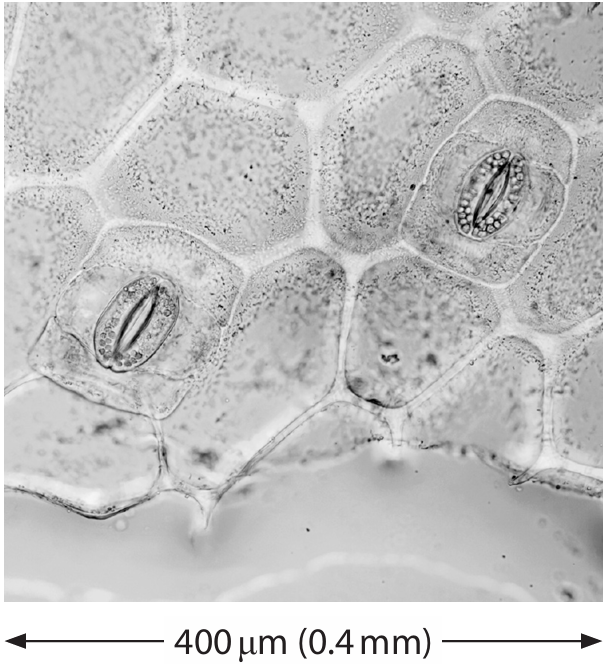
(f) The photograph shows stomata on a small square of the lower surface of a leaf.

The total area of the lower surface of the leaf is \(150 \text{ cm}^2\).
Using the photograph and the total lower surface area of the leaf, estimate the number of stomata on the lower surface of the leaf.

(g) Stomata also have a role in water transport in the plant. Explain the role of stomata in water transport.

Most-appropriate topic codes (Edexcel IGCSE Biology):

2(e): Nutrition (Photosynthesis) — parts (c), (e)
4(d): Human influences on the environment — parts (a), (b)
4(c): Cycles within ecosystems (Carbon cycle) — part (d)
2(g): Gas exchange — parts (e), (f), (g)
2(h): Transport in plants — part (g)
▶️ Answer/Explanation
Solution

(a)
An explanation that makes reference to:
• Burning / combustion of petrol / diesel / fuel in car engines. (1 mark)
• This combustion reaction releases carbon dioxide (\( \text{C} + \text{O}_2 \rightarrow \text{CO}_2 \)). (1 mark)
More cars mean more fuel burned, directly increasing \( \text{CO}_2 \) emissions.

(b)
An explanation that makes reference to two of the following:
• Carbon dioxide is a greenhouse gas. (1 mark)
• It traps / absorbs infrared (IR) radiation (heat) from the Earth, preventing its escape into space. (1 mark)
• This leads to an enhanced greenhouse effect, causing global warming / climate change. (1 mark)
(Maximum 2 marks)

(c)
An explanation that makes reference to:
• Carbon dioxide is a reactant / raw material needed for photosynthesis. (1 mark)
• At lower concentrations, \( \text{CO}_2 \) can be a limiting factor for photosynthesis; increasing its concentration can increase the rate up to a point. (1 mark)
The photosynthesis equation is: \( 6\text{CO}_2 + 6\text{H}_2\text{O} \xrightarrow{\text{light}} \text{C}_6\text{H}_{12}\text{O}_6 + 6\text{O}_2 \).

(d)
An explanation that makes reference to two of the following:
• A carbon sink absorbs more \( \text{CO}_2 \) than it releases. (1 mark)
• Respiration (by plants, animals, decomposers) releases \( \text{CO}_2 \) back into the atmosphere, reducing net absorption. (1 mark)
• Deforestation (cutting down trees) reduces the number of plants for photosynthesis and often involves burning/decay, releasing stored carbon as \( \text{CO}_2 \). (1 mark)
(Maximum 2 marks)

(e)
A description that makes reference to three of the following:
• Place leaves (or aquatic plants like pondweed) in test tubes containing hydrogen-carbonate indicator. (1 mark)
• Expose one setup to bright light and another to darkness (or vary light intensity using a lamp at different distances). (1 mark)
• In bright light, the indicator turns purple/dark red (due to net \( \text{CO}_2 \) uptake in photosynthesis). In darkness, it turns yellow (due to net \( \text{CO}_2 \) release from respiration). (1 mark)
• Control other variables: use leaves of the same species, size, age; same volume and concentration of indicator; same temperature; same time period. (1 mark)
(Maximum 3 marks)

(f)
Step-by-step calculation:
1. Area in photograph: side = \( 400 \mu\text{m} = 0.4 \text{ mm} = 0.04 \text{ cm} \).
2. Area of square = \( (0.04 \text{ cm})^2 = 0.0016 \text{ cm}^2 \).
3. Number of stomata in this area = 2.
4. Stomatal density = \( \frac{2}{0.0016} = 1250 \) stomata per \( \text{cm}^2 \).
5. Total number on leaf = \( 1250 \times 150 = 187500 \).
Answer: \( \mathbf{187500} \) stomata. (3 marks)

(g)
An explanation that makes reference to:
• Stomata allow water vapour to evaporate / be lost from the leaf in a process called transpiration. (1 mark)
• This transpiration pull creates a tension / negative pressure in the xylem, drawing a continuous column of water up from the roots, through the stem, and into the leaves. (1 mark)
This is known as the transpiration stream, and it relies on stomatal opening for water movement against gravity.
Question

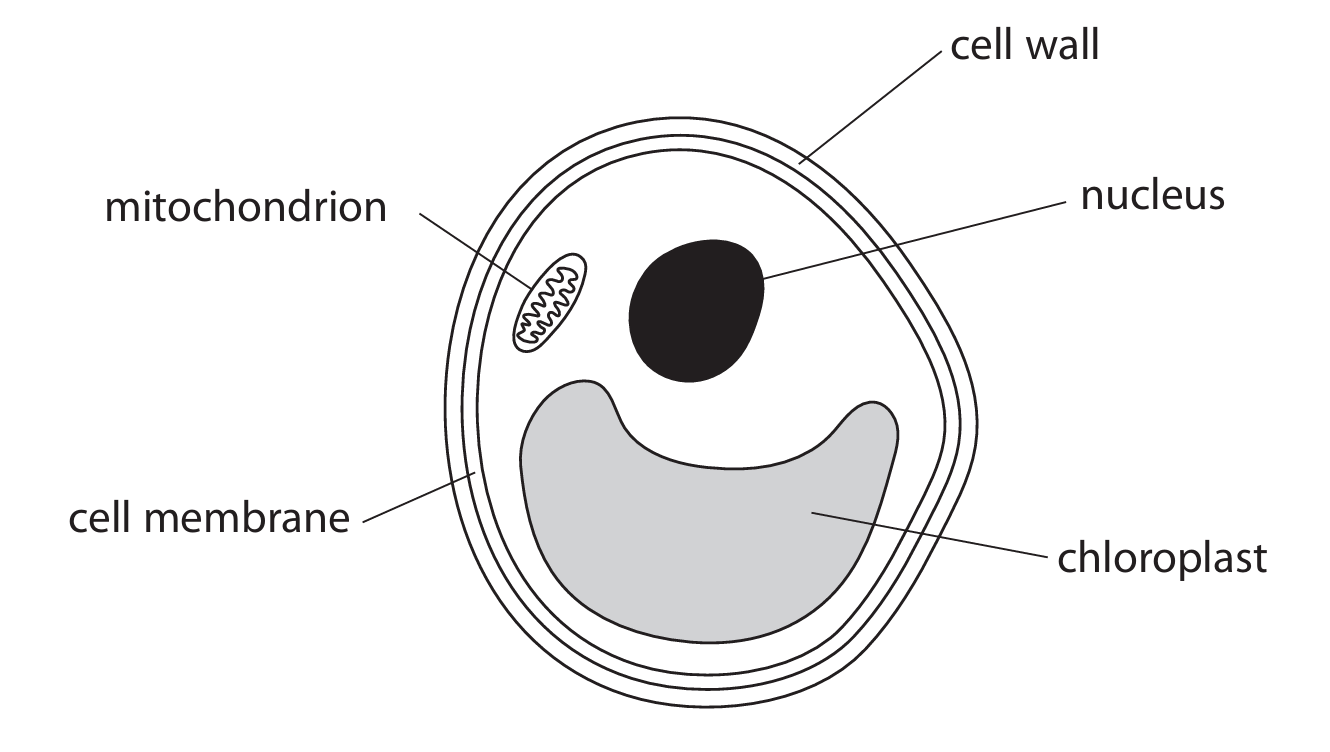
The diagram shows a single-celled organism called Chlorella that lives in fresh water.

Chlorella has a chloroplast and can photosynthesise.

(a) (i) Which of these groups of organisms contains Chlorella?

  • A. animals
  • B. bacteria
  • C. plants
  • D. protoctists

(ii) Which of these labelled structures would also be present in an animal cell?

  • A. cell membrane and chloroplast
  • B. cell membrane and mitochondrion
  • C. cell wall and chloroplast
  • D. cell wall and mitochondrion

(b) Complete the balanced chemical symbol equation for photosynthesis.

__________ + __________ → C6H12O6 + 6O2

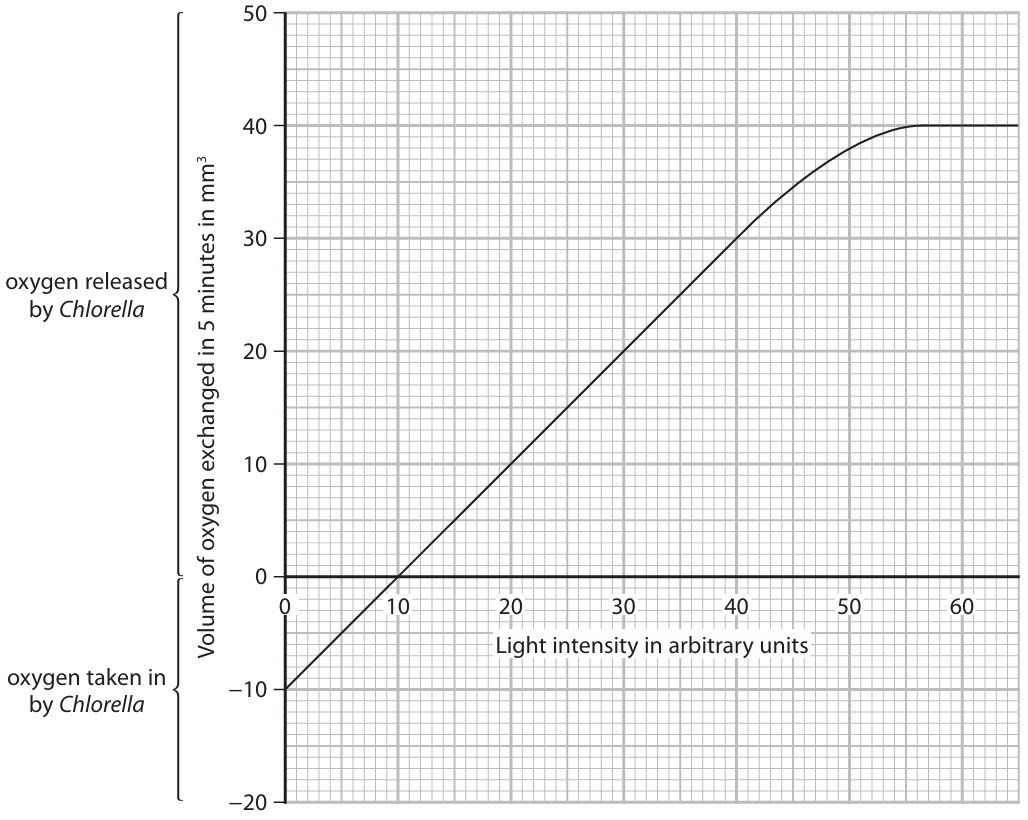
(c) The graph shows the effect of light intensity on gas exchange by Chlorella.

(i) Explain why Chlorella takes in oxygen at light intensities below 10 arbitrary units.

(ii) Explain the changes in the volume of oxygen released as the light intensity increases from 10 arbitrary units.

(iii) The volume of oxygen released by Chlorella is the difference between the oxygen produced by photosynthesis and the oxygen taken in.

Use the graph to calculate the volume of oxygen produced in five minutes by photosynthesis at a light intensity of 50 arbitrary units.

(d) Describe how hydrogen-carbonate indicator could be used to investigate the effect of light intensity on carbon dioxide exchange by Chlorella.

Most-appropriate topic codes (Edexcel IGCSE Biology):

1(b): Variety of living organisms — part (a)(i)
2(b): Cell structure — part (a)(ii)
2(e): Nutrition (photosynthesis) — parts (b), (c), (d)
2(f): Respiration — parts (c)(i), (c)(ii), (c)(iii)
2(g): Gas exchange — part (d)
▶️ Answer/Explanation
Solution

(a) (i) D (protoctists)

Explanation: Chlorella is a single-celled, photosynthetic organism with a nucleus and chloroplasts. It is not an animal (A) because it has chloroplasts and a cell wall. It is not a bacterium (B) because it has a true nucleus and membrane-bound organelles like chloroplasts and mitochondria. It is not a plant (C) because it is unicellular, whereas plants are multicellular. Therefore, it belongs to the kingdom Protoctista (D), which contains various unicellular and simple multicellular eukaryotes, including algae.

(a) (ii) B (cell membrane and mitochondrion)

Explanation: Animal cells have a cell membrane and mitochondria. They do not have chloroplasts (so A and C are incorrect) and they do not have a cell wall (so D is incorrect). Both animal cells and Chlorella require mitochondria for respiration to release energy.

(b) 6CO2 + 6H2O → C6H12O6 + 6O2

Explanation: The balanced equation for photosynthesis shows that six molecules of carbon dioxide (6CO2) and six molecules of water (6H2O), in the presence of light energy and chlorophyll, react to produce one molecule of glucose (C6H12O6) and six molecules of oxygen (6O2). The reactants must be placed on the left-hand side of the arrow.

(c) (i)

Explanation: At low light intensities (below 10 arbitrary units), the rate of photosynthesis is very low because there is insufficient light energy. However, respiration continues at all times to release energy for cell processes. Therefore, the oxygen produced by photosynthesis is less than the oxygen consumed by respiration. This results in a net uptake of oxygen from the surroundings, which is why the graph shows a negative value for oxygen exchange (indicating net intake).

(c) (ii)

Explanation: As light intensity increases from 10 arbitrary units, the rate of photosynthesis also increases because light is a key factor for the light-dependent reactions. At 10 arbitrary units, the compensation point is reached where the rate of photosynthesis equals the rate of respiration, so there is no net gas exchange. Above this point, the rate of photosynthesis becomes greater than the rate of respiration. This means more oxygen is produced by photosynthesis than is consumed by respiration, leading to a net release of oxygen, which is shown by the positive values on the graph. The curve eventually levels off because another factor, such as carbon dioxide concentration or temperature, becomes limiting and prevents the rate of photosynthesis from increasing further, even with more light.

(c) (iii) 48 mm3

Explanation: The graph shows the net oxygen released, which is the oxygen from photosynthesis minus the oxygen used in respiration. At 50 arbitrary units, the net oxygen released is approximately 38 mm³. We are told that the oxygen taken in (used in respiration) is 10 mm³ (this value is consistent across light intensities as respiration rate is relatively constant). To find the gross oxygen produced by photosynthesis, we add the oxygen used in respiration to the net oxygen released: 38 mm³ + 10 mm³ = 48 mm³.

(d)

Explanation: To investigate the effect of light intensity on carbon dioxide exchange, you could set up the following experiment. Place equal volumes or masses of Chlorella in several test tubes containing the same volume of hydrogen-carbonate indicator solution. Seal the tubes. Hydrogen-carbonate indicator changes color with carbon dioxide concentration: it turns yellow when carbon dioxide levels are high, red at atmospheric levels, and purple when carbon dioxide levels are low. You would then place the tubes at different distances from a light source to create different light intensities (e.g., 10 cm, 20 cm, 30 cm away). A control tube with no Chlorella should be set up to show that any color change is due to the organism. You would also need to control other variables, such as temperature and the initial concentration of the algae and indicator. After leaving the tubes for a set period, you would observe and record the final color of the indicator in each tube. In high light, photosynthesis would be high, so carbon dioxide would be absorbed, and the indicator would turn purple. In low light or darkness, respiration would dominate, releasing carbon dioxide, and the indicator would turn yellow.
Question

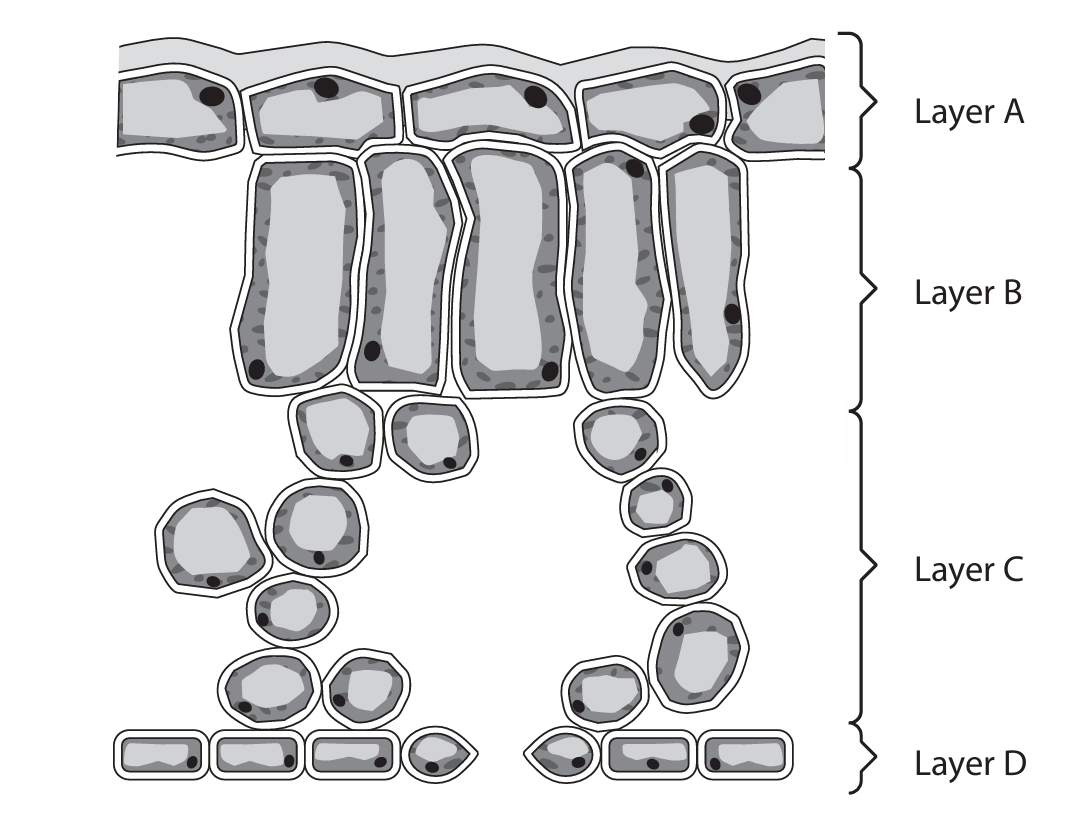
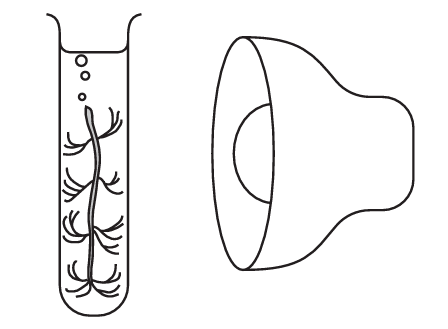
The diagram shows a transverse section through a leaf.

(a) Explain how layer A is adapted for its role.

(b) Explain how layers B and C are adapted for photosynthesis and gas exchange.

(c) State the role of guard cells.

(d) Gardeners sometimes apply a spray called an anti-transpirant to plant leaves.

The spray is impermeable to water vapour but allows other gases to pass through. Discuss whether an anti-transpirant spray will promote plant growth.

Most-appropriate topic codes (Edexcel IGCSE Biology):

2(e): Nutrition in flowering plants — parts (a), (b)
2(g): Gas exchange in flowering plants — parts (b), (c)
2(h): Transport in flowering plants — part (d)
2(j): Co-ordination and response in flowering plants — part (c)
▶️ Answer/Explanation
Solution

(a) Explain how layer A is adapted for its role.

Answer: Layer A (the waxy cuticle/epidermis) is adapted by being transparent to allow light through, having a waxy coating to reduce water loss, and having few chloroplasts as it is not photosynthetic.

Detailed Explanation:
Layer A represents the upper epidermis and its waxy cuticle. This layer has several key adaptations for its protective role. First, it is transparent, allowing sunlight to pass through to the underlying palisade mesophyll cells where most photosynthesis occurs. Second, it secretes a waxy, waterproof substance called the cuticle that forms a protective barrier. This cuticle significantly reduces water loss through evaporation from the leaf surface, which is crucial for preventing the plant from wilting, especially in dry conditions. Additionally, the cells of the epidermis typically contain few or no chloroplasts since their primary function is protection rather than photosynthesis. This combination of transparency and waterproofing makes the epidermis highly efficient at protecting inner tissues while still enabling the essential process of photosynthesis to occur.

(b) Explain how layers B and C are adapted for photosynthesis and gas exchange.

Answer: Layer B (palisade mesophyll) is adapted with many chloroplasts and tightly packed cells for efficient light absorption. Layer C (spongy mesophyll) has air spaces and loosely packed cells to facilitate gas exchange.

Detailed Explanation:
Layer B is the palisade mesophyll layer, which is perfectly adapted for its role as the main photosynthetic tissue. The cells are elongated and arranged vertically in a tightly packed formation, positioned close to the upper epidermis where light intensity is highest. This arrangement maximizes light capture. Furthermore, these cells contain a high density of chloroplasts – the organelles where photosynthesis actually occurs – making them extremely efficient at converting light energy into chemical energy.

Layer C is the spongy mesophyll layer, which is specialized for gas exchange. Unlike the tightly packed palisade cells, the spongy mesophyll cells are irregularly shaped and loosely arranged, creating numerous interconnected air spaces between them. These air spaces create a large surface area for the diffusion of gases. Carbon dioxide (\(CO_2\)), which is needed for photosynthesis, can diffuse freely from the stomata through these air spaces to reach the photosynthetic cells. Simultaneously, oxygen (\(O_2\)), produced as a byproduct of photosynthesis, can diffuse out of the cells into these air spaces and eventually exit the leaf. The loose arrangement and abundant air spaces thus create an optimal environment for the efficient exchange of these vital gases.

(c) State the role of guard cells.

Answer: Guard cells control the opening and closing of stomata to regulate gas exchange and water loss.

Detailed Explanation:
Guard cells are highly specialized cells that surround each stoma (plural: stomata), which are tiny pores on the leaf surface. Their primary role is to regulate the opening and closing of these stomatal pores. When guard cells are turgid (swollen with water), they bend and create an opening between them, allowing the stoma to open. This opening enables carbon dioxide (\(CO_2\)) to enter the leaf for photosynthesis during daylight hours. Conversely, when guard cells lose water and become flaccid, they relax and close the stoma. This closure helps to conserve water by reducing transpiration (water vapor loss), particularly during hot, dry conditions or at night when photosynthesis isn’t occurring. Therefore, guard cells perform the crucial balancing act of allowing sufficient \(CO_2\) intake for photosynthesis while minimizing excessive water loss.

(d) Discuss whether an anti-transpirant spray will promote plant growth.

Answer: Anti-transpirant sprays may not consistently promote plant growth because while they reduce water loss, they may also limit carbon dioxide intake and mineral transport.

Detailed Explanation:
The effect of anti-transpirant sprays on plant growth involves a complex trade-off. On one hand, these sprays can be beneficial because they form a waterproof coating that reduces transpiration (water loss from the leaves). By conserving water, they help prevent wilting and water stress, especially during drought conditions or in windy environments. This water conservation could potentially support growth by maintaining turgor pressure and physiological processes.

However, there are significant drawbacks that may hinder growth. Although the spray allows other gases like carbon dioxide (\(CO_2\)) to pass through, it might still create an additional barrier that slightly reduces the rate of \(CO_2\) diffusion into the leaf. Since \(CO_2\) is essential for photosynthesis, any reduction in its uptake could limit the plant’s ability to produce glucose and other carbohydrates, ultimately slowing growth. Additionally, the transpiration stream plays a vital role in transporting mineral ions from the roots to the shoots. By reducing transpiration, the spray might also reduce the upward movement of these essential nutrients, potentially causing nutrient deficiencies that impair growth. Furthermore, transpiration provides a cooling effect for leaves; reducing it might lead to overheating in bright sunlight, damaging plant tissues. Therefore, whether an anti-transpirant promotes growth depends on the specific environmental conditions – it might be helpful in water-scarce situations but detrimental when water is plentiful and maximum photosynthetic rate is desired.
Question

The human kidney is an organ that is able to process excretory products from human metabolism.

(a) Concentration of urine is calculated using this formula.

concentration in milliseconds per dm\(^3\) = \(\frac{\text{amount of waste in milliseconds}}{\text{volume in dm}^3}\)

The amount of waste the kidneys produce per day is 600 milliseconds.

The maximum concentration that the human kidneys can produce is 1400 milliseconds per dm\(^3\).

Calculate the minimum volume of urine that must be produced each day.

Give your answer in cm\(^3\).

(b) Name another organ that carries out excretion in the human body.

(c) Explain the role of the nephron in osmoregulation.

Most-appropriate topic codes (Edexcel IGCSE Biology):

2(i): Excretion — part (b)
2(i)B: Kidney function and osmoregulation — parts (a), (c)
Appendix 4: Mathematical skills — part (a)
2(g): Gas exchange (human lungs) — part (b)
▶️ Answer/Explanation
Solution

(a)

Answer: 430 cm³

Explanation:

To find the minimum volume of urine, we use the formula for concentration:

concentration = \(\frac{\text{amount of waste}}{\text{volume}}\)

We rearrange this formula to solve for volume:

volume = \(\frac{\text{amount of waste}}{\text{concentration}}\)

Substituting the given values:

volume = \(\frac{600 \text{ milliseconds}}{1400 \text{ milliseconds per dm}^3} = 0.42857 \text{ dm}^3\)

Now we convert from dm³ to cm³. Since 1 dm³ = 1000 cm³:

0.42857 dm³ × 1000 = 428.57 cm³

Rounding to a sensible figure gives us 430 cm³. This is the minimum volume of urine that must be produced each day to excrete all the waste without exceeding the kidney’s maximum concentrating ability.

(b)

Answer: Lungs

Explanation:

The lungs are another major excretory organ in the human body. While their primary function is gas exchange, they also excrete waste products. Specifically, they remove carbon dioxide (CO₂) from the bloodstream. Carbon dioxide is a waste product of cellular respiration. When we breathe out, we are excreting this CO₂ from our bodies. Water vapor is also excreted through the lungs during exhalation.

(c)

Explanation:

Osmoregulation is the process of maintaining the correct water and salt balance in the blood and body fluids. The nephron, the functional unit of the kidney, plays a central role in this process through a series of coordinated steps:

  1. Detection: Specialized cells called osmoreceptors, located in the hypothalamus of the brain, continuously monitor the water potential (concentration) of the blood. If the blood becomes too concentrated (for example, due to dehydration or eating salty food), the osmoreceptors detect this change.
  2. Hormonal Response: The hypothalamus stimulates the pituitary gland to release more Antidiuretic Hormone (ADH) into the bloodstream.
  3. Action on the Nephron: ADH travels in the blood to the kidneys. Its main target is the collecting duct of the nephron. ADH makes the walls of the collecting duct more permeable to water.
  4. Water Reabsorption: As the filtrate flows down the collecting duct, which passes through the hypertonic renal medulla, water moves out of the duct by osmosis, down its concentration gradient. This water is reabsorbed back into the surrounding blood capillaries.
  5. Result: Because more water is reabsorbed, a smaller volume of more concentrated urine is produced. This helps to conserve water in the body and increases the water content of the blood, diluting it back to its normal concentration.
  6. Negative Feedback: Once the blood concentration returns to normal, the osmoreceptors are no longer stimulated. This leads to a reduction in ADH secretion from the pituitary gland. The collecting ducts become less permeable again, and urine output returns to normal. This is an example of a negative feedback loop, which is crucial for maintaining homeostasis.

Conversely, if the blood is too dilute, less ADH is released, the collecting ducts remain impermeable, less water is reabsorbed, and a large volume of dilute urine is produced to remove excess water from the body.

Question

A student investigates the effect of different colours of light on the rate of photosynthesis in a water plant.

This is the student’s method.

  • place a 1% sodium hydrogen carbonate solution in a boiling tube
  • cut a 5 cm length of pondweed and place it in the tube
  • place a lamp 10 cm from the tube containing the pondweed
  • leave the pondweed for 10 minutes until it starts to produce bubbles from the cut end
  • count the bubbles produced in one minute
  • count the bubbles for two more one minute periods

The student repeats the experiment three more times using filters in front of the lamp that let through either red light, blue light or green light.

These are the student’s results.

Colour of filterNumber of bubbles per minute
 Test 1Test 2Test 3Mean
no filter478480 
red48484246
blue55565054
green98109

(a) Write the balanced symbol equation for photosynthesis.

(b)(i) Anomalous results are not included in the calculation of the mean. Calculate the mean number of bubbles per minute for the lamp with no filter.
(ii) Explain the student’s results.
(iii) Give two abiotic variables that the student should control in her experiment.

(c)(i) Explain why measuring the rate of photosynthesis by counting bubbles may not be an accurate method to use.
(ii) Suggest an alternative method that the student could use to measure the rate of photosynthesis in her experiment.

Most-appropriate topic codes (Edexcel IGCSE Biology):

2(e): Nutrition in flowering plants — parts (a), (b)(ii)
2(g): Gas exchange in plants — part (c)(ii)
4 Assessment Information / Experimental Skills:parts (b)(i), (b)(iii), (c)(i), (c)(ii)
Appendix 3: Mathematical skills — part (b)(i)
▶️ Answer/Explanation
Solution

(a) 6CO2 + 6H2O → C6H12O6 + 6O2 (2)

(b)(i) 84 + 80 ÷ 2 = 82 (bubbles per minute) (2)

(b)(ii) An explanation that makes reference to four of the following points:

  • no filter has highest rate of photosynthesis / bubbling / oxygen (1)
  • (because) all light colours / wavelengths are present / has more light energy / most amount of light that can be absorbed (1)
  • green has low(est) rate of photosynthesis, because green light is not absorbed (1)
  • blue / red has a medium rate of photosynthesis because light is, absorbed / not reflected (1)
  • chlorophyll / chloroplast absorbs red / blue light / does not absorb green light (1)

(b)(iii) An answer that makes reference to two of the following points:

  • temperature (1)
  • carbon dioxide (1) Allow volume / amount / concentration of hydrogen carbonate
  • light intensity (1) Allow brightness of lamp / thickness of filter

(c)(i) An explanation that makes reference to two of the following points:

  • bubbles are different volumes / sizes (1)
  • O2 may dissolve in water (1)
  • bubbles may be CO2 not oxygen / may not be due to photosynthesis / other gases may be present (1) Allow bubbles may be due to respiration
  • easy to miscount / miss bubbles (1)
  • bubbles get trapped / stuck (1)

(c)(ii) An answer that makes reference to two of the following points:

    • use measuring cylinder / (gas) syringe / burette / graduated test tube (1)
    • (to measure) volume (1)

OR

  • use hydrogen carbonate indicator (1)
  • change colour (of hydrogen carbonate indicator) (1)
Question

Gas exchange in a flowering plant changes depending on conditions.

(a) Complete the passage by writing a suitable word or words in each blank space.

Plants carry out photosynthesis to produce ………………….. To enable this process to occur the leaf cells absorb carbon dioxide and release oxygen.

At the same time the cells in the leaves are respiring. This means that they are using …………………. and producing carbon dioxide. If the leaves are in bright sunlight, then the rate of photosynthesis will be …………………. than the rate of respiration. If the leaves are in dim light, then the rate of respiration will be greater than the rate of photosynthesis and there will be a net production of …………………..

In conditions when there is no net absorption or release of carbon dioxide the rate of photosynthesis and respiration are …………………. and the plant is at its compensation point.

(b) Describe how you could use hydrogen-carbonate indicator to investigate the effect of light intensity on net gas exchange in a leaf.

Most-appropriate topic codes (Edexcel IGCSE Biology):

2(e): Nutrition (Photosynthesis) — part (a)
2(g): Gas exchange (Flowering plants) — parts (a), (b)
2(f): Respiration — part (a)
2(g): Practical Investigation — part (b)
▶️ Answer/Explanation
Solution

(a) An answer that makes reference to the following points:

  • carbohydrate / named carbohydrate (e.g., glucose, starch) (1)
  • oxygen (1) allow carbohydrate / named carbohydrate
  • higher / greater / more (1)
  • carbon dioxide (1)
  • equal / the same / balanced (1)

Completed passage: Plants carry out photosynthesis to produce carbohydrate (e.g., glucose). To enable this process to occur the leaf cells absorb carbon dioxide and release oxygen. At the same time the cells in the leaves are respiring. This means that they are using oxygen and producing carbon dioxide. If the leaves are in bright sunlight, then the rate of photosynthesis will be higher than the rate of respiration. If the leaves are in dim light, then the rate of respiration will be greater than the rate of photosynthesis and there will be a net production of carbon dioxide. In conditions when there is no net absorption or release of carbon dioxide the rate of photosynthesis and respiration are equal and the plant is at its compensation point.

(b) A description that makes reference to three of the following points:

  • (how light intensity is varied) foil / muslin / move lamp / eq (1) allow light and dark
  • leaf in test tube with bung / use flask with delivery tube / eq (1)
  • (look for colour change after) same / stated time (1)
  • same size / species / type / surface area / eq (1)
  • same temperature / same volume of indicator (1)
  • correct colour change so goes yellow with increased CO\(_2\) in dark / goes dark red/ red/ purple with reduced CO\(_2\) in light / eq (1)

Suggested answer: Place a leaf in a test tube containing a set volume of hydrogen-carbonate indicator and seal it. Repeat with another leaf in a second test tube. Cover one tube with foil to provide dark conditions (low light intensity) and leave the other in bright light. Keep all other variables (e.g., temperature, leaf size/species, time) the same. After a set time, observe the colour change. The indicator goes yellow if there is a net production of CO\(_2\) (respiration > photosynthesis in dim/dark) and purple/red if there is a net uptake of CO\(_2\) (photosynthesis > respiration in bright light).

Scroll to Top