Home / Edexcel iGCSE / Edexcel iGCSE Biology / Exam Style Questions

Edexcel iGCSE Biology 4BI1 - Paper 2B -Inheritance- Exam Style Questions- New Syllabus

Question

Apples contain an enzyme called phenol oxidase.

When apple tissue is exposed to oxygen in the air, this enzyme turns the apple tissue brown.

(a) A student uses this method to investigate the effect of pH on the time taken for apple tissue to turn brown.

  • mash an apple to produce a pulp
  • place 25 g of this pulp into a beaker
  • mix a pH 7 buffer with the pulp to maintain the pH
  • check the colour of the pulp every five minutes
  • record the time when the pulp turns brown

The student repeats this method using pH buffers of 3, 5, 9, and 11.

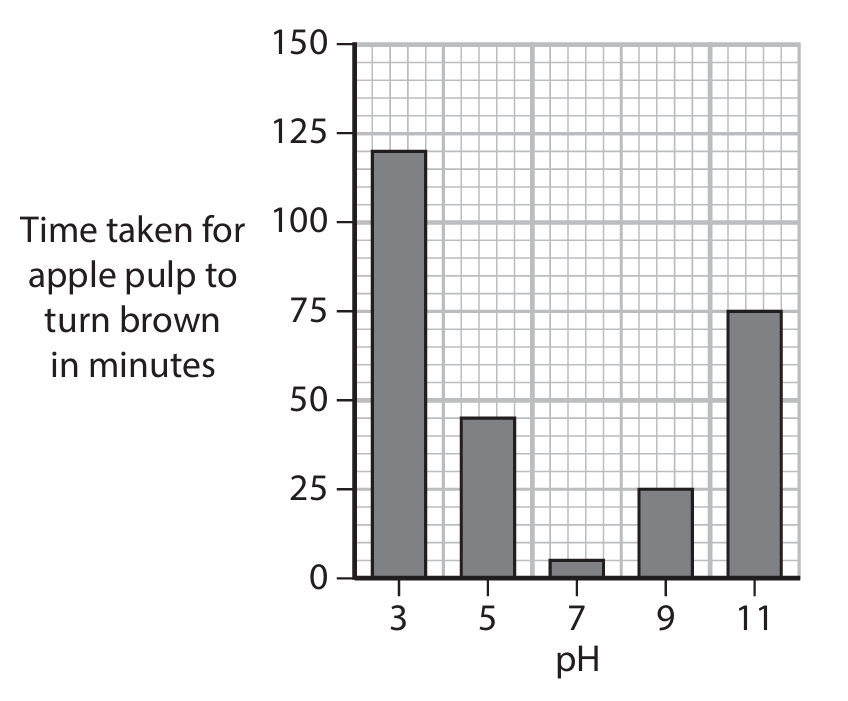
The graph shows the student’s results.

(i) Calculate the percentage increase in time taken for the apple pulp to turn brown at pH 11 compared with the time taken at pH 7.
(ii) Explain why the change in pH affects the time taken for the apple pulp to turn brown.
(iii) Explain how the student could modify this method to give a more accurate measure of the time taken for the apple pulp to turn brown.

(b) A genetically modified (GM) variety of apple has been produced that does not turn brown when exposed to air.

These apples have a gene in their DNA that produces a section of mRNA with a complementary sequence to the mRNA for the phenol oxidase gene.

(i) State two differences between DNA and mRNA.
(ii) Explain why these GM apples do not turn brown when the apple tissue is exposed to air. Use your knowledge of protein synthesis to support your answer.

Most-appropriate topic codes (Edexcel IGCSE Biology):

2(c): Biological molecules — parts (a)(ii), (b)(ii)
2(c): Enzymes as biological catalysts — parts (a)(ii), (a)(iii)
3(b): Inheritance — parts (b)(i), (b)(ii)
5(c): Genetic modification (genetic engineering) — part (b)(ii)
Appendix 3: Mathematical skills — part (a)(i)
▶️ Answer/Explanation
Solution

(a)(i)

• 1400 (%) (2)

One mark for 75 ÷ 5 = 15 OR 70 ÷ 5 = 14

Calculation: Time at pH 11 = 75 minutes, Time at pH 7 = 5 minutes

Percentage increase = \(\frac{75 – 5}{5} \times 100 = \frac{70}{5} \times 100 = 14 \times 100 = 1400\%\)

(a)(ii)

An explanation that makes reference to three of the following points:

1. optimum pH is 7 (1)

2. (pH causes) enzyme to denature (1)

3. shape of enzyme changes / shape of active site changes (1)

4. substrate does not fit active site / enzyme no longer complementary / cannot form enzyme-substrate complexes (1)

(a)(iii)

An explanation that makes reference to two of the following points:

1. use a colour matching chart / light sensor / colorimeter (1)

2. (because) colour change is subjective / to standardise the end colour / so colour is always same (1)

3. use intervals of shorter than 5 minutes / shorter intervals / check more often / check colour constantly (1)

(b)(i)

An answer that makes reference to two of the following points:

1. DNA is double stranded / RNA is single stranded (1)

2. DNA has T (thymine) / RNA has U (uracil) (1)

3. DNA is a helix / RNA is not a helix (1)

4. DNA has deoxyribose / RNA has ribose (1)

(b)(ii)

An explanation that makes reference to four of the following points:

1. (complementary) RNA binds to the phenol oxidase RNA (1)

2. translation cannot occur (1)

3. so enzyme / phenol oxidase not made (1)

AND

Maximum three from:

4. transcription makes mRNA (1)

5. RNA leaves nucleus and enters cytoplasm / RNA moves to ribosome (1)

6. tRNA brings / carries / transports amino acids (1)

7. (during translation) tRNA binds mRNA / anticodons bind codons (1)

8. amino acids join / amino acid chain / makes polypeptide / peptide bonds form (1)
Question

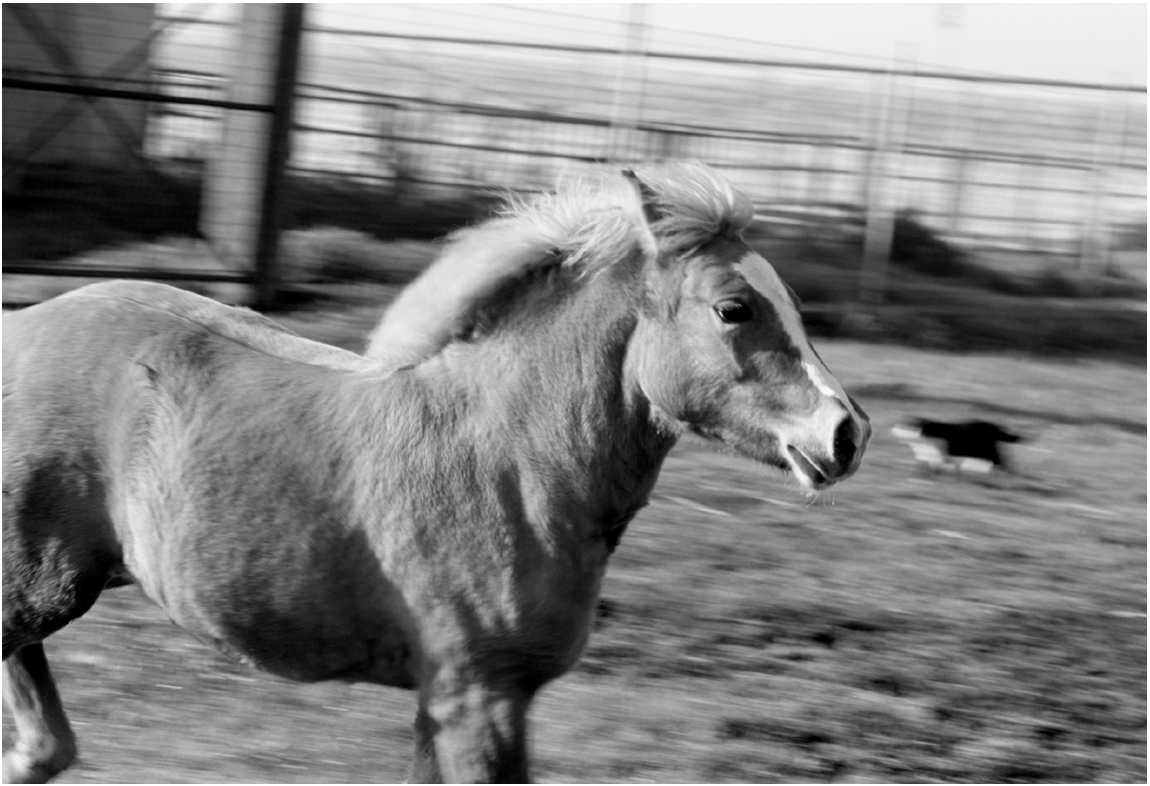
The photograph shows Prometea, the first cloned horse.

Prometea was produced by cloning, using the nucleus of a skin cell from a horse called Stella Cometa.

(a) Complete the passage about cloning by writing a suitable word or words in each blank space.

A ______ nucleus was taken from a skin cell from Stella Cometa.

This nucleus was inserted into an enucleated ______ that had been taken from a donor horse. An ______ was used to start the type of cell division called ______, eventually producing an embryo. The embryo was then placed into the ______ of the mother.

(b) Until recently, most cloning has been attempted with farm animals.

The table shows some information about the success rates of cloning different farm animals during a four-year period.

AnimalNumber in four-year period
 embryos madelive birthssurviving at least two years
cattle75007555
sheep35005015
goat500255

Some people now want to use cloning to replace their pets. The cost of cloning a pet cat can be as much as 50 000 United States dollars.

Comment on the use of cloning to replace pets.

Use the information in the table and your own knowledge about variation to support your answer.

Most-appropriate topic codes (Edexcel IGCSE Biology):

5(d): Cloning — part (a)
5(d): Cloning — part (b)
3(b): Inheritance — part (b) – variation aspects
▶️ Answer/Explanation
Solution

(a)

A diploid nucleus was taken from a skin cell from Stella Cometa.

This nucleus was inserted into an enucleated egg (cell) / ovum that had been taken from a donor horse. An (electric) shock / shock was used to start the type of cell division called mitosis, eventually producing an embryo. The embryo was then placed into the uterus / womb of the mother.

(b)

An answer that makes reference to five of the following points:

  1. most embryos made with cattle / fewest embryos made with goats / eq (1)
  2. low success rate / few live births / few survive / pets usually live longer than two years / low life expectancy / eq (1)
  3. cattle have highest survival rate (from live births) / goats have lowest survival rates (from live births) / eq (1)
  4. goats have highest live birth rate / cattle have lowest live birth rate (1)
  5. credit manipulated data (1)
  6. cloning is expensive / not cost effective / more cost than buying a new pet / eq (1)
  7. cloned pets are genetically identical / little genetic variation / could pass on harmful alleles / eq (1)
  8. some variation is environmental / not all variation is genetic / some features of pets will not be same / eq (1)
  9. no data for pets / pets may be different to farm animals / needs to be repeated for pets / eq (1)
  10. raises ethical issues / may not be ethical / eq (1)
  11. pet cloning could provide emotional benefits for people / eq (1)
Question

Read the passage below. Use the information in the passage and your own knowledge to answer the questions that follow.

Rivers – the arteries of the world

Rivers are important supplies of water for drinking, farming, industry, and leisure activities. Like our circulatory system, rivers are essential for transport, and have a homeostatic effect on nature. The biodiversity in rivers is high as they are the habitat for many different species. In many countries rivers are under threat from human impact, particularly the release of untreated sewage.

Flooding can cause untreated sewage to run into rivers from pipelines. Scientists estimated that in England and Wales during 2022, sewage was released into rivers for a total time of 300 000 hours. This sewage came from 1200 different pipelines. Untreated sewage may contain fertilisers, pesticides, pathogenic bacteria, and pharmaceutical drugs.

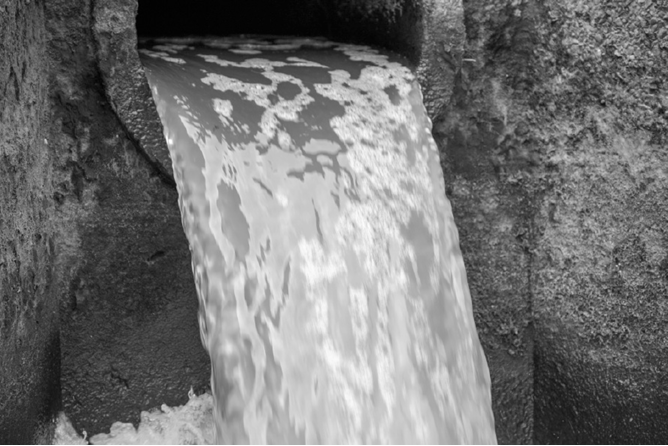
The photograph shows sewage being released into a river. The sewage causes the growth of something called ‘sewage fungus’. Sewage fungus looks like fungus but is a solid collection of several types of anaerobic bacteria. Sewage fungus is common in rivers that are polluted with untreated sewage or are near to cattle and intensive crop farms. If sewage fungus is found in a river it often indicates that the biodiversity of the river will be low.

Pesticides from agriculture are also released into rivers, and these are frequently transferred through natural food chains. Even pharmaceutical drugs, such as those containing the hormones oestrogen and progesterone, have been found in polluted rivers. These drugs must have been consumed by humans, excreted and then released into the sewage flowing into rivers.

Untreated sewage can also contain pathogenic species of bacteria that then enter rivers. If humans are infected with these bacteria, the large intestine absorbs less water, causing diarrhoea. Some of the bacteria found in sewage are resistant to antibiotics.

Scientists are looking for ways to prevent river pollution. One way is to reduce the risk of pollution from fertilisers and from cattle urine and faeces. Woodchip bioreactors are being trialled in agricultural fields that are near to rivers. These bioreactors are pits filled with woodchips and denitrifying bacteria. Water drains through these bioreactors, which helps to remove nitrates before they reach the rivers. In some countries, efforts are being made to replant forests in areas upstream of rivers to reduce river flooding and the risk of untreated sewage release.

(a) Rivers have a homeostatic effect on nature. This is similar to the role of homeostasis in humans.
State what is meant by the term homeostasis (lines 2 and 3).

(b) Calculate the mean number of hours that each pipeline released sewage into rivers in 2022 (lines 7 and 8).

(c)(i) Sewage fungus is not a fungus but is made from several different species of bacteria.
Which of these structures are present both in fungi and in bacteria?

A) cell wall and cytoplasm only
B) cell wall and nucleus only
C) cell wall, cytoplasm and nucleus
D) cytoplasm and nucleus only

(ii) Explain why rivers near to farms may have low biodiversity (lines 13 to 16).

(d) Oestrogen and progesterone in polluted water lower the levels of FSH and LH in mammals.

(i)State why lower levels of FSH can reduce fertility in mammals.
(ii) State why lower levels of LH can reduce fertility in mammals.

(e)(i) Pathogenic bacteria produce poisons that prevent the active transport of salt into the blood vessels surrounding the intestines.
Explain why preventing the transport of salt into the blood vessels will cause more water to be present in faeces (lines 22 to 24).

(ii) Explain why overuse of antibiotics has led to an increase in antibiotic-resistant bacteria (lines 24 and 25).

(f)(i) Explain how woodchip bioreactors reduce pollution in rivers (lines 27 to 31).
(ii) Explain why replanting forests in areas upstream of rivers will reduce flooding (lines 31 to 33).

Most-appropriate topic codes (Edexcel IGCSE Biology):

2(j): Co-ordination and response — part (a)
4(d): Human influences on the environment — parts (c)(ii), (e)(ii), (f)(i), (f)(ii)
1(b): Variety of living organisms — part (c)(i)
3(a): Reproduction — parts (d)(i), (d)(ii)
2(d): Movement of substances into and out of cells — part (e)(i)
3(b): Inheritance — part (e)(ii)
▶️ Answer/Explanation
Solution

(a) An answer that makes reference to one of the following points:
• maintenance of constant (internal) conditions in body / eq (1)
• control / regulating / maintaining internal conditions / eq (1)
• control / regulating / maintaining internal environment / eq (1)
• keeping conditions in body the same / within a (narrow) range / eq (1)

(b) • 250 (1)
Calculation: \( \frac{300000}{1200} = 250 \)

(c)(i) A (cell wall and cytoplasm only)
B is not the answer as bacteria do not have nuclei
C is not the answer as bacteria do not have nuclei
D is not the answer as bacteria do not have nuclei

(c)(ii) An explanation that makes reference to the following points:
1. fertilisers / animal waste / minerals / nitrates / phosphates (run off / leach) / eq (1)
2. algal growth / eutrophication / eq (1)
3. less light (penetrates) / competition for light / less photosynthesis / eq (1)
4. decomposition / decay (of dead algae / plants / organisms / organic waste / manure / faeces / sewage) eq (1)
5. less oxygen / only anaerobic species grow / eq (1)
6. bacteria respire / other species cannot respire / reduced respiration / eq (1)
7. pesticides kill organisms / eq (1)

(d)(i) An answer that makes reference to one of the following points:
• eggs / ova / follicles, do not mature / do not grow / eq (1)
• (FSH is required to) mature eggs / ova / follicles (1)
• (low FSH leads to) less oestrogen / (FSH) stimulates oestrogen release (1)

(d)(ii) An answer that makes reference to one of the following points:
• no ovulation occurs / egg not released / ova not released / eq (1)
• LH / it stimulates ovulation / LH / it stimulates egg release / eq (1)
• (lower LH leads to) less progesterone / LH / it stimulates progesterone (1)

(e)(i) An explanation that makes reference to two of the following points:
• less water absorbed / less water enters blood / less water enters capillaries / eq (1)
• (water moves by) osmosis (1)
• water potential in blood is high(er) / water potential in gut / faeces / lumen is low(er) / eq (1)

(e)(ii) An explanation that makes reference to three of the following points:
1. mutation (1)
2. (only resistant bacteria) survive / are not killed / non-resistant bacteria die / eq (1)
3. bacteria reproduce / multiply / eq (1)
4. pass on allele / gene / mutation / eq (1)

(f)(i) An explanation that makes reference to two of the following points:
• (denitrifying bacteria convert) nitrate into nitrogen (1)
• so less eutrophication / less algal growth / more oxygen in river / lower BOD / eq (1)
• wood chips have large surface area (for bacteria) / wood chips are biodegradable (so do not pollute) / eq (1)

(f)(ii) An explanation that makes reference to two of the following points:
1. trees / roots absorb water / trees intercept water / eq (1)
2. (more) transpiration (1)
3. less runoff / slows down water flow / more soil permeability / more infiltration / eq (1)
4. less soil erosion / roots hold onto soil / roots stabilise soil / eq (1)
5. rivers do not get blocked (with soil) / eq (1)
Question

Read the passage below. Use the information in the passage and your own knowledge to answer the questions that follow.

Pollination in fruit trees

Plants need to be pollinated to produce fruits and seeds. Some plants are self-pollinated and others are cross-pollinated.

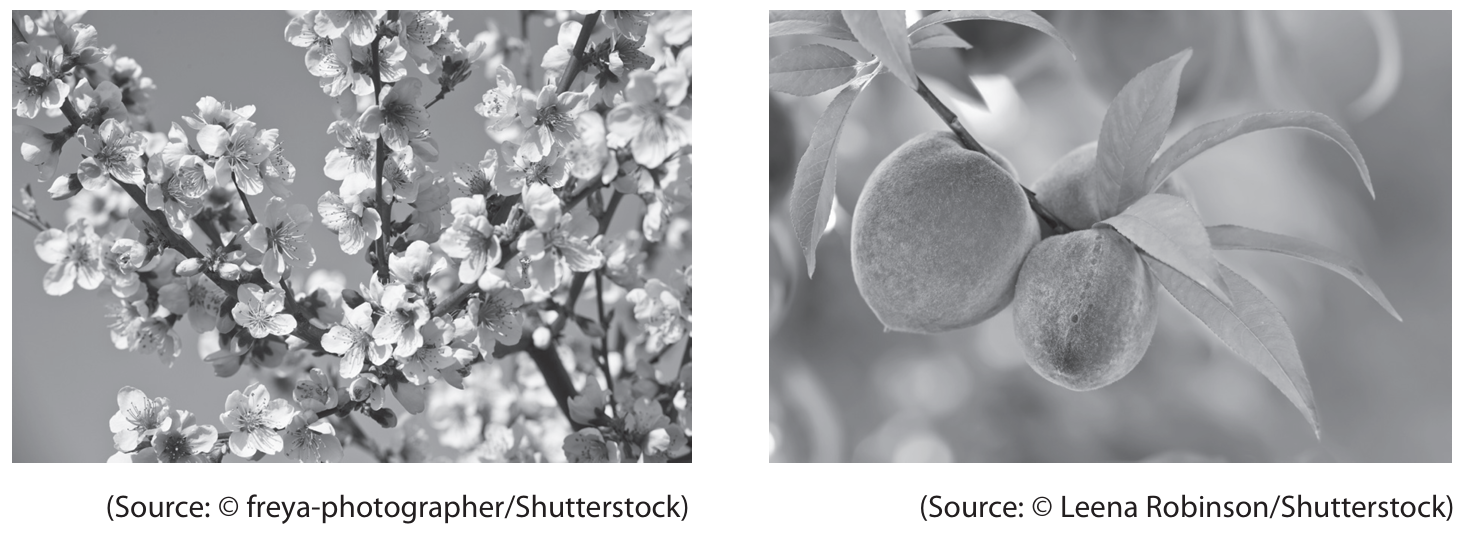
Self-pollination is usually the transfer of pollen from flowers on the same tree. In fruit trees, self-pollination also includes the transfer of pollen from another tree of the same cultivar. A cultivar is a genetically identical group of trees produced by selective breeding. Self-pollinating plants need bees or other insects to transfer pollen. Examples of self-pollinated fruit trees are plum, apricot and peach that have sweet-tasting, soft fruits.

Other fruit trees require cross-pollination and can only produce fruit by fertilisation from a different cultivar. Cross-pollination is the transfer of pollen from one cultivar to the flower of a different cultivar. Self-incompatibility prevents the same plant or cultivar from fertilising its own flowers. For example, the pollen from one cultivar of an apple tree will not fertilise trees of the same cultivar. Most hard fruit trees such as pear and apple require the presence of two different compatible cultivars for pollination to result in fruit production.

Pollen can be transferred by wind, insects or birds. Many fruit trees are pollinated by insects. Nut trees are usually pollinated by wind.

After pollination the pollen grain must germinate to lead to fertilisation. The success of pollination and fertilisation depends on favourable environmental conditions. It also requires the right pollen grain reaching the right flower, as pollen can only fertilise specific, compatible flowers. For example, pollen from a peach flower will not pollinate apple flowers.

Cross-pollinating fruit trees should be planted no more than 60 m apart. This will ensure that bees visit the trees often enough to ensure pollination. Nut trees need to be planted no more than 15 m apart.

A further complication is that a few apple and pear cultivars, known as triploids, produce sterile pollen. Triploid cultivars have three sets of chromosomes within their cells. A triploid cultivar will require another cultivar for pollination, and the trees must flower at the same time.

(a) Explain the differences between self-pollination and cross-pollination. (lines 3 to 5 and 9 to 11)

(b) Describe the sequence of events from pollen landing on a flower to fruit production.

(c) Fruit trees often produce sweet-tasting fruit containing sugars.

(i) Sugars are carbohydrates. Name the three elements in carbohydrates.
(ii) Suggest how production of sweet-tasting fruit may help spread the seeds of fruit trees. (lines 7 to 8)

(d) Explain how self-incompatibility prevents self-fertilisation. (lines 11 to 13)

(e) Describe how the structure of insect-pollinated flowers helps to achieve pollination. (line 16)

(f) Give a reason why nut trees need to be planted closer together than fruit trees. (lines 23 to 25)

(g) Explain why triploid cultivars produce sterile pollen. (lines 26 to 29)

Most-appropriate topic codes (Edexcel IGCSE Biology):

3(a): Reproduction — parts (a), (b), (c)(ii), (d), (e), (f), (g)
2(c): Biological molecules — part (c)(i)
3(b): Inheritance — part (g)
▶️ Answer/Explanation
Solution

(a) An explanation that makes reference to two of the following:

  • self-pollination within same plant / flower / cultivar / tree / uses one parent / eq (1)
  • cross-pollination from different plant / flower / cultivar / tree / uses two parents / eq (1)

(b) A description that makes reference to four of the following:

  1. germinates / eq (1)
  2. pollen tube grows down style / goes down style / eq (1)
  3. enters ovule (via micropyle) / eq (1)
  4. male nucleus / gamete travels down pollen tube / eq (1)
  5. fuses with ovum / fuses with female gamete / fertilises ovum / fertilises female gamete / eq (1)
  6. ovule becomes seed / eq (1)
  7. ovary becomes fruit / eq (1)

(c)(i) carbon hydrogen oxygen / C H O (1)

(c)(ii) An answer that makes reference to two of the following:

  • fruit eaten by animals / insects / birds / eq (1)
  • egested / lost in faeces / eq (1)
  • seeds dispersed / taken to new areas / eq (1)

(d) An explanation that makes reference to two of the following:

  • pollen from same plant / flower / cultivar eq (1)
  • cannot germinate / no pollen tube growth / eq (1)
  • no fusion / fertilisation / eq (1)

(e) A description that makes reference to the following:

  • flowers are large / petals are large (so seen by insects) / eq (1)
  • flowers / petals are coloured (so seen by insects) / eq (1)
  • flowers are scented / have scented petals / eq (1)
  • have nectary / produce nectar / eq (1)
  • anthers within flower / stigma within flower so insect brushes pollen / transfers pollen to stigma / eq (1)

(f) An answer that includes:

  • wind pollinated / no insects to carry pollen long distance / eq (1)

(g) An explanation that makes reference to two of the following:

  • triploid cells cannot divide by meiosis / cannot be divided by two / equally / eq (1)
  • cannot produce haploid (gametes) / produce one set / n chromosomes / eq (1)
  • fertilisation / fusion not possible / eq (1)
Question

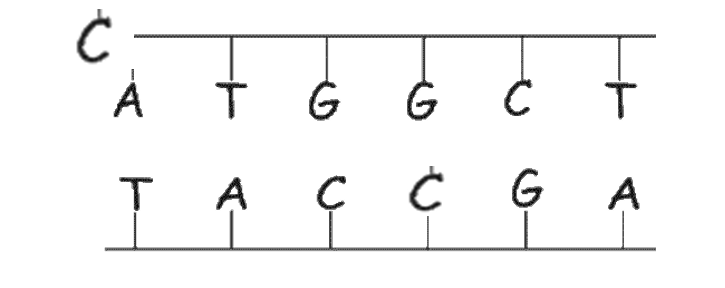
The sequence of bases on one strand of a section of DNA is:

TAC CGT AAT TAT

(a) (i) Which of these is the complementary sequence of DNA on the other strand of the double helix?

A) ATG GCA TTA ATA
B) AUG GCA UUA AUA
C) CGT TAC GGC CGC
D) CGU UAC GGC CGC

(ii) Which of these is the correct summary of the processes occurring during protein synthesis?

A) DNA transcription → RNA translation → protein
B) DNA translation → RNA transcription → protein
C) RNA transcription → DNA translation → protein
D) RNA translation → DNA transcription → protein

(b) The table shows different mRNA codons for some amino acids.

CodonsAmino acid
UUU, UUCW
AUGX
UGU, UGCY

(i) UUU-AUG-UGU is one combination of codons that codes for the sequence of amino acids W-X-Y.

Give the number of other combinations that code for the same amino acid sequence.

(ii) Explain why most genetic mutations have no effect on the phenotype of an organism.

Use the information in the table and your own knowledge in your answer.

(iii) State one factor that can increase the rate of mutation.

Most-appropriate topic codes (Edexcel IGCSE Biology):

3(b): Inheritance — DNA structure, protein synthesis, mutations — parts (a)(i), (a)(ii), (b)(ii), (b)(iii)
3(b): Inheritance — The genetic code — part (b)(i)
▶️ Answer/Explanation
Solution

(a)(i) A (ATG GCA TTA ATA)
B is incorrect because DNA does not contain Uracil (U).
C is incorrect because the base pairing is wrong (A pairs with T, C pairs with G).
D is incorrect because DNA does not contain Uracil (U) and the pairing is wrong.

(a)(ii) A (DNA → transcription → RNA → translation → protein)
B is incorrect because translation is in the wrong place.
C is incorrect because RNA is in the wrong place.
D is incorrect because RNA is in the wrong place.

(b)(i) • 3
Reasoning: The codon for amino acid W (UUU, UUC) offers 2 choices. The codon for amino acid X (AUG) offers 1 choice. The codon for amino acid Y (UGU, UGC) offers 2 choices. Total combinations: \(2 \times 1 \times 2 = 4\). One combination (UUU-AUG-UGU) is given, so other combinations = \(4 – 1 = 3\).

(b)(ii) An explanation that makes reference to three of the following points:
1. Some sequences / codons / different base triplets may code for the same amino acid (e.g., UUU and UUC both code for W) / the genetic code is degenerate. (1)
2. (Same amino acid so) no change in protein structure / no change in enzyme / protein has same function. (1)
3. Mutation may not affect bonding / (3D) shape / active site of enzyme. (1)
4. Mutation / allele may be recessive / not expressed. (1)
5. Mutation may occur in non-coding DNA / introns. (1)

(b)(iii) • (Ionising) radiation / UV light / tar (in tobacco) / mutagen / carcinogen / gamma rays / X-rays / radioactivity. (1)
Do not accept infra-red radiation.
Accept smoking or other correct mutagens.

Question

Cells use genetic information when carrying out protein synthesis.

(a) Give the difference between a gene and a genome.

(b) Describe the process of transcription. 

(c) Explain why a change in the sequence of bases in the DNA does not always result in a change in enzyme function. 

(d) Some characteristics are determined only by the genes, and some are determined by a combination of the genes and the environment. Give an example of each type of characteristic in humans. 

  • determined only by the genes
  • determined by the genes and the environment

Most-appropriate topic codes (Edexcel IGCSE Biology):

3(b): Inheritance — parts (a), (c), (d) [genes, DNA, variation, mutations]
3(b): Protein synthesis — part (b) [transcription]
2(c): Biological molecules (Enzymes) — part (c) [effect on enzyme function]
3(a): Reproduction and inheritance — implicit link to genetic determination of characteristics
▶️ Answer/Explanation
Solution

(a) A gene is a section of DNA that codes for a single polypeptide/protein, whereas a genome includes all of the DNA/all of the genes in an organism. (Requires both parts for the mark.)

(b) A description that makes reference to four of the following points (1 mark each):

  1. DNA unzips/unwinds.
  2. Involves mRNA (messenger RNA).
  3. mRNA copies the code/sequence of the DNA strand (DNA acts as a template).
  4. Process occurs in the nucleus / mRNA leaves the nucleus.
  5. mRNA goes to a ribosome.

(c) An explanation that makes reference to three of the following points (1 mark each):

  1. Some different base sequences/codons may code for the same amino acid (degeneracy of genetic code).
  2. No change in the protein/enzyme is produced.
  3. The mutation may not affect the bonding/3D shape/active site of the enzyme.
  4. The allele may be recessive and therefore not expressed.
  5. The change may be in non-coding DNA.

(d) An answer that makes reference to the following (1 mark each):

  • Determined only by genes: Blood group, eye colour, iris colour. (Examples of single-gene traits.)
  • Determined by genes and environment: Mass, height, skin colour, body shape, hair colour, behavioural traits.
Question

Rabies is a dangerous disease caused by a virus.

(a) The rabies virus is a pathogen.

Which other groups of microorganisms include pathogens?

  • A. bacteria and fungi only
  • B. bacteria, fungi, and protoctists
  • C. bacteria and protoctists only
  • D. fungi and protoctists only

(b) Rabies is transmitted to humans when they are bitten by an infected animal. Domestic dogs are dogs kept by people as pets or as working animals. Dogs and some wild animals are known to transfer rabies to humans.

In the 1940s, a rabies vaccine for animals was introduced in the United States and most domestic dogs were vaccinated.

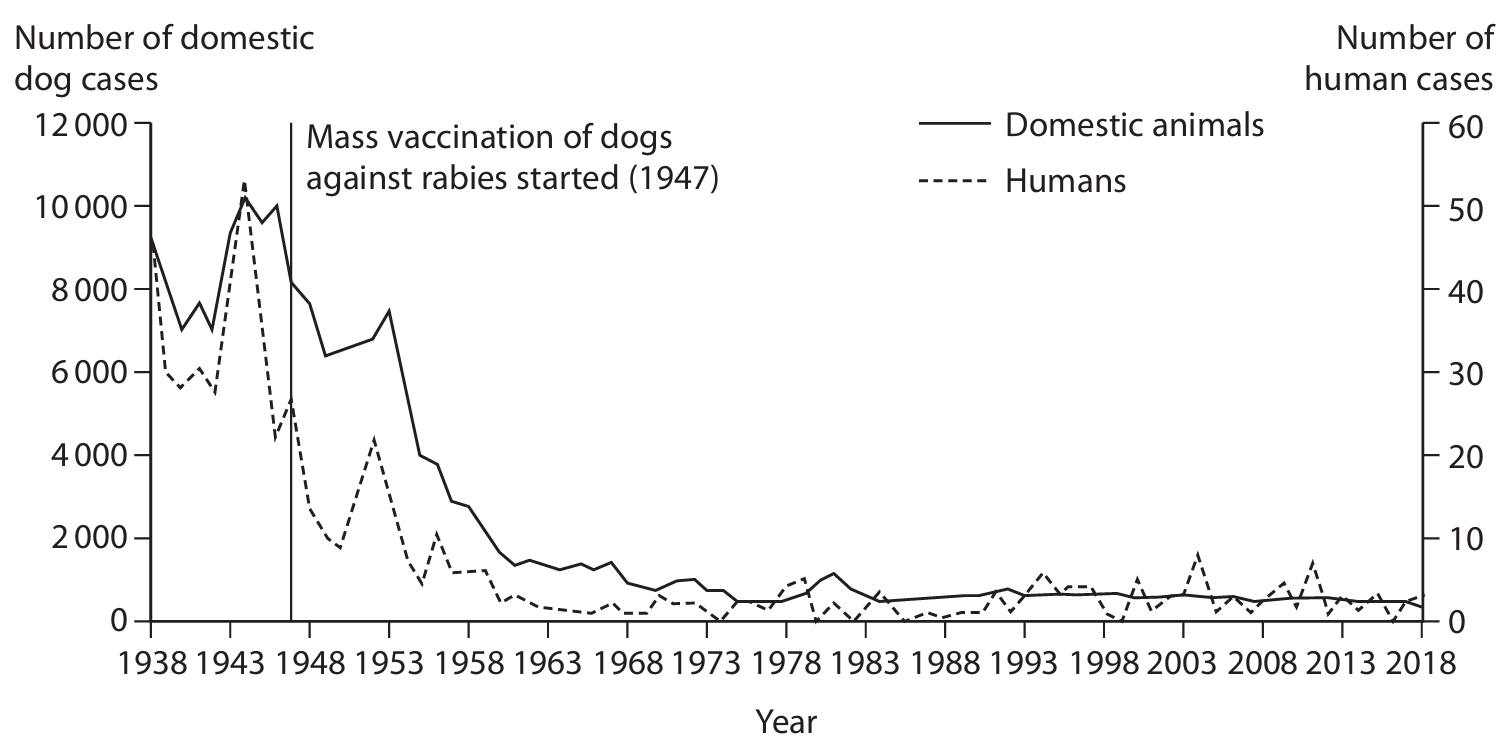
The graph shows the number of cases of human rabies and domestic dog rabies in the United States from 1938 to 2018.

Graph showing rabies cases in humans and dogs from 1938 to 2018

(i) The immune system of dogs works in a similar way to the immune system of humans.

Explain how the rabies vaccine prevents dogs from developing rabies.

(ii) Discuss the effects of the use of the rabies vaccine to immunise domestic dogs on the number of cases of rabies in humans.

Use information from the graph to support your answer.

(iii) A new RNA vaccine is being developed to treat rabies.

RNA that codes for parts of the rabies virus protein coat are injected into the body. Cells then take up the RNA and produce the viral proteins.

Describe how the cells use the RNA to produce the viral proteins.

Most-appropriate topic codes (Edexcel IGCSE Biology):

1(b): Variety of living organisms — part (a)
2(h): Transport — part (b)(i)
2(i): Excretion — part (b)(ii)
3(b): Inheritance — part (b)(iii)
▶️ Answer/Explanation
Solution

(a) B (bacteria, fungi, and protoctists)

Explanation: Pathogens are disease-causing microorganisms. While viruses like rabies are one type, other major groups also contain pathogenic species. Bacteria include pathogens like those causing tuberculosis and cholera. Fungi include pathogens responsible for athlete’s foot and ringworm. Protoctists (protists) include pathogenic organisms like Plasmodium which causes malaria and Entamoeba which causes dysentery. Therefore, all three groups – bacteria, fungi, and protoctists – include pathogens.

(b)(i)

Explanation: The rabies vaccine contains weakened or inactivated forms of the rabies virus or its antigens. When this vaccine is administered to dogs, it stimulates their immune system without causing the actual disease. The immune system recognizes these viral antigens as foreign invaders and produces specific antibodies against them. Specialized white blood cells called lymphocytes are activated during this process. Some of these lymphocytes develop into memory cells that remain in the body long-term. If the vaccinated dog is later exposed to the actual rabies virus, these memory cells recognize the pathogen immediately and trigger a rapid, strong immune response. This secondary response produces antibodies much faster and in greater quantities, effectively neutralizing the virus before it can establish an infection and cause disease.

(b)(ii)

Explanation: The graph shows a clear correlation between the vaccination of domestic dogs and the decline in human rabies cases. Before mass vaccination began in 1947, both dog and human rabies cases were relatively high. After vaccination programs were implemented, we observe a continuous and dramatic decline in rabies cases in both dogs and humans throughout the 1950s and beyond. This strong correlation suggests that most human rabies cases were originating from infected domestic dogs rather than wild animals. The data shows that as dog vaccination reduced the reservoir of infection in the canine population, human cases consequently decreased. However, the graph also indicates that human rabies cases didn’t disappear completely but plateaued at low levels, suggesting that some transmission still occurs from wild animals or unvaccinated dogs. This demonstrates that while vaccinating domestic dogs significantly reduces human rabies risk, it doesn’t completely eliminate it due to other potential sources of infection.

(b)(iii)

Explanation: When the RNA vaccine is injected, cells take up the RNA molecules that code for parts of the rabies virus protein coat. Inside the cell, these RNA molecules move to the ribosomes, which are the cellular structures responsible for protein synthesis. The process of translation then occurs, where the genetic code on the RNA is read and converted into a sequence of amino acids. Transfer RNA (tRNA) molecules with specific anticodons bind to complementary codons on the mRNA, each bringing with it a specific amino acid. As the ribosome moves along the mRNA strand, it facilitates the formation of peptide bonds between adjacent amino acids, creating a growing polypeptide chain. This chain folds into the three-dimensional structure of the viral protein. These viral proteins then act as antigens, stimulating the immune system to produce antibodies against rabies without exposure to the actual virus, thus providing protection against future infection.
Question

Hair colour in cattle is controlled by one gene with two alleles. The allele for white hair, CW, is codominant with the allele for red hair, CR.

Heterozygous cattle are a pale red colour called roan.

(a) State what is meant by the term gene.

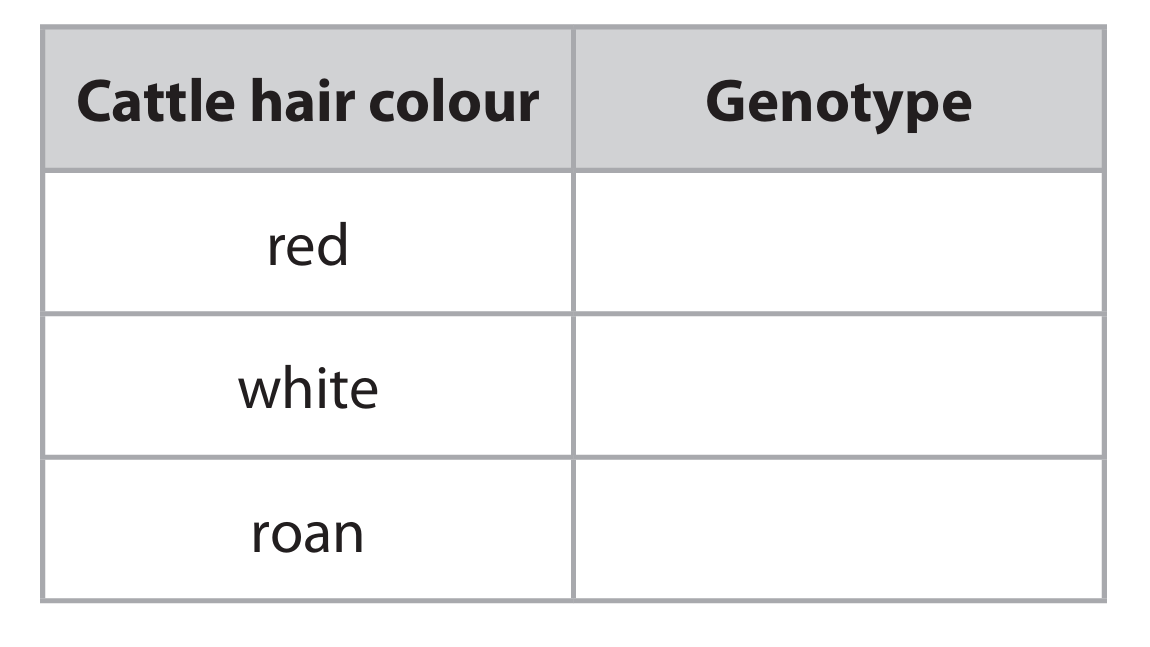
(b) (i) Complete the table by giving the genotypes of red cattle, white cattle, and roan cattle.

Table for cattle genotypes

(ii) Two roan-coloured cattle are mated.

Determine the probability that the calf produced is a male calf with roan-coloured hair.

Include a genetic diagram in your answer.

(c) (i) In a group of cattle, there are cattle with white-, red-, and roan-coloured hair. Height of cattle is also a genetically controlled characteristic. In the same group, there is a greater variation of heights compared with hair colour.

Explain why there is a greater variation in height of the cattle than there is in hair colour.

(ii) Describe how a farmer could use selective breeding to increase the height of cattle.

Most-appropriate topic codes (Edexcel IGCSE Biology):

3(b): Inheritance — parts (a), (b)(i), (b)(ii), (c)(i)
5(b): Selective breeding — part (c)(ii)
▶️ Answer/Explanation
Solution

(a) A gene is a section or length of DNA that codes for a protein, polypeptide, or chain of amino acids.

Explanation: Genes are the fundamental units of heredity. They are specific sequences of DNA nucleotides that carry the instructions for building proteins. These proteins determine various traits and characteristics in organisms, such as hair color in cattle.

(b)(i)

Cattle hair colourGenotype
redCRCR
whiteCWCW
roanCWCR or CRCW

Explanation: Since the alleles are codominant, heterozygous cattle (CWCR) express both colors, resulting in the roan phenotype. Homozygous CRCR results in red, and homozygous CWCW results in white.

(b)(ii) Probability = 0.25 / ¼ / 25%

Genetic Diagram:

Parental genotypes: CWCR × CWCR

Parental gametes: CW or CR (from each parent)

Offspring genotypes:

  • 1 CRCR : red
  • 2 CWCR : roan
  • 1 CWCW : white

Probability of a roan calf = 2/4 = ½

Probability of a male calf = ½

Therefore, probability of a male roan calf = ½ × ½ = ¼

Explanation: The genetic cross shows that there is a 50% chance of getting a roan calf. The sex of the calf is determined independently, with a 50% chance of being male. To find the combined probability of both events (roan AND male), we multiply the individual probabilities: ½ × ½ = ¼.

(c)(i) Height shows greater variation because it is a polygenic trait, controlled by multiple genes, whereas hair color is monogenic, controlled by a single gene. Additionally, environmental factors like nutrition can influence height but not hair color.

Explanation: Polygenic traits, such as height, involve many genes, each contributing a small effect. This results in a continuous range of phenotypes (e.g., various heights). In contrast, monogenic traits like hair color (controlled by one gene with two codominant alleles) have only three distinct phenotypes (red, white, roan). Furthermore, height can be affected by external factors like diet, while hair color is purely genetic.

(c)(ii) The farmer should select the tallest cattle and breed them together. From their offspring, select the tallest again and breed them. Repeat this process over several generations.

Explanation: Selective breeding works by consistently choosing individuals with the desired trait (height) and allowing them to reproduce. This increases the frequency of alleles associated with tallness in the population over time. By repeating this process, the farmer can gradually increase the average height of the cattle herd.
Question

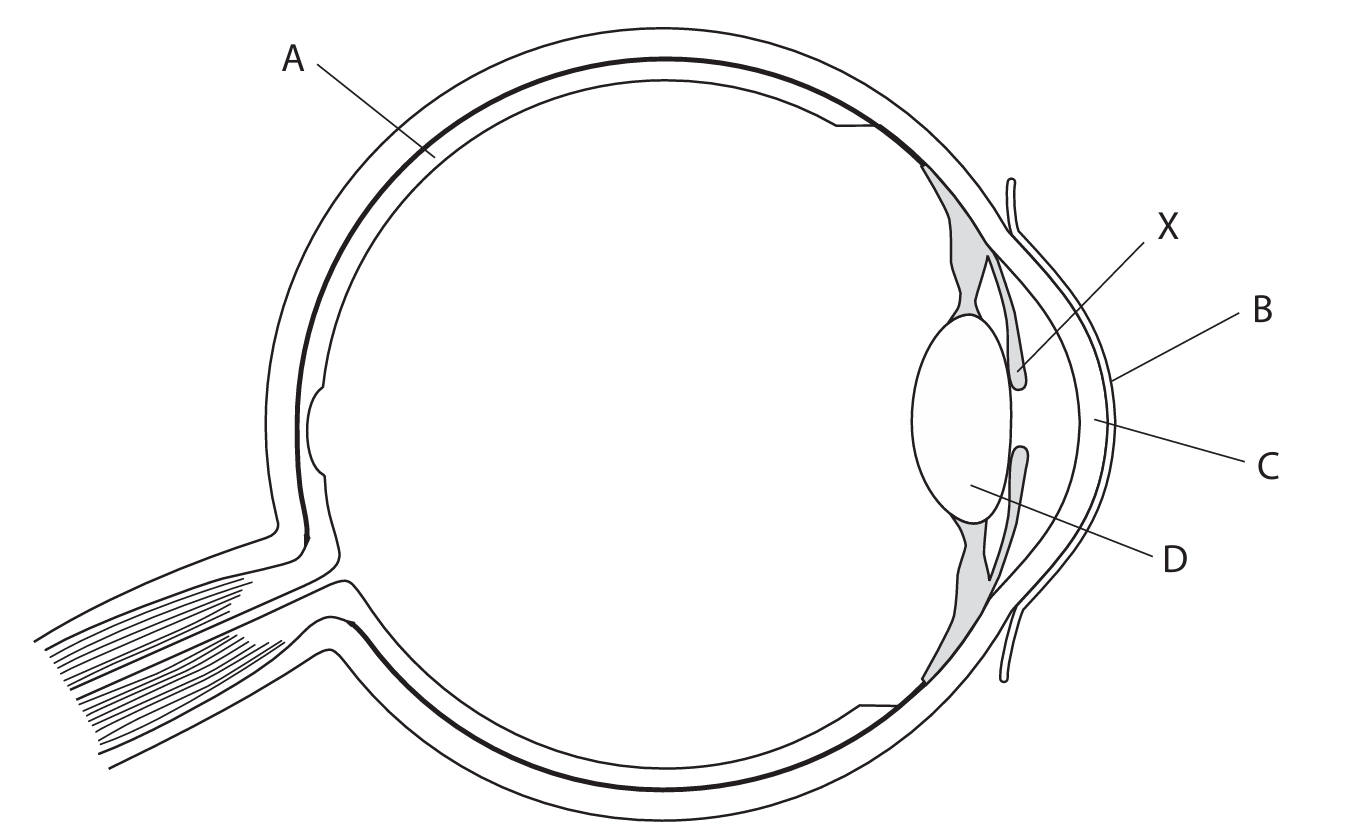
(a) The diagram shows a human eye.

(i) Which labelled structure is the cornea?

  • A
  • B
  • C
  • D

(ii) Explain the changes in structure X as a person moves from a room where the light is dim to a room where the light is bright.

(b) A student investigates if using one eye or using two eyes is better for judging the distance of objects.

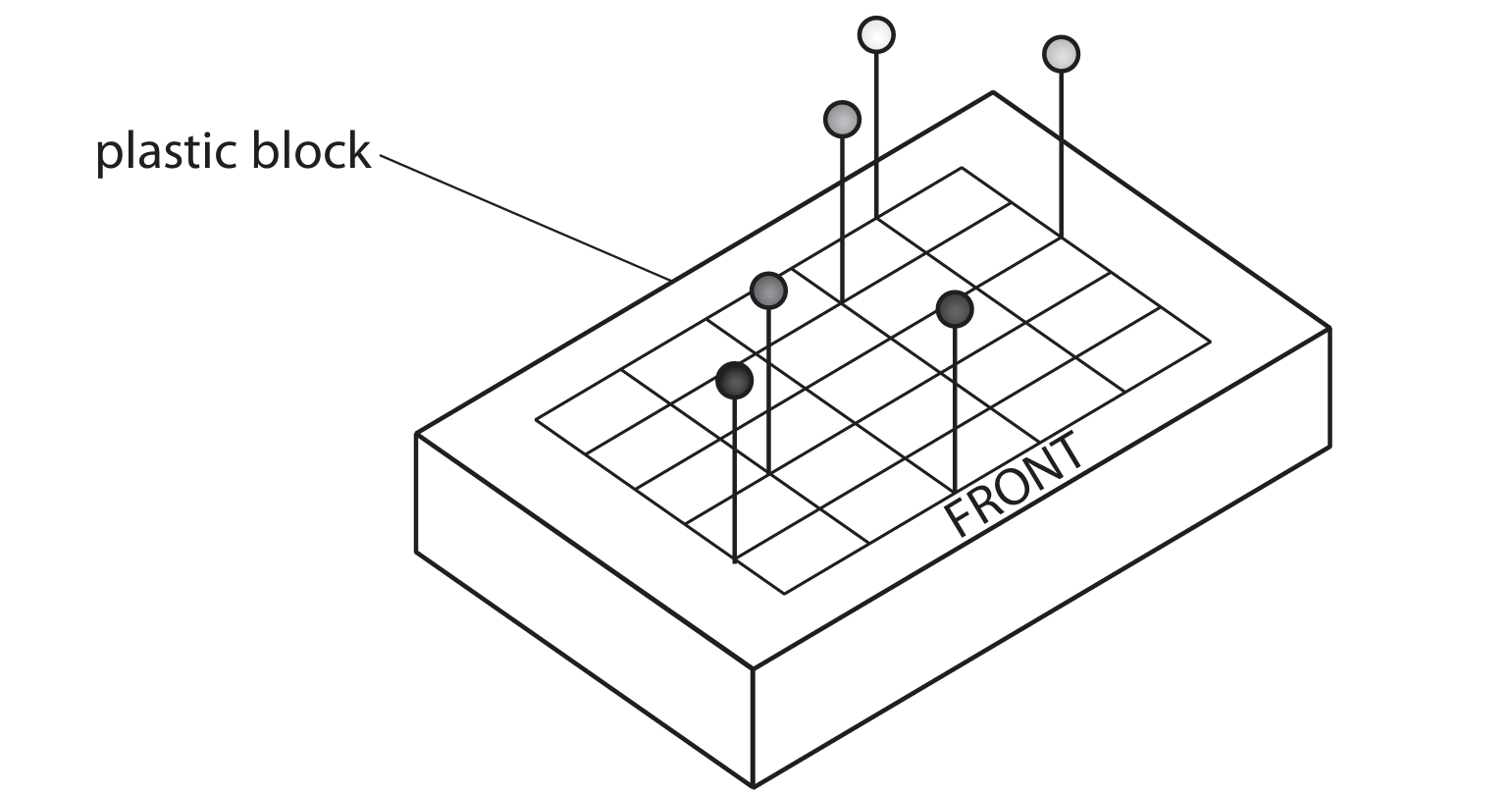
The student uses the plastic block shown in the diagram. The block has a grid where six different coloured pins can be placed as shown in the diagram.


This is the student’s method.

  • place one pin into the lines of each column and row so that each pin is a different distance from the front of the grid
  • ask a volunteer to close one eye
  • hold the grid in front of the volunteer so they can see the coloured pins but not the grid
  • ask the volunteer to call out the colour of the pins in order of distance, from nearest to furthest
  • record the number of pins that the volunteer identifies correctly
  • repeat eight more times, each time moving the pins to different positions in the grid

The student does the experiment again with both eyes open.

(i) Give the independent variable for the student’s investigation.

(ii) Give one variable that the student should control.

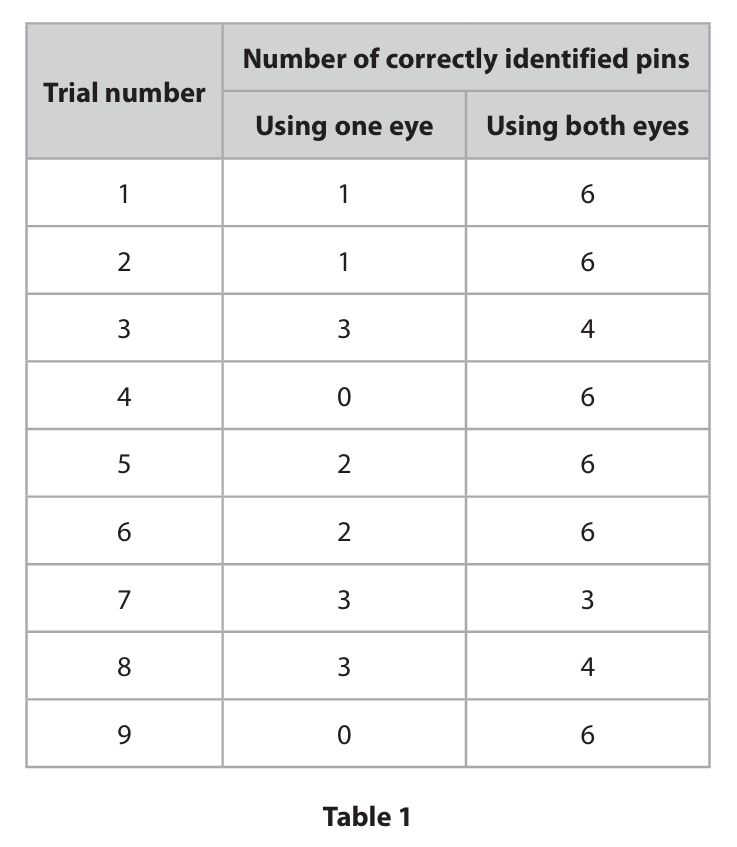
(iii) Table 1 shows the student’s results.
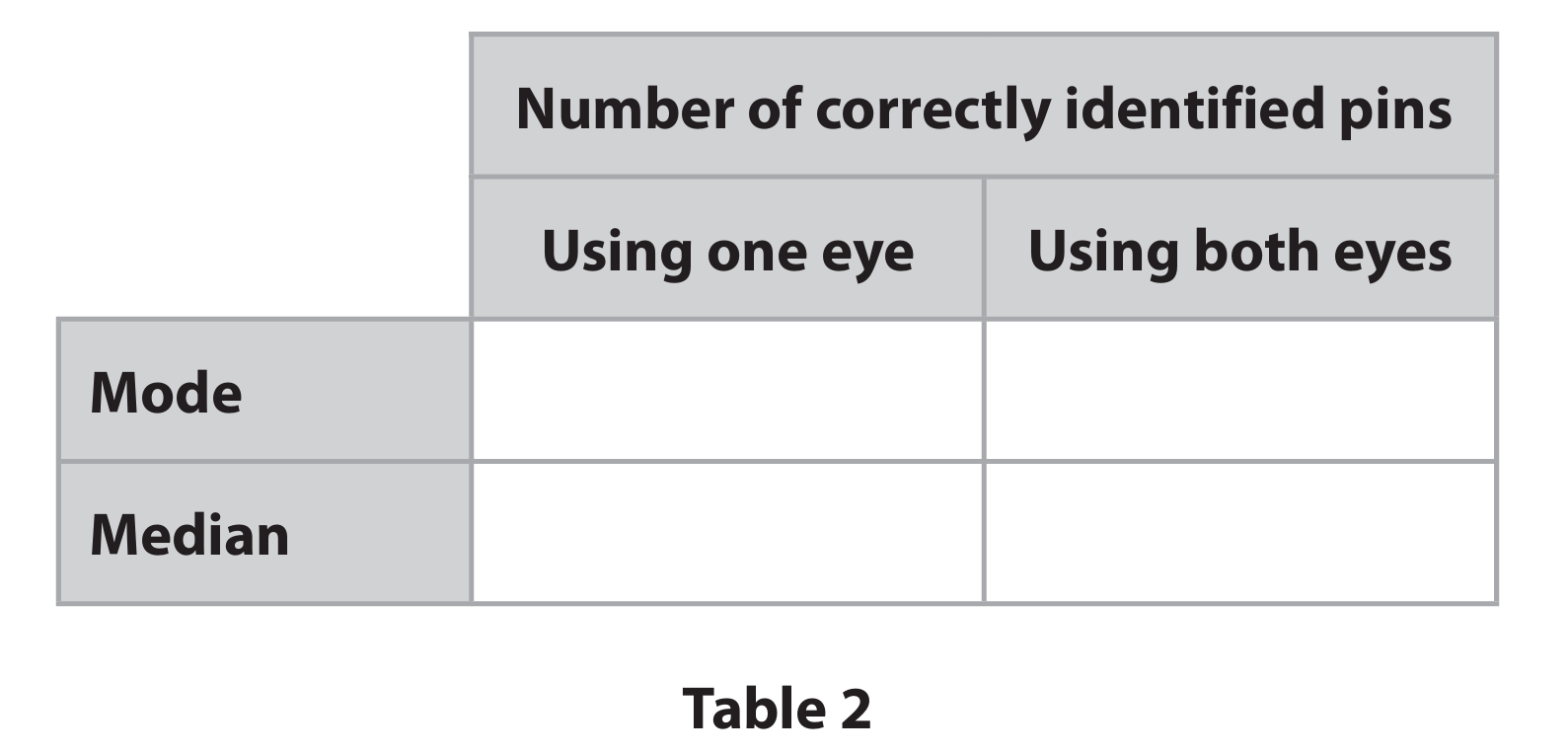
Complete Table 2 by determining the mode and the median for the data shown in Table 1.

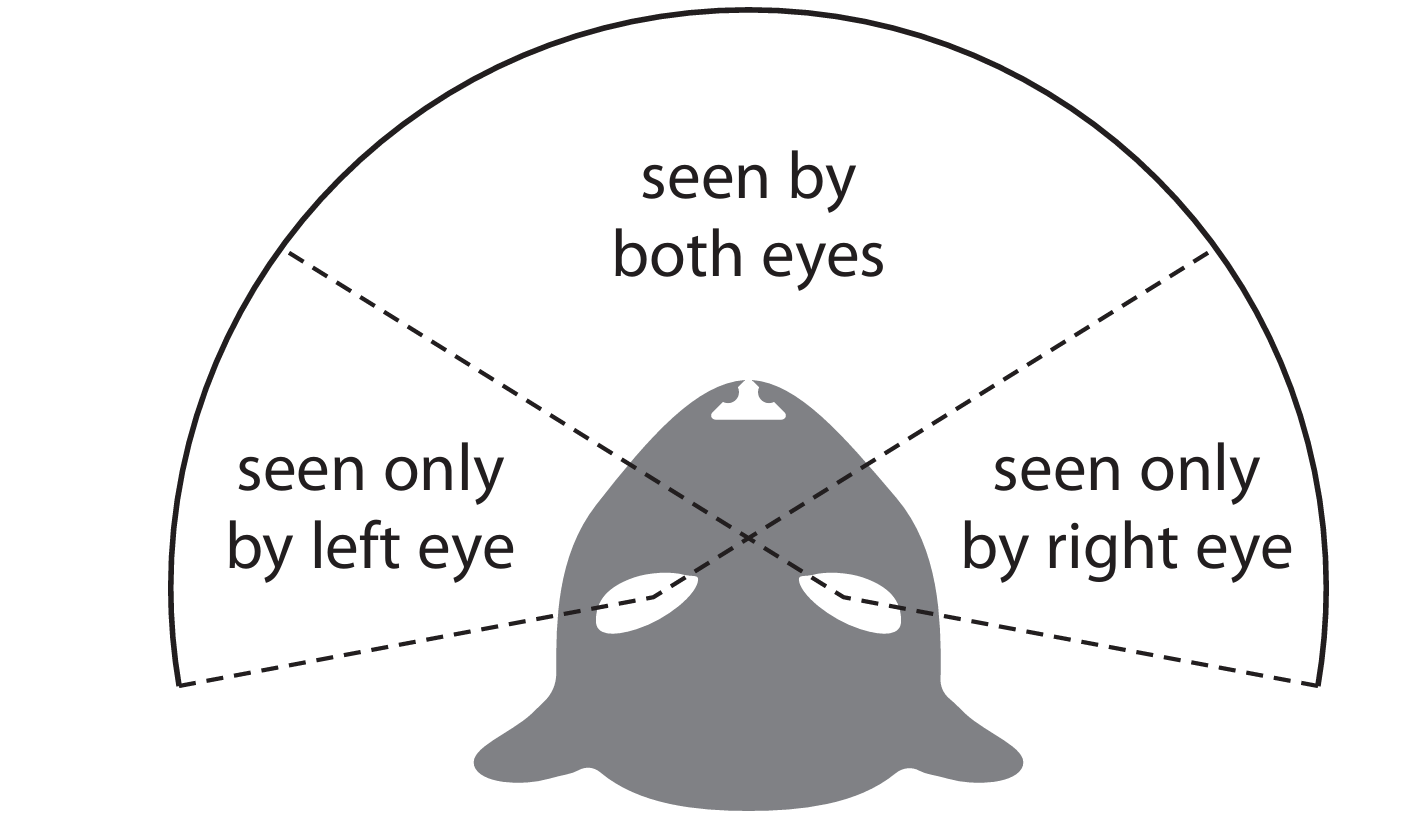
(iv) The field of view is the area that an animal can see with their eyes.
The diagram shows the field of view for a cat.


Explain why predators, such as cats, have two forward facing eyes.
Use the information in the diagram and Table 2 to support your answer.

Most-appropriate topic codes (Edexcel IGCSE Biology):

2(j): Co-ordination and response — parts (a)(i), (a)(ii), (b)(iv)
Experimental Skills: Investigation design & data handling — parts (b)(i), (b)(ii), (b)(iii)
3(b): Inheritance & Natural Selection — part (b)(iv)
▶️ Answer/Explanation
Solution

2 (a)(i) C

Explanation: The cornea is the transparent front part of the eye that covers the iris and pupil. In the diagram, label C points to this structure. Label A is the retina (incorrect), B is the conjunctiva (incorrect), and D is the lens (incorrect).

2 (a)(ii) An explanation that makes reference to two of the following:

  • Circular muscles contract (1)
  • Radial muscles relax (1)
  • (So) pupil narrows / gets smaller / constricts / iris widens (1)

Detailed Explanation: Structure X is the iris. In bright light, the circular muscles of the iris contract. Simultaneously, the radial muscles of the iris relax. This coordinated action causes the pupil (the hole in the center of the iris) to constrict or become smaller. This reduces the amount of light entering the eye, protecting the retina from potential damage caused by excessive light intensity.

2 (b)(i) Using one eye or both eyes / number of eyes used.

Explanation: The independent variable is the factor that the investigator deliberately changes. In this experiment, the student is comparing the results when the volunteer uses one eye versus when they use both eyes. Therefore, the number of eyes used (one or two) is the independent variable.

2 (b)(ii) Any one from: light intensity, distance from the block, size/shape/colour of pins, size/shape/angle of the block or grid.

Explanation: A controlled variable is a factor that must be kept constant to ensure a fair test. For this investigation, many variables could affect the volunteer’s ability to judge distance. For example, the light intensity must be the same in all trials, as poor lighting would make it harder to see the pins regardless of how many eyes are used. Similarly, the distance between the volunteer and the block must be kept constant.

2 (b)(iii)
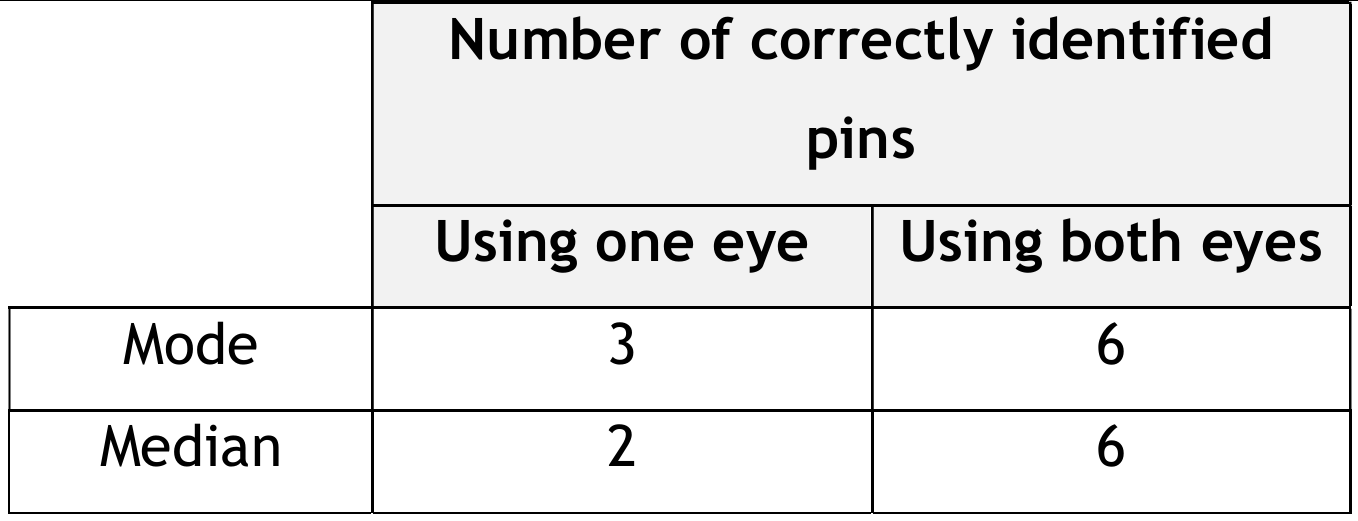
Explanation:
Mode is the value that appears most frequently.

  • One eye: The scores are: 0, 0, 1, 1, 2, 2, 3, 3, 3. The number 3 appears most often (three times), so the mode is 3.
  • Both eyes: The scores are: 3, 4, 4, 6, 6, 6, 6, 6, 6. The number 6 appears most often (six times), so the mode is 6.

Median is the middle value when all values are arranged in order.

  • One eye (ordered): 0, 0, 1, 1, 2, 2, 3, 3, 3. The fifth value (out of nine) is the median, which is 2.
  • Both eyes (ordered): 3, 4, 4, 6, 6, 6, 6, 6, 6. The fifth value is the median, which is 6.

2 (b)(iv) An explanation that makes reference to three of the following:

  • Better distance judgement (with two eyes) / better depth perception (1)
  • Large area seen by both eyes / large overlapping visual field (1)
  • To locate prey / catch prey (1)
  • Do not need wide field of view as not preyed upon (1)

Detailed Explanation: The results in Table 2 show a higher mode and median (both 6) when using both eyes compared to using one eye (mode=3, median=2). This means the volunteer was significantly better at correctly judging the distance of the pins with two eyes. This is due to binocular vision. The diagram shows that predators like cats have a large area of overlap (seen by both eyes) in front of them. This overlapping field of view allows the brain to compare the slightly different images from each eye (a process called stereopsis) to calculate precise depth and distance. This accurate depth perception is crucial for predators to successfully judge the distance to their prey before pouncing or chasing. They sacrifice a wide total field of view (which is more important for prey animals to spot predators) for this superior forward-facing depth perception, which is a key adaptive feature for a hunting lifestyle.
Question

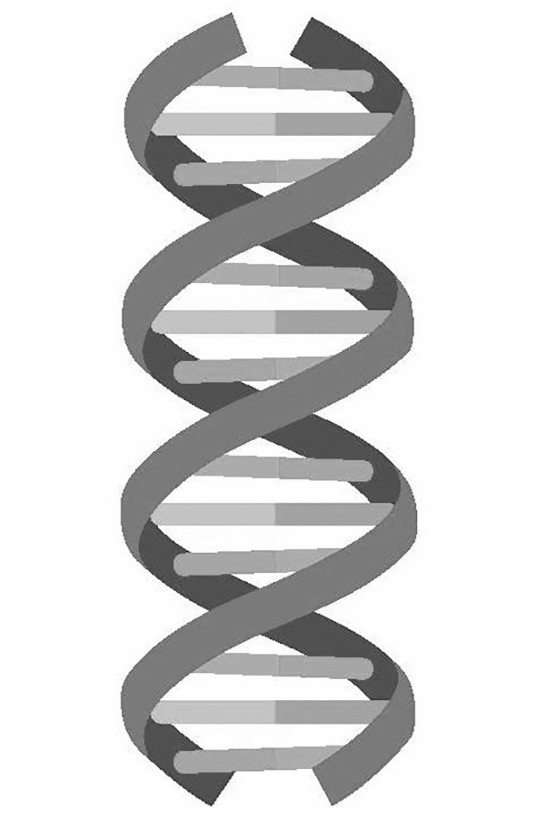
The diagram shows part of a molecule of DNA.

(a) State what is meant by the term genome.

(b) Describe the differences between the structure of DNA and the structure of RNA.

(c) Describe the roles of RNA in protein synthesis.

Most-appropriate topic codes (Edexcel IGCSE Biology):

3(b): Inheritance — parts (a), (b), (c)
3.14: Genome and genes — part (a)
3.16B & 3.17B: DNA and RNA structure — part (b)
3.18B: Protein synthesis (transcription and translation) — part (c)
▶️ Answer/Explanation
Solution

(a) The entire genetic material of an organism / all the genes / all the DNA in an organism.

Detailed Explanation:
The term genome refers to the complete set of genetic instructions found in a cell. In organisms like humans, this includes all the DNA contained in the chromosomes within the nucleus, as well as the DNA in mitochondria. It’s essentially the blueprint that contains all the information needed to build, maintain, and reproduce that organism. Knowing an organism’s genome allows scientists to understand the genes that code for proteins and those that regulate various biological processes.

(b) Key differences include:

  • DNA is double-stranded (forming a double helix), whereas RNA is generally single-stranded. (1)
  • The sugar in DNA is deoxyribose, while the sugar in RNA is ribose. (1)
  • DNA contains the nitrogenous base thymine (T), which pairs with adenine (A). RNA contains uracil (U) instead of thymine, so in RNA, uracil pairs with adenine. (1)
  • DNA is typically a much longer polymer and is stable, serving as long-term storage for genetic information. RNA molecules are generally shorter and more transient, acting as messengers or functional molecules. (1)

Detailed Explanation:
The structural differences between DNA and RNA are fundamental to their distinct roles in the cell. DNA’s famous double-helix structure, held together by hydrogen bonds between complementary bases (A-T and C-G), makes it very stable and ideal for protecting genetic information over the long term. The absence of an oxygen atom on the second carbon of its deoxyribose sugar (compared to ribose) also contributes to this stability. RNA, being single-stranded, is more flexible and can fold into complex three-dimensional shapes, which is crucial for its roles in protein synthesis (as mRNA, tRNA, and rRNA). The substitution of thymine with uracil in RNA is a key chemical difference, though uracil base-pairs with adenine just like thymine does.

(c) RNA plays several critical roles:

  1. Messenger RNA (mRNA): It is produced during transcription, where it copies the genetic code from a specific gene on the DNA strand. (1) This mRNA molecule then carries this code out of the nucleus and into the cytoplasm. (1)
  2. Ribosomal RNA (rRNA): It is a key structural and functional component of ribosomes, which are the cellular structures where protein synthesis (translation) occurs. The rRNA helps catalyze the formation of peptide bonds between amino acids. (1)
  3. Transfer RNA (tRNA): Its role is to bring specific amino acids to the ribosome during translation. Each tRNA molecule has an anticodon that recognizes and binds to a specific complementary codon on the mRNA strand. (1) This ensures that the amino acids are added to the growing polypeptide chain in the correct order as specified by the mRNA code. (1)

Detailed Explanation:
Protein synthesis is a two-stage process, and RNA is the central player in both. First, in the nucleus, the DNA sequence of a gene is transcribed into a mobile mRNA copy. This mRNA acts like a coded message or a recipe. It travels out into the cytoplasm and attaches to a ribosome (made of rRNA and proteins). The ribosome reads the mRNA code in three-letter chunks called codons. For each codon, a specific tRNA molecule, carrying its corresponding amino acid, docks onto the ribosome. The tRNA’s anticodon matches the mRNA codon. The ribosome then catalyzes the formation of a peptide bond between the incoming amino acid and the growing chain of amino acids (the polypeptide). This continues until a stop codon is reached, and a complete protein is released. Without the different forms of RNA acting as messenger, workbench, and adaptor, the information stored in DNA could not be converted into functional proteins.

Note: The mark scheme awards marks for the points indicated in the numbered list. The detailed explanation provides the broader context for these points.
Question

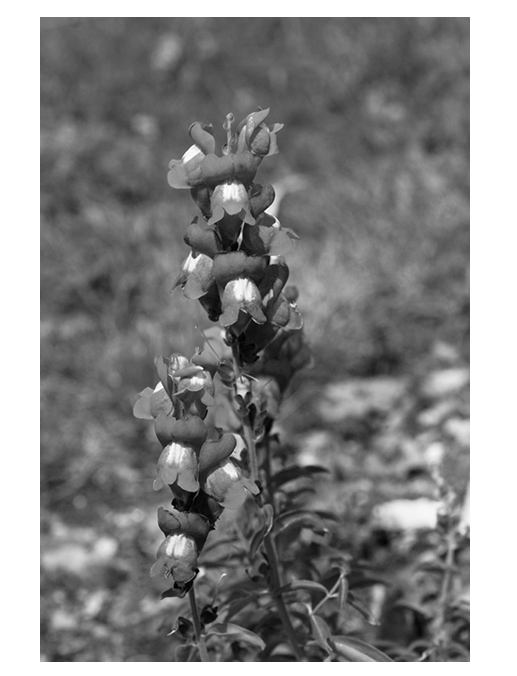
The photograph shows a plant called a snapdragon.

Selective breeding has been used to produce snapdragons with brightly coloured flowers.

(a) (i) Describe how selective breeding can produce snapdragon plants with brightly coloured flowers.

(ii) Micropropagation is often used to make copies of a snapdragon plant. Describe the process of micropropagation.

(b) Scientists investigate the effect of exposing snapdragon explants to increasing amounts of ionising radiation.

This is the scientists’ method:

  • take a snapdragon plant and use micropropagation to produce many explants
  • expose groups of explants to different amounts of ionising radiation
  • grow the explants into plants and record the number of differences in their phenotypes compared with the original plant
  • take samples of each of the plants and measure the number of differences in DNA nucleotides of each plant compared with the original plant

(i) Give the reason why micropropagation is used to produce the plants to be tested.

(ii) What term is given to all the DNA in an organism?

  • A. gene
  • B. genome
  • C. genotype
  • D. nucleoid

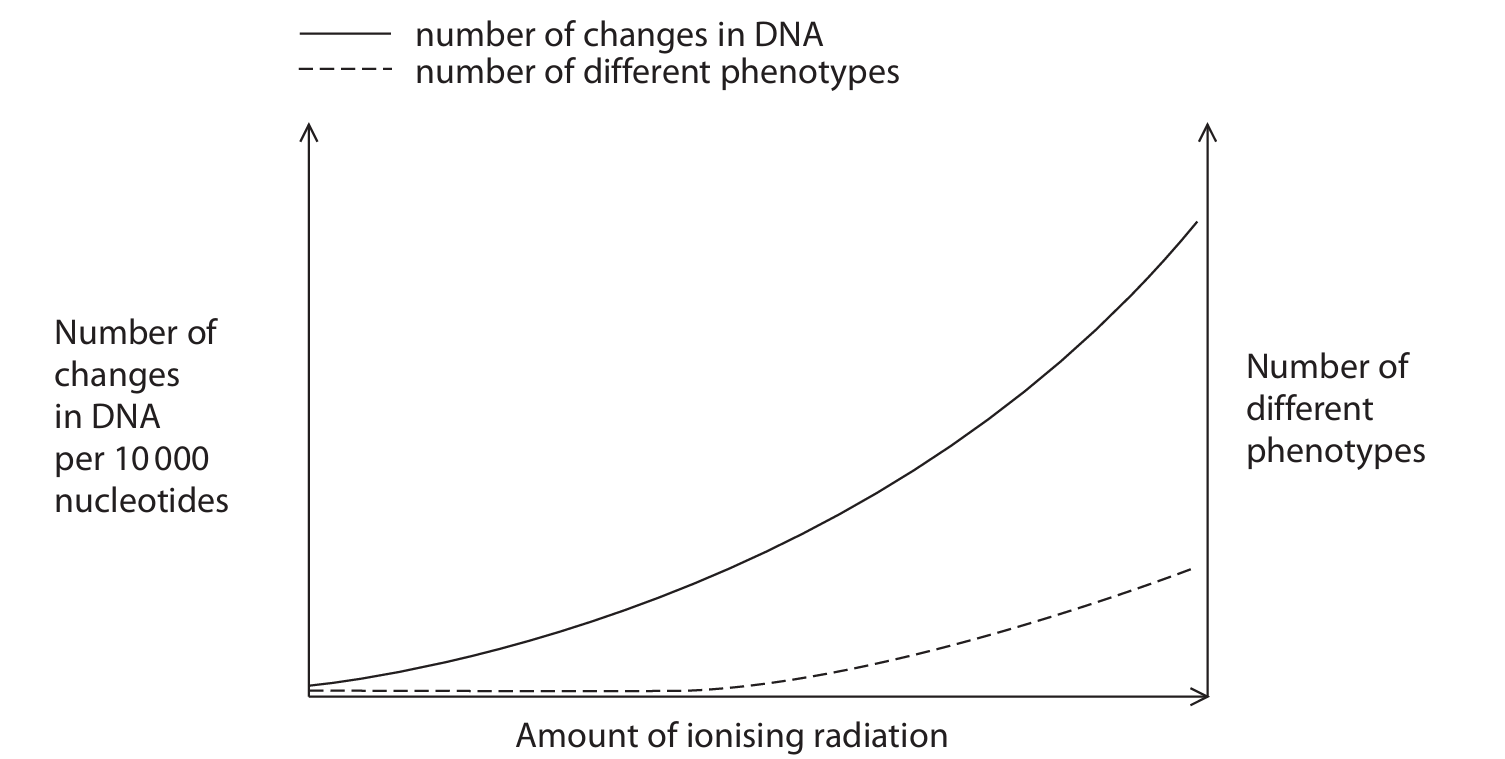
(iii) The graph shows the scientists’ results.

Discuss the effects that increasing the amount of ionising radiation has on the snapdragons.

Most-appropriate topic codes (Edexcel IGCSE Biology):

5(b): Selective breeding — part (a)(i)
5(d): Cloning — parts (a)(ii), (b)(i)
3(b): Inheritance — parts (b)(ii), (b)(iii)
3(b): Mutation — part (b)(iii)
▶️ Answer/Explanation
Solution

(a)(i) Selective breeding for brightly colored snapdragons involves first selecting parent plants that exhibit the desired bright flower coloration. These selected plants are then cross-pollinated to produce offspring. From these offspring, those that display the brightest flowers are selected again. This process of selection and breeding is repeated over several generations, gradually increasing the frequency of alleles responsible for bright flower coloration in the population, eventually producing a true-breeding variety with consistently bright flowers.

(a)(ii) Micropropagation is a tissue culture technique used to rapidly produce large numbers of genetically identical plants (clones). The process begins with taking small tissue samples (explants) from the parent plant, often from meristematic tissue. These explants are sterilized using ethanol or other disinfectants to remove any microorganisms. The sterile explants are then placed on a nutrient-rich agar medium containing essential minerals, sugars, amino acids, and plant growth regulators (such as auxins and cytokinins). Under controlled environmental conditions, the explants develop into small plantlets. These plantlets are eventually transferred to soil where they grow into mature plants genetically identical to the original parent plant.

(b)(i) Micropropagation is used to produce the plants for testing because it generates genetically identical clones. This ensures that any differences observed in phenotypes or DNA after radiation exposure are due to the radiation treatment itself rather than genetic variation between individual plants. Using clones controls for genetic variables, making the experiment more reliable and the results more valid.

(b)(ii) Answer: B (genome)
Explanation: The genome refers to the complete set of DNA in an organism, including all of its genes. A gene is a specific segment of DNA that codes for a particular protein or functional RNA. Genotype refers to the genetic makeup of an individual organism for specific traits. Nucleoid is the region in prokaryotic cells where DNA is located, but not the term for all DNA in an organism.

(b)(iii) Increasing ionising radiation has several effects on snapdragons. Firstly, it causes an increase in DNA mutations, as shown by the rising number of changes in DNA nucleotides. This occurs because radiation damages DNA by breaking strands or altering bases. Secondly, it increases phenotypic variation, as more different phenotypes appear with higher radiation doses. However, the relationship isn’t perfectly proportional – DNA changes increase more rapidly than phenotypic variations. This is because many mutations are silent (don’t change amino acid sequences), occur in non-coding regions, or are recessive and don’t affect the phenotype when heterozygous. Additionally, some mutations may be lethal and not represented in the phenotypic data. At very high radiation levels, the mutation rate may become detrimental to plant survival and reproduction.
Question

Read the passage below. Use the information in the passage and your own knowledge to answer the questions that follow.

When the Oceans Glow

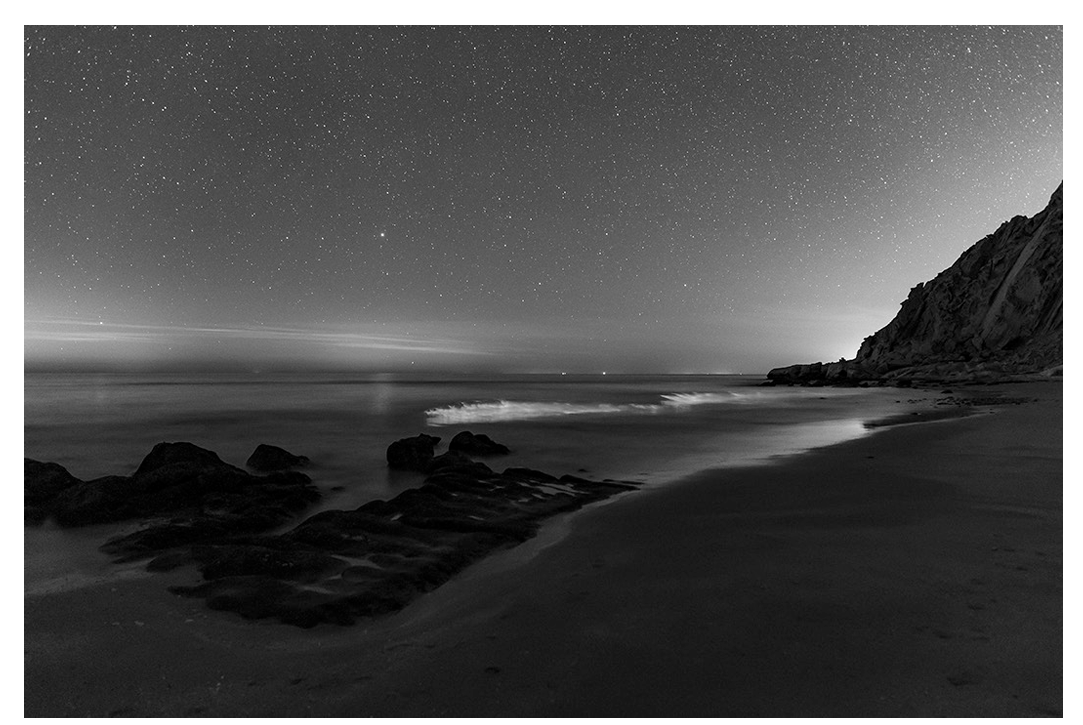
In some areas of the world the oceans around the coast sometimes glow with a blue light. The photograph shows an area of coast that is glowing. This blue light is produced by the presence of thousands of microscopic, living organisms called dinoflagellates. These dinoflagellates are protocysts. The production of light by living organisms is called bioluminescence, a process that has evolved many times in different species of organism.

To generate light, dinoflagellates use special proteins and the ATP produced within their cells. Many species of dinoflagellate contain chlorophyll and are able to photosynthesize. The appearance of glowing dinoflagellates in the sea used to be a rare event but this now occurs much more frequently. Many of the events occur in the sea around river estuaries and scientists think that intensive farming and deforestation could be to blame. Due to overpopulation of dinoflagellates in these areas, other species of animal are often harmed. After a series of glowing events, large numbers of dinoflagellates die causing oxygen levels in the water to decrease.

People have often wondered why dinoflagellates glow. They only glow in areas where the water moves around, such as when waves hit a beach. Scientists now think that the production of light is a type of warning to stop predators eating the dinoflagellates. If an animal eats dinoflagellates, the dinoflagellates in the area glow making the animal obvious to its own predators. To test this, scientists placed dinoflagellates into a tank along with 15 copepods, which are predators of dinoflagellates. When the dinoflagellates glowed, the copepods ate 1200 dinoflagellates in two hours. When the dinoflagellates did not glow, the copepods ate 2100 dinoflagellates in two hours.

Some scientists think that we could make use of the dinoflagellates to provide sustainable street lighting. Tanks of dinoflagellates could be placed on top of lamp posts. The dinoflagellates would photosynthesize during the day when it is light. A stirrer powered by a small battery would then move them at night so that they would glow. These sustainable lamps could be carbon neutral and help to reduce pollution.

(a) Which of these processes produces ATP? (line 6)

  • A. active transport
  • B. diffusion
  • C. respiration
  • D. transpiration

(b) (i) Explain why intensive farming and deforestation would cause an increase in populations of dinoflagellates. (lines 9 to 11)

(ii) Explain why oxygen levels decrease after a series of glowing events. (lines 10 to 13)

(c) Which type of bacteria converts ammonia into nitrates?

  • A. decomposer
  • B. denitrifying
  • C. nitrifying
  • D. nitrogen fixing

(d) (i) Each of the 15 copepods ate glowing dinoflagellates at a mean rate of 40 dinoflagellates per hour. Calculate the mean rate at which each copepod ate dinoflagellates that were not glowing. (lines 18 to 21)

(ii) Explain how natural selection could have resulted in the evolution of dinoflagellates that glow. (lines 15 to 18)

(e) Explain why using dinoflagellates for street lighting would help to reduce pollution. (lines 22 to 26)

Most-appropriate topic codes (Edexcel IGCSE Biology):

1(b): Variety of living organisms — identification of dinoflagellates as protocysts
2(f): Respiration — part (a) ATP production
2(e): Nutrition (Photosynthesis) — reference to chlorophyll and photosynthesis in dinoflagellates
4(d): Human influences on the environment — parts (b)(i), (e) pollution, eutrophication, deforestation
4(c): Cycles within ecosystems (Nitrogen cycle) — part (c) role of bacteria
3(b): Inheritance and evolution — part (d)(ii) natural selection
2(e): Nutrition (Diet and energy) — part (d)(i) calculation of feeding rate
5(a): Use of biological resources (Food production) — part (e) sustainable use of organisms
▶️ Answer/Explanation
Solution

(a) C (respiration)

Explanation: Respiration is the metabolic process that breaks down glucose to release energy, which is stored in ATP molecules. Active transport uses ATP but does not produce it. Diffusion is a passive process and does not require or produce ATP. Transpiration is the loss of water vapor from plants and is not directly involved in ATP production.

(b)(i)

Explanation: Intensive farming often involves the heavy use of fertilizers. Deforestation removes trees whose roots help bind the soil. The combination of these factors leads to soil erosion. When it rains, eroded soil and excess fertilizers (rich in minerals like nitrates and phosphates) are washed into rivers and eventually into estuaries and the sea. These minerals act as nutrients for dinoflagellates, allowing their populations to grow rapidly, a process known as eutrophication.

(b)(ii)

Explanation: After the glowing events, large numbers of dinoflagellates die. Their bodies are decomposed by bacteria and other microorganisms. These decomposers respire as they break down the organic matter, a process that consumes oxygen. The large algal bloom may also block light, reducing photosynthesis and oxygen production by other organisms. The high rate of oxygen consumption by decomposers leads to a decrease in dissolved oxygen levels.

(c) C (nitrifying)

Explanation: Nitrifying bacteria are specifically responsible for converting ammonia into nitrites and then into nitrates in the nitrogen cycle. Decomposer bacteria break down organic matter into ammonia. Denitrifying bacteria convert nitrates back into nitrogen gas. Nitrogen-fixing bacteria convert atmospheric nitrogen gas into ammonia.

(d)(i) 70 dinoflagellates per hour

Explanation: The total number of non-glowing dinoflagellates eaten in 2 hours was 2100. The total eaten per hour is \( 2100 \div 2 = 1050 \) dinoflagellates per hour. This is the rate for all 15 copepods. The mean rate per copepod is \( 1050 \div 15 = 70 \) dinoflagellates per hour per copepod.

(d)(ii)

Explanation: A random mutation gave some dinoflagellates the allele to glow. This created variation. When predators were present, dinoflagellates that glowed were less likely to be eaten (as the glow attracted the predators’ own predators). These dinoflagellates had a higher survival rate and were more likely to reproduce, passing the advantageous allele for glowing to their offspring. Over many generations, the frequency of the glowing allele increased in the population, leading to the evolution of this trait.

(e)

Explanation: It would reduce reliance on electricity generated from burning fossil fuels. The dinoflagellates photosynthesize during the day, taking in carbon dioxide (\(CO_2\)) from the atmosphere. At night, they produce light through bioluminescence without burning fuels. Therefore, this method produces no direct air pollutants and contributes less to the greenhouse effect, making it a more sustainable and carbon-neutral alternative.
Question

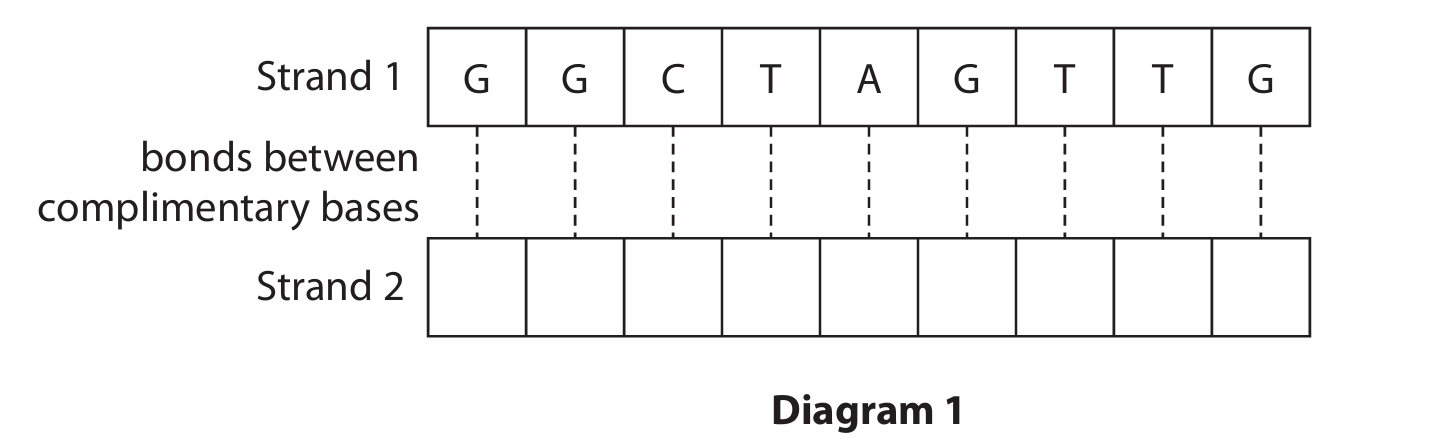
(a) Diagram 1 shows part of a DNA molecule.

(i) Complete Diagram 1 by writing the letters of the missing bases in the empty boxes for strand 2.

(ii) Give the maximum number of amino acids that are coded for by this DNA strand (strand 2).

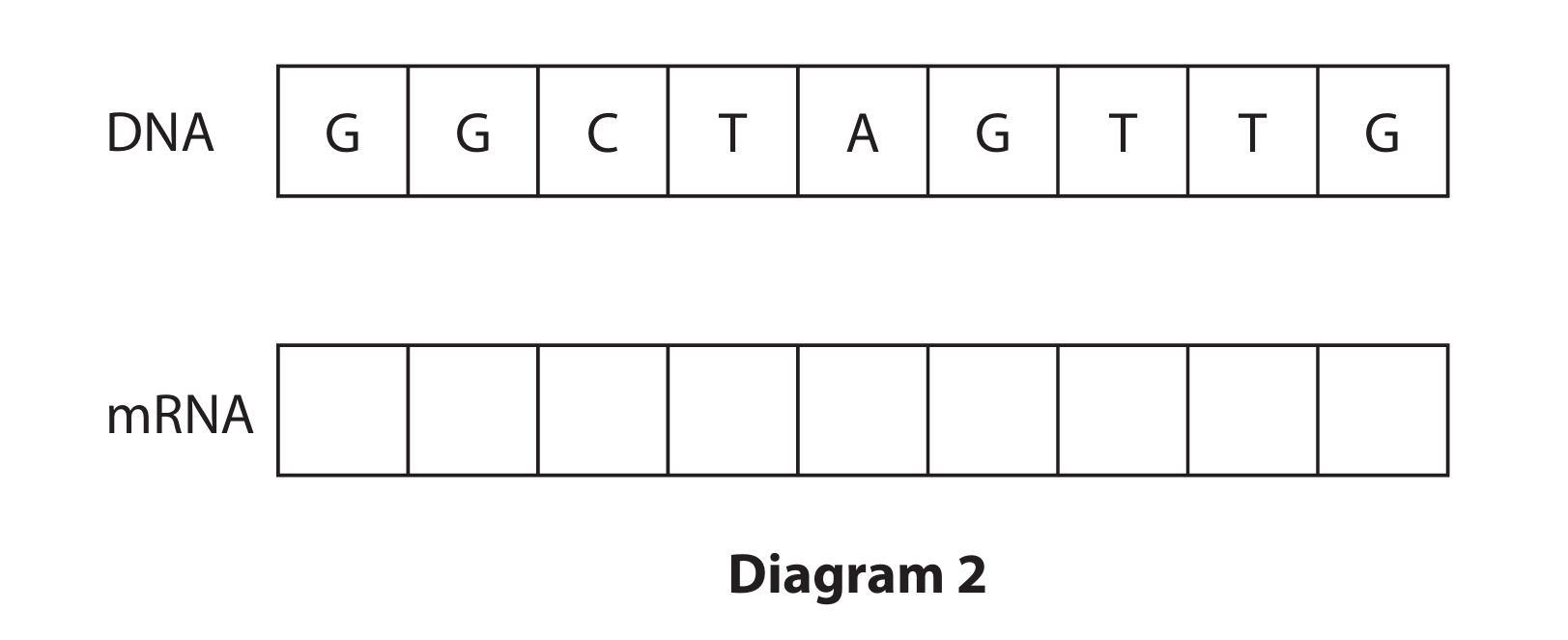
(iii) The original DNA strand is used to produce mRNA.
Complete the empty boxes in Diagram 2 to show the mRNA coded for by this DNA strand.

(b) A length of DNA consists of 25 000 base pairs.
This makes a total of 50 000 bases.
In this length of DNA, 30% of the bases are adenine (A).
Determine the number of thymine (T) bases, cytosine (C) bases, and guanine (G) bases in this length of DNA.

(c) Describe the differences between the process of transcription and the process of translation.

Most-appropriate topic codes (Edexcel IGCSE Biology):

3(b): Inheritance — parts (a)(i), (a)(ii), (a)(iii), (b), (c)
3.16B: DNA structure and base pairing — parts (a)(i), (b)
3.18B: Protein synthesis (transcription and translation) — parts (a)(iii), (c)
3.14–3.15: Genes and chromosomes — part (a)(ii)
▶️ Answer/Explanation
Solution

(a)(i)

Answer: C C G A T C A A C

Explanation: DNA bases pair specifically: Adenine (A) pairs with Thymine (T), and Cytosine (C) pairs with Guanine (G). To find the complementary strand (Strand 2), we pair each base in Strand 1 with its partner. So, G (Strand 1) pairs with C (Strand 2), the next G pairs with C, C pairs with G, T pairs with A, A pairs with T, G pairs with C, T pairs with A, T pairs with A, and G pairs with C. This gives the sequence C, C, G, A, T, C, A, A, C for Strand 2.

(a)(ii)

Answer: 3

Explanation: In DNA, a sequence of three bases (a triplet codon) codes for one amino acid. The DNA strand given has 9 bases. To find the maximum number of amino acids it could code for, we divide the number of bases by 3: \(9 \div 3 = 3\). Therefore, the maximum number of amino acids is 3.

(a)(iii)

Answer: C C G A U C A A C

Explanation: mRNA is transcribed from the DNA template strand. The base pairing rules for transcription are similar to DNA replication but with Uracil (U) replacing Thymine (T). So, the DNA base pairs with mRNA as follows: G (DNA) pairs with C (mRNA), G with C, C with G, T with A, A with U, G with C, T with A, T with A, and G with C. This results in the mRNA sequence: C, C, G, A, U, C, A, A, C.

(b)

Answer:
number of thymine bases (T) = 15000
number of cytosine bases (C) = 10000
number of guanine bases (G) = 10000

Explanation: According to Chargaff’s rules, in double-stranded DNA, the amount of Adenine (A) equals the amount of Thymine (T), and the amount of Cytosine (C) equals the amount of Guanine (G). We are told that 30% of the 50,000 bases are Adenine. So, number of A bases = \(30\% \times 50,000 = 15,000\). Therefore, the number of T bases must also be 15,000. This accounts for \(15,000 + 15,000 = 30,000\) bases (A and T). The remaining bases are \(50,000 – 30,000 = 20,000\), which must be made up of equal amounts of C and G. So, number of C bases = \(20,000 \div 2 = 10,000\) and number of G bases = \(20,000 \div 2 = 10,000\).

(c)

Answer & Explanation: Transcription and translation are the two main steps in protein synthesis, but they differ in several key aspects:

  • Location: Transcription occurs in the nucleus (in eukaryotic cells), where the DNA is located. Translation occurs in the cytoplasm, specifically on ribosomes.
  • Template Used: Transcription uses a DNA strand as its template to synthesize a complementary mRNA molecule. Translation uses the mRNA strand as its template to assemble a sequence of amino acids into a polypeptide chain.
  • Product Synthesized: The product of transcription is a messenger RNA (mRNA) molecule. The product of translation is a polypeptide chain (which folds into a protein).
  • Key Molecules Involved: Transcription primarily involves the enzyme RNA polymerase and nucleotide triphosphates (ATP, GTP, CTP, UTP). Translation involves transfer RNA (tRNA) molecules, ribosomes (composed of rRNA and proteins), and amino acids.
  • Process Description: Transcription is the process of copying genetic information from DNA to mRNA. Translation is the process of decoding the mRNA sequence to build a protein using tRNA molecules that carry specific amino acids.
Question

Mutation can cause changes in the enzymes produced during protein synthesis.

(a) State what is meant by the term mutation.

(b) Explain the different effects that a single base mutation can have on transcription and translation and the production and activity of an enzyme.

(c) Scientists investigate the rate of spontaneous mutations in yeast. They record the number of mutations per cell during mitosis and during meiosis. They count the mutations in three different strains of yeast and repeat each count. The mutation rates are counted per division per cell.

Yeast strainMutation rate \( \times 10^9 \) per division per cell
 mitosismeiosis
51606.5345.4
4.8629.6
52075.90132.6
5.0343.2
52090.212.20
0.281.42

(i) Calculate the mean mutation rate for strain 5207 during meiosis.

(ii) Suggest why the mutation rate is calculated per division per cell rather than just per cell.

(iii) Comment on the differences in rates of mutation for mitosis and meiosis in the different yeast strains.

Most-appropriate topic codes (Edexcel IGCSE Biology):

3(b): Inheritance — parts (a), (b), (c)(ii), (c)(iii)
3(b) B: DNA, protein synthesis, and mutation — parts (a), (b)
Appendix 3: Mathematical skills — part (c)(i)
▶️ Answer/Explanation
Solution

(a) A mutation is a rare, random change in the DNA / genetic material (1). Mutations can be caused by factors like radiation or chemicals and can be inherited.

(b) An explanation that makes reference to the following points:
• During transcription, mRNA is produced from DNA (1). A single base mutation changes the codon / triplet / base sequence on the mRNA (1).
• During translation, a different tRNA with a different anticodon may bind, leading to a different amino acid being incorporated (1).
• This results in a different sequence of amino acids in the polypeptide chain (1).
• The final protein / enzyme may have a different structure / shape (1).
• If the enzyme’s active site is altered, it may no longer fit the substrate, reducing or stopping enzyme activity (1).
• However, due to the degenerate genetic code, the mutation may code for the same amino acid and have no effect on the protein (1).
Up to 5 marks available.

(c)(i)
• Values for strain 5207 during meiosis: \( 132.6 \) and \( 43.2 \).
• Sum = \( 132.6 + 43.2 = 175.8 \).
• Mean = \( \frac{175.8}{2} = 87.9 \).
• Mean mutation rate = \( \mathbf{87.9 \times 10^9} \) per division per cell (2).
Accept 88 for full marks.

(c)(ii) The rate is calculated per division per cell because meiosis involves two divisions (meiosis I and II), while mitosis involves only one division (1). This allows for a fair comparison between the two processes.

(c)(iii) Comment making reference to the following observations:
• In all strains, the mutation rate is higher during meiosis than during mitosis (1).
• The largest difference between mitosis and meiosis rates is seen in strain 5207 (1).
• The smallest difference is in strain 5209 (1).
• Strain 5209 shows the lowest mutation rates for both mitosis and meiosis (1).
• The highest mitosis rate is in strain 5160 (first reading 6.53) (1).
• The highest meiosis rate is in strain 5207 (first reading 132.6) (1).
• There is variation between the repeated measurements for each strain, indicating natural variability or experimental error (1).
Up to 4 marks available.

Question

(a) The diagram shows one strand of DNA from a section of a gene.

ATTCCGAGT

What would be the complementary sequence of bases on the messenger RNA produced from this strand of DNA?

  • A. TAGGGCTCA
  • B. ATTCCGAGT
  • C. UAAGGCUCA
  • D. AUUCCGAGU

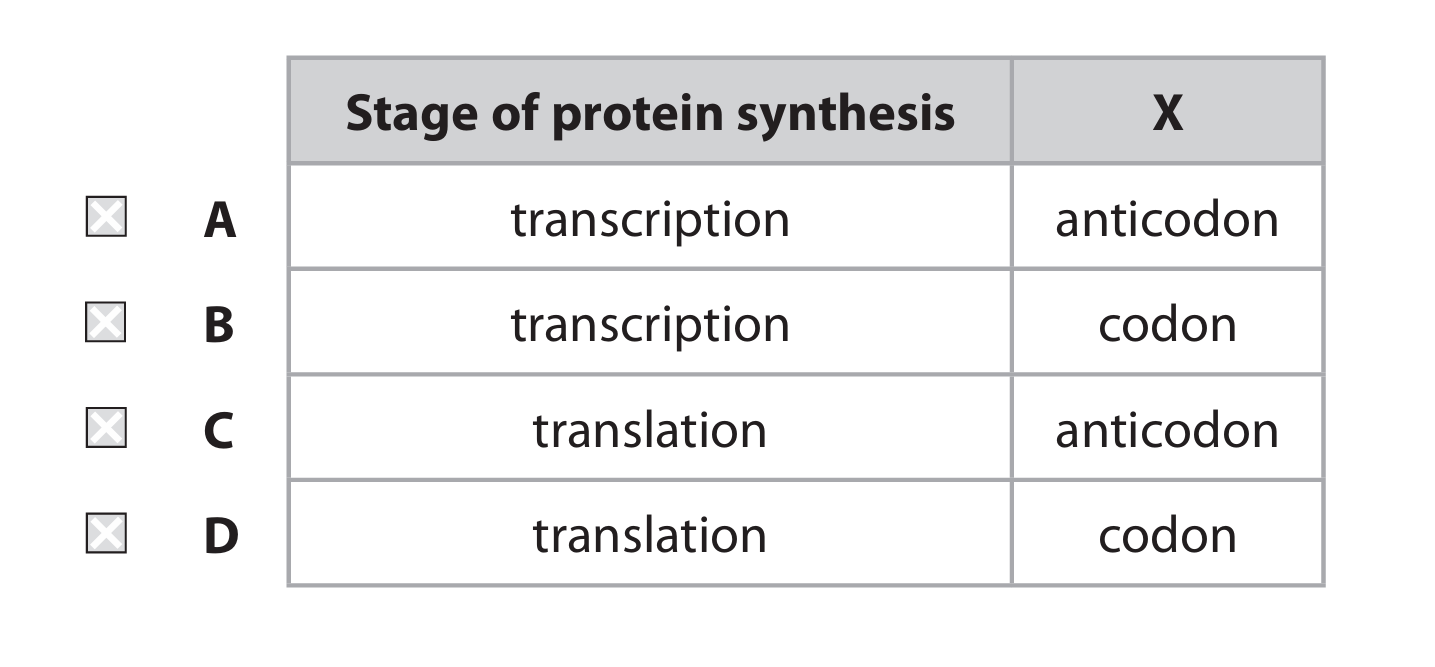
(b) The diagram shows a stage during protein synthesis.

Which row gives the correct names for the stage of protein synthesis shown and the sequence of bases labelled X?

(c) Explain how a mutation in a gene can affect the phenotype of an organism.

(d) In an accident at a nuclear power station, radioactive material was released into the surrounding areas of land.

Scientists investigated the impact of this on a species of butterfly.

Samples of adult butterflies were collected from an area near the power station two months after the release of the radioactive material.

The percentages of butterflies with abnormalities were calculated.

The butterflies were then mated in the laboratory and the percentage of offspring with abnormalities calculated.

The experiment was repeated with butterflies collected from the same area, 10 months after the release of the radioactive material.

(i) Describe how the scientists could have sampled the population of butterflies in the area.

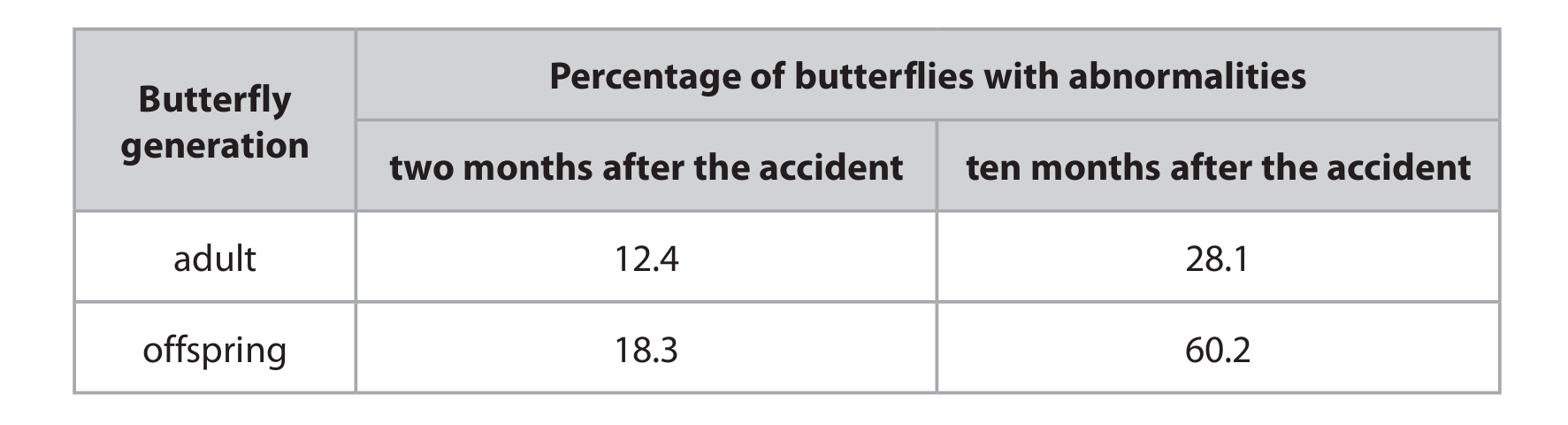
(ii) The results of the investigation are shown in the table.

The scientists concluded that the increased level of radioactivity has led to an increased rate of mutation of DNA.

Discuss the scientists’ conclusion referring to data from the table to support your answer.

Most-appropriate topic codes (Edexcel IGCSE Biology):

3(b): Inheritance — parts (a), (b), (c)
3(b): DNA structure and protein synthesis — parts (a), (b)
3(b): Mutation and genetic variation — parts (c), (d)(ii)
4(a): The organism in the environment — part (d)(i)
4(a): Investigating populations — part (d)(i)
▶️ Answer/Explanation
Solution

(a) C (UAAGGCUCA)

Explanation: To find the complementary mRNA sequence, we need to remember two key rules: RNA uses uracil (U) instead of thymine (T), and the base pairing rules are A→U, T→A, C→G, and G→C. Starting with the DNA strand ATTCCGAGT, we pair A with U, T with A, T with A, C with G, C with G, G with C, A with U, G with C, and T with A. This gives us the mRNA sequence UAAGGCUCA.

Option A is incorrect because it contains T (thymine), which is not found in RNA. Option B is simply the original DNA strand and also contains T. Option D has the incorrect complementary sequence (it should be UAAGGCUCA, not AUUCCGAGU).

(b) C (translation, anticodon)

Explanation: The diagram shows protein synthesis occurring at a ribosome, which is the site of translation – the process where mRNA is decoded to build a protein. The sequence of bases labelled X is part of a tRNA molecule, specifically the anticodon region that pairs with the complementary codon on the mRNA strand.

Options A and B are incorrect because transcription is the process of making mRNA from DNA in the nucleus, not what’s shown here. Option D is incorrect because while it correctly identifies translation, the sequence X is an anticodon (on tRNA), not a codon (on mRNA).

(c)

Explanation: A mutation is a rare, random change in the DNA sequence that can affect an organism’s phenotype in several ways. First, the mutation changes the sequence of nucleotides in the DNA. This altered DNA sequence is transcribed into mRNA, and since the genetic code is read in triplets (codons), this can change which amino acids are incorporated into the resulting protein during translation.

If the protein is an enzyme, the mutation might change the shape of its active site, making it less effective or completely non-functional. Since enzymes control metabolic reactions, this could disrupt normal cellular processes. The changed protein structure and function ultimately leads to an altered phenotype – the observable characteristics of the organism. The effect can range from beneficial to harmful to neutral, depending on the specific mutation and environmental conditions.

(d)(i)

Explanation: The scientists likely used a systematic sampling method to ensure their sample was representative of the entire butterfly population. They might have divided the area into a grid using quadrats and randomly selected coordinates within this grid to sample from. At each selected location, they would count the number of butterflies present, carefully capturing them for examination.

To ensure reliability, they would repeat this process multiple times in different randomly selected areas and calculate means to account for natural variation. They would also need to sample at different times of day since butterfly activity varies. This method ensures the sample isn’t biased toward areas that are easier to access or more visible.

(d)(ii)

Explanation: The data provides compelling but not conclusive evidence supporting the scientists’ conclusion. Looking at the table, we see a clear increase in abnormalities over time: adult abnormalities rose from 12.4% to 28.1%, and offspring abnormalities increased dramatically from 18.3% to 60.2% between the two-month and ten-month samples.

The particularly large increase in offspring abnormalities (41.9% increase compared to 15.7% in adults) suggests mutations are being inherited. This makes sense because DNA mutations in reproductive cells can be passed to offspring. The longer exposure time (10 months vs 2 months) likely allowed more mutations to accumulate, explaining the higher abnormality rates.

However, there are limitations to this conclusion. We don’t have baseline data from before the accident or from uncontaminated areas for comparison. Other environmental factors like pesticides or diseases could also cause abnormalities. The sample size isn’t specified, and we don’t know if the radioactivity levels were consistent over time. While the data strongly suggests radioactive exposure caused genetic mutations, we cannot rule out other contributing factors without additional controlled experiments.
Question

Read the passage below. Use the information in the passage and your own knowledge to answer the questions that follow.

Making Enough Blood for the World

A blood transfusion is the transfer of blood from a donor into a patient. Blood transfusions are routine medical procedures that save the lives of millions of people every year.

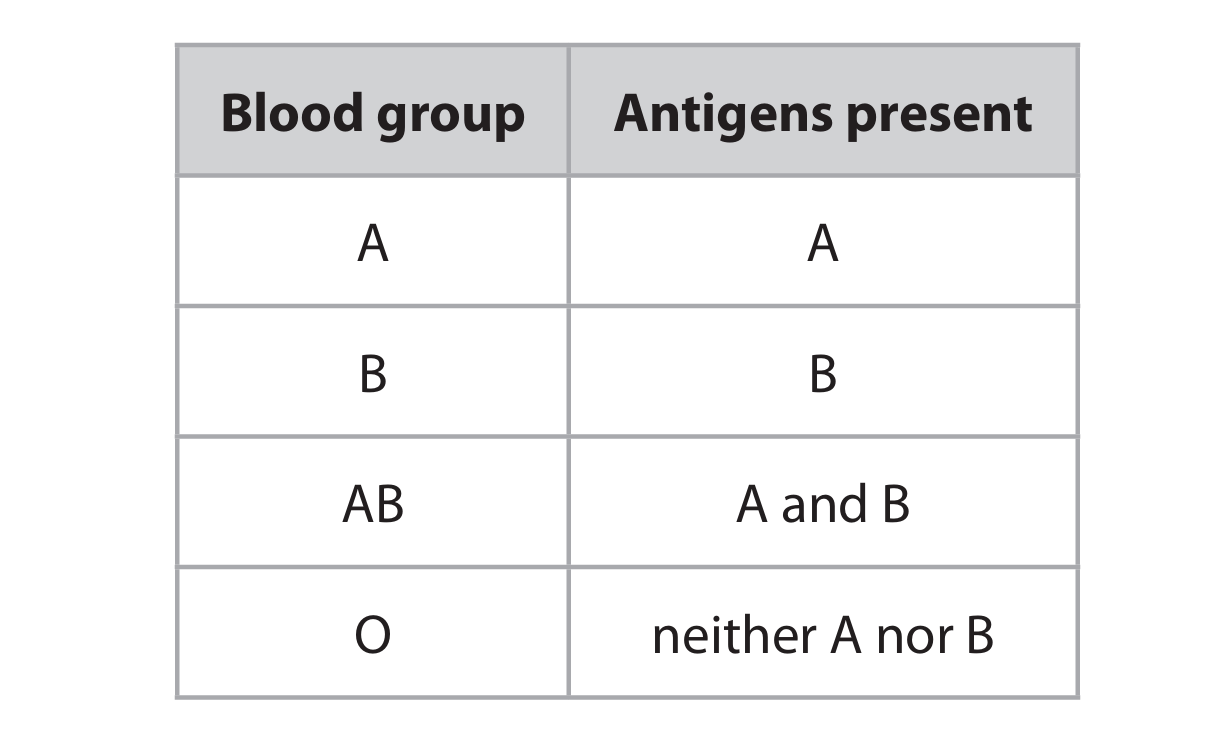
The first successful blood transfusions were performed in the early twentieth century after scientists discovered that there are four main blood groups, A, B, AB and O. The blood groups are due to the presence of proteins, called antigens, on the surface of red blood cells. There are two main protein antigens called A and B. If a patient is given blood with antigens different to their own cells, their immune system will make antibodies against that antigen. The antigens present on the surface of red blood cells for each blood group are shown in the table.

Currently, blood transfusions are carried out with blood that has been donated by healthy people. The World Health Organisation calculates that there are 118.5 million blood donations collected globally every year. Of these donations, 40% are collected from a small group of high-income countries. This means that there is a shortage of blood in many countries so the hunt is on to find an alternative.

Scientists have found a way to make artificial red blood cells. They made spheres of cell membranes filled with haemoglobin. These artificial cells are then suspended in sodium chloride solution. These artificial red blood cells have no proteins on their surface. Another way of making red blood cells is being developed in the United Kingdom. A research team has used stem cells to produce red blood cells with blood group O. The red blood cells produced are then suspended in sodium chloride solution.

Both methods produce large quantities of safe red blood cells. There may be other advantages as well, artificial blood would always have the same concentration of solutes and will not clot when stored. Critics have pointed out that the artificial blood will only transport oxygen and that blood has many more functions.

(a) Name the type of cell that produces antibodies. (Lines 8 and 9)

(b) Human blood groups are controlled by three alleles, IA, IB and IO. The IA and IB alleles are codominant and the IO allele is recessive.

(i) State what is meant by the term codominant.

(ii) Two parents have genotypes of IAIO and IBIO. Which of these are all the possible blood groups of their children?

  • A. A and B
  • B. A, B and O
  • C. AB and O
  • D. A, B, AB and O

(c) Calculate the number of blood donations collected per year from the high-income countries. (Lines 14 and 15) Give your answer in standard form.

(d) Some scientists have suggested that spherical artificial red blood cells transport oxygen less efficiently than normal human red blood cells. Explain why the shape of the artificial red blood cells reduces the efficiency of oxygen transport compared to normal human red blood cells. (Lines 18 and 19)

(e) Suggest why artificial blood does not clot when stored. (Lines 26 and 27)

(f) Explain why the artificial red blood cells are suspended in sodium chloride solution instead of in water. (Line 20)

(g) (i) Explain why stem cells can be used to make large quantities of red blood cells. (Lines 22 and 23)

(ii) Suggest why the scientists made red blood cells with blood group O. (Lines 22 and 23)

(h) Give two substances found in blood plasma that are not present in the artificial blood. (Lines 28 and 29)

Most-appropriate topic codes (Edexcel IGCSE Biology):

2(h): Transport — blood composition and red blood cell adaptations — parts (d), (e), (f), (h)
2(b): Cell structure — cell membranes and organelles — part (f)
2(h): Immune response and antibody production — part (a)
3(b): Inheritance — codominance and multiple alleles — parts (b)(i), (b)(ii)
3(b): Genetics — stem cells and differentiation — part (g)(i)
4: Mathematical skills — standard form and percentage calculation — part (c)
▶️ Answer/Explanation
Solution

(a) Lymphocytes

Explanation: Antibodies are proteins produced by specialized white blood cells called lymphocytes as part of the immune response. When foreign antigens are detected, lymphocytes are activated to produce specific antibodies that bind to and help eliminate the foreign substances.

(b)(i) Both alleles are expressed in the phenotype.

Explanation: Codominance occurs when both alleles in a heterozygous individual are fully expressed, resulting in a phenotype that shows characteristics of both alleles simultaneously. For example, in blood groups, the IA and IB alleles are codominant, meaning an individual with genotype IAIB will have blood group AB, expressing both A and B antigens.

(b)(ii) D (A, B, AB and O)

Explanation: When crossing parents with genotypes IAIO and IBIO, we can create a Punnett square to determine the possible offspring genotypes:

The possible gametes from IAIO parent: IA and IO

The possible gametes from IBIO parent: IB and IO

Possible offspring genotypes: IAIB (blood group AB), IAIO (blood group A), IBIO (blood group B), and IOIO (blood group O). Therefore, all four blood groups are possible.

(c) 4.74 × 10⁷

Explanation: The total global blood donations are 118.5 million, which is 118,500,000. High-income countries contribute 40% of this total. To calculate: 40% of 118,500,000 = 0.40 × 118,500,000 = 47,400,000. In standard form, this is written as 4.74 × 10⁷.

(d) Artificial spherical red blood cells have a smaller surface area to volume ratio compared to normal biconcave red blood cells, reducing oxygen diffusion efficiency.

Explanation: Normal human red blood cells have a unique biconcave disc shape that maximizes their surface area to volume ratio. This specialized shape allows for more efficient gas exchange as it provides a larger surface area for oxygen to diffuse across. Spherical artificial cells have a lower surface area to volume ratio, meaning less surface is available for oxygen binding and release. Additionally, the biconcave shape of natural red blood cells allows them to flow more easily through narrow capillaries, while spherical cells might not navigate the circulatory system as efficiently.

(e) Artificial blood lacks platelets and clotting factors.

Explanation: Natural blood contains platelets and various clotting factors that work together to form clots when bleeding occurs. Artificial blood, being designed primarily for oxygen transport, doesn’t include these components. Without platelets and clotting factors like fibrinogen, the coagulation cascade cannot be initiated, preventing clot formation during storage.

(f) Sodium chloride solution maintains osmotic balance, preventing cell bursting or shrinkage.

Explanation: If artificial red blood cells were suspended in pure water, water would enter the cells by osmosis due to the higher solute concentration inside the cells. This would cause the cells to swell and potentially burst (hemolysis). Sodium chloride solution is isotonic, meaning it has the same solute concentration as the interior of the cells. This prevents net movement of water across the cell membrane, maintaining cell integrity and function during storage.

(g)(i) Stem cells can undergo mitosis to produce more cells and differentiate into specialized cell types.

Explanation: Stem cells are undifferentiated cells with two key properties: self-renewal (ability to divide and produce more stem cells through mitosis) and differentiation (ability to develop into specialized cell types). By controlling the growth conditions and providing specific signals, scientists can direct stem cells to differentiate exclusively into red blood cells, allowing for large-scale production in laboratory settings.

(g)(ii) Blood group O lacks A and B antigens, making it universally compatible.

Explanation: Blood group O red blood cells don’t have A or B antigens on their surface. This means they won’t trigger an immune response when transfused into recipients with any blood type (A, B, AB, or O). People with other blood types don’t have pre-formed antibodies against O blood cells. This universal compatibility makes blood group O particularly valuable in emergency situations when there might not be time to determine the recipient’s blood type.

(h) Any two from: urea, carbon dioxide, hormones, mineral ions, vitamins, proteins (antibodies/clotting factors), digested food (glucose/amino acids)

Explanation: Natural blood plasma contains numerous substances that artificial blood lacks. Urea is a waste product transported to the kidneys for excretion. Carbon dioxide is carried from tissues to the lungs. Hormones act as chemical messengers throughout the body. Mineral ions and vitamins serve various metabolic functions. Proteins include antibodies for immunity and clotting factors for wound healing. Digested nutrients like glucose and amino acids are transported to cells for energy and growth.
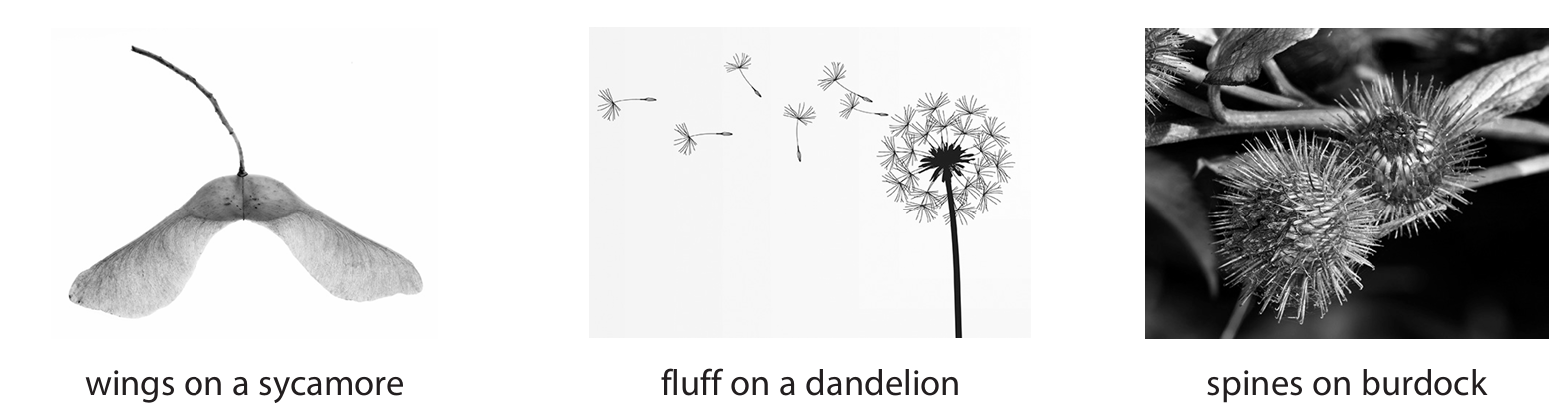
Question

Read the passage below. Use the information in the passage and your own knowledge to answer the questions that follow.

Moving plants

Flowering plants reproduce using different methods to transfer the pollen from plant to plant. This cross-pollination enables plants to produce offspring that show genetic variation. The transfer can be done by animals such as insects or by wind.

The reliance on animals and wind for reproduction does not end with pollination. Flowering plants also need a mechanism to disperse their fruits or the seeds they contain. This seed dispersal means that seeds producing new young plants will germinate away from the parent plant.

The simplest method of seed dispersal uses gravity. The seeds are within heavy fruit, which fall from the tree when they are ripe. Although some of the fruit may roll away from the parent plant, most remain close to the parent plant.

Animal dispersal is when plants rely on animals to transport their seeds to a different area. This may be because the seeds are surrounded by a brightly-coloured and sweet-tasting fruit. Examples of this are soft fruits such as raspberry and hard fruits such as apple.

Animals may also carry seeds in a different way. Many plants produce fruits or individual seeds covered in hooks or spines that attach the seeds to the animals’ fur. The seeds are then carried away from the parent plant. Eventually, the seeds may fall off, or be rubbed off by the animal. Examples of plants using this form of dispersal are burdock and sea holly.

Some plants provide seed pods with a mechanism that ejects the seeds from the pod by force. All of these rely on the effect of evaporation of water in the seed pod, so this method of seed dispersal usually takes place in sunlight. Examples of plants using this form of dispersal are gorse bushes and lupins.

Wind is one of the main methods of seed dispersal. Some tall trees produce seed pods that have wings, which allow the seeds to travel long distances. Some seed pods have two wings such as the sycamore while others have one wing such as the ash.

There are also lightweight adaptations that help seeds to be blown by the wind. These include various sorts of fluff that increase the surface area of the seed, so that it can be picked up by the slightest breeze. Examples of plants using this form of dispersal are thistle and dandelion.

The last method uses water. Trees found on tropical beaches often have their seeds carried away by the sea. The seeds have woody, waterproof coverings enabling them to float in the water for long periods. Coconuts are a well-known example.

(a) Explain how cross-pollination can lead to an increase in genetic variation. (2)

(b) (i) Explain the advantages of the seeds germinating away from the parent plant. (3)

(ii) Give one advantage of a seed germinating close to the parent plant. (1)

(c) Explain the conditions needed for seed germination. (3)

(d) Explain why some seeds are surrounded by a brightly-coloured and sweet-tasting fruit. (2)

(e) Large numbers of tomato plants are often found growing along the sides of drains and settling beds on sewage farms. Suggest a reason for this observation. (1)

(f) Give the reason why sunlight is required for lupin seeds to be dispersed. (1)

(g) Describe an experiment you could carry out to investigate how the presence of fluff on dandelion seeds affects how fast they fall. (3)

Most-appropriate topic codes (Edexcel IGCSE Biology):

3(a): Reproduction — parts (a), (b)(i), (b)(ii), (d), (e), (f)
3(b): Inheritance — part (a)
2(e): Nutrition (Flowering plants) — part (c)
Appendix 6: Suggested practical investigations — part (g)
▶️ Answer/Explanation
Solution

(a) Cross-pollination involves the transfer of pollen from one plant to the stigma of another plant of the same species. This leads to increased genetic variation because the gametes (sex cells) come from two different parent plants, each with their own unique set of genes and alleles. When these gametes fuse during fertilization, the resulting offspring inherits a combination of genetic material from both parents, creating new genetic combinations that weren’t present in either parent alone.

(b)(i) Seeds germinating away from the parent plant have several advantages. First, there’s less competition for essential resources like light, as young plants won’t be shaded by the larger parent plant. Second, they face less competition for water and minerals from the soil, since the parent plant’s extensive root system isn’t drawing from the same immediate area. Third, being dispersed reduces the chance of all offspring being affected by local diseases, pests, or unfavorable conditions that might wipe out plants concentrated in one area.

(b)(ii) One advantage of a seed germinating close to the parent plant is that the location has already proven to be suitable for that species’ growth. The parent plant successfully grew there, indicating the soil conditions, light availability, and other environmental factors are appropriate.

(c) Seeds require three main conditions for germination. Water is essential to activate enzymes that break down stored food reserves and to soften the seed coat. Oxygen is necessary for aerobic respiration to provide energy for growth. A suitable temperature (warmth) is needed to optimize enzyme activity for the metabolic processes involved in germination.

(d) Seeds are surrounded by brightly-colored and sweet-tasting fruit to attract animals. The bright colors make the fruits easily visible, while the sweet taste (due to sugars like glucose) makes them appealing to eat. Animals consume the fruits and later excrete the seeds at different locations, effectively dispersing them.

(e) Tomato plants grow along sewage farm drains because humans eat tomatoes but don’t digest the seeds. The seeds pass through the digestive system and are egested in feces, which end up in sewage systems. When this sewage is processed, the undigested seeds can germinate in the nutrient-rich environment.

(f) Sunlight is required for lupin seed dispersal because it provides heat that causes water in the seed pods to evaporate. This evaporation builds up pressure inside the pods until they suddenly split open, forcefully ejecting the seeds away from the parent plant.

(g) To investigate how fluff affects dandelion seed fall rate: First, obtain dandelion seeds with fluff and carefully remove the fluff from some seeds to create two groups (with fluff and without fluff). Second, drop seeds from both groups from the same height (e.g., 2 meters) and use a stopwatch to time how long each takes to reach the ground. Third, repeat this process multiple times with different seeds from each group to calculate average fall times, ensuring you use seeds of the same mass/species for fair comparison.

Question

Beta thalassaemia is a genetic condition caused by a mutation in a gene for haemoglobin. People with beta thalassaemia produce less haemoglobin and fewer red blood cells than people without the condition.

(a) Explain why people with beta thalassaemia may experience severe tiredness.

(b) A new treatment for beta thalassaemia has been developed that edits the haemoglobin gene. These are the steps in the treatment.

  • remove blood stem cells from a patient’s bone marrow
  • put a strand of RNA and an enzyme into the blood stem cells to correct the haemoglobin gene
  • use drugs to destroy the patient’s remaining bone marrow cells
  • replace the patient’s bone marrow cells with the modified stem cells

The modified stem cells that are in the bone marrow now produce red blood cells containing sufficient haemoglobin.

(i) The strand of RNA used in this treatment is complementary to one strand of the DNA in the haemoglobin gene.

Give the base sequence of RNA that is complementary to this sequence of DNA.

(ii) Protein synthesis of the modified gene will produce haemoglobin.

Describe the stages of this protein synthesis.

(iii) The standard treatment for beta thalassaemia is a weekly blood transfusion.

The new treatment has so far been tested on two patients, with these results.

  • both patients started making large numbers of red blood cells with sufficient haemoglobin
  • both patients experienced serious side effects from the drugs used, needing to spend several months in isolation in hospital before recovering
  • 15 months after the treatment, neither patient required further blood transfusions
  • both patients were able to exercise normally without feeling tired

Evaluate the use of the new treatment compared to weekly blood transfusions.

Most-appropriate topic codes (Edexcel IGCSE Biology):

2(h): Transport — part (a)
3(b): Inheritance — parts (b)(i), (b)(ii)
5(c): Genetic modification (genetic engineering) — part (b)(i), (b)(ii)
5(d): Cloning — part (b) context
3(b): Inheritance — part (b)(iii) (evaluation of treatment)
▶️ Answer/Explanation
Solution

(a)

Answer: An explanation that makes reference to two of the following:

  • less oxygen (transported) (1)
  • to muscles (1)
  • less respiration / less ATP production / less energy release / more lactic acid / more anaerobic respiration (1)

Detailed Explanation:

People with beta thalassaemia produce less haemoglobin, which is the protein in red blood cells responsible for carrying oxygen. Since there are fewer red blood cells and less haemoglobin, the blood’s overall oxygen-carrying capacity is significantly reduced. This means that less oxygen is delivered to the body’s tissues, particularly to active muscles.

Oxygen is essential for aerobic respiration, the process that efficiently releases energy (in the form of ATP) from glucose. When oxygen is limited, cells are forced to rely more on anaerobic respiration. Anaerobic respiration releases much less energy per glucose molecule and also produces lactic acid as a waste product, which can lead to muscle fatigue and pain. The combination of reduced ATP (energy) production and the buildup of lactic acid results in the severe tiredness and weakness experienced by individuals with this condition.

(b)(i)

Answer: UUACCGCCGAGU (2)

Detailed Explanation:

To find the complementary RNA sequence, you need to remember the base pairing rules. In RNA, adenine (A) pairs with uracil (U) (instead of thymine, as in DNA), and guanine (G) pairs with cytosine (C).

Let’s go through the DNA strand base by base:

  • DNA A → RNA U
  • DNA A → RNA U
  • DNA T → RNA A
  • DNA G → RNA C
  • DNA G → RNA C
  • DNA C → RNA G
  • DNA G → RNA C
  • DNA G → RNA C
  • DNA C → RNA G
  • DNA T → RNA A
  • DNA C → RNA G
  • DNA A → RNA U

Putting it all together, the complementary RNA strand is U U A C C G C C G A G U.

(b)(ii)

Answer: A description that makes reference to four of the following:

  • transcription occurs in nucleus (1)
  • production of messenger RNA / mRNA (from DNA) (1)
  • translation occurs on ribosome / mRNA binds to ribosome / mRNA goes to ribosome (1)
  • tRNA brings / has amino acids (1)
  • codon binds to anticodon / codons are complementary to anticodons / (complementary) triplets on tRNA and mRNA bind / eq (1)
  • polypeptide produced / amino acids joined together / amino acid chain produced / eq (1)

Detailed Explanation:

Protein synthesis occurs in two main stages: transcription and translation.

1. Transcription: This first stage takes place inside the nucleus. The DNA double helix unwinds at the specific gene that codes for haemoglobin. The enzyme RNA polymerase uses one strand of the DNA as a template to build a complementary strand of messenger RNA (mRNA). This process follows base-pairing rules (A with U, T with A, G with C, C with G). Once the mRNA strand is complete, it detaches from the DNA, which rewinds, and the mRNA molecule leaves the nucleus through a nuclear pore and enters the cytoplasm.

2. Translation: This second stage occurs on ribosomes in the cytoplasm. The mRNA molecule binds to a ribosome. The ribosome reads the mRNA sequence in groups of three bases called codons. Transfer RNA (tRNA) molecules, each carrying a specific amino acid, have a three-base anticodon that is complementary to the mRNA codon. The tRNA molecules bring the correct amino acids to the ribosome in the order specified by the mRNA sequence. As the ribosome moves along the mRNA, it links the amino acids together with peptide bonds, forming a growing polypeptide chain. This chain continues to grow until a stop codon is reached on the mRNA, at which point the completed haemoglobin polypeptide is released.

(b)(iii)

Answer: An answer that makes reference to four of the following:

Pros (max 3):

  • patients produce red blood cells / can exercise / are not breathless / have more energy / eq (1)
  • independent life / transfusions not needed / better quality of life / no need to keep visiting hospitals / eq (1)
  • no rejection (1)
  • less risk of infectious disease (from blood) (1)
  • permanent treatment / long lasting / lasts a lifetime / cure / works for at least 15 months (1)

Cons (max 3):

  • need to spend long time in isolation (for treatment) / eq (1)
  • side effects (1)
  • small sample size / only tested on two people / needs further testing / more repeats / eq (1)
  • could cause mutations in DNA / cause cancers (1)
  • need to be tested for more than 15 months / for longer / eq (1)

Detailed Explanation:

Advantages of the New Treatment:

The new gene therapy treatment offers significant potential benefits. It appears to be a long-term or even permanent solution, as evidenced by patients not needing transfusions for 15 months post-treatment. This eliminates the lifelong dependency on weekly blood transfusions, freeing patients from frequent hospital visits and the associated disruptions to their daily lives. Using the patient’s own modified cells eliminates the risk of immune rejection, a common problem with organ or tissue transplants. Furthermore, it removes the risk of contracting infectious diseases from donated blood. The results showing patients could exercise normally indicate a vastly improved quality of life and physical capability.

Disadvantages and Risks of the New Treatment:

However, the treatment carries serious risks and limitations. The drugs used to destroy the existing bone marrow caused severe side effects, requiring a long and isolating hospital stay, which is physically and emotionally taxing. The sample size of only two patients is very small, making it difficult to be certain about the treatment’s effectiveness and safety for the wider population. There is a potential risk that the gene editing process could cause unintended mutations in the DNA, which might lead to other health issues, including cancer. The 15-month success period, while promising, is not long enough to confirm it is a true lifelong cure, and longer-term monitoring is essential. In contrast, while weekly transfusions are inconvenient and carry their own risks (like infection or iron overload), they are a well-established and predictable treatment.

In conclusion, the new treatment is a promising potential cure that could greatly improve quality of life, but it is currently associated with significant short-term risks and its long-term safety and efficacy are still unknown due to limited testing.
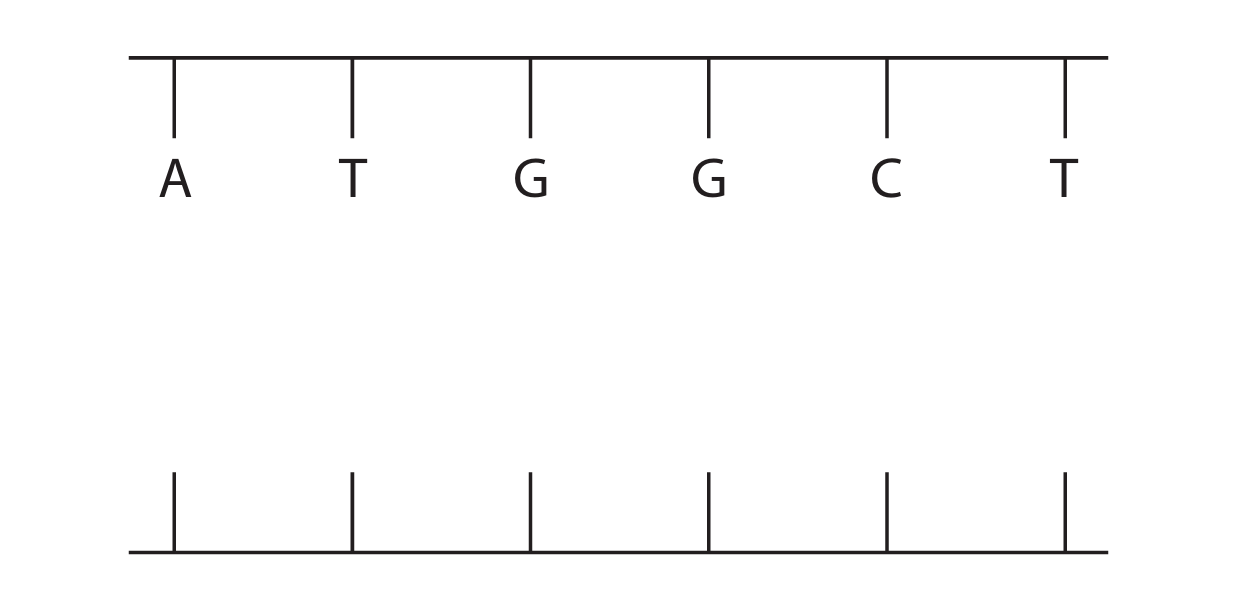
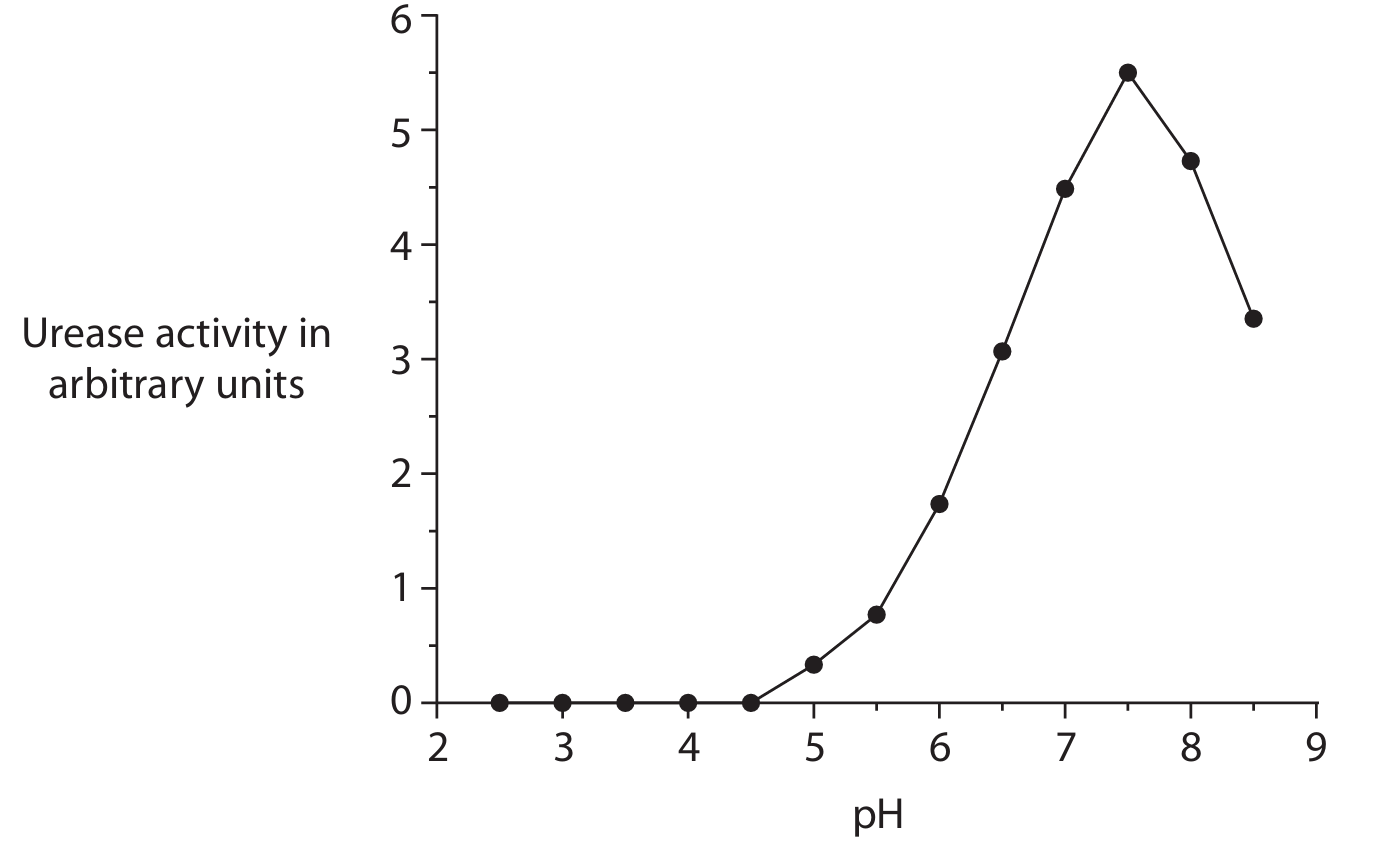
Question

(a) A DNA strand has this sequence of bases.

C A T T C A A T T C A T T T C

(i) How many amino acids does this sequence of bases code for?

  • A. 1
  • B. 3
  • C. 5
  • D. 15

(ii) Write down the complementary mRNA code for this sequence of bases.

(iii) A student reads that DNA codons are non-overlapping.
Suggest what is meant by the term non-overlapping.
You should refer to the sequence of bases in your answer.

(b) Describe what happens in the translation stage of protein synthesis.

(c) State what is meant by the genome of an organism.

Most-appropriate topic codes (Edexcel IGCSE Biology):

3(b): Inheritance — parts (a)(i), (a)(ii), (a)(iii), (b), (c)
3(b): DNA structure and protein synthesis — parts (a)(i), (a)(ii), (a)(iii), (b)
3.14: Genome definition — part (c)
▶️ Answer/Explanation
Solution

(a)(i) C 5

Explanation: In protein synthesis, DNA sequences are read in groups of three bases called codons. Each codon codes for one amino acid. The given DNA sequence has 15 bases (C A T T C A A T T C A T T T C). When divided into triplets, we get: CAT TCA ATT CAT TTC. This gives us 5 codons, therefore it codes for 5 amino acids.

(a)(ii) GUA AGU UAA GUA AAG

Explanation: To find the complementary mRNA code, we need to remember two things: RNA uses uracil (U) instead of thymine (T), and mRNA is complementary to the DNA template strand. The base pairing rules are: A→U, T→A, G→C, C→G. Applying this to our DNA sequence:

DNA: C A T T C A A T T C A T T T C

mRNA: G U A A G U U A A G U A A A G

When written in codon groups, this becomes: GUA AGU UAA GUA AAG

(a)(iii) Non-overlapping means each codon is read separately without sharing bases between adjacent codons.

Explanation: In non-overlapping codons, the genetic code is read in discrete groups of three bases. Each base belongs to only one codon and is not shared between neighboring codons. For example, in the sequence CAT TCA ATT, the first codon uses bases 1-3 (CAT), the second uses bases 4-6 (TCA), and the third uses bases 7-9 (ATT). The bases are not shared – base 3 (T) only belongs to the first codon, base 4 (T) only belongs to the second codon, and so on. This ensures that each amino acid in the protein chain is determined by a unique, non-overlapping set of three bases.

(b) Translation occurs at the ribosome where mRNA is read to synthesize proteins.

Explanation: Translation is the process where the genetic code in mRNA is used to build a protein. It begins when mRNA attaches to a ribosome. The ribosome moves along the mRNA strand, reading the codons in sequence. For each codon, a specific tRNA molecule with the complementary anticodon brings the corresponding amino acid. The tRNA binds to the mRNA codon at the ribosome, and the amino acids are joined together by peptide bonds to form a growing polypeptide chain. This continues until a stop codon is reached, at which point the completed protein is released.

(c) The genome is the complete set of genetic material (DNA/genes) of an organism.

Explanation: The genome represents all the hereditary information of an organism, encoded in its DNA (or RNA for some viruses). It includes all the genes that code for proteins as well as non-coding regions of DNA. The genome contains the complete blueprint for building and maintaining the organism, determining its characteristics and biological functions.

Question

Read the passage below. Use the information in the passage and your own knowledge to answer the questions that follow.

Haemolytic disease

Haemolysis is the term used to describe the bursting of red blood cells. Haemolytic disease occurs when the red blood cells burst in the body of a foetus in a pregnant woman. The bursting of the red blood cells affects the development of the foetus into a baby.

The red blood cells burst when certain antibodies from the mother pass across the placenta. The antibodies attach to protein molecules called antigens. These antigens are on the surface of the foetal red blood cells. The protein antigen is called the rhesus factor and is made using the genetic code found on the dominant allele, D, during the production of red blood cells in bone marrow.

Homozygous dominant and heterozygous individuals have cells with the antigen. These individuals have the rhesus positive blood group. Homozygous recessive individuals have cells that do not have the antigen. These individuals have the rhesus negative blood group.

During the birth of a rhesus positive baby, some red blood cells may leak into the circulatory system of the mother. This happens as the placenta pulls away from the wall of the uterus. A rhesus negative mother will make antibodies that destroy rhesus positive red blood cells. This is not a problem for the child that has just been born. However, if the mother becomes pregnant again with another rhesus positive foetus, the antibodies will harm the foetus.

Haemolytic disease can be avoided by treating a rhesus negative woman at risk of having a second rhesus positive child. This treatment involves the mother having an injection during and after pregnancy. The injection destroys rhesus positive cells in the mother’s blood before the cells can cause an immune response.

If the foetus is rhesus positive, the pregnancy is carefully monitored for signs of haemolytic disease. Monitoring includes regular ultrasound scans of the foetus and measuring the amount of antibody in the mother’s blood. A change in the concentration of the antibody in the mother’s blood, due to her secondary immune response, can lead to dangerous haemolysis. If a foetal blood test confirms a low number of red blood cells, a blood transfusion can be done in utero to replace the burst foetal red blood cells.

(a) Explain why bursting of red blood cells affects the development of a foetus.

(b) The dominant allele codes for the production of the protein that will act as an antigen.
Describe how the dominant allele leads to the production of RNA during protein synthesis.

(c) Give the reason why proteins cannot be made by red blood cells.

(d) Give one piece of evidence from the passage that shows that antibodies are smaller than red blood cells.

(e) (i) A mother who is homozygous recessive for the rhesus factor has a child with a father who is heterozygous.
Give the genotypes of the mother, the father, their gametes and the possible genotypes of the child.

(ii) Give the probability that the child will be rhesus positive.

(f) Explain why the concentration of the rhesus antibody in the mother’s blood rises quickly to harmful levels if she has a second child who is Rhesus positive.

(g) Suggest what is meant by the term in utero.

(h) A foetus with haemolytic disease can be given a blood transfusion.
Suggest the blood group of the source of the cells used for this transfusion.

Most-appropriate topic codes (Edexcel IGCSE Biology):

2(h): Transport — parts (a), (h)
3(b): Inheritance — parts (b), (e)(i), (e)(ii)
2(b): Cell structure — part (c)
2(i): Excretion and osmoregulation — part (d)
2(j): Co-ordination and response — part (f)
3(a): Reproduction — part (g)

▶️ Answer/Explanation
Solution

(a) An explanation that makes reference to two of the following points:

  • less oxygen (1)
  • (less) respiration (1)
  • (less) energy / ATP (1)

Detailed Explanation: When red blood cells burst (haemolysis), they can no longer carry oxygen effectively. Oxygen is essential for cellular respiration, which releases energy in the form of ATP. Reduced oxygen leads to less respiration and less ATP. Since foetal development requires energy for growth and cell division, a lack of ATP directly hinders development.

(b) An explanation that makes reference to three of the following points:

  • DNA unzips / separates / one strand copied (1)
  • complementary / base pairing (1)
  • template (1)
  • mRNA produced (1)
  • transcription (1)

Detailed Explanation: Transcription occurs: the DNA double helix unwinds, one strand acts as a template, RNA nucleotides pair complementarily (A-U, C-G), and mRNA is formed by RNA polymerase, carrying the code from the gene to the ribosome.

(c) no nucleus / DNA / no ribosomes / mitochondria (1)

Detailed Explanation: Mature red blood cells lack a nucleus (and therefore DNA) and ribosomes. Protein synthesis requires DNA for instructions and ribosomes for assembly, so they cannot make proteins.

(d) can pass across placenta (1)

Detailed Explanation: The passage states antibodies pass across the placenta, a selective barrier. Red blood cells cannot cross normally, indicating antibodies are smaller.

(e)(i) An answer that makes reference to the following points:

  • parent genotype dd x Dd (1)
  • gamete d (and d) and D or d (1)
  • offspring genotype Dd and dd (1)

Detailed Explanation: Mother: dd, Father: Dd. Gametes: mother → d only; father → D or d. Possible offspring: Dd (Rhesus positive) or dd (Rhesus negative).

(e)(ii) 50% / 0.5 / half / 50:50 (1)

Detailed Explanation: From a Punnett square, 2 out of 4 possibilities are Dd (Rhesus positive), so probability = ½ or 50%.

(f) An explanation that makes reference to three of the following points:

  • memory cells (1)
  • remain in mother’s blood (1)
  • recognise / identify antigen / binds with antigen (1)
  • more antibodies produced / produced faster / sooner (1)
  • secondary immune response (1)

Detailed Explanation: During the first pregnancy, memory cells are made. In a second pregnancy, these memory cells quickly recognise the Rhesus antigen and trigger a rapid, strong secondary immune response, producing large amounts of antibody quickly.

(g) in the uterus / womb (1)

Detailed Explanation: “In utero” means inside the uterus (womb), referring to procedures performed on the foetus before birth.

(h) (adult) (rhesus) negative / negative (1)

Detailed Explanation: The foetus is being attacked by anti-Rhesus antibodies. Transfusing Rhesus negative blood (lacking the antigen) ensures the new cells are not attacked, allowing them to survive and carry oxygen.

Question

Decomposer bacteria are involved in the nitrogen cycle.

The bacteria release an enzyme called urease.

(a) The diagram shows part of one strand of DNA used to make urease.

Complete the diagram by giving the missing bases on the other strand of DNA.

(b) Urease acts on urine to produce ammonia.

The graph shows how pH affects the activity of urease.

(i) Which of these is the optimum pH for urease?

  • A. 2.5
  • B. 4.5
  • C. 7.5
  • D. 8.5

(ii) Explain the activity of urease at pH 8.5

(c) Describe the role of the other bacteria involved in the nitrogen cycle.

Most-appropriate topic codes (Edexcel IGCSE Biology):

3(b): Inheritance — DNA structure and base pairing (part a)
2(c): Biological molecules — Enzymes and factors affecting enzyme activity (parts b(i), b(ii))
4(c): Cycles within ecosystems — The nitrogen cycle and roles of bacteria (part c)
▶️ Answer/Explanation
Solution

(a)

Explanation: DNA strands are complementary. Adenine (A) always pairs with Thymine (T), and Guanine (G) always pairs with Cytosine (C). Therefore, to complete the complementary strand, we match A with T, T with A, G with C, G with C, C with G, and T with A.

(b)(i) C 7.5

Explanation: The optimum pH is the point at which the enzyme shows its highest activity. From the graph (which would show this visually), urease activity peaks at around pH 7.5, making it the optimum pH for this enzyme’s function.

(b)(ii) At pH 8.5, the activity of urease is lower than its optimum. This happens because the higher pH (alkaline conditions) can cause the enzyme to denature. Denaturation means the enzyme’s active site changes shape, so it can no longer bind effectively to its substrate (urea in this case), resulting in fewer enzyme-substrate complexes and reduced activity.

Explanation: Enzymes are proteins that are sensitive to pH changes. Each enzyme has an optimum pH where its structure is ideal for catalysis. When the pH moves away from this optimum, particularly to extremes like pH 8.5 for urease, the ionic bonds and hydrogen bonds that maintain the enzyme’s specific three-dimensional shape can be disrupted. This alteration in shape, especially of the active site, prevents the substrate from fitting properly, drastically reducing the rate of reaction.

(c) Other bacteria in the nitrogen cycle have crucial roles:

  • Nitrogen-fixing bacteria: These convert atmospheric nitrogen gas (\(N_2\)) into ammonia (\(NH_3\)), making nitrogen available to plants in a usable form.
  • Nitrifying bacteria: This is a two-step process. First, some bacteria convert ammonia (\(NH_3\)) into nitrites (\(NO_2^-\)). Then, other bacteria convert these nitrites (\(NO_2^-\)) into nitrates (\(NO_3^-\)), which is the form most easily absorbed by plant roots.
  • Denitrifying bacteria: These bacteria perform denitrification, which is the conversion of nitrates (\(NO_3^-\)) back into nitrogen gas (\(N_2\)). This process releases nitrogen back into the atmosphere, completing the cycle.

Explanation: The nitrogen cycle is essential for life, as nitrogen is a key component of amino acids and nucleic acids. Different groups of bacteria drive this cycle. Nitrogen-fixing bacteria, often found in root nodules of legumes, “fix” inert atmospheric nitrogen into reactive ammonia. Nitrifying bacteria in the soil then oxidize ammonia to nitrites and then to nitrates, which are soluble and can be taken up by plants. Finally, denitrifying bacteria, typically active in waterlogged, anaerobic soils, reduce nitrates back to nitrogen gas, returning it to the atmosphere and balancing the cycle. Without these bacterial processes, the vast reservoir of nitrogen in the air would be largely inaccessible to living organisms.
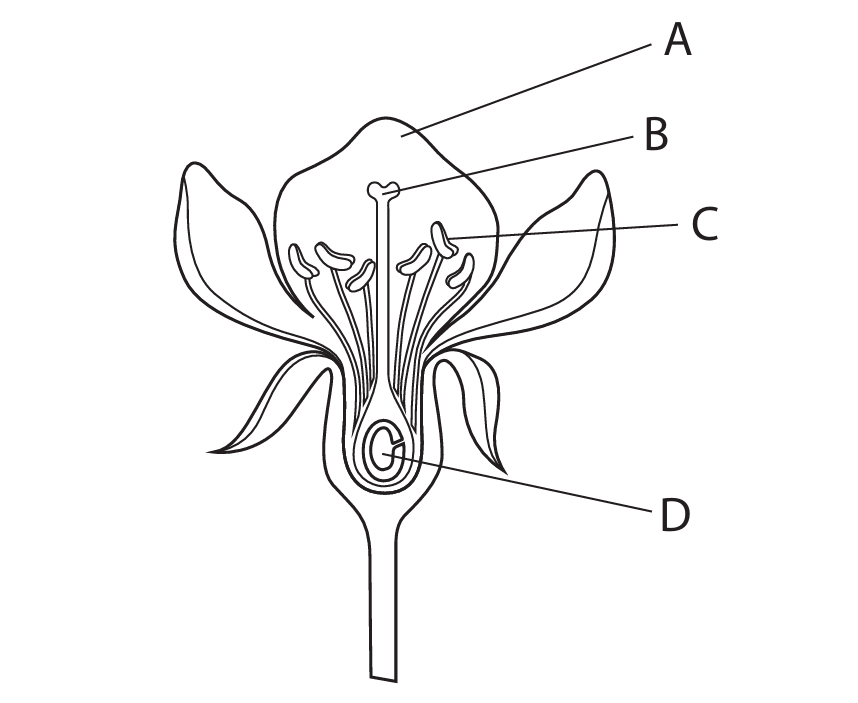
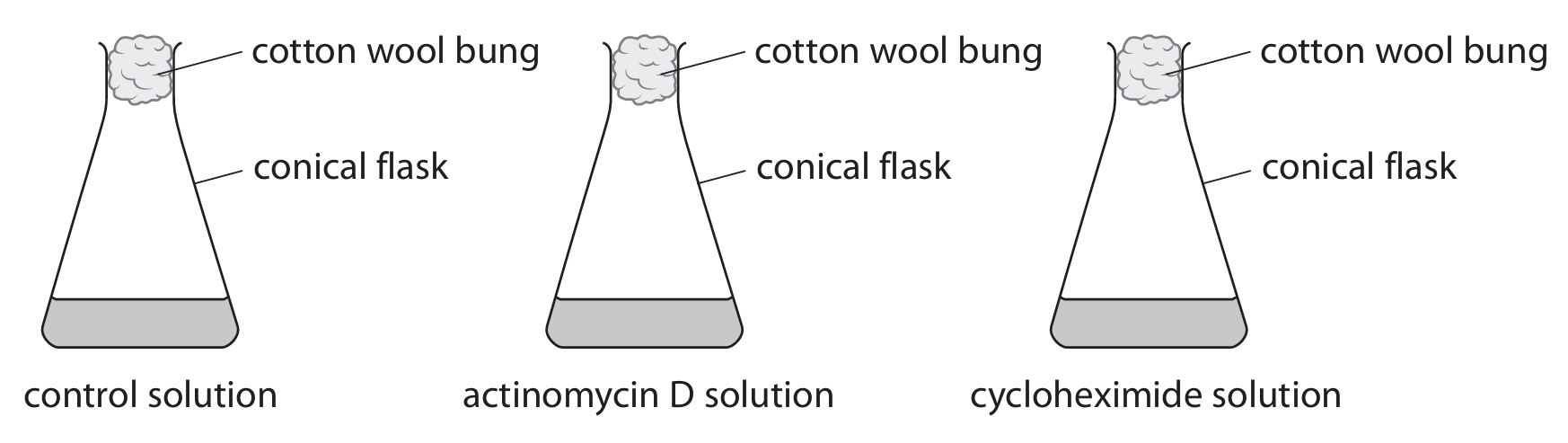
Question

Flowers are involved in plant reproduction.

The diagram shows a section through a flower with parts labelled A, B, C and D.

(a) (i) Which part of the flower makes pollen grains?

  • A
  • B
  • C
  • D

(ii) What part of the flower is the stigma?

  • A
  • B
  • C
  • D

(b) After a pollen grain lands on the stigma of a flower, a pollen tube grows.
Explain the role of the pollen tube.

(c) A scientist investigates the effect of three different solutions on the growth of pollen tubes using this apparatus.

This is the scientist’s method.
– place a different solution in three different flasks
– add pollen grains to the solution in each flask
– leave the grains in each solution for three hours
– take a sample of pollen grains from each solution
– measure the length of the pollen tubes in each sample

The graph shows the scientist’s results.

(i) Calculate the difference between the mean rate of pollen tube growth in the control solution and the mean rate of pollen tube growth in the actinomycin D solution.
Give your answer in µm per hour.

(ii) Actinomycin D prevents transcription and cycloheximide prevents translation.
Use this information and your own knowledge to explain the results of this investigation.

(d) Describe a method the scientist could use to observe pollen grains.

Most-appropriate topic codes (Edexcel IGCSE Biology):

3(a): Reproduction — flowering plants — parts (a)(i), (a)(ii), (b)
2(b): Cell structure — part (d)
3(b): Inheritance — protein synthesis — part (c)(ii)
Appendix 4: Mathematical skills — part (c)(i)
Appendix 6: Suggested practical investigations — microscopy — part (d)
▶️ Answer/Explanation
Solution

(a)(i) C

Explanation: The part labelled C is the anther, which is the male reproductive organ of the flower responsible for producing and releasing pollen grains.

(a)(ii) B

Explanation: The stigma is the sticky, receptive tip of the female reproductive structure (carpel) that captures pollen grains. In the diagram, this is represented by label B.

(b)

Explanation: The pollen tube plays a crucial role in plant fertilization. After a pollen grain lands on the stigma, it germinates and grows a pollen tube. This tube extends down through the style, which is the long stalk connecting the stigma to the ovary. The pollen tube acts as a conduit, transporting the male gametes (sperm cells) from the pollen grain to the ovary. Once the pollen tube reaches the ovary, it enters an ovule through a small opening called the micropyle. This allows the male gametes to fertilize the female gamete (egg cell) inside the ovule, leading to the formation of a seed.

(c)(i) 80 µm per hour

Explanation: To calculate the growth rates, we first determine the rate for each solution:
Control: 600 µm ÷ 3 hours = 200 µm/hour
Actinomycin D: 360 µm ÷ 3 hours = 120 µm/hour
Difference: 200 µm/hour – 120 µm/hour = 80 µm/hour
Alternatively: (600 µm – 360 µm) = 240 µm total difference over 3 hours, so 240 µm ÷ 3 hours = 80 µm/hour.

(c)(ii)

Explanation: Both chemicals inhibit pollen tube growth because they disrupt protein synthesis, which is essential for growth. Actinomycin D prevents transcription, the process where DNA is copied into mRNA. Without mRNA, the instructions for making proteins cannot reach the ribosomes. Cycloheximide prevents translation, where mRNA is read by ribosomes to assemble amino acids into proteins. Since both processes are blocked, protein synthesis decreases, slowing down pollen tube growth. The growth with actinomycin D is higher than with cycloheximide because some mRNA molecules might already be present in the pollen grain and can still be translated until they degrade, allowing limited protein production. With cycloheximide, translation is directly blocked, so even existing mRNA cannot be used, resulting in more severe growth inhibition.

(d)

Explanation: To observe pollen grains effectively, the scientist should use microscopy. First, place a pollen grain sample on a clean glass slide. Add a drop of water or a suitable stain (like methylene blue) to make the structures more visible. Carefully lower a cover slip over the sample to avoid air bubbles. Then, examine the slide under a light microscope, starting with low magnification to locate the pollen grains and switching to higher magnification to observe detailed structures such as the shape, size, and surface patterns of the pollen grains.
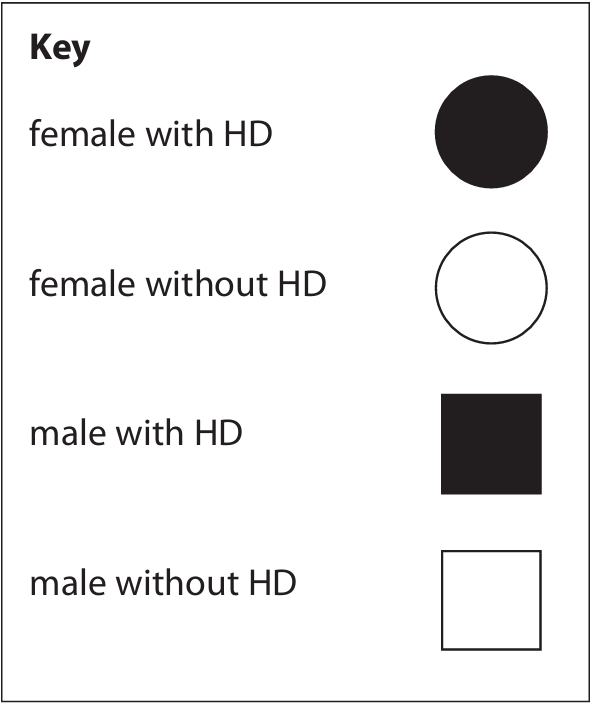
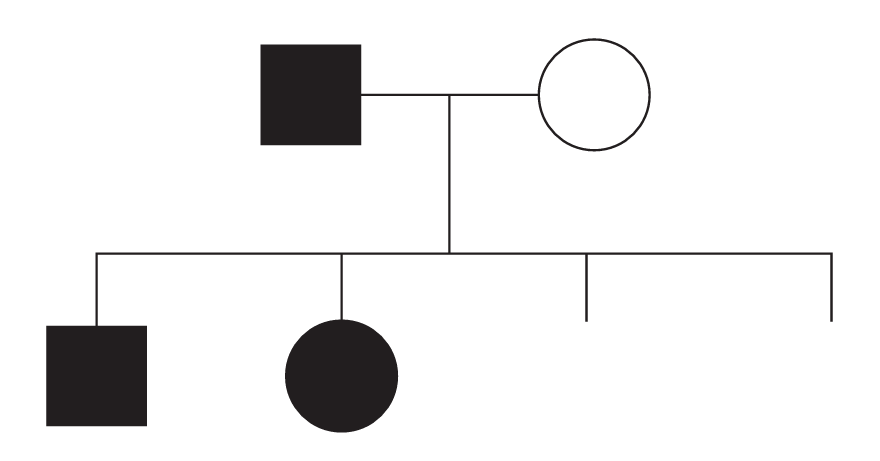
Question

The brain is part of the central nervous system.

(a) Name the other part of the central nervous system.

(b) Huntington’s disease (HD) is caused by a mutation in the gene for making a protein called huntingtin. This protein damages nerve cells in the brain. HD is caused by a dominant allele. A heterozygous parent and a homozygous recessive parent have a child.

(i) What is the probability of this child having HD? 

A) 0.0
B) 0.25
C) 0.5
D) 1.0

(ii) These parents have three more children. The key shows the possible sex and phenotype of the individuals with or without HD.

The family pedigree gives the predicted sex ratio and the predicted phenotype ratio for two of the children.

Complete the family pedigree by giving the predicted sex ratio and predicted phenotype ratio for the other two children.

(c) A drug can reduce the damage to nerve cells in the brains of people with HD. The drug binds to messenger RNA produced by the mutated gene for huntingtin protein. Suggest ways that this drug reduces damage to nerve cells in people with HD.

Most-appropriate topic codes (Edexcel IGCSE Biology):

2(j): Co-ordination and response — part (a)
3(b): Inheritance — parts (b)(i), (b)(ii), (c)
3(b): Protein synthesis — part (c)
2(j): Central nervous system — part (a)
▶️ Answer/Explanation
Solution

(a) spinal cord

(b)(i) C (0.5)
A is incorrect because 0.5 is the answer
B is incorrect because 0.5 is the answer
D is incorrect because 0.5 is the answer
Cross: Hh (heterozygous, HD) × hh (homozygous recessive, no HD). Probability of child inheriting H (HD) allele from heterozygous parent is \( \frac{1}{2} = 0.5 \).

(b)(ii) A diagram that makes reference to the following points:
• one circle and one square shown (1)
• two shapes unshaded (1)
For each of the two additional children, the predicted sex ratio is 1:1 (one male, one female). The predicted phenotype ratio for children from this cross is 1 with HD : 1 without HD. Therefore, for two more children, one is predicted to have HD and one without, with sexes not specified by probability.

(c) An explanation that makes reference to three of the following points:
• prevents translation / no translation (1)
• prevents ribosomes attaching (to mRNA) (1)
• prevents / no, codon binding to anticodon (1) Allow tRNA does not bind to mRNA
• prevents amino acids joining / amino acid chain not made (1)
• huntingtin / protein / polypeptide not made (1) Allow less huntingtin / protein made
The drug binds to the mutated mRNA, blocking the process of protein synthesis (translation). This prevents the formation of the harmful huntingtin protein, thereby reducing damage to nerve cells.
Question

Variation in a population can have different causes.

(a) Which of these will not lead to an increase in genetic variation in a population of plants?


(b) Explain how a change in the DNA of a microorganism can reduce its ability to digest a substance.

(c) Explain why a change in DNA may not affect the phenotype of an organism. 

Most-appropriate topic codes (Edexcel IGCSE Biology):

3(a): Reproduction — Sexual vs. asexual reproduction (part a)
3(b): Inheritance — Mutation, Protein synthesis (parts b, c)
2(c): Biological molecules — Enzymes (part b)
▶️ Answer/Explanation
Solution

(a) A (asexual reproduction)

  • B is not correct as it increases genetic variation
  • C is not correct as it increases genetic variation
  • D is not correct as it increases genetic variation

(b) An explanation that makes reference to five of the following points:

  1. Different (sequence of) bases in DNA / eq (1)
  2. Changes mRNA / codons (1)
  3. Transcription (1)
  4. Change tRNA / anticodons / (sequence of) amino acids (1)
  5. Translation (1)
  6. Changes structure / shape of protein / eq (1) (changes shape of active site = 2 marks)
  7. Changes active site (1)
  8. Enzyme not functional / no binding / no enzyme-substrate complex formed / eq (1)

(c) An explanation that makes reference to four of the following points:

  1. As some triplets / codons code for same amino acid / degenerative code / eq (1)
  2. No change in protein / polypeptide / enzyme produced (1)
  3. Active site not changed / affected (1)
  4. Mutation / allele may be recessive (1)
  5. So not expressed in phenotype / if heterozygous / dominant allele present / eq (1)
  6. Mutation may occur in a non-coding sequence of DNA / eq (1)
Question

A scientist investigates the effect of growth hormone (GH) on the body mass of rats.

This is his method.

  • give one rat a GH solution every day for 500 days
  • give another rat a control solution every day for 500 days
  • measure the mass of each rat each week for 500 days

The graph shows his results.

(a) Suggest how the control solution differs from the GH solution.

(b) Calculate the average rate of growth of the rat given GH solution from 100 days to 500 days. Give your answer in \(g\) per day.

(c) The scientist controlled all the variables in his investigation. Suggest two abiotic variables he controls.

(d) The scientist repeats his investigation using more rats. Explain why using more rats improves his investigation.

(e) GH increases transcription in cells. Explain why this affects the growth of rats.

Most-appropriate topic codes (Edexcel IGCSE Biology):

1.1, 3.44: Characteristics of living organisms, Hormones (growth) — context of the investigation
3.31: Homeostasis — controlled variables in (c)
Appendix 3: Mathematical skills — calculation in (b)
3(b): Inheritance — transcription and growth in (e)
Appendix 4: Command words (Suggest, Calculate, Explain) — across all parts
▶️ Answer/Explanation
Solution

(a) • no GH / water / saline / eq

(b) Increase in mass between 100 and 500 days: \(485 – 230 = 255g\)
Divide by the number of days: \(400\) days
Average rate = \(255 \div 400 = 0.6375\) \(g\)/day
Allow any answer between \(0.6375\) and \(0.65\) \(g\)/day.

(c) An answer that makes reference to two of the following points:
• temperature (1)
• (mass of) food / diet / type of food / eq (1)
• water (1)
• size of cage (1)
• time (of day measurements are taken) (1)
• volume of solution given / eq (1)

(d) An explanation that makes reference to two of the following points:
• avoids making wrong conclusion based on one / few result(s) / conclusion is valid / eq (1)
• can calculate mean / average (1)
• results are reliable / increase reliability (1)
• anomalous results recognised / eq (1)

(e) An answer that makes reference to three of the following points:
• (more) mRNA made (1)
• (more) translation (1)
• (more) proteins / polypeptides made (1)
• proteins are needed for growth / to make enzymes / muscle / tissue / eq (1)

Scroll to Top