
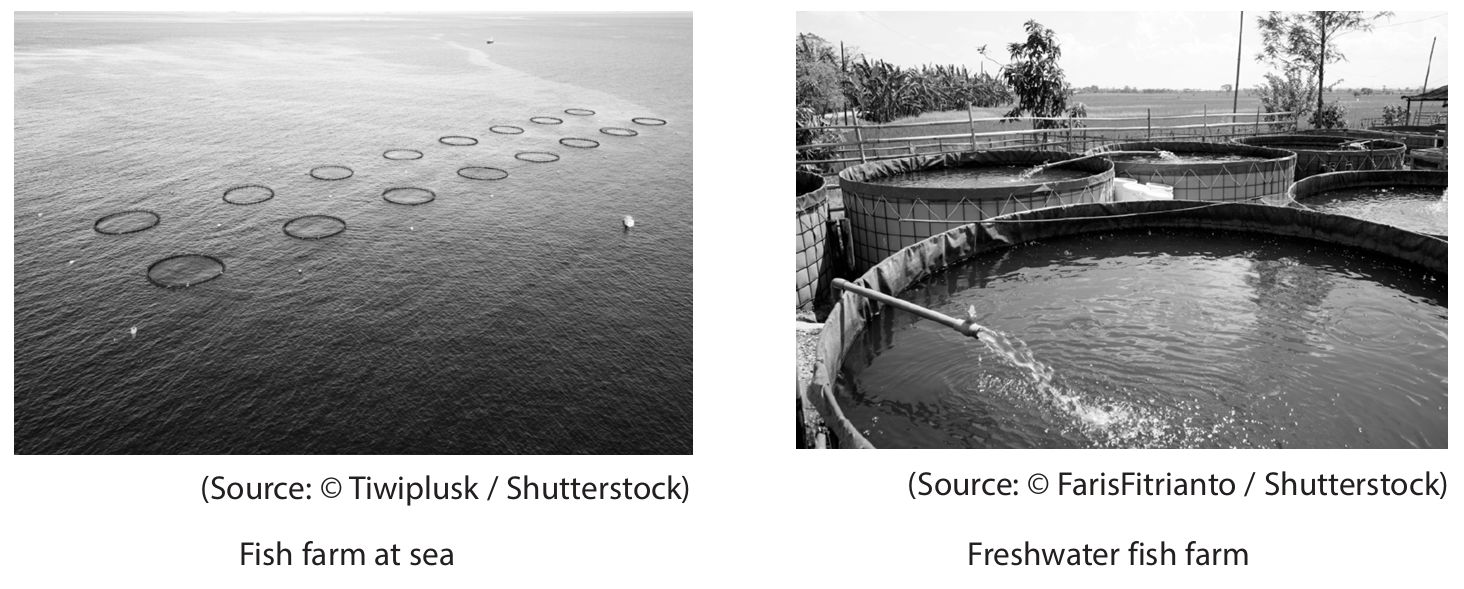
▶️ Answer/Explanation
(a) • drowning / being washed overboard / sinking / storms / (bad) weather / attacked / killed by sharks by predators / eq (1)
(b) An explanation that makes reference to three of the following points: (3)
1. only based on forecasts / model / not happened yet / can’t predict future / 30 years is a long way off / not guaranteed / eq (1)
2. other (scientists) have different view / only an opinion / government policy may change / eq (1)
3. amount of sea farms may change / may not work / unproven / untested / eq (1)
4. peoples’ tastes may changes / diet / choices / demand for fish may change / eq (1)
5. effect of climate change / sea temperature rising / levels rising / global warming /eq (1)
6. effect of pollution / eq (1)
(c) An explanation that makes reference to three of the following points: (3)
1. (fish) faeces / waste / uneaten food /eq (1)
2. nitrate / phosphate levels increase / eq (1)
3. leads to algal growth / eutrophication / (eq)
4. less oxygen (for respiration)/ oxygen used (by bacteria) / eq (1)
5. chemicals / hormones /eq (1)
6. bacteria / decomposers / eq (1)
(d)(i) A description that makes reference to two of the following points: (2)
1. pesticide / insecticide / fungicide / eq (1)
2. antibiotics / vaccinate fish / eq (1)
3. selective breeding / GM fish / eq (1)
4. separating / isolating diseased fish / removing sick / dead fish / eq (1)
5. low stocking density /eq (1)
(d)(ii) An explanation that makes reference to two of the following points: (2)
1. pesticide / insecticide / fungicide/ antibiotic / kill other organisms / disrupt food chain /eq (1)
2. (pesticide / insecticide / fungicide / antibiotics ) can (bio)accumulate / eq (1)
3. (antibiotics) lead to antibiotic resistance / eq (1)
4. selective bred / GM organisms may escape and interbreed / eq (1)
(e) An explanation that makes reference to two of the following points: (2)
1. deep water / greater volume / eq (1)
2. (so) dilution / reduces concentration / eq (1)
3. fast water flowing / eq (1)
4. (so) dispersed / carried away / eq (1)
(f) An answer that includes: (1)
• further from shore / further from land / isolated / longer distance to travel / no population nearby / need to use boat to reach / take a long time to get there / eq (1)
(g) An answer that includes one of: (1)
• is cheaper / use cheaper food (readily available) / surplus food / crop waste /eq (1)
• more efficient energy transfer / eq (1)
• will not eat each other / other fish / eq(1)
(h) An explanation that makes reference to two of the following points: (2)
• less fuel / less transport of equipment /supplies / workers / less food miles / eq (1)
• less energy used / less electricity / less machinery (in running / building) / eq (1)
• less carbon dioxide released (from burning the fossil fuel) / eq (1)
Total = 17 marks
▶️ Answer/Explanation
(a) A gene is a section or length of DNA that codes for a protein, polypeptide, or chain of amino acids.
Explanation: Genes are the fundamental units of heredity. They are specific sequences of DNA nucleotides that carry the instructions for building proteins. These proteins determine various traits and characteristics in organisms, such as hair color in cattle.
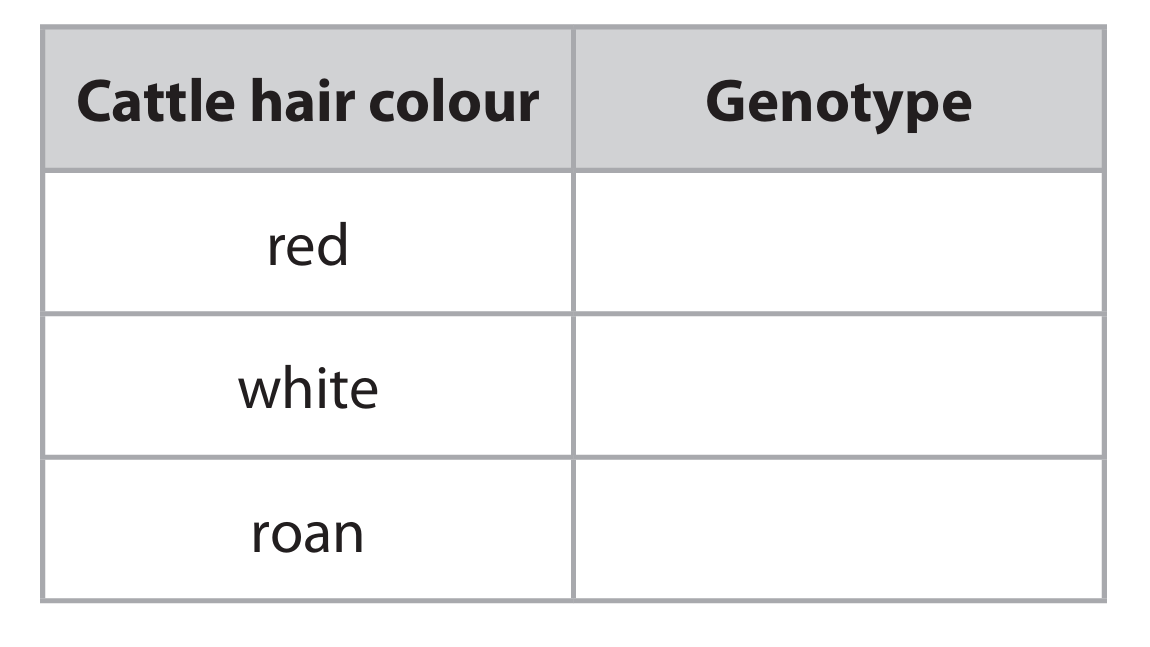
(b)(i)
| Cattle hair colour | Genotype |
|---|---|
| red | CRCR |
| white | CWCW |
| roan | CWCR or CRCW |
Explanation: Since the alleles are codominant, heterozygous cattle (CWCR) express both colors, resulting in the roan phenotype. Homozygous CRCR results in red, and homozygous CWCW results in white.
(b)(ii) Probability = 0.25 / ¼ / 25%
Genetic Diagram:
Parental genotypes: CWCR × CWCR
Parental gametes: CW or CR (from each parent)
Offspring genotypes:
- 1 CRCR : red
- 2 CWCR : roan
- 1 CWCW : white
Probability of a roan calf = 2/4 = ½
Probability of a male calf = ½
Therefore, probability of a male roan calf = ½ × ½ = ¼
Explanation: The genetic cross shows that there is a 50% chance of getting a roan calf. The sex of the calf is determined independently, with a 50% chance of being male. To find the combined probability of both events (roan AND male), we multiply the individual probabilities: ½ × ½ = ¼.
(c)(i) Height shows greater variation because it is a polygenic trait, controlled by multiple genes, whereas hair color is monogenic, controlled by a single gene. Additionally, environmental factors like nutrition can influence height but not hair color.
Explanation: Polygenic traits, such as height, involve many genes, each contributing a small effect. This results in a continuous range of phenotypes (e.g., various heights). In contrast, monogenic traits like hair color (controlled by one gene with two codominant alleles) have only three distinct phenotypes (red, white, roan). Furthermore, height can be affected by external factors like diet, while hair color is purely genetic.
(c)(ii) The farmer should select the tallest cattle and breed them together. From their offspring, select the tallest again and breed them. Repeat this process over several generations.
Explanation: Selective breeding works by consistently choosing individuals with the desired trait (height) and allowing them to reproduce. This increases the frequency of alleles associated with tallness in the population over time. By repeating this process, the farmer can gradually increase the average height of the cattle herd.
▶️ Answer/Explanation
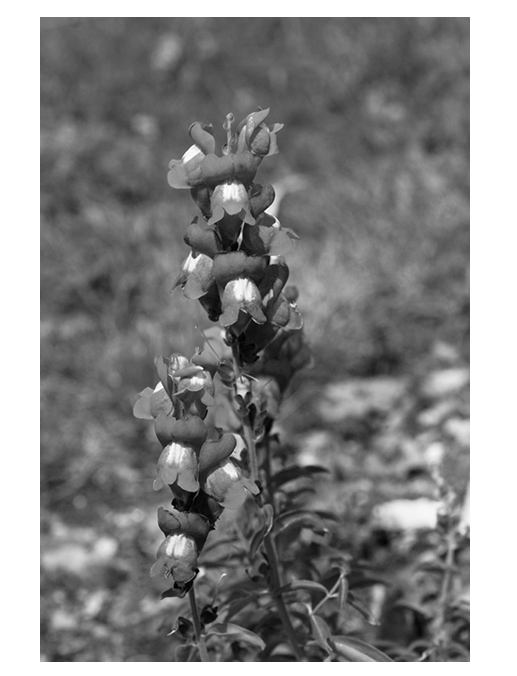
(a)(i) Selective breeding for brightly colored snapdragons involves first selecting parent plants that exhibit the desired bright flower coloration. These selected plants are then cross-pollinated to produce offspring. From these offspring, those that display the brightest flowers are selected again. This process of selection and breeding is repeated over several generations, gradually increasing the frequency of alleles responsible for bright flower coloration in the population, eventually producing a true-breeding variety with consistently bright flowers.
(a)(ii) Micropropagation is a tissue culture technique used to rapidly produce large numbers of genetically identical plants (clones). The process begins with taking small tissue samples (explants) from the parent plant, often from meristematic tissue. These explants are sterilized using ethanol or other disinfectants to remove any microorganisms. The sterile explants are then placed on a nutrient-rich agar medium containing essential minerals, sugars, amino acids, and plant growth regulators (such as auxins and cytokinins). Under controlled environmental conditions, the explants develop into small plantlets. These plantlets are eventually transferred to soil where they grow into mature plants genetically identical to the original parent plant.
(b)(i) Micropropagation is used to produce the plants for testing because it generates genetically identical clones. This ensures that any differences observed in phenotypes or DNA after radiation exposure are due to the radiation treatment itself rather than genetic variation between individual plants. Using clones controls for genetic variables, making the experiment more reliable and the results more valid.
(b)(ii) Answer: B (genome)
Explanation: The genome refers to the complete set of DNA in an organism, including all of its genes. A gene is a specific segment of DNA that codes for a particular protein or functional RNA. Genotype refers to the genetic makeup of an individual organism for specific traits. Nucleoid is the region in prokaryotic cells where DNA is located, but not the term for all DNA in an organism.
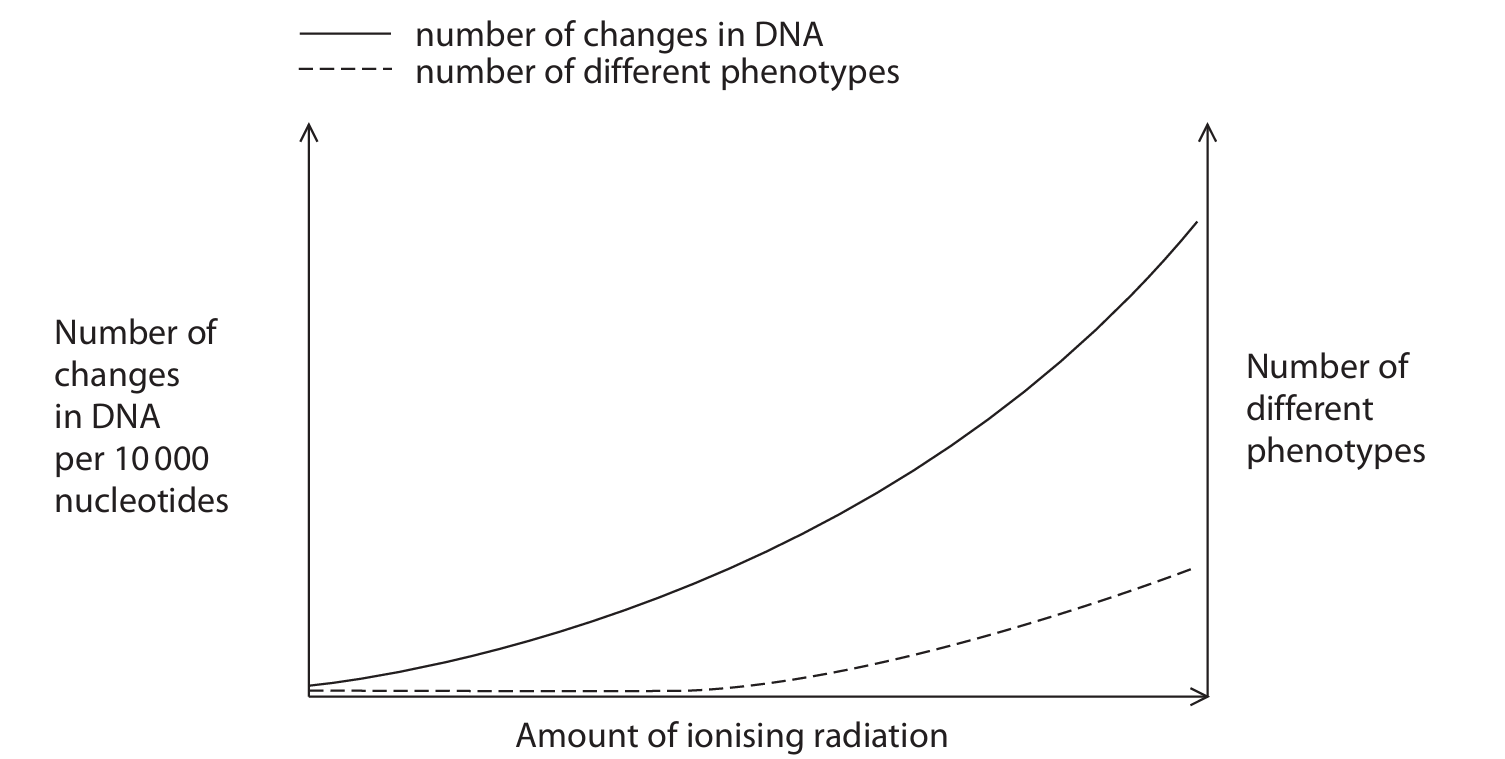
(b)(iii) Increasing ionising radiation has several effects on snapdragons. Firstly, it causes an increase in DNA mutations, as shown by the rising number of changes in DNA nucleotides. This occurs because radiation damages DNA by breaking strands or altering bases. Secondly, it increases phenotypic variation, as more different phenotypes appear with higher radiation doses. However, the relationship isn’t perfectly proportional – DNA changes increase more rapidly than phenotypic variations. This is because many mutations are silent (don’t change amino acid sequences), occur in non-coding regions, or are recessive and don’t affect the phenotype when heterozygous. Additionally, some mutations may be lethal and not represented in the phenotypic data. At very high radiation levels, the mutation rate may become detrimental to plant survival and reproduction.
▶️ Answer/Explanation
(a)
Explanation: Selective breeding involves a deliberate process to enhance desirable traits. To produce fish that grow rapidly, fish farmers would first identify and select parent fish that already exhibit fast growth rates. These selected fish are then bred together. From their offspring, the fastest-growing individuals are again selected to be the parents for the next generation. By repeating this process over many generations, the alleles (gene variants) responsible for rapid growth become more common in the population, leading to a stock of fish that consistently grows quickly.
(b)
Explanation: The conversion of ammonia to nitrates is a natural biological process called nitrification. This process is carried out by specific types of bacteria known as nitrifying bacteria. These bacteria are autotrophs that obtain energy by oxidizing nitrogen compounds. The process occurs in two main stages. First, bacteria such as Nitrosomonas convert ammonia (NH₃) into nitrites (NO₂⁻). Then, other bacteria, like Nitrobacter, convert these nitrites into nitrates (NO₃⁻). Nitrates are a form of nitrogen that can be more easily utilized by plants and algae.
(c)
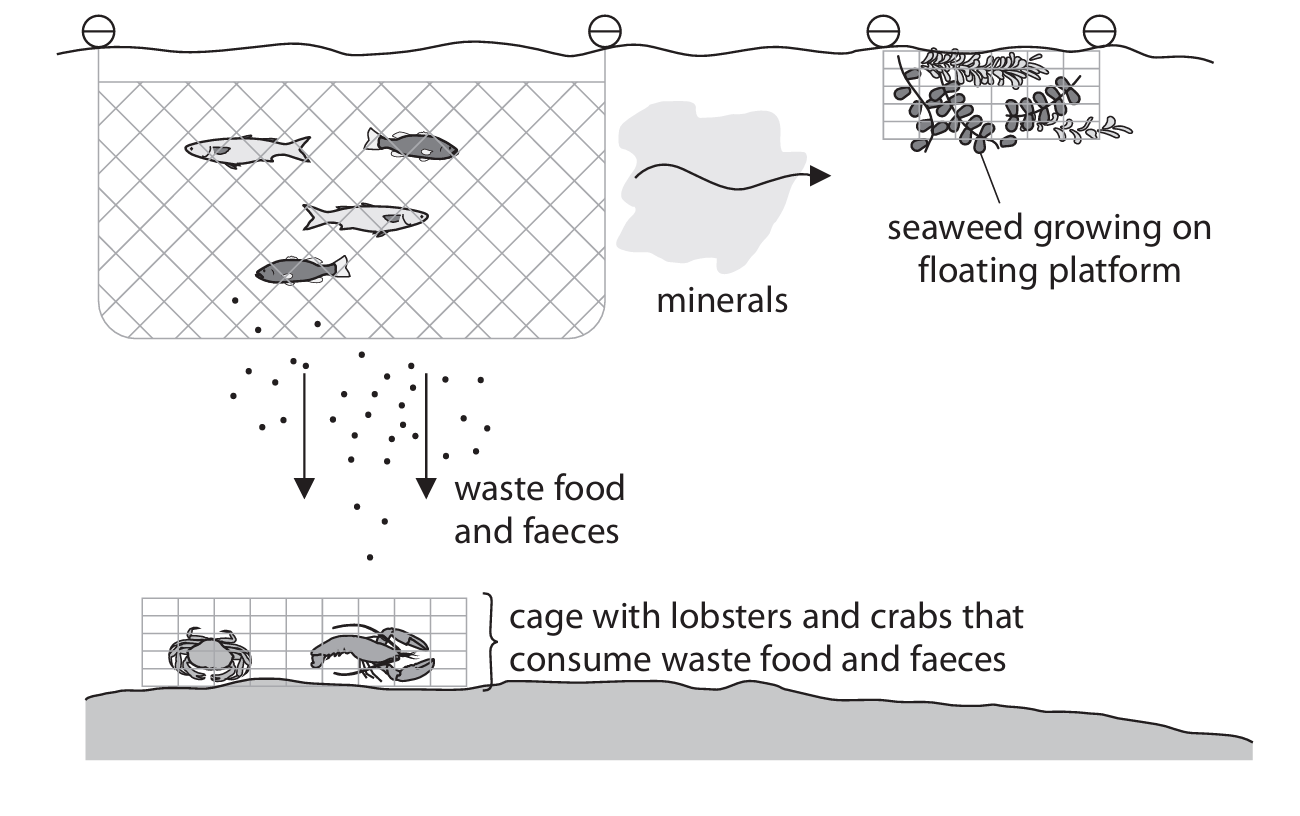
Explanation: The multi-trophic level aquaculture system is designed to create a more balanced and efficient ecosystem, which directly addresses pollution and profitability.
Reducing Pollution:
- The system significantly reduces solid waste pollution because lobsters and crabs consume the waste food and faeces produced by the main fish stock. This means less organic matter accumulates on the seabed.
- With less waste material available, there is a reduction in the population of decomposing bacteria. This is beneficial because these bacteria consume large amounts of oxygen during respiration; therefore, lower bacterial numbers help to maintain higher oxygen levels in the water, preventing oxygen depletion that can kill aquatic life.
- Furthermore, the seaweed plays a crucial role in reducing dissolved nutrient pollution. It absorbs nitrates, phosphates, and other minerals from the water that would otherwise act as fertilizers, potentially causing excessive algal growth (algal blooms) and eutrophication. The seaweed also releases oxygen through photosynthesis, further improving water quality.
Increasing Profits:
- This system creates additional saleable products. The farmer can now harvest and sell not only the main fish but also the lobsters, crabs, and seaweed, diversifying their income streams.
- It also reduces costs. There is no need to purchase extra feed for the lobsters and crabs, as they consume the waste from the fish. Similarly, the seaweed obtains its minerals naturally from the water, eliminating the need for artificial fertilizers.
- Healthier fish, resulting from the improved water quality (higher oxygen, lower disease risk), are likely to grow better and have lower mortality rates, leading to higher yields and reduced losses.
▶️ Answer/Explanation
(a)
• so semen contained sperm / (bull is) (sexually) mature / sperm in semen / gone through puberty / fully developed.
(b)
An explanation that includes two of the following points:
• collect semen / sperm from penis of bull (1)
• insert straw into / inject semen (into cow) (1)
• put (it / semen / sperm) in vagina / uterus / womb / cervix (1)
(c)(i)
• preserve (sperm) / keep (sperm) alive / viable / prevent growth of microorganisms / slow down metabolism.
(c)(ii)
• provide females (produce milk) / will produce cows.
(d)
\( 500\,000 \div 2.4 \text{ million} = 0.2083 \)
Percentage = \( 0.2083 \times 100 = 20.83\% \) (allow 1 mark for ÷ 2.4 million).
(e)
A description that makes reference to three of the following points:
• use semen (from each bull) to fertilise (many / similar) cows (1)
• collect / measure milk yields (1)
• from each daughter / offspring of these cows / mother of bull (1)
• select bull with highest (average) milk yield (across all daughters) (1)
(f)
An explanation that makes reference to two of the following points:
• (milk that contains) (most) fat (1)
• (most) protein (1)
• (most) vitamins (1)
• (milk that contains) (most) calcium (1)
(g)(i)
A description that makes reference to four of the following points:
• nucleus from (body) cell of bull (1)
• insert this nucleus into enucleated egg cell (1)
• electric shock (1)
• mitosis / cell division (1)
• embryo into uterus / womb (1)
• surrogate mother (1)
(g)(ii)
An explanation that makes reference to two of the following points:
• genetically identical / no genetic variation / same (combination of) alleles (1)
• quicker process (1)