Home / Edexcel iGCSE / Edexcel iGCSE Biology / Exam Style Questions

Edexcel iGCSE Biology 4BI1 - Paper 2B -Transport- Exam Style Questions- New Syllabus

Question

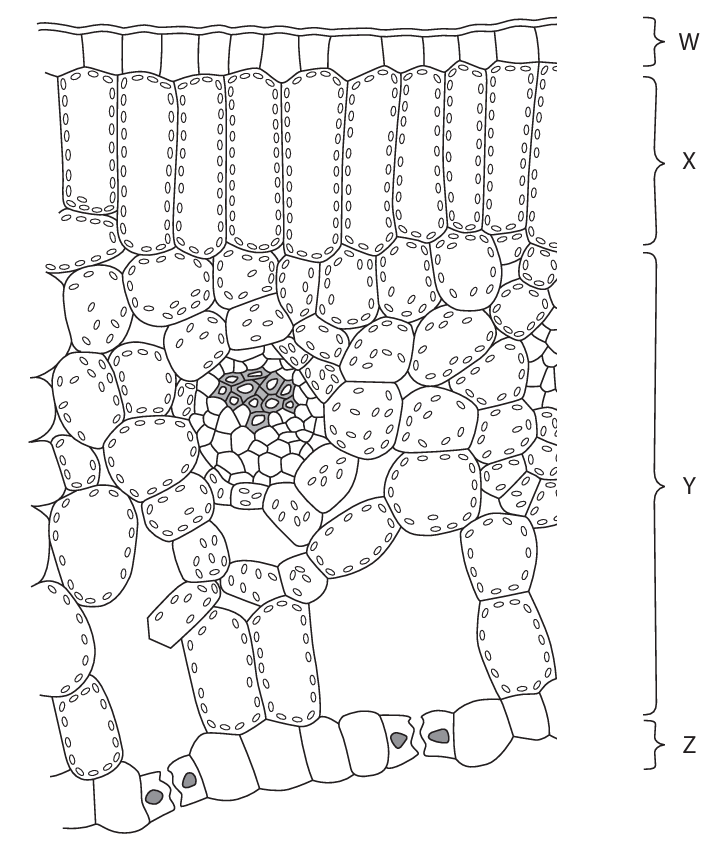
The diagram shows a cross section through a plant leaf.

(a) Which area of the leaf contains xylem vessels?

A) W
B) X
C) Y
D) Z

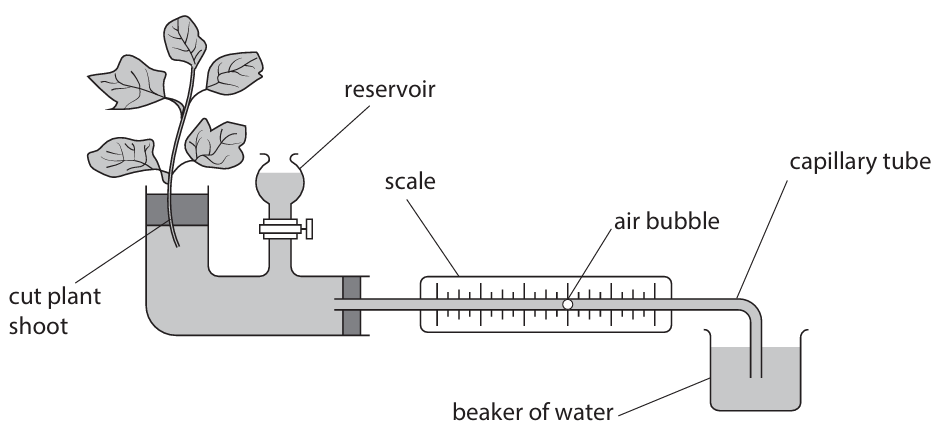
(b) A student uses this apparatus to measure the water uptake by a cut plant shoot.

(i) The inside of the capillary tube is a cylinder shape. The air bubble moves a length, \( l \), of 5.2 cm in 5 minutes. The inside of the capillary tube has a radius, \( r \), of 0.50 mm. Calculate the rate of water uptake, in \( \text{mm}^3 \) per minute, by the cut plant shoot.

[volume of cylinder = \( \pi r^2 l \)]
[\( \pi = 3.14 \)]

(ii) Describe how the student can use the apparatus to investigate the effect of changing wind speed on water uptake by the cut plant shoot.

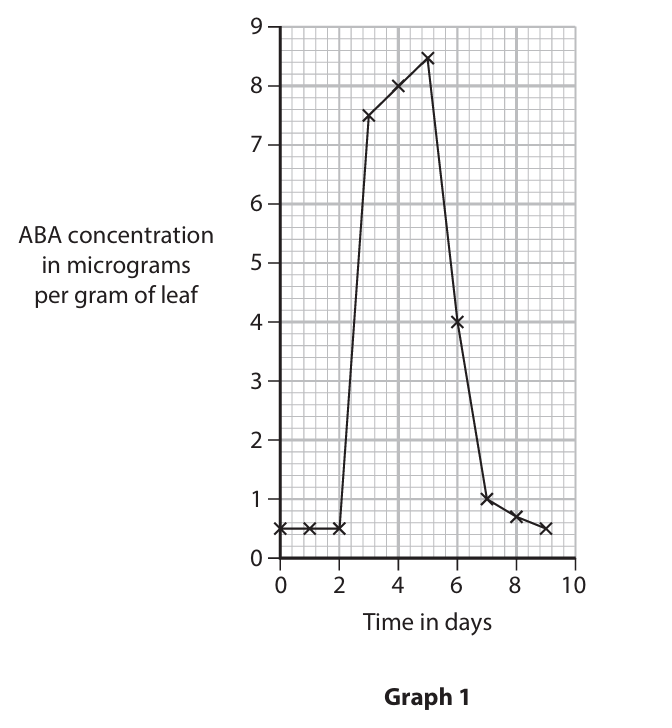
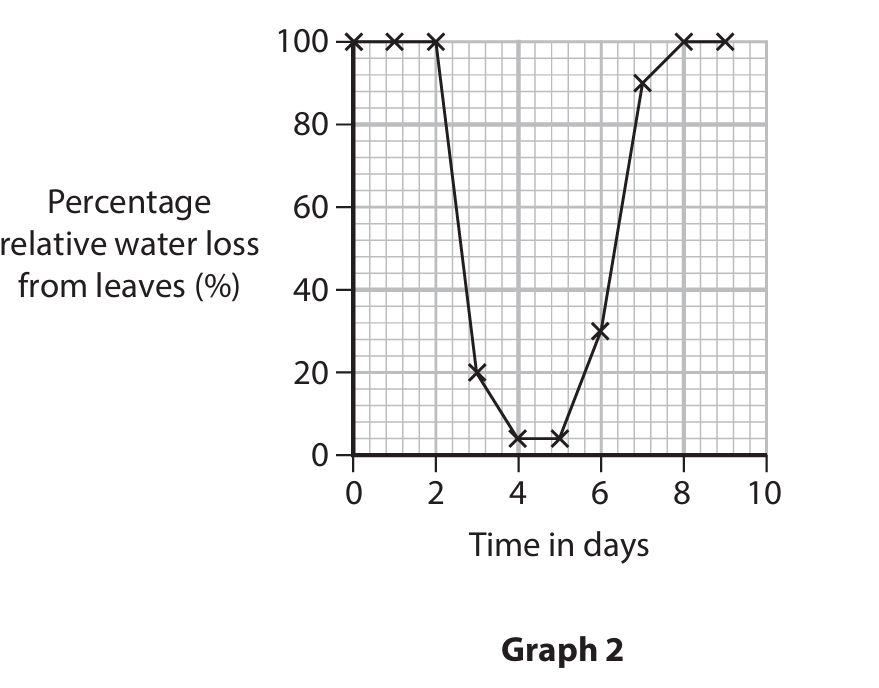
(c) A scientist investigates how ABA, an auxin-like substance, affects plant growth. The scientist does not water a plant for 4 days. They then water the plant on day 5.
Graph 1 shows the changes in the ABA concentration in the leaves of the plant.

Graph 2 shows the changes in percentage relative water loss from the leaves of the plant.

Comment on the changes in ABA concentration and water loss in the scientist’s investigation. Use information from both graphs in your answer.

Most-appropriate topic codes (Edexcel IGCSE Biology):

2(h): Transport — parts (a), (b)(i), (b)(ii)
2(j): Co-ordination and response — part (c)
2(b): Cell structure — part (a)
Appendix 3: Mathematical skills — part (b)(i)
▶️ Answer/Explanation
Solution

(a) C (Y)
A is not the answer as W does not contain xylem
B is not the answer as X does not contain xylem
D is not the answer as Z does not contain xylem

(b)(i) • 8.16(4) (2)
One mark for:
÷ by 5
OR
× 52
OR
× 0.25
OR
0.8(164)
OR
40.82 (allow between 40.82 and 40.85)

Working:
Convert length to mm: \( l = 5.2 \text{ cm} = 52 \text{ mm} \)
Volume = \( \pi r^2 l = 3.14 \times (0.50)^2 \times 52 = 3.14 \times 0.25 \times 52 = 40.82 \text{ mm}^3 \)
Rate = \( 40.82 \div 5 = 8.164 \text{ mm}^3/\text{min} \)

(b)(ii) A description that makes reference to four of the following points:
1. set up potometer underwater / cut stem underwater / dry leaves / eq (1)
2. use a fan at different distances / with and without fans / different fan speeds / eq (1)
3. leave for set time / stated time (1)
4. measure distance bubble moves / distance water moves (on scale) / eq (1)
5. keep other factors constant (1)
6. repeat / reset bubble with reservoir / eq (1)

(c) An answer that makes reference to four of the following points:
1. at start / for first two days, ABA is low / is 0.5 OR at start / for first two days water loss is high / is 100 (1)
2. after two days / from three days ABA increases OR after two days / from three days percentage water loss decreases / eq (1)
3. after five days / after watering / ABA decreases OR after five days / after watering water loss increases / eq (1)
4. as ABA increases water loss decreases / inverse relationship / negative correlation / eq (1)
5. ABA closes stomata / stomata open when ABA low / eq (1)
6. stomata close from two days / stomata close from three days / eq (1)
7. stomata closing reduces transpiration / water loss / evaporation / stomata closing prevents wilting / stomata closing prevents loss of turgidity / ABA reduces transpiration / eq (1)
8. light intensity may change / humidity may change / wind may change / eq (1)
Question

The lungs and the kidneys are excretory organs.

(a) (i) Which substances are excreted by the lungs?

A) carbon dioxide and urea
B) carbon dioxide and water
C) carbon dioxide, urea, and water
D) urea and water

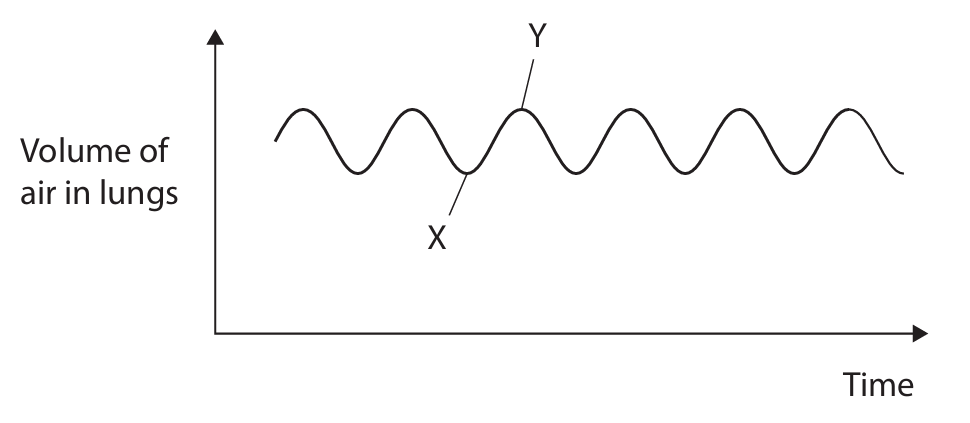
(ii) The graph shows how the volume of air in the lungs changes over time.

Explain the change in volume of air in the lungs from point X to point Y.

(b) People with a condition called diabetes often have very high blood sugar.

Urine from people with diabetes attracts ants but urine from people without diabetes does not attract ants.

Ants are insects that are attracted to glucose.

Explain why people with diabetes produce urine that can attract ants.

Most-appropriate topic codes (Edexcel IGCSE Biology):

2(i): Excretion — part (a)(i)
2(g): Gas exchange — part (a)(ii)
2(i): Excretion — part (b)
2(h): Transport — part (b)
▶️ Answer/Explanation
Solution

(a)(i) B (carbon dioxide and water)
A is not the answer as lungs do not excrete urea
C is not the answer as lungs do not excrete urea
D is not the answer as lungs do not excrete urea

(a)(ii) An explanation that makes reference to three of the following points:

  • volume increases / inhalation occurs / air drawn in (1)
  • diaphragm / intercostal muscles contract (1)
  • diaphragm moves down / flattens (1)
  • ribcage expands (1)
  • pressure decreases (inside thorax / lungs) (1)

Accept: internal intercostal muscles relax; ribs move up / move out; thorax / chest expands; pressure higher outside

(b) An explanation that makes reference to three of the following points:

  • glucose in urine (1)
  • glucose released by ultrafiltration (into filtrate) (1)
  • glucose not reabsorbed / too much glucose (in filtrate) to reabsorb (1)
  • in the proximal convoluted tubule / PCT / first convoluted tubule (1)
  • by active transport (1)

Accept: glucose not absorbed into blood; some glucose not reabsorbed
Reject: if active transport pumping glucose into filtrate
Question

Scientists collect data to measure how successful cloning is in cattle.

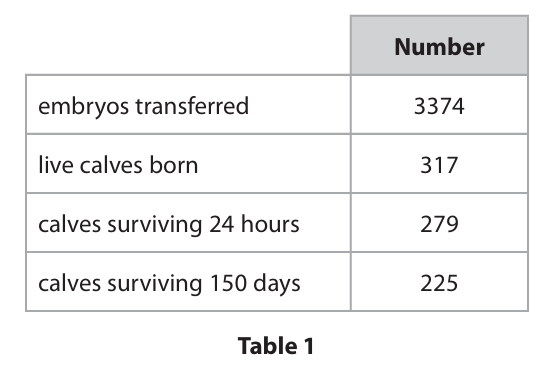
Table 1 shows the scientists’ data.

(a) Calculate the percentage of embryos transferred that result in live calves being born.

(b) Describe the stages in the production of a cloned mammal from an adult mammal.

(c) There is some evidence that cloned cattle may have weakened immune systems. Explain why a weakened immune system can affect the health of cloned cattle.

(d) Scientists also collected data comparing cloned cattle and a control group.

Table 2 shows their results.

 Group
 clonescontrols
number of cows1011
mean birth mass in kg45.839.6
mean age at puberty in days419.3356.5
mean body mass at puberty in kg359303
daily mass increase in kg per day0.750.78

Comment on the effects of cloning on the growth and development of these cattle.

Most-appropriate topic codes (Edexcel IGCSE Biology):

5(d): Cloning — parts (a), (b), (d)
2(h): Transport — part (c)
Appendix 3: Mathematical skills — part (a)
▶️ Answer/Explanation
Solution

(a)

Calculation: \( \frac{317}{3374} \times 100 = 9.40\% \)

Percentage = 9.40%

(b)

A description that makes reference to four of the following points:

  • use enucleated egg / empty egg / remove nucleus from egg
  • nucleus from body cell / diploid nucleus placed into empty egg
  • use of electricity / shock
  • cell division / mitosis
  • embryo into uterus / womb
  • surrogate mother

(c)

An explanation that makes reference to two of the following points:

  • fewer white blood cells / phagocytes / lymphocytes / memory cells
  • fewer antibodies produced / antibodies produced slower / less phagocytosis / less engulfing
  • less resistance / more susceptible to infection / disease / pathogen not killed / pathogen remains

(d)

An answer description that makes reference to four of the following:

  • small study few cows involved
  • not repeated / not reliable / no information on strain / breed / type only females / only cows
  • higher birth mass in clones
  • older at puberty in clones / puberty later in clones
  • higher mass at puberty in clones
  • small difference / slight difference in growth rate / no significant difference in growth rate / slightly lower daily mass increase
  • no reference to diet / hormones / supplements
Question

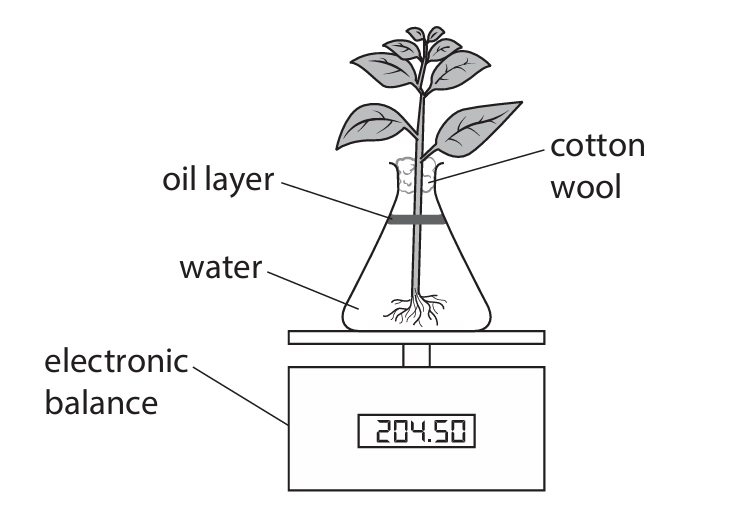
A student uses this apparatus to investigate water loss from a plant.

This is the student’s method:

  1. Measure the total mass of the flask, water, oil, cotton wool and plant
  2. Leave the apparatus for 48 hours
  3. Measure the new total mass of the flask, water, oil, cotton wool and plant
  4. Calculate the rate of change of mass during the 48 hours

Repeat steps 1-4 with the same conditions.

(a) Name the piece of apparatus used in this investigation.

A) bubble potometer
B) hydrometer
C) osmometer
D) weight potometer

(b) The total mass changes from 207.25 g to 204.50 g in the first 48 hours. Calculate, in grams per hour, the rate of change of mass.
Give your answer to two significant figures.

(c) Explain why the student repeats the investigation with the same conditions.

(d) The student then changes the conditions surrounding the plant.

(i) Describe how the student could investigate the effect that moving air has on the change in mass.
(ii) Explain the effect that faster moving air has on the change in mass.

(e) Describe how the student could modify the investigation to study the role of roots in the loss of water from a plant.

Most-appropriate topic codes (Edexcel IGCSE Biology):

2(h): Transport — parts (a), (b), (d)(ii), (e)
3.6B-3.8B: Transpiration — parts (a), (b), (d)(ii)
4: Experimental skills — parts (c), (d)(i), (e)
▶️ Answer/Explanation
Solution

(a) D (weight potometer)

A is not the answer as it is not a bubble potometer
B is not the answer as it is not a hydrometer
C is not the answer as it is not an osmometer

(b) Calculation:

\[ \text{Rate} = \frac{207.25 – 204.50}{48} = \frac{2.75}{48} = 0.05729 \text{ g/h} \]

To two significant figures: \(0.057\) g/h

(c) An explanation that makes reference to two of the following:

  • can calculate mean/average
  • increases reliability
  • allows detection/exclusion of anomalous results/ensure results are concordant
  • change in conditions could affect water loss/results

(d)(i) A description that makes reference to the following:

  • use fan/hairdryer
  • control other/named environmental condition/temp/light

(d)(ii) An explanation that makes reference to three of the following:

  • moves moist air/water molecules away from leaf surface/stomata/reduces humidity
  • increases/restores concentration gradient
  • increases transpiration/evaporation/diffusion
  • more mass lost/mass changes more

(e) A description that makes reference to two of the following:

  • have two plants of same species/same type/same size/same leaf area/use same plant
  • remove roots
  • control named environmental condition/temperature/light/moving air
Question

Isotonic drinks are often used to rehydrate athletes after exercise.

(a) Explain why athletes lose water during exercise. 

(b) Isotonic drinks contain salt and sugar solutions that are the same concentration as normal blood plasma.

A scientist uses this method to investigate how well an isotonic drink rehydrates athletes.

  • three athletes exercise for one hour
  • one athlete has no drink
  • the second athlete drinks \(1000\ \text{cm}^3\) of pure water
  • the third athlete drinks \(1000\ \text{cm}^3\) of isotonic drink
  • the volume and colour of urine produced by each athlete are measured one hour later

The table shows the scientist’s results.

Drink consumed by athleteVolume of urine produced in \(\text{cm}^3\)Colour of urine
no drink100very dark yellow
pure water750very light yellow
isotonic drink500yellow

(i) Explain the results shown in the table for the athlete who consumed no drink.
(ii) Explain the differences in urine volume and urine colour produced by the athlete who consumed the isotonic drink and the athlete who consumed pure water. 

Most-appropriate topic codes (Edexcel IGCSE Biology):

1(a): Characteristics of living organisms — part (a)
2(h): Transport (Humans) — part (a, b)
2(i): Excretion (Humans) — parts (b)(i), (b)(ii)
2(j): Co-ordination and response (Homeostasis) — parts (b)(i), (b)(ii)
▶️ Answer/Explanation
Solution

(a) An explanation that makes reference to two of the following:

  • Exercise increases body temperature / eq (1)
  • (More) sweat / eq (1)
  • To cool down / lose heat / eq (1)
  • By evaporation (of sweat) (1)

(b)(i) An explanation that makes reference to three of the following:

  • Blood concentration increases / less water in blood / eq (1)
  • (Detected by) hypothalamus / osmoreceptors / pituitary gland (1)
  • Releases ADH (1)
  • Collecting duct becomes more permeable / eq (1)
  • Increased water reabsorption (so less urine produced) (1)

(b)(ii) An explanation that makes reference to two of the following:

  • With (pure water) blood becomes more dilute / less concentrated / has high water concentration / eq (1)
  • Less / no ADH released when drinking water / eq (1)
  • Less water reabsorbed (by kidney) when water drunk / eq (1)
  • Salt / sugar absorbed into blood (in intestine) (from isotonic drink) / eq (1)

Accept converse arguments for the isotonic drink (e.g., more ADH released, more water reabsorbed).

Question

Transpiration (water loss) is affected by several environmental factors.

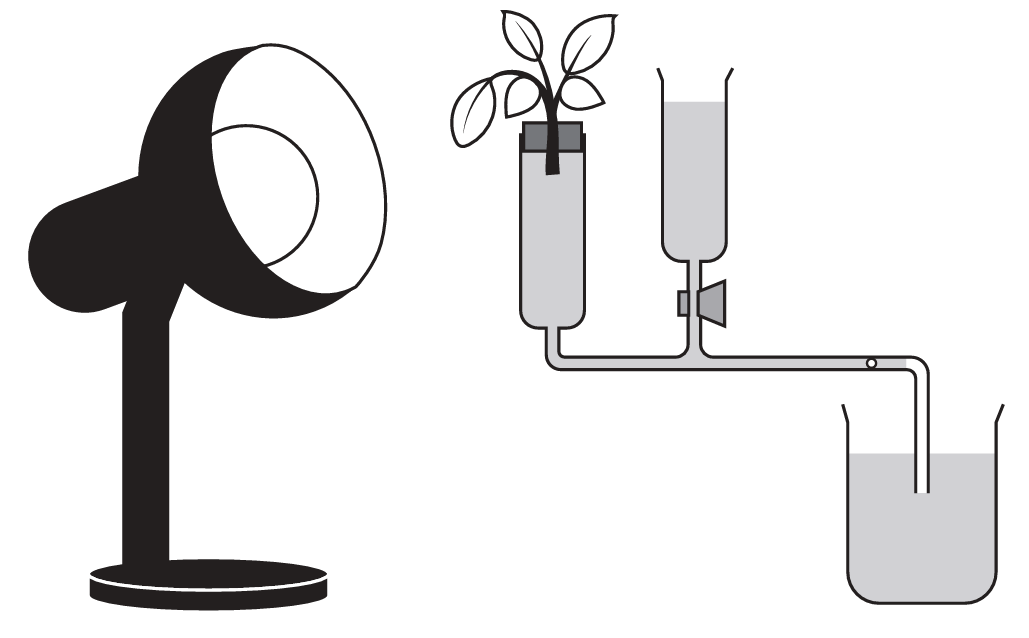
A student investigates the effect of light intensity on water loss from a plant shoot. The diagram shows some of the apparatus the student uses.

The student predicts that water loss from a plant shoot will increase as light intensity increases.

(a) (i) Describe how to set up and use the student’s apparatus to test this prediction. 
(ii) State the dependent variable in this investigation.

(b) Another student uses the apparatus to collect and process the data. Table 1 shows their results.

Light intensity in arbitrary unitsMean volume of water lost by shoot in 10 minutes in mm3
02
58
1012
1512
Table 1

(i) Explain why light intensity changes the mean volume of water lost by the shoot.

(ii) The student repeats the experiment with a plant that is adapted to live in desert environments. Table 2 shows the results for this desert plant.

Light intensity in arbitrary unitsMean volume of water lost by shoot in 10 minutes in mm3
06
54
100
150
Table 2

The desert plant has adaptations to survive in desert environments where not much water is available.

Explain why the results for this desert plant, in table 2, are different from the results in table 1.

Most-appropriate topic codes (Edexcel IGCSE Biology):

2(h): Transport — parts (a)(i), (a)(ii), (b)(i), (b)(ii) [focus on transpiration]
2(g): Gas exchange in plants — parts (b)(i), (b)(ii) [link to stomatal behavior]
3(b): Structure and functions in living organisms: Part 1 (Nutrition in plants) — implicit link to water uptake
4(a): Ecology and the environment — part (b)(ii) [adaptations to environment]
▶️ Answer/Explanation
Solution

(a)(i) Mark Scheme Summary: A description that makes reference to four of the following points (1 mark each):

  1. Cut shoot underwater / cut shoot diagonally.
  2. Ensure apparatus is airtight (e.g., dry leaves, check seals, use petroleum jelly).
  3. Measure distance bubble moves / distance water moves in capillary tube.
  4. Measure this movement over a set time.
  5. Place lamp at different distances from the shoot (to vary light intensity).
  6. Control other variables (e.g., temperature, humidity).
  7. Repeat readings / use reservoir to reset bubble.

(a)(ii) Water loss / distance moved by bubble / volume of water taken up / time taken to move bubble / rate of bubble movement.
Accept: water uptake / transpiration speed.

(b)(i) An explanation that makes reference to two of the following (1 mark each):

  1. More water loss as light intensity increases (more transpiration/evaporation).
  2. Because (more) stomata open / stomata open wider.
  3. Until all stomata are open (completely) / until stomata are fully open.

(b)(ii) An explanation that makes reference to three of the following (1 mark each):

  1. Desert plant loses less water in total / retains/conserves water.
  2. Water is lost in low light / water is not lost in high light (water loss decreases as light intensity increases for desert plant).
  3. Stomata close in light/day / stomata open in dark/night (reverse of normal plants).
  4. Desert plants have fewer stomata.
  5. This adaptation reduces wilting / stops plant going flaccid.
Question

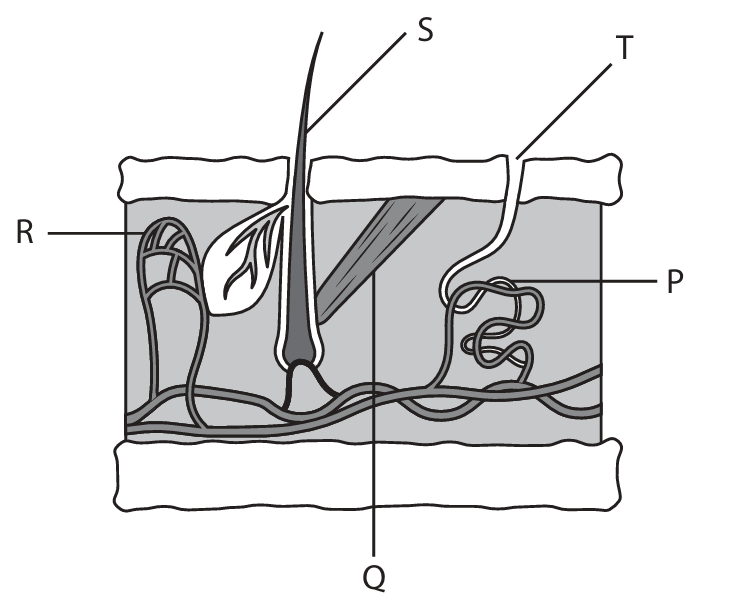
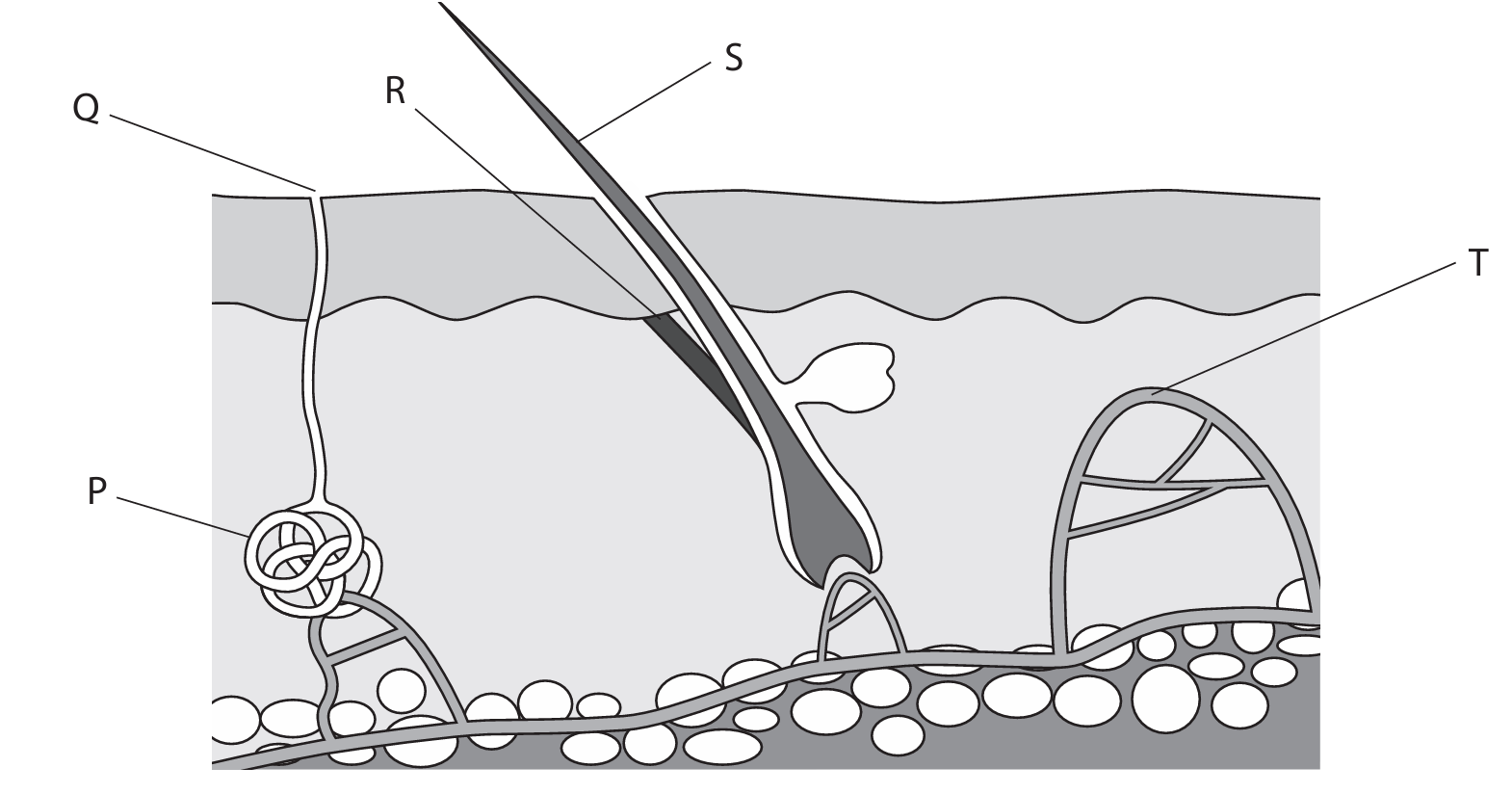
The diagram shows a section of human skin with some structures labelled.

(a) (i) Which structure is a pore of a sweat gland?

A) Q
B) R
C) S
D) T

(ii) Which structure carries blood?

A) P
B) R
C) S
D) T

(iii) The skin responds to changes in temperature.

Describe how the skin responds when a person enters a cold environment. 

(b) Scientists investigate the effect of heat strain on two groups of men. Heat strain is caused by increasing the external temperature. The scientists measure the skin temperature with no heat strain, low heat strain and moderate heat strain. They also measure the rate of sweating with low and moderate heat strain.

The table shows the scientists’ results.

GroupNumber in groupMean age in yearsMean skin temperature in °CMean sweating rate per cm² of skin in mg per min
no heat strainlow heat strainmoderate heat strainlow heat strainmoderate heat strain
young142434.937.638.11.01.2
old166934.037.337.70.20.8

Discuss the relationship between age and the effect of heat strain on the mean skin temperature and the mean rate of sweating. Use information from the table and your own knowledge in your answer. (5)

Most-appropriate topic codes (Edexcel IGCSE Biology):

2(j): Co-ordination and response — parts (a)(iii), (b)
2(j): Homeostasis — parts (a)(iii), (b)
2(b): Cell structure and function — parts (a)(i), (a)(ii)
2(h): Transport in humans — part (a)(ii)
▶️ Answer/Explanation
Solution

(a)(i) D (T)
A is not correct as Q is not the pore of a sweat gland
B is not correct as R is not the pore of a sweat gland
C is not correct as S is not the pore of a sweat gland

(a)(ii) B (R)
A is not correct as P is not the structure that carries blood
C is not correct as S is not the structure that carries blood
D is not correct as T is not the structure that carries blood

(a)(iii) A description that makes reference to four of the following points:
1. vasoconstriction (1)
2. arterioles supplying capillaries near skin surface constrict / blood vessels supplying skin narrow (1)
3. less blood flows to skin surface (1)
4. hair erector muscle contracts / hair stands up (1)
5. traps air / insulates (1)
6. less heat loss by radiation / convection / evaporation (of sweat) (1)
7. less sweating (1)

(b) An answer that makes reference to five of the following points:
1. (mean) skin temperature is higher in young (1)
2. (mean) skin temperature is higher with heat strain (1)
3. mean sweating rate higher in young (1)
4. mean sweating rate higher in moderate/higher heat strain (1)
5. smaller difference in sweating rate between low and moderate strain in young (1)
6. no information on sweat rate with no heat strain / at rest (1)
7. more sweat glands in young / each gland produces more sweat in young (1)
8. young can reduce (core) body temperature faster / young less likely to overheat (1)
9. numbers very small / not repeated / unreliable / no information on age (1)
10. no information on BMI / fat layers / health / diet (1)
Question

(a) The diagram shows a section through the skin with some structures labelled.

(i) Which structure is the sweat gland?

  • A. P
  • B. Q
  • C. S
  • D. T

(ii) Which structure is a capillary?

  • A. Q
  • B. R
  • C. S
  • D. T

(iii) Describe the changes that take place in the blood vessels in the skin if a person moves to a hot environment.

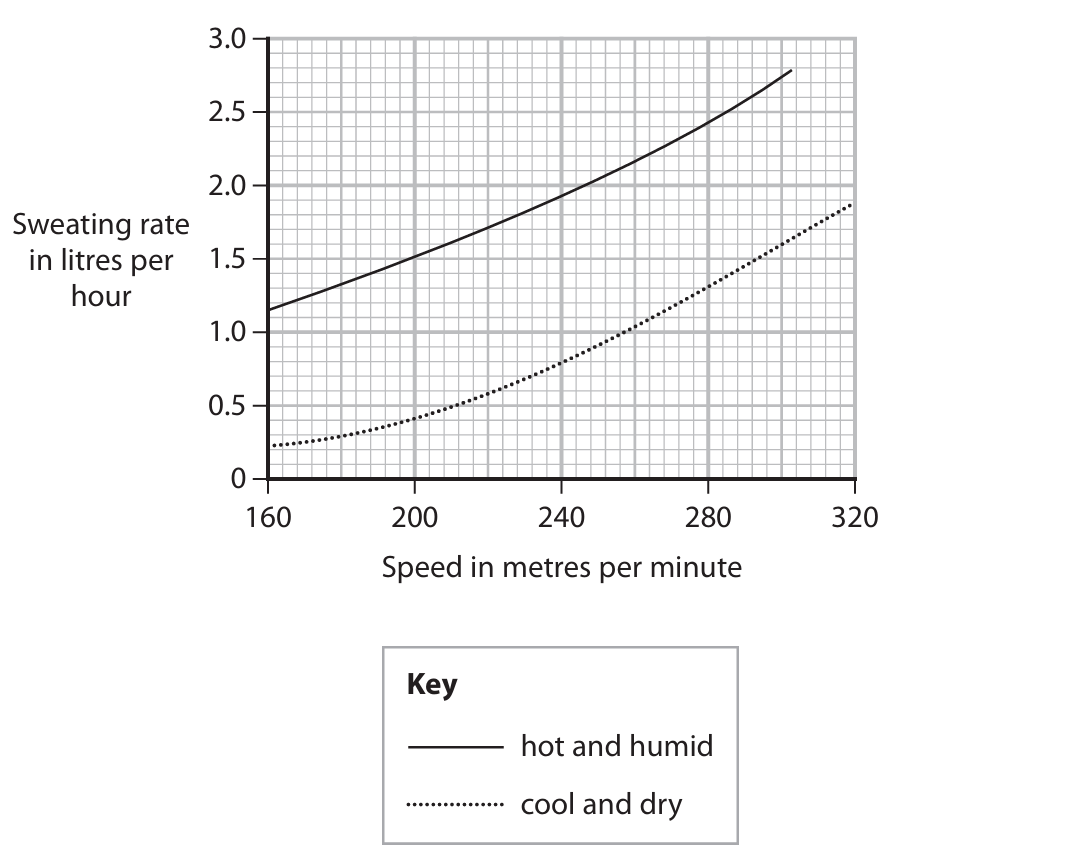
(b) Scientists investigate the release of sweat from human skin when a person runs at different speeds. They measure the rate of sweating in litres per hour. They take measurements in two environments. The first environment is hot and humid, and the second environment is cool and dry. The graph shows the scientists’ results.

(i) Give the dependent variable in this investigation.

(ii) A person runs at a speed of 220 metres per minute in hot and humid conditions. Calculate the volume of sweat the person releases in 15 minutes.

(iii) Using information from the graph, discuss the effect of increased running speed on sweating in the two environments.

Most-appropriate topic codes (Edexcel IGCSE Biology):

2(j): Co-ordination and response — parts (a)(i), (a)(iii), (b)
2(h): Transport — part (a)(ii)
2(j): Homeostasis and skin function — parts (a)(i), (a)(iii), (b)
Appendix 4: Mathematical skills — part (b)(ii)
Appendix 5: Command word taxonomy — parts (b)(i), (b)(iii)
▶️ Answer/Explanation
Solution

(a)(i) A (P)

Explanation: The sweat gland is correctly identified as structure P. Sweat glands are coiled tubular structures found in the dermis layer of the skin that produce sweat, which helps regulate body temperature through evaporation.

(a)(ii) D (T)

Explanation: Capillaries are the smallest blood vessels where exchange of gases, nutrients, and waste products occurs between blood and tissues. In skin diagrams, capillaries are typically shown as tiny vessels near the skin surface, which matches structure T.

(a)(iii) Vasodilation occurs, increasing blood flow to the skin surface for heat loss.

Explanation: When a person moves to a hot environment, several changes occur in the blood vessels of the skin to facilitate heat loss. Vasodilation occurs, where the arterioles and small arteries supplying the skin widen. This allows more blood to flow through the capillaries near the skin surface. The increased blood flow brings more heat to the skin surface where it can be radiated away. This process helps cool the blood and ultimately reduces core body temperature. These changes are part of the body’s thermoregulatory response to prevent overheating in hot conditions.

(b)(i) Sweating rate (in litres per hour)

Explanation: The dependent variable is the factor being measured in response to changes in the independent variable. In this investigation, scientists are measuring how sweating rate changes with running speed and environmental conditions, making sweating rate the dependent variable.

(b)(ii) 0.425 litres

Explanation: From the graph, at 220 m/min in hot/humid conditions, the sweating rate is approximately 1.7 L/hour. To find the volume in 15 minutes (which is 0.25 hours): Volume = Rate × Time = 1.7 L/hour × 0.25 hour = 0.425 L. This calculation shows that the person would release 0.425 litres of sweat in 15 minutes under these conditions.

(b)(iii) Sweating rate increases with running speed in both environments, but is consistently higher in hot/humid conditions.

Explanation: The graph shows several important relationships: In both environments, sweating rate increases with running speed, indicating that higher exercise intensity generates more body heat that needs to be dissipated. The hot and humid environment consistently results in higher sweating rates across all running speeds compared to the cool and dry environment. This occurs because in humid conditions, sweat evaporates less efficiently, so the body produces more sweat to achieve the same cooling effect. The similar slope of both lines suggests that the relationship between running speed and sweating rate is consistent regardless of environmental conditions, though the baseline sweating rate is higher in hot/humid conditions. These findings demonstrate how both internal factors (exercise intensity) and external factors (environmental conditions) influence the body’s thermoregulatory response through sweating.
Question

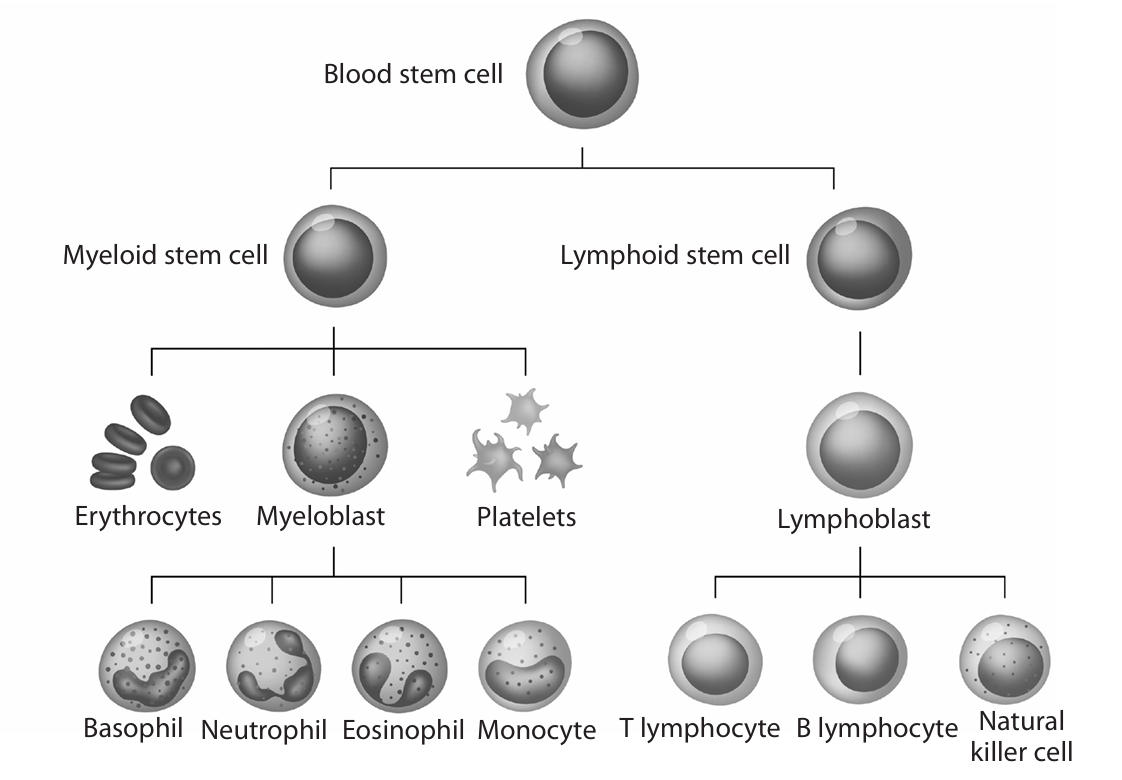
The diagram shows how human blood develops from blood stem cells.

(a) Describe how stem cells are different from most body cells.

(b) Describe the role of platelets in the body.

(c) Explain how vaccination protects the body from disease.

(d) Blood stem cells can be used to treat blood disorders such as sickle cell anaemia which affects red blood cells and leukaemia which affects white blood cells.

Explain why blood stem cells can be used to treat a variety of blood disorders.

Most-appropriate topic codes (Edexcel IGCSE Biology):

2(b): Cell structure — part (a)
2(h): Transport — part (b), (d)
2(b): Cell differentiation and specialized cells — part (a), (d)
2.63B: Vaccination and immune response — part (c)
▶️ Answer/Explanation
Solution

(a) Stem cells are unspecialized/undifferentiated and can divide by mitosis to form other cell types/specialized cells.

Detailed Explanation: Unlike most body cells which are specialized for specific functions (like nerve cells for transmitting signals or muscle cells for contraction), stem cells have not yet undergone differentiation. This means they haven’t developed the specific structures and functions of mature cells. Their key abilities are to continuously divide through mitosis to produce more stem cells (self-renewal) and to differentiate into various specialized cell types when given the right signals. This makes them fundamentally different from the majority of cells in our body that are locked into their specific roles.

(b) Platelets help blood to clot, prevent blood loss, and prevent entry of pathogens.

Detailed Explanation: Platelets are tiny cell fragments that circulate in the blood. When a blood vessel is damaged, they rush to the site and become activated. They change shape, become sticky, and clump together to form a temporary plug that helps stop bleeding. More importantly, they release chemicals that trigger a complex process called the clotting cascade. This process converts a soluble plasma protein called fibrinogen into insoluble strands of fibrin. These fibrin strands form a mesh that traps red blood cells and more platelets, creating a stable blood clot that seals the wound. This not only prevents further blood loss but also creates a barrier that prevents microorganisms like bacteria and viruses from entering the body through the break in the skin.

(c) Vaccination introduces dead/weakened pathogens or their antigens into the body. Lymphocytes respond by producing antibodies and memory cells. If the same pathogen infects the body later, memory cells trigger a faster, stronger secondary immune response with more antibodies produced sooner.

Detailed Explanation: Vaccines work by safely simulating an infection without causing the disease. They contain either killed or greatly weakened (attenuated) pathogens, parts of pathogens (like proteins or sugars which act as antigens), or inactivated toxins. When administered, these antigens are recognized as foreign by the immune system. Specifically, white blood cells called lymphocytes are activated. B lymphocytes produce antibodies that can bind to and neutralize the specific antigens. Additionally, special memory B cells and memory T cells are created during this primary response. These memory cells remain in the body for a long time, sometimes for life. If the person is later exposed to the actual, live pathogen, these memory cells recognize the antigens immediately. They mount a rapid and massive secondary immune response, producing a huge amount of the correct antibodies much faster than the first time. This swift response usually destroys the pathogen before it can multiply to sufficient numbers to cause illness, thus providing protection.

(d) Blood stem cells can differentiate into various blood cells (red blood cells, white blood cells, platelets). They can make red blood cells to transport oxygen and white blood cells to destroy pathogens. They can also make platelets to help blood clotting.

Detailed Explanation: Blood stem cells, also known as hematopoietic stem cells, are multipotent. This means they have the potential to differentiate into all the different types of specialized cells found in blood. This includes red blood cells (erythrocytes) which carry oxygen, the various types of white blood cells (leukocytes like lymphocytes, phagocytes) which fight infection and provide immunity, and platelets (thrombocytes) which are crucial for clotting. In disorders like sickle cell anaemia, the patient produces faulty red blood cells. A transplant of healthy blood stem cells can provide a new population of cells that can differentiate into healthy, oxygen-carrying red blood cells. In leukaemia, a cancer of white blood cells, chemotherapy is often used to destroy the cancerous cells, but this also destroys healthy stem cells. A stem cell transplant then repopulates the bone marrow with healthy stem cells that can differentiate into functional white blood cells, effectively restarting the immune system. Their ability to become any blood cell type makes them a versatile treatment for a wide range of blood disorders.
Question

Read the passage below. Use the information in the passage and your own knowledge to answer the questions that follow.

Kidney transplants

The main role of the kidneys is to filter waste products from the blood. If the kidneys lose this ability, waste products can build up, which could lead to death. This loss of kidney function, known as kidney failure, is the most common reason for needing a kidney transplant.

It is possible to use a kidney machine to partially perform the functions of the kidney, using a blood filtering procedure known as dialysis. However, this can be inconvenient and it takes a long time. A kidney transplant is a better solution for kidney failure whenever possible.

A kidney transplant is suitable for people of all ages who need to have one, if they are fit enough for surgery. If a patient has an infection this will need to be cured before the transplant. The person who receives the transplant must agree to continue with the recommended treatments after the transplant. These treatments include taking medication known as immunosuppressant drugs.

People have two kidneys, but they can survive well with only one kidney. This means it is possible for a person to donate a kidney while they are alive. This is known as a living donation. People who want to be considered as a living donor are carefully tested to make sure they are a suitable donor and are fit for the operation needed to remove a kidney. Living donations are best from a close relative as this reduces the risk of the body rejecting the kidney. In the United Kingdom, the number of living donations in 2020 was 1040. In 2021 the number of living donations was 429.

Kidney donations are also possible from people who have recently died. This is known as deceased kidney donation. However, this type of kidney donation has a slightly lower chance of long-term success. In the United Kingdom, the number of deceased donations in 2020 was 2283. In 2021 the number of deceased donations was 1836.

People who need a kidney transplant, but do not have a suitable living donor, will have to wait until a suitable deceased donor kidney becomes available. In the United Kingdom, the average waiting time for a deceased donor kidney transplant is between 30 months and 36 months.

Kidney donors are particularly required from people of non-white ethnic origin, as kidney disease is more common in people of South Asian, African and Afro-Caribbean ethnic origin. However, there are not many donors from these communities.

When a person receives a kidney from a living donor, this is a carefully planned operation. If they are waiting for a deceased donor kidney, they will be contacted when a suitable kidney becomes available. The patient then has surgery to insert the new kidney and connect it to their blood vessels and bladder. The new kidney will be placed in the lower part of the abdomen. The patient’s own failed kidneys will usually be left in place.

(a) State two waste products that kidneys remove from the blood. (Line 1)

(b) Dialysis can be inconvenient and takes a long time. (Lines 6 and 7)

Suggest two other reasons why a kidney transplant is a better solution for kidney failure than dialysis.

(c) The patient receiving the transplant must take immunosuppressive drugs after the operation. These drugs reduce the action of the immune system. (Lines 12 and 13)

Describe how the immune system responds to disease.

(d) Explain why the chances of rejection are lower if the kidney comes from a close relative. (Lines 18 and 19)

(e) The number of donations changed between 2020 and 2021. (Lines 20 and 21 and lines 25 and 26)

(i) Calculate the difference between the percentage change in living donations from 2020 to 2021 and the percentage change in deceased donations from 2020 to 2021.

(ii) Suggest a reason why there are fewer transplant operations from living donors than from deceased donors.

(f) Suggest what is meant by a suitable kidney. (Line 37)

(g) Explain why kidney donors are particularly required from people of South Asian, African and Afro-Caribbean ethnic origin. (Lines 32 to 34)

Most-appropriate topic codes (Edexcel IGCSE Biology):

2(i): Excretion — part (a)
2(i): Excretion (specifically kidney function and transplants) — parts (b), (d), (f), (g)
2(h): Transport (specifically immune response) — part (c)
Appendix 4: Mathematical skills — part (e)(i)
▶️ Answer/Explanation
Solution

(a)

1. Urea

2. Water (or Salts/Ions, e.g., Sodium, Potassium)

Explanation: The kidneys are vital excretory organs. They filter the blood to remove toxic nitrogenous waste, primarily urea, which is produced from the breakdown of excess proteins in the liver. They also play a crucial role in osmoregulation by removing excess water and mineral ions (like sodium and potassium) to maintain the water and salt balance in the body. Other waste products include creatinine and uric acid.

(b)

1. It is a permanent/long-term solution.

2. It allows for a better quality of life/normal diet/more independence.

Explanation: Unlike dialysis, which is a temporary and ongoing treatment requiring frequent sessions (often 3 times a week for several hours), a successful kidney transplant is a permanent fix. It restores near-normal kidney function, freeing the patient from the grueling schedule of dialysis appointments. Furthermore, transplant recipients have far fewer dietary restrictions (e.g., on fluid, potassium, and phosphate intake) compared to those on dialysis, leading to a significantly better and more independent quality of life.

(c)

The immune system responds to disease through a coordinated attack involving white blood cells. Phagocytes (a type of white blood cell) engulf and digest pathogens in a process called phagocytosis. Lymphocytes (another type of white blood cell) respond to specific antigens on pathogens by producing antibodies. These antibodies help to destroy the pathogens. Furthermore, memory cells are created, which provide long-term immunity by allowing a faster and stronger response if the same pathogen is encountered again.

Explanation: The immune system’s primary function is to defend the body against foreign invaders (pathogens). This defense is multi-layered. First, phagocytes act as the general infantry, patrolling the body and engulfing any foreign cells they find. Simultaneously, lymphocytes act as the special forces; they are highly specific. Each lymphocyte recognizes one unique antigen. When they find their match, they multiply and produce vast numbers of antibodies tailored to neutralize that specific pathogen. After the infection is cleared, some of these lymphocytes remain as “memory cells,” ensuring the body is prepared for a future attack by the same pathogen, which is the basis of vaccination.

(d)

Close relatives are genetically similar. This means they have similar proteins and antigens on their cells. Therefore, the recipient’s immune system is more likely to recognize the donated kidney as “self” rather than as foreign tissue, resulting in a lower immune response and a reduced chance of rejection.

Explanation: The immune system identifies cells based on their surface antigens. If these antigens are too different from the recipient’s own, the immune system will launch an attack, leading to organ rejection. Since close relatives share a significant amount of their genetic material, the antigens on the cells of a kidney from a close relative will be very similar to the recipient’s own antigens. This similarity tricks the immune system into accepting the new kidney, minimizing the aggressive immune response that requires heavy suppression by drugs.

(e)(i)

Difference = 39.17% (or a value between 39.15% and 39.2%)

Explanation and Calculation:

First, calculate the percentage change for living donations:

  • Change = 1040 – 429 = 611
  • Percentage Change = (611 / 1040) × 100 = 58.75% decrease

Next, calculate the percentage change for deceased donations:

  • Change = 2283 – 1836 = 447
  • Percentage Change = (447 / 2283) × 100 = 19.58% decrease

Finally, find the difference between these two percentage decreases:

  • Difference = |58.75% – 19.58%| = 39.17%

This means the decrease in living donations was 39.17 percentage points greater than the decrease in deceased donations from 2020 to 2021.

(e)(ii)

There are more deceased donors available because two kidneys can be taken from each deceased person, and they do not need their kidneys anymore. In contrast, a living person can only donate one kidney and may be reluctant to undergo major surgery.

Explanation: The pool of potential deceased donors is inherently larger. When a person dies, both of their healthy kidneys can be donated. Furthermore, since the donor has passed away, there is no physical risk or long-term health consideration for them. Conversely, a living donor must undergo a significant surgical procedure, which carries inherent risks and a recovery period. The donor must also be healthy enough to live a full life with only one kidney. This combination of medical suitability and personal willingness significantly limits the number of living donors compared to the potential number of organs available from deceased donors.

(f)

A suitable kidney is one that is a close tissue match (and blood type match) to the recipient, is healthy, and is functioning properly, which reduces the risk of rejection.

Explanation: “Suitable” refers to compatibility. The most important factor is a match in tissue type (HLA antigens), which is more likely found in relatives or individuals of the same ethnic background. A matching blood type (e.g., A, B, O) is also essential. Beyond compatibility, the kidney itself must be healthy and free from disease to ensure it will function correctly once transplanted into the recipient.

(g)

People of South Asian, African, and Afro-Caribbean origin are more susceptible to kidney disease, so they more frequently need transplants. However, there are fewer donors from these communities. Furthermore, a better genetic match (and therefore less chance of rejection) is often found within the same ethnic group.

Explanation: There is a higher prevalence of conditions like hypertension and diabetes in these communities, which are leading causes of kidney failure. This creates a higher demand for transplants within these groups. Due to genetic similarities, the best tissue matches for a patient are most likely to come from a donor of the same ethnic background. Therefore, to meet the specific and high demand within these communities and to ensure the best possible outcomes (i.e., lower rejection rates), there is a particular need for donors from South Asian, African, and Afro-Caribbean ethnic origins.

Question

Rabies is a dangerous disease caused by a virus.

(a) The rabies virus is a pathogen.

Which other groups of microorganisms include pathogens?

  • A. bacteria and fungi only
  • B. bacteria, fungi, and protoctists
  • C. bacteria and protoctists only
  • D. fungi and protoctists only

(b) Rabies is transmitted to humans when they are bitten by an infected animal. Domestic dogs are dogs kept by people as pets or as working animals. Dogs and some wild animals are known to transfer rabies to humans.

In the 1940s, a rabies vaccine for animals was introduced in the United States and most domestic dogs were vaccinated.

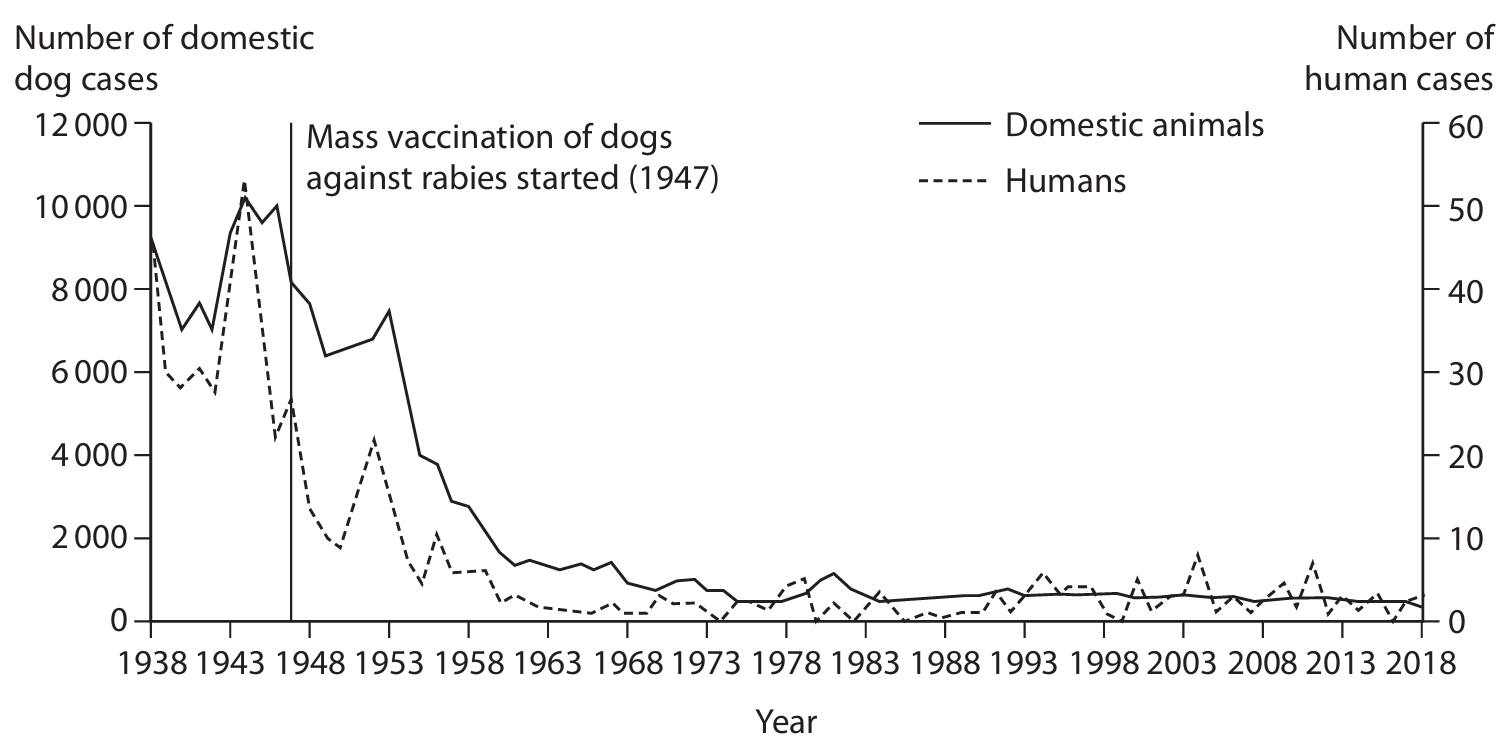
The graph shows the number of cases of human rabies and domestic dog rabies in the United States from 1938 to 2018.

Graph showing rabies cases in humans and dogs from 1938 to 2018

(i) The immune system of dogs works in a similar way to the immune system of humans.

Explain how the rabies vaccine prevents dogs from developing rabies.

(ii) Discuss the effects of the use of the rabies vaccine to immunise domestic dogs on the number of cases of rabies in humans.

Use information from the graph to support your answer.

(iii) A new RNA vaccine is being developed to treat rabies.

RNA that codes for parts of the rabies virus protein coat are injected into the body. Cells then take up the RNA and produce the viral proteins.

Describe how the cells use the RNA to produce the viral proteins.

Most-appropriate topic codes (Edexcel IGCSE Biology):

1(b): Variety of living organisms — part (a)
2(h): Transport — part (b)(i)
2(i): Excretion — part (b)(ii)
3(b): Inheritance — part (b)(iii)
▶️ Answer/Explanation
Solution

(a) B (bacteria, fungi, and protoctists)

Explanation: Pathogens are disease-causing microorganisms. While viruses like rabies are one type, other major groups also contain pathogenic species. Bacteria include pathogens like those causing tuberculosis and cholera. Fungi include pathogens responsible for athlete’s foot and ringworm. Protoctists (protists) include pathogenic organisms like Plasmodium which causes malaria and Entamoeba which causes dysentery. Therefore, all three groups – bacteria, fungi, and protoctists – include pathogens.

(b)(i)

Explanation: The rabies vaccine contains weakened or inactivated forms of the rabies virus or its antigens. When this vaccine is administered to dogs, it stimulates their immune system without causing the actual disease. The immune system recognizes these viral antigens as foreign invaders and produces specific antibodies against them. Specialized white blood cells called lymphocytes are activated during this process. Some of these lymphocytes develop into memory cells that remain in the body long-term. If the vaccinated dog is later exposed to the actual rabies virus, these memory cells recognize the pathogen immediately and trigger a rapid, strong immune response. This secondary response produces antibodies much faster and in greater quantities, effectively neutralizing the virus before it can establish an infection and cause disease.

(b)(ii)

Explanation: The graph shows a clear correlation between the vaccination of domestic dogs and the decline in human rabies cases. Before mass vaccination began in 1947, both dog and human rabies cases were relatively high. After vaccination programs were implemented, we observe a continuous and dramatic decline in rabies cases in both dogs and humans throughout the 1950s and beyond. This strong correlation suggests that most human rabies cases were originating from infected domestic dogs rather than wild animals. The data shows that as dog vaccination reduced the reservoir of infection in the canine population, human cases consequently decreased. However, the graph also indicates that human rabies cases didn’t disappear completely but plateaued at low levels, suggesting that some transmission still occurs from wild animals or unvaccinated dogs. This demonstrates that while vaccinating domestic dogs significantly reduces human rabies risk, it doesn’t completely eliminate it due to other potential sources of infection.

(b)(iii)

Explanation: When the RNA vaccine is injected, cells take up the RNA molecules that code for parts of the rabies virus protein coat. Inside the cell, these RNA molecules move to the ribosomes, which are the cellular structures responsible for protein synthesis. The process of translation then occurs, where the genetic code on the RNA is read and converted into a sequence of amino acids. Transfer RNA (tRNA) molecules with specific anticodons bind to complementary codons on the mRNA, each bringing with it a specific amino acid. As the ribosome moves along the mRNA strand, it facilitates the formation of peptide bonds between adjacent amino acids, creating a growing polypeptide chain. This chain folds into the three-dimensional structure of the viral protein. These viral proteins then act as antigens, stimulating the immune system to produce antibodies against rabies without exposure to the actual virus, thus providing protection against future infection.
Question

Read the passage below. Use the information in the passage and your own knowledge to answer the questions that follow.

Treating Kidney Disease

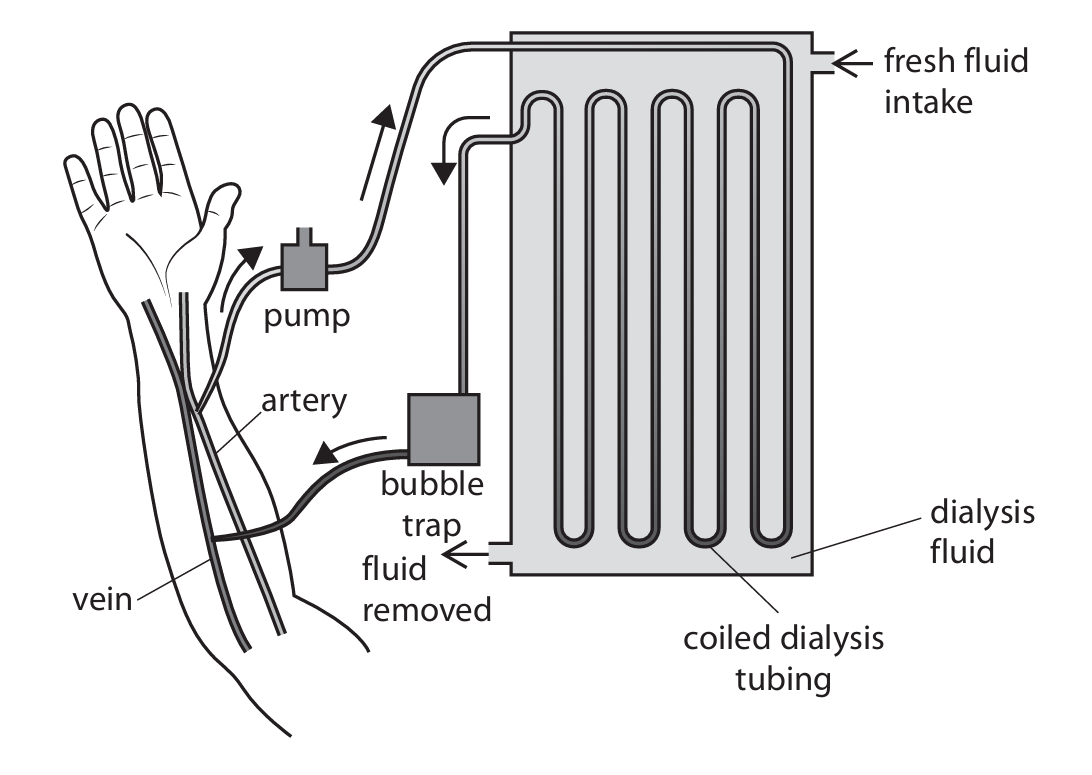
Chronic kidney disease affects approximately 12% of the world’s population and many people are unable to obtain treatment. One method of treating chronic kidney disease is by dialysis. The diagram shows how kidney dialysis is done.

During dialysis, blood is taken from an artery in the arm and is pumped through a dialyser. In the dialyser, the blood passes through a long, coiled dialysis tube made of a thin partially permeable membrane. The tube is surrounded by dialysis fluid. The dialysis fluid contains glucose and ions at concentrations normally found in blood plasma, but does not contain urea. The urea passes from the blood into the dialysis fluid. The temperature in the dialyser is kept at 40°C. After passing through the dialyser, the blood is returned to a vein in the arm. Kidney dialysis can take up to three hours and must be done three times a week.

Scientists have now designed a new bioartificial kidney. This artificial kidney is a combination of engineering and living cells. This artificial kidney has a haemofilter made from artificial membranes that filter the blood. The substances filtered out of the blood then pass through a device called a bioreactor. This bioreactor absorbs useful substances back into the blood. The bioreactor is made of living nephron cells that are grown from stem cells. These cells are separated from the patient’s blood by a silicon membrane to prevent the immune system rejecting them. Bioartificial kidneys are the same size as a human kidney and will be fitted inside the body to replace a kidney. The bioartificial kidney can react to changes in the body in the same way as a normal kidney.

(a) In 2021, the world’s population was 7 900 000 000.

Calculate the number of people in the world who have chronic kidney disease.

Give your answer in standard form.

(b) Urea is an excretory product that is released by the kidneys.

Give the name of an excretory product that is released by the lungs.

(c) Explain two ways that the dialyser is designed to increase the rate of removal of urea from the blood.

(d) (i) The haemofilter in the bioartificial kidney filters the blood.

Where does ultrafiltration occur in a nephron?

  • A. Bowman’s capsule
  • B. collecting duct
  • C. distal convoluted tubule
  • D. loop of Henle

(d) (ii) The cells in the bioreactor absorb glucose from the filtrate in a way that is similar to the cells in a nephron.

Describe how the nephron absorbs glucose back into the blood from the filtrate.

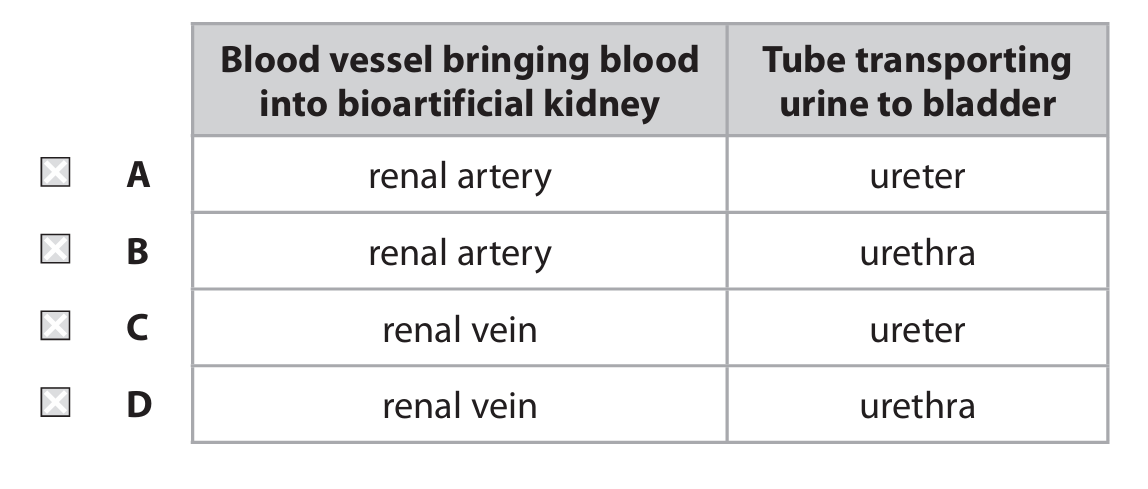
(d) (iii) The bioartificial kidney is connected to blood vessels and to the tube that transports urine to the bladder in the same way as the human kidney.

Which row of the table is correct?

(e) Explain how the pituitary gland and the nephron cells in the bioreactor will respond in a patient who is dehydrated.

Most-appropriate topic codes (Edexcel IGCSE Biology):

2(i): Excretion — parts (b), (c), (d)(i), (d)(ii), (d)(iii), (e)
4: Mathematical skillspart (a)
2(h): Transport — part (d)(ii)
5(d): Cloning — related context in passage
▶️ Answer/Explanation
Solution

(a) Answer: 9.5 × 10⁸

Explanation: To calculate the number of people with chronic kidney disease, we multiply the world population by 12% (or 0.12).

Calculation: 7,900,000,000 × 0.12 = 948,000,000

In standard form, this is 9.48 × 10⁸, which rounds to 9.5 × 10⁸ when expressed to two significant figures as appropriate for the percentage given (12%).


(b) Answer: Carbon dioxide / CO2 or Water (vapour) / H2O

Explanation: The lungs are responsible for excreting carbon dioxide, which is a waste product of cellular respiration. Water vapor is also excreted through the lungs during exhalation, especially in humid environments.


(c) Answer: The dialyser is designed in two key ways to increase urea removal:

1. The temperature is maintained at 40°C, which is slightly higher than normal body temperature. This increases the kinetic energy of urea molecules, making them move faster and diffuse more rapidly across the partially permeable membrane.

2. The dialysis fluid contains no urea, creating a steep concentration gradient between the blood and the dialysis fluid. This maximizes the rate of diffusion of urea from the blood into the dialysis fluid, following the principle of moving from an area of high concentration to an area of low concentration.

Additional design features include the long, coiled tubing which provides a large surface area for diffusion, and the thin partially permeable membrane which shortens the diffusion pathway.


(d)(i) Answer: A. Bowman’s capsule

Explanation: Ultrafiltration occurs in the Bowman’s capsule of the nephron, where high pressure forces small molecules like water, glucose, urea, and salts out of the blood and into the nephron tubule, while larger molecules like proteins and blood cells remain in the blood.


(d)(ii) Answer: Glucose is reabsorbed from the filtrate in the nephron through selective reabsorption in the proximal convoluted tubule. This process involves active transport, which requires energy (ATP) to move glucose molecules against their concentration gradient from the tubule back into the blood capillaries. Specialized carrier proteins in the cells lining the tubule facilitate this transport.


(d)(iii) Answer: A (renal artery / ureter)

Explanation: The renal artery brings oxygenated blood into the kidney for filtration, while the ureter is the tube that transports urine from the kidney to the bladder. The urethra is not correct as it transports urine from the bladder out of the body, not from the kidney to the bladder.


(e) Answer: In a dehydrated patient:

1. Osmoreceptors in the hypothalamus detect the increased solute concentration (decreased water potential) in the blood.

2. The hypothalamus stimulates the pituitary gland to release more antidiuretic hormone (ADH).

3. ADH travels through the bloodstream to the kidneys (or bioreactor nephron cells).

4. ADH makes the walls of the collecting duct (or bioreactor membrane) more permeable to water.

5. More water is reabsorbed from the filtrate back into the blood, resulting in a smaller volume of more concentrated urine.

This negative feedback mechanism helps conserve water in the body and restore normal blood concentration.
Question

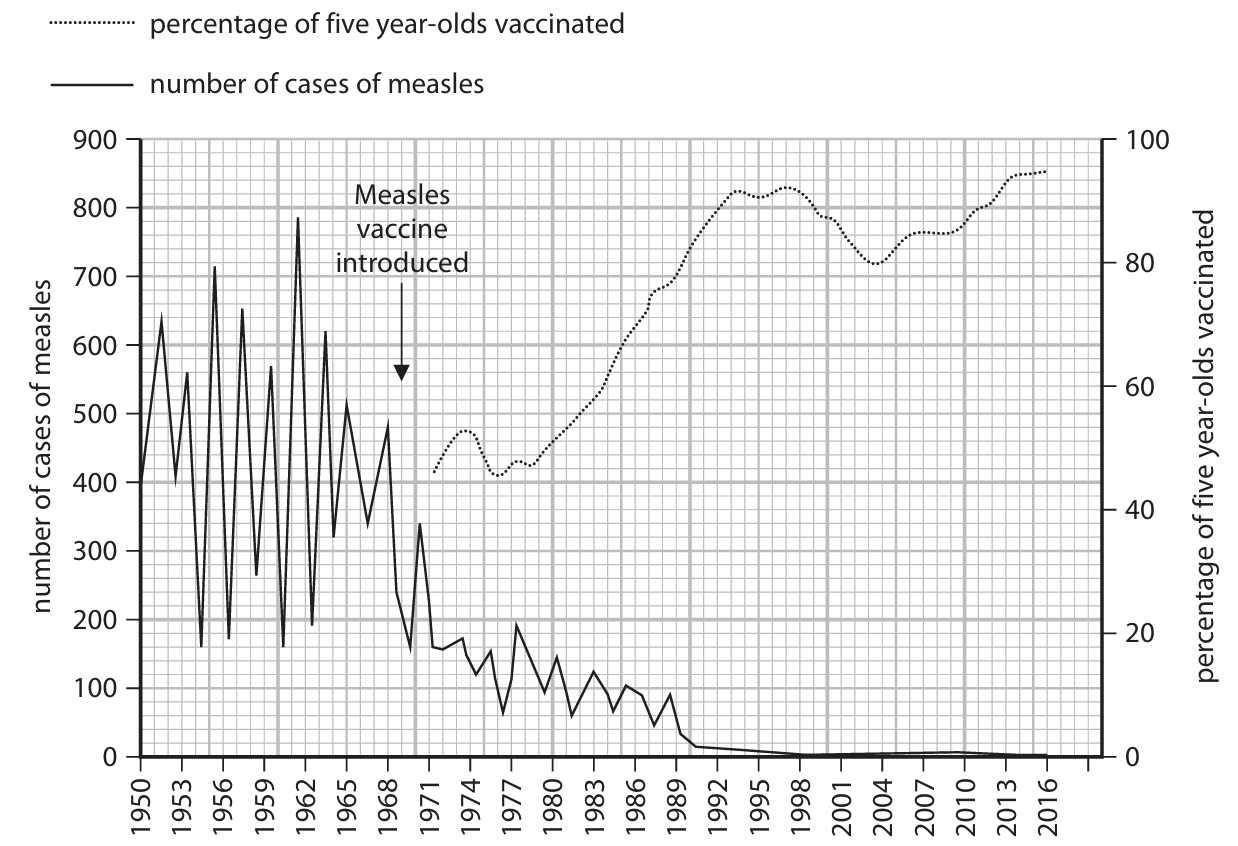
Measles is a disease caused by a virus. The graph shows the number of cases of measles each year and the percentage of five year-olds vaccinated between 1950 and 2016 in the United Kingdom.

(a) Determine the difference in the percentage change in the number of cases of measles between 1950 and 1965 and the percentage change in the number of cases of measles between 1968 and 1983.

(b) Explain the relationship between the number of cases of measles and the percentage of five year-olds vaccinated. Use information from the graph in your answer.

(c) Some children are receiving treatments that reduce the activity of their immune system. Explain why vaccinations are not used on these children.

Most-appropriate topic codes (Edexcel IGCSE Biology):

1(b): Variety of living organisms — part (a) (knowing measles is viral)
2(h): Transport — part (c) (immune response, antibodies)
5(a): Use of biological resources — part (b) (vaccination as a biological control method)
4(d): Human influences on the environment — part (b) (public health, vaccination programmes)
▶️ Answer/Explanation
Solution

(a) Difference = approximately 105% (range: 94-106%)

Explanation: To calculate this difference, we need to find the percentage change for each time period separately and then find the difference between them.

For 1950-1965: Cases increased from approximately 400-420 to 510-520. Using the midpoint values (410 to 515):

Percentage change = \(\frac{515 – 410}{410} \times 100 = \frac{105}{410} \times 100 ≈ 25.6\%\)

For 1968-1983: Cases decreased from approximately 480-490 to 120-130. Using the midpoint values (485 to 125):

Percentage change = \(\frac{125 – 485}{485} \times 100 = \frac{-360}{485} \times 100 ≈ -74.2\%\)

Difference = |25.6 – (-74.2)| = 99.8% (approximately 100%)

The exact answer may vary slightly depending on the precise values read from the graph, but should fall within the range of 94-106%.

(b) The relationship shows that as vaccination rates increase, measles cases decrease significantly.

Explanation: The graph demonstrates an inverse relationship between vaccination rates and measles cases. Before widespread vaccination (pre-1968), cases were high and fluctuated significantly. After the introduction of vaccination, cases began to decline steadily as vaccination rates increased.

For example, in the early 1970s when vaccination rates were around 50-60%, cases dropped to about 100-200 thousand. By the 1990s, when vaccination rates reached 80-90%, cases fell dramatically to very low levels (less than 20 thousand). This shows that vaccination provides herd immunity, reducing the virus’s ability to spread through the population.

The relationship is not perfectly linear because other factors like vaccination campaigns, public awareness, and natural immunity from previous infections also play a role. However, the overall trend clearly shows that higher vaccination coverage leads to fewer measles cases.

(c) Vaccinations are not used on immunocompromised children because they may not develop proper immunity and could develop the disease.

Explanation: Children with compromised immune systems (due to treatments like chemotherapy or immunosuppressive drugs) have reduced ability to produce antibodies and memory cells in response to vaccines. Vaccines contain weakened or inactivated pathogens that stimulate the immune system to create protection.

In immunocompromised children, their weakened immune systems may not be able to mount an effective response to the vaccine, leaving them unprotected. Even more concerning, there’s a risk that the weakened pathogen in the vaccine could cause the actual disease in these vulnerable children.

Instead of vaccination, these children rely on herd immunity – the protection provided when enough people in the community are vaccinated to prevent the disease from spreading. This is why high vaccination rates in the general population are so important, as they protect those who cannot be vaccinated themselves.
Question

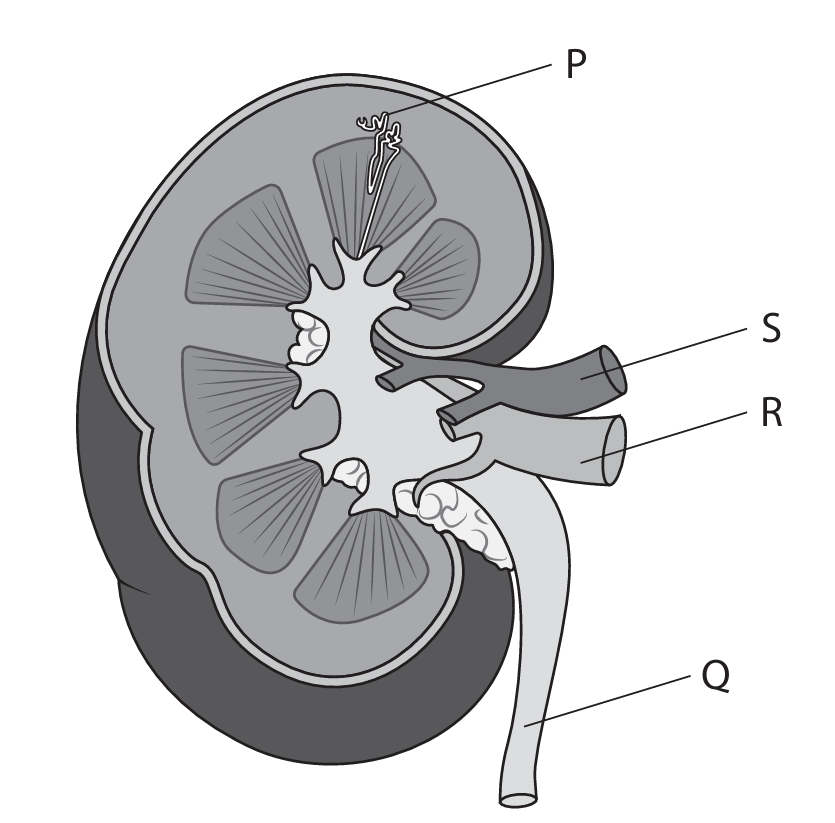
The diagram shows a section through a human kidney with some structures labelled.

(a) (i) Which structure is labelled P in the diagram?

A. bladder
B. nephron
C. ureter
D. urethra

(a) (ii) Which fluid is carried in tube S?

A. bile
B. blood
C. filtrate
D. urine

(a) (iii) Which tube is labelled Q in the diagram?

A. renal artery
B. renal vein
C. ureter
D. urethra

(b) Analysis of the composition of urine can be used in the diagnosis of problems with kidney function.

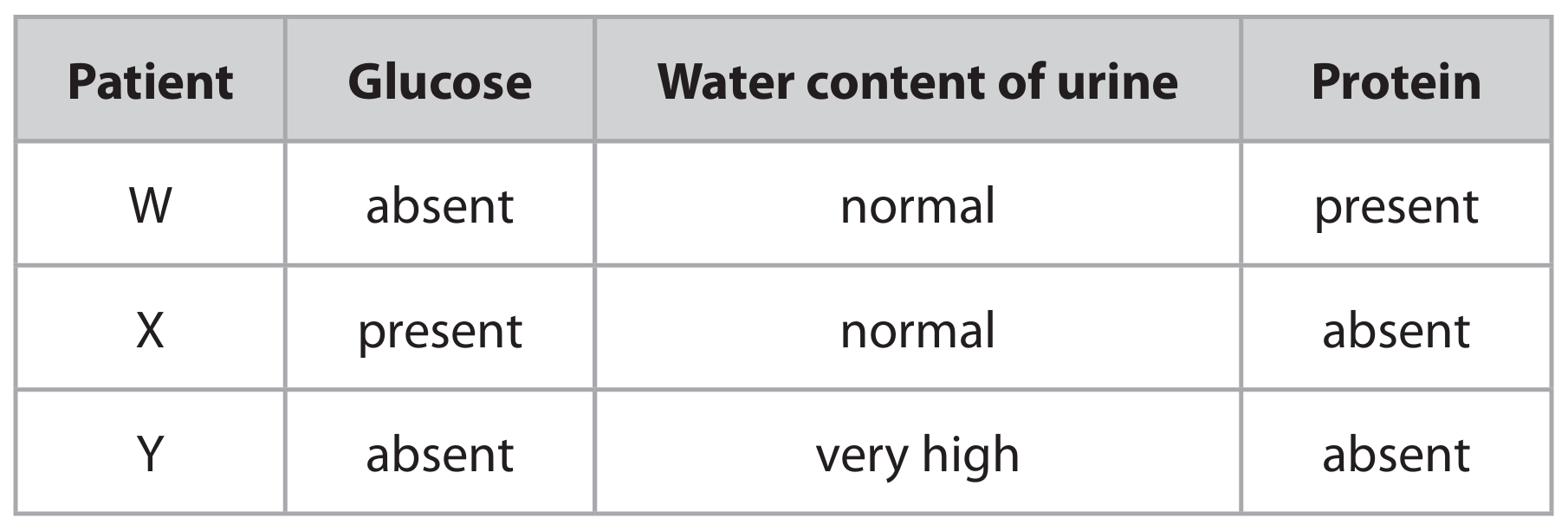
Urine samples are taken from three patients and the results are shown in the table.

(b) (i) Discuss which processes in the kidney may be affected to produce the results shown.

Include in your answer where in the nephron the processes occur.

(b) (ii) Describe how to test for glucose in a sample of urine.

Most-appropriate topic codes (Edexcel IGCSE Biology):

2(i): Excretion — parts (a)(i), (a)(ii), (a)(iii), (b)(i), (b)(ii)
2(b): Cell structure — part (a)(i) (nephron as functional unit)
2(h): Transport — part (a)(ii) (blood vessels)
2(e): Nutrition — part (b)(ii) (testing for glucose)
Appendix 6: Suggested practical investigations — part (b)(ii) (practical testing method)
▶️ Answer/Explanation
Solution

(a)(i) B (nephron)
Explanation: Structure P represents the functional unit of the kidney, which is the nephron.

(a)(ii) B (blood)
Explanation: Tube S carries blood to or from the kidney, specifically it is likely the renal artery or vein.

(a)(iii) C (ureter)
Explanation: Tube Q is the ureter, which transports urine from the kidney to the bladder.

(b)(i) An explanation that makes reference to:
Patient W: Presence of protein indicates failure of ultrafiltration in the glomerulus/Bowman’s capsule.
Patient X: Presence of glucose indicates failure of selective reabsorption in the proximal convoluted tubule.
Patient Y: High water content indicates reduced water reabsorption in the collecting duct, possibly due to low ADH.

(b)(ii) A description that includes:
• Use Benedict’s reagent
• Heat in a water bath
• Observe colour change (green → red indicates glucose)
• Alternatively, use a glucose test strip and compare colour to a chart.
Question

Read the passage below. Use the information in the passage and your own knowledge to answer the questions that follow.

Antitranspirants

Antitranspirants are substances applied to plants to reduce water loss. There are three types of antitranspirant, film-forming compounds, stomatal regulators and reflective compounds.

The first type of antitranspirant contains film-forming compounds. These compounds are oils or waxes that are mixed with water to form an emulsion. This emulsion is then sprayed onto the leaves of plants. The emulsion forms a physical barrier that covers the stomata. The film is designed to prevent water loss but allow gas exchange. Scientists have found that that the film-forming antitranspirant is effective in increasing yield and increasing photosynthesis in drought conditions. The increased leaf turgor in plants sprayed with film, compared to control plants, shows that the film decreases water loss and maintains turgor in drought conditions.

Film-forming antitranspirants are used in horticulture to reduce water stress. This can occur during storage, transport and planting of container grown plants. Application of the antitranspirant before transplanting, helps the plant survive until the root system is established. The film-forming compounds are used to reduce drying out in rolled turf and in transporting flowering plants and trees with root balls.

The second type of antitranspirants are stomatal regulators that reduce the size of the stomatal pore. Stomatal pores affect diffusion as well as transpiration. Therefore, photosynthesis and growth may change when stomatal regulators are applied to leaf surfaces. If the stomatal pores close completely this will stop photosynthesis. However, if stomatal openings are only reduced in size, transpiration will be reduced but some photosynthesis will continue.

The third type of antitranspirants are reflective compounds. These work by adding a white coating to leaves. This changes the amount of light that is reflected by the leaf surface. The coating is only applied to the upper surface of leaves so does not block the stomatal pores. Coating a leaf with a reflective chemical can reduce leaf temperature, transpiration rate and also increase the efficiency of water use. Experiments show that transpiration rate can be reduced by up to 30% and leaf temperature reduced from 40°C to 30°C after a coating of reflective compound is applied to leaf surfaces.

Crops depend on photosynthesis for growth and final yield. Therefore, it is unlikely that currently available antitranspirants would increase the yield of a crop unless the crop suffers from a low water supply or very high rates of evaporation. Spraying film-forming or stomata regulating antitranspirants on a field-grown cereal crop under drought conditions, produced a grain yield increase of 17%. Experiments also show that any effect that antitranspirants have on the minerals supplied to the leaves has little effect on plant growth.

(a) Explain why plants that have been dug up and transported are at most risk of drying out.

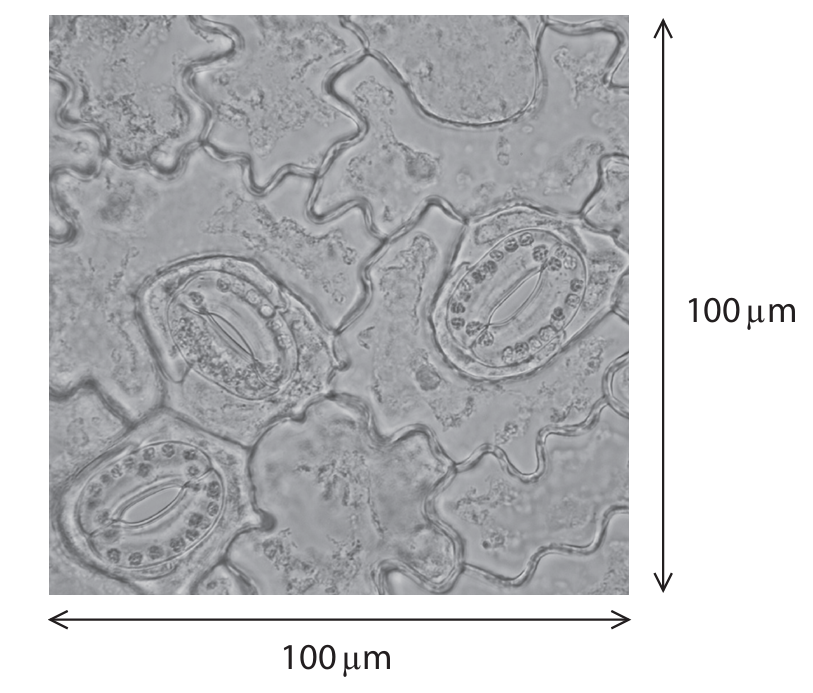
(b) The photograph shows some stomata on a leaf surface.

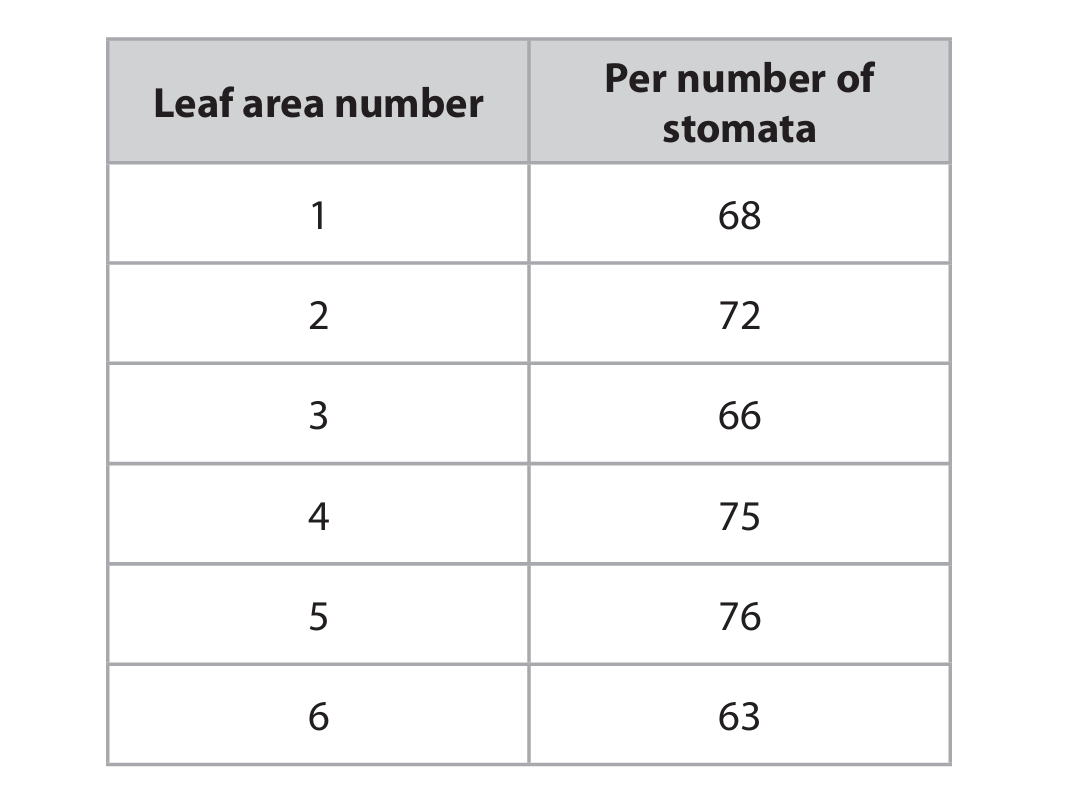
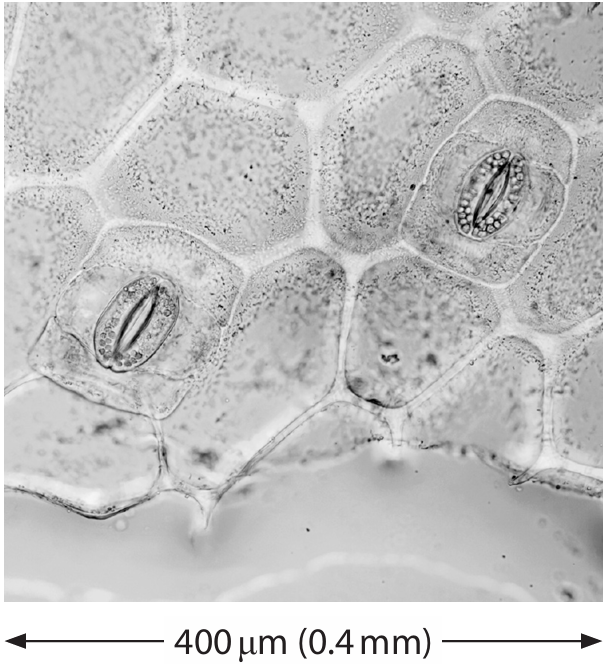
Use the photograph to determine the number of stomata per mm² on this leaf surface. [1 mm = 1000 μm]

(c) Explain why stomatal regulators reduce photosynthesis.

(d) (i) Explain why reflective compounds should only be applied to the upper surface of a leaf.

(ii) Explain why reducing leaf temperature reduces transpiration rate.

(e) Describe the role of one named mineral ion in plant growth.

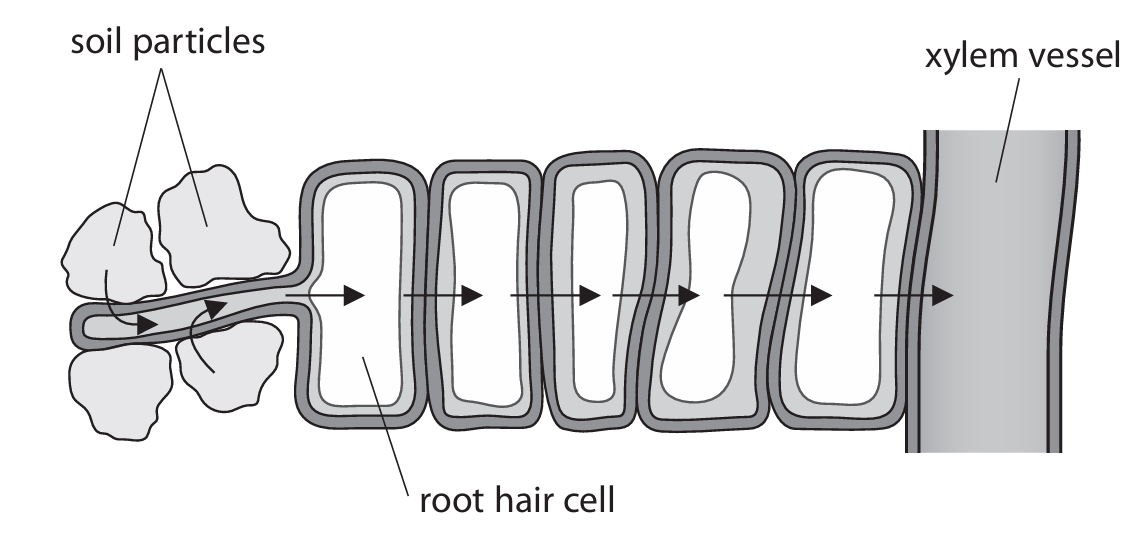
(f) Describe how water is transported from the soil to the leaves in plants.

Most-appropriate topic codes (Edexcel IGCSE Biology):

2(e): Nutrition — Flowering plants — parts (e), (f)
2(g): Gas exchange — Flowering plants — parts (c), (d)(i), (d)(ii)
2(h): Transport — Flowering plants — parts (a), (f)
4(a): The organism in the environment — part (b)
4(c): Cycles within ecosystems — part (e)
▶️ Answer/Explanation
Solution

(a) Plants that have been dug up and transported are at most risk of drying out because their roots (and root hair cells) are damaged or not in soil/exposed. This means water cannot be absorbed or taken up effectively. Additionally, water continues to be lost through transpiration or evaporation from the leaves, creating a water deficit that the damaged root system cannot replenish.

(b) number of stomata per mm² = 300

Explanation: The photograph shows an area of 100 μm × 100 μm, which contains 3 stomata. To find the number per mm²:
1 mm = 1000 μm, so 1 mm² = 1000 μm × 1000 μm = 1,000,000 μm².
The area of the photograph is 100 μm × 100 μm = 10,000 μm².
So, the number of stomata per mm² = (number in photo ÷ area of photo) × area of 1 mm² = (3 ÷ 10,000) × 1,000,000 = 300.

(c) Stomatal regulators reduce photosynthesis because they cause the stomatal pores to close or become smaller. This reduces the amount of carbon dioxide that can diffuse into the leaf. Since carbon dioxide is a key reactant in photosynthesis, a reduced supply limits the rate at which photosynthesis can occur.

(d)(i) Reflective compounds should only be applied to the upper surface of a leaf because the stomata are mainly or only located on the lower surface in most plants. Applying the coating only to the upper surface ensures the stomatal pores are not blocked, allowing gas exchange (carbon dioxide absorption and oxygen release) to continue uninterrupted. Additionally, the upper surface receives the most direct sunlight, so applying the reflective coating there is most effective at reducing heat absorption.

(d)(ii) Reducing leaf temperature reduces the transpiration rate because lower temperatures decrease the kinetic energy of water molecules. With less energy, water molecules move more slowly and are less likely to evaporate from the leaf surface (especially from the stomata). This reduces the rate of diffusion of water vapor out of the leaf, thereby lowering the transpiration rate.

(e) Nitrate ions (NO₃⁻) play a crucial role in plant growth. They are absorbed from the soil and are used by the plant to synthesize amino acids. These amino acids are then built up into proteins, which are essential for growth (e.g., enzymes for metabolic reactions, structural proteins for cell walls) and development.

Alternatively, magnesium ions (Mg²⁺) are a key component of chlorophyll, the pigment that absorbs light energy for photosynthesis. Without sufficient magnesium, chlorophyll production is impaired, leading to reduced photosynthesis and stunted growth.

(f) Water is transported from the soil to the leaves through the following process:
1. Water is absorbed from the soil by root hair cells through osmosis. Root hairs increase the surface area for absorption.
2. Osmosis occurs because the soil water is a dilute solution (higher water potential) compared to the concentrated cell sap inside the root hair cells (lower water potential).
3. Once inside the root, water moves across the cortex and into the xylem vessels.
4. Water is then transported upwards through the xylem to the leaves due to transpiration pull. This is a suction force created by the evaporation of water from the surfaces of mesophyll cells in the leaves and its subsequent diffusion out of the stomata.
5. The cohesion (water molecules sticking together) and adhesion (water molecules sticking to the xylem walls) properties of water help maintain a continuous column of water from the roots to the leaves.
Question

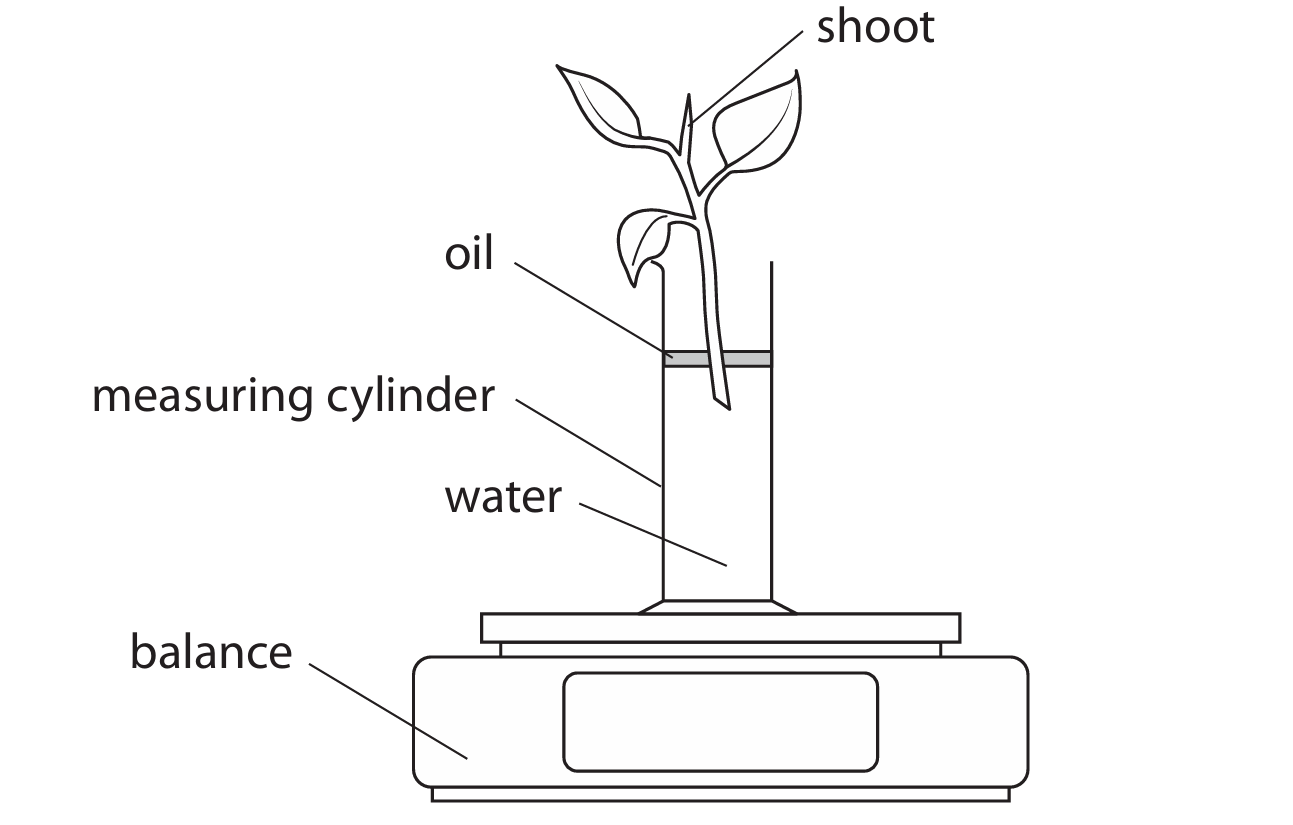
A student uses this method to investigate water uptake and water loss by a plant shoot.

  • pour 100 cm³ of water into a measuring cylinder
  • place a plant shoot into the measuring cylinder
  • cover the surface of the water with oil
  • place the measuring cylinder and plant shoot on a balance and record the total mass
  • shine light on the plant shoot using a lamp
  • record the volume of the water in the measuring cylinder after four days, and after eight days
  • record the total mass of the measuring cylinder and plant shoot after four days, and after eight days

The diagram shows the student’s apparatus.

(a) State the reason for using the oil.

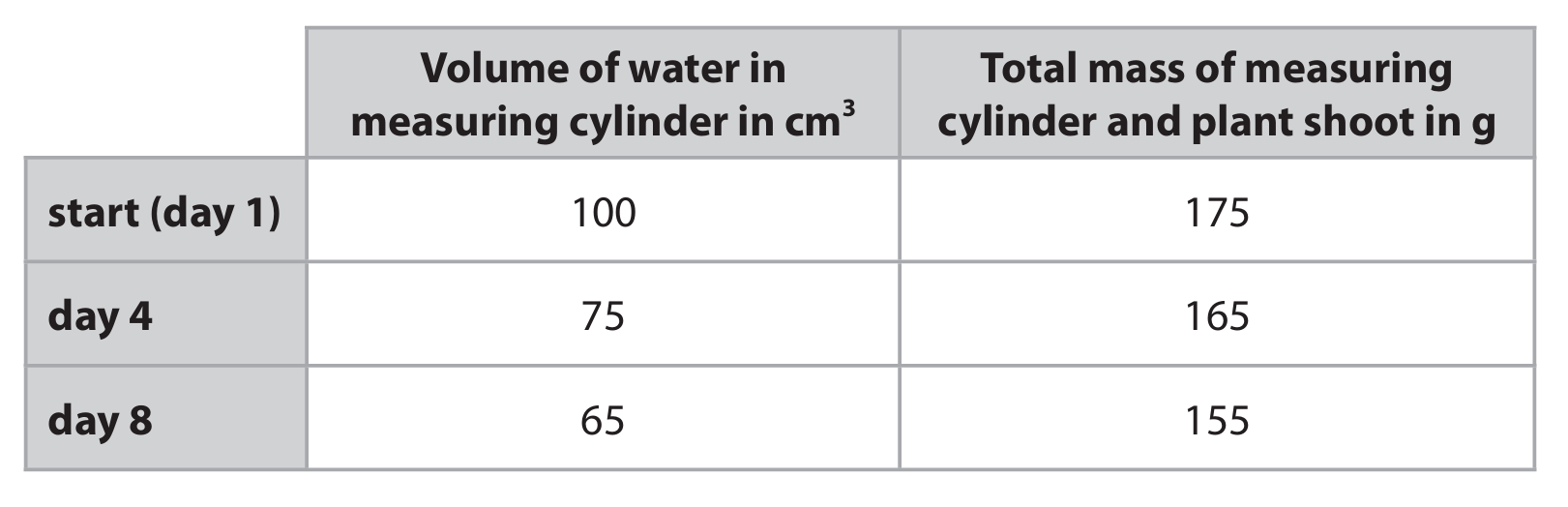
(b) The table shows the student’s results.

(i) The volume of water taken up by the plant shoot is equal to the change in volume of water in the measuring cylinder. This is called the water uptake.

Calculate, in cm³ per day, the mean rate of water uptake by the plant shoot during the eight days.

(ii) Comment on the changes in total mass of the measuring cylinder and plant shoot, compared with the changes in volume of water in the measuring cylinder.

[1 cm³ of water has a mass of 1 g]

(c) Explain why the rate of water loss would be different if a working fan is placed in front of the plant shoot.

Most-appropriate topic codes (Edexcel IGCSE Biology):

2(h): Transport in flowering plants — part (a), (b), (c)
2(d): Movement of substances into and out of cells — part (a)
2(e): Nutrition in flowering plants — part (b)(ii)
2(f): Respiration — part (b)(ii)
4(a): The organism in the environment — part (b)(ii)
▶️ Answer/Explanation
Solution

(a) To prevent evaporation from the surface of the water.

Explanation: The oil creates a physical barrier on top of the water surface. This prevents water molecules from evaporating into the air, ensuring that any changes in water volume in the measuring cylinder are due to water uptake by the plant shoot rather than evaporation. Without this oil layer, we wouldn’t be able to accurately measure how much water the plant is actually taking up.

(b)(i) Mean rate = 4.4 cm³ per day

Explanation: To calculate the mean rate of water uptake:
Total water uptake = Initial volume – Final volume = 100 cm³ – 65 cm³ = 35 cm³
Total time = 8 days
Mean rate = Total water uptake ÷ Total time = 35 cm³ ÷ 8 days = 4.375 cm³/day
Rounded to one decimal place, this gives us 4.4 cm³ per day.

(b)(ii) Both the volume of water and the total mass decrease over time, but the volume decreases more than the mass.

Explanation: Looking at the data, we can see that after 8 days, the water volume decreased by 35 cm³ (from 100 cm³ to 65 cm³), while the total mass decreased by only 20 g (from 175 g to 155 g). This difference occurs because not all water taken up by the plant is lost through transpiration – some is retained within the plant cells for maintaining turgor pressure, some is used in photosynthesis, and some is stored. The plant is essentially accumulating water while simultaneously losing it through transpiration. Between days 4 and 8, both water uptake and water loss occur at similar rates, as indicated by the parallel changes in volume and mass.

(c) The rate of water loss would increase with a fan.

Explanation: A working fan would increase the rate of transpiration (water loss) from the plant. This happens because the fan moves air across the leaf surface, which carries away water vapor that has evaporated through the stomata. This maintains a steeper concentration gradient between the moist air inside the leaf and the drier air outside, accelerating diffusion. Additionally, the fan disrupts the still, humid boundary layer of air that typically forms around leaves, replacing it with drier air that can accept more water vapor. All these factors combined would result in increased water loss from the plant shoot.
Question

Smoking cigarettes has harmful effects on the body.

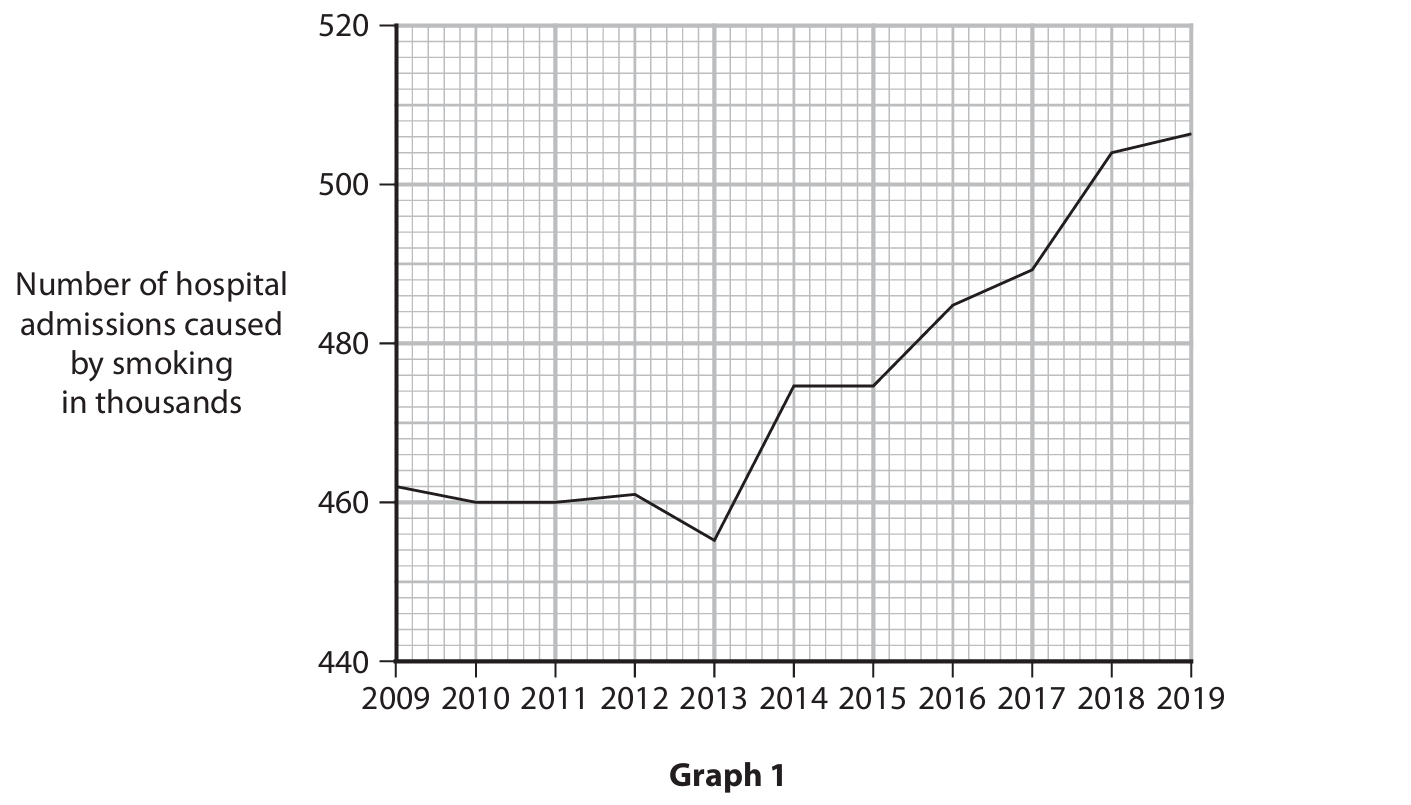
Graph 1 shows the number of hospital admissions in thousands due to conditions caused by smoking each year from 2009 to 2019.

(a) Using information from Graph 1, calculate the percentage increase in the number of hospital admissions caused by smoking in 2019 compared with 2009.

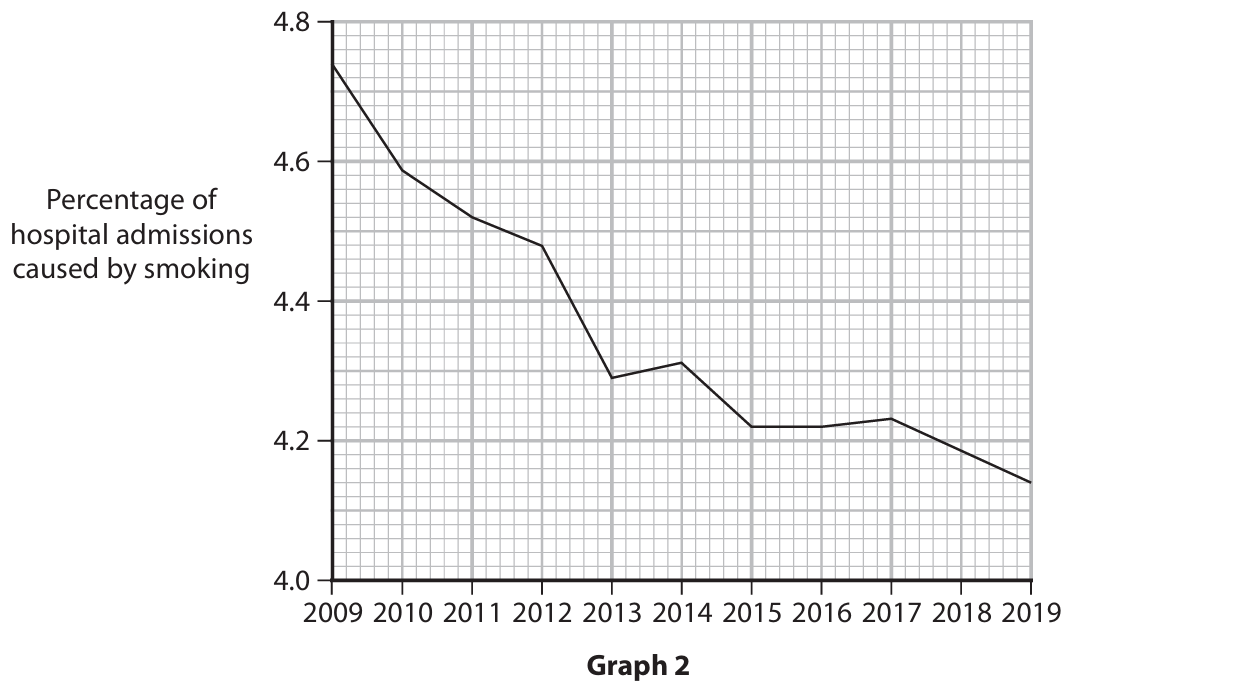
(b) Graph 2 shows the percentage of all hospital admissions that were due to conditions caused by smoking each year from 2009 to 2019.

Comment on the changes in the number of hospital admissions caused by smoking and the percentage of all hospital admissions that were caused by smoking.
Use data from graph 1 and graph 2 in your answer.

(c) Smoking causes harmful effects on the lungs.

Describe the consequences of smoking cigarettes for the functioning of the lungs.

Most-appropriate topic codes (Edexcel IGCSE Biology):

2(g): Gas exchange — part (c)
2(h): Transport — part (c)
4(d): Human influences on the environment — implicit in smoking as pollution
Appendix 4: Mathematical skills — parts (a) and (b) (data interpretation, percentage calculation)
▶️ Answer/Explanation
Solution

(a)

Percentage increase ≈ 9.52%

Explanation:

To calculate the percentage increase, we first need the number of admissions for the start year (2009) and the end year (2019) from Graph 1.

From the graph, the number in 2009 is approximately 462 (thousand). The number in 2019 is approximately 506 (thousand).

The actual increase is calculated as: 506 – 462 = 44 (thousand).

The percentage increase is calculated using the formula:

\[ \text{Percentage Increase} = \left( \frac{\text{Change}}{\text{Original}} \right) \times 100 = \left( \frac{44}{462} \right) \times 100 \]

Performing the calculation: (44 ÷ 462) ≈ 0.095238. Multiplying by 100 gives approximately 9.52%.

Therefore, the percentage increase in hospital admissions caused by smoking from 2009 to 2019 was about 9.52%.

(b)

Comment:

Explanation:

Analyzing the data from both graphs reveals important trends. Graph 1 shows that the absolute number of hospital admissions due to smoking generally increased from 2009 (≈462,000) to 2019 (≈506,000), with a noticeable dip or plateau around 2012-2013 where numbers were at their lowest.

However, Graph 2 tells a different story about the proportion of total admissions. It shows that the percentage of all hospital admissions that were caused by smoking declined over the same period, reaching its lowest point in 2019.

This apparent contradiction can be explained by factors such as an increase in the total number of hospital admissions from all causes (e.g., due to a growing or aging population, or an increase in other illnesses), meaning smoking-related admissions make up a smaller share of a larger total. It could also suggest that while the number of people suffering smoking-related illnesses is high, fewer people are starting to smoke or more people are quitting, leading to a slower growth rate of smoking-related admissions compared to admissions from other causes.

(c)

Consequences for Lung Function:

Explanation:

Smoking severely damages the lungs and impairs their function through several mechanisms:

  1. Damage to Cilia: The trachea and bronchi are lined with cilia (tiny hair-like structures) that sweep mucus and trapped particles out of the airways. Smoke paralyzes and destroys these cilia. This is a primary and early consequence.
  2. Mucus Buildup: With the cilia unable to function, mucus builds up in the airways. This buildup cannot be cleared effectively, creating a stagnant environment.
  3. Increased Infection Risk: The accumulated mucus becomes a breeding ground for bacteria, leading to frequent bacterial infections, bronchitis, and pneumonia.
  4. Alveoli Destruction: The toxins in smoke damage the walls of the alveoli (air sacs where gas exchange occurs). This causes the alveoli to break down and merge, a condition called emphysema. This drastically reduces the surface area available for oxygen and carbon dioxide exchange.
  5. Inflammation and Narrowing: Smoke causes chronic inflammation and swelling of the bronchioles. The muscles around these airways can also tighten, causing them to narrow. This makes it physically harder to move air in and out, leading to breathlessness, a characteristic of chronic bronchitis.
  6. Cancer: The carcinogens in tobacco smoke can cause mutations in lung cells, leading to uncontrolled cell growth and lung cancer.

Collectively, the destruction of alveoli (emphysema) and the inflamed, narrowed airways (chronic bronchitis) are often grouped under the term Chronic Obstructive Pulmonary Disease (COPD), a major long-term consequence of smoking.
Question

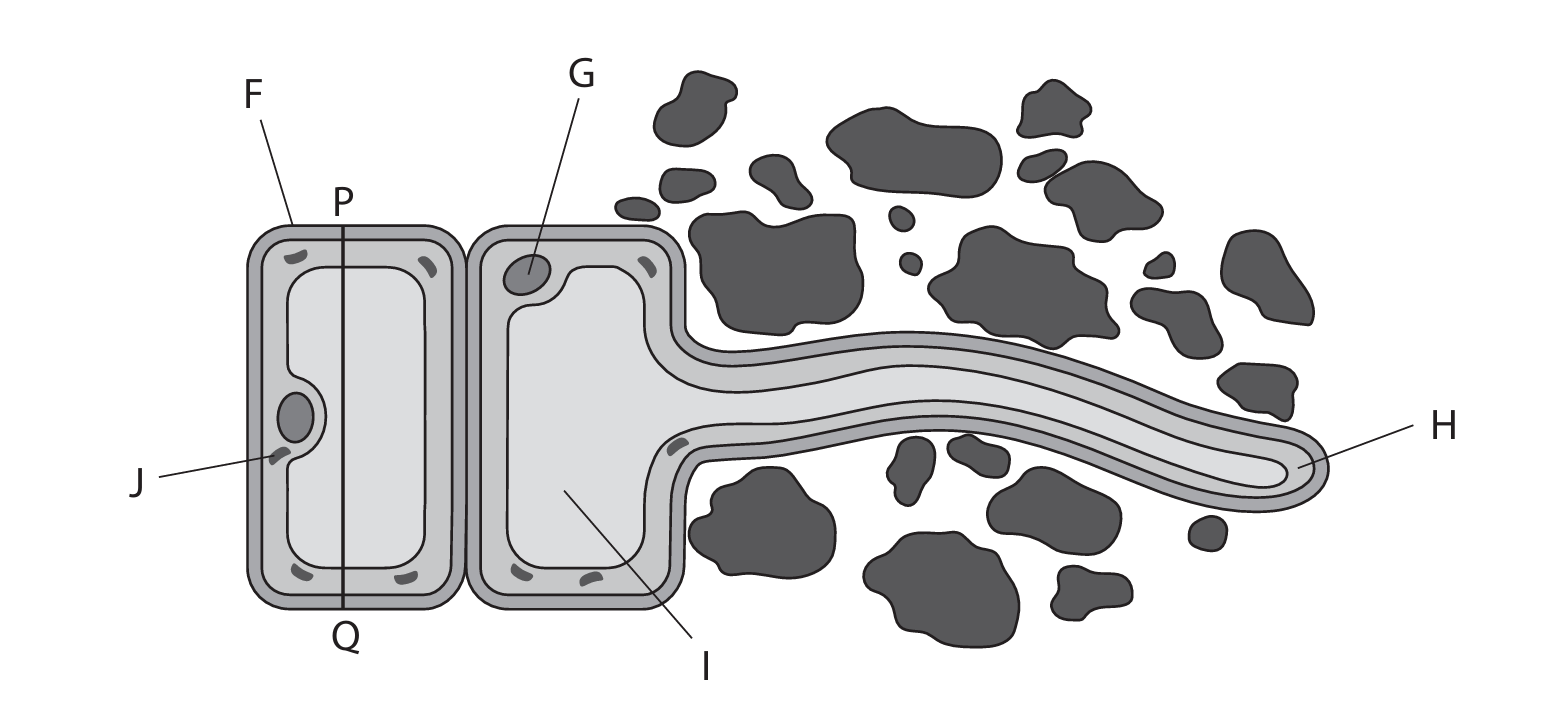
The diagram shows two cells from a plant root.

(a) (i) Which structure is the vacuole?

A) F
B) G
C) H
D) I

(a) (ii) Which structure is the nucleus?

A) F
B) G
C) H
D) J

(b) The actual length of the root cell from P to Q is 80 μm. Determine the magnification of the diagram. [1000 μm = 1 mm]

(c) Root hair cells are specialised cells adapted for their functions. Explain how root hair cells are adapted for their functions in the plant.

Most-appropriate topic codes (Edexcel IGCSE Biology):

2(b): Cell structure — parts (a)(i), (a)(ii)
4: Mathematical skillspart (b)
2(b): Cell differentiation and development of specialised cells — part (c)
2(h): Transport — part (c)
▶️ Answer/Explanation
Solution

(a)(i) D (I)
A is not the answer as F is the cell wall
B is not the answer as G is the nucleus
C is not the answer as H is the cytoplasm

(a)(ii) B (G)
A is not the answer as F is the cell wall
C is not the answer as H is the cytoplasm
D is not the answer as J is a mitochondrion

(b) Magnification = 475 (or approximately 475×)
The measured length from P to Q on the diagram is approximately 38 mm. Convert this to micrometers: 38 mm × 1000 = 38,000 μm. Using the magnification formula (Magnification = Size of Image / Actual Size): Magnification = 38,000 μm / 80 μm = 475.

(c) An explanation that includes:
• Long root hair / extension increases surface area for absorption of water and mineral ions.
• Thin cell wall reduces distance for diffusion / osmosis.
• Many mitochondria provide ATP / energy for active transport of minerals.
• Large, permanent vacuole maintains water potential gradient for osmosis.
• Cell surface membrane contains transport proteins for selective uptake of ions.
Question

(a) Describe how stem cells are different from other cell types.

(b) Stem cells from a donor can be used for stem cell therapy. Human blood cells are produced in bone marrow. Explain how using stem cells from the bone marrow enables doctors to treat a number of different blood conditions.

(c) One type of stem cell transplant uses a patient’s own stem cells. They can be used if the patient is producing enough healthy bone marrow cells. These cells can be collected, frozen and stored for later use. Explain the advantage of using the patient’s own stem cells rather than using stem cells from a donor.

Most-appropriate topic codes (Edexcel IGCSE Biology):

2(b): Cell structure — part (a)
2.5B: Cell differentiation in development of specialised cells — part (a)
2.6B: Advantages and disadvantages of using stem cells in medicine — parts (b) and (c)
2(h): Transport — part (b) (blood cell production)
3.12: Immune system response — part (c) (rejection)
▶️ Answer/Explanation
Solution

(a) A description that makes reference to two of the following points:

  • Undifferentiated / unspecialised / can differentiate / can become specialised cells (1)
  • And can become different cell types (1)
  • Can continue to divide / continue to multiply / can divide several times (1)

Note: “Can divide whilst remaining undifferentiated” scores 2 marks.

Explanation: Stem cells are unique because they are not yet specialized for a specific function (like muscle or nerve cells). They retain the ability to divide and produce more stem cells or differentiate into various specialized cell types when needed.

(b) An explanation that makes reference to three of the following points:

  • Can make different (blood) cells / red cells and white cells / red cells and platelets / white cells and platelets (1) (Accept any two types of blood cell)
  • Max two from:
    • Red blood cells to treat anaemia / ensure oxygen transport around body (1) (Accept to treat sickle cell anaemia / thalassemia)
    • White blood cells to kill infections / kill bacteria / remove viruses / improve immunity / increase antibodies (1)
    • Platelets to treat blood clotting problems (1)
    • Any one blood cell type to treat bone marrow cancer / treat leukaemia / treat lymphoma / treat myeloma / recover from chemotherapy (1)

Explanation: Bone marrow contains hematopoietic stem cells that can differentiate into all types of blood cells. This makes them extremely valuable in medicine. They can be transplanted to replace faulty or destroyed bone marrow, enabling the production of healthy red blood cells (to treat anaemia), white blood cells (to fight infections and restore immunity), and platelets (to aid clotting). This is crucial in treating conditions like leukaemia, lymphoma, or after high-dose chemotherapy.

(c) An explanation that makes reference to two of the following points:

  • Have same proteins / antigens (1)
  • Genetically identical / same genes (1)
  • No rejection / immune response / no need for immunosuppressant drugs / cells are accepted by body / cells are compatible / cells have same blood group (1)
  • No transfer of other disease / infections / viruses (1)

Explanation: Using a patient’s own stem cells (an autologous transplant) eliminates the risk of immune rejection because the cells are genetically identical to the patient’s own tissues. There is no need for powerful immunosuppressant drugs, which have serious side effects. Additionally, it removes the risk of transmitting infectious diseases from a donor. This makes the transplant safer and increases the likelihood of successful engraftment.

Question

Read the passage below. Use the information in the passage and your own knowledge to answer the questions that follow.

Plants to the rescue

Since the early 20th century, the concentration of carbon dioxide in the atmosphere has increased rapidly. This has further increased in recent years due to more cars and the increased demand for electricity for homes and industry.

Scientists have found that plants play a critical part in removing this excess carbon dioxide from the atmosphere. Using computer models, the scientists concluded that photosynthesis has increased by 30 per cent.

The scientists measured carbonyl sulfide found in ice cores and air samples. In addition to carbon dioxide, plants take in carbonyl sulfide gas during their natural carbon cycle, and this is frequently used as a measure of photosynthesis on a global scale. Terrestrial plants are removing about 29 per cent of carbon dioxide emissions that would otherwise contribute to an increase in the atmospheric carbon dioxide concentration.

A carbon sink is an ecosystem, such as a forest, that absorbs more carbon dioxide than it releases. The size of the carbon sink depends on the rate of photosynthesis but also on the levels of deforestation and respiration. The model the scientists used showed that the role of photosynthesis in producing a carbon sink in land plants is larger than estimated in most other models.

Other scientists are less confident about using carbonyl sulfide as a measure of photosynthesis. Plant absorption of carbonyl sulfide can vary depending upon the amount of light the plants receive. Therefore, the measure of global photosynthesis could be overestimated.

Regardless of the rate at which photosynthesis has increased, scientists agree that excess carbon dioxide is boosting the growth of plants. Trees are becoming leafier, and there is more wood. The wood is where most of the carbon is stored in the plant.

In experimental research, scientists exposed plants to double the normal concentration of carbon dioxide found in the atmosphere. Under these increased carbon dioxide conditions, the composition of the leaf tissues changed. This made the leaves tougher for herbivores to eat and made it harder for insect larvae to grow.

Scientists have also observed that when plants are exposed to increasing levels of carbon dioxide, the size of the stomatal pores on a leaf increases.

(a) Explain why more cars would result in an increase in atmospheric carbon dioxide. (Lines 1-3)

(b) Explain how increased carbon dioxide can cause climate change.

(c) Explain why increasing carbon dioxide concentration can increase photosynthesis in plants.

(d) Explain why the carbon sink depends upon respiration and deforestation as well as photosynthesis. (Lines 13 to 15)

(e) Light affects gas exchange in leaves. (Lines 19 and 20)
Describe an experiment that shows how the net gas exchange from a leaf varies with light intensity.

(f) The photograph shows stomata on a small square of the lower surface of a leaf.

The total area of the lower surface of the leaf is \(150 \text{ cm}^2\).
Using the photograph and the total lower surface area of the leaf, estimate the number of stomata on the lower surface of the leaf.

(g) Stomata also have a role in water transport in the plant. Explain the role of stomata in water transport.

Most-appropriate topic codes (Edexcel IGCSE Biology):

2(e): Nutrition (Photosynthesis) — parts (c), (e)
4(d): Human influences on the environment — parts (a), (b)
4(c): Cycles within ecosystems (Carbon cycle) — part (d)
2(g): Gas exchange — parts (e), (f), (g)
2(h): Transport in plants — part (g)
▶️ Answer/Explanation
Solution

(a)
An explanation that makes reference to:
• Burning / combustion of petrol / diesel / fuel in car engines. (1 mark)
• This combustion reaction releases carbon dioxide (\( \text{C} + \text{O}_2 \rightarrow \text{CO}_2 \)). (1 mark)
More cars mean more fuel burned, directly increasing \( \text{CO}_2 \) emissions.

(b)
An explanation that makes reference to two of the following:
• Carbon dioxide is a greenhouse gas. (1 mark)
• It traps / absorbs infrared (IR) radiation (heat) from the Earth, preventing its escape into space. (1 mark)
• This leads to an enhanced greenhouse effect, causing global warming / climate change. (1 mark)
(Maximum 2 marks)

(c)
An explanation that makes reference to:
• Carbon dioxide is a reactant / raw material needed for photosynthesis. (1 mark)
• At lower concentrations, \( \text{CO}_2 \) can be a limiting factor for photosynthesis; increasing its concentration can increase the rate up to a point. (1 mark)
The photosynthesis equation is: \( 6\text{CO}_2 + 6\text{H}_2\text{O} \xrightarrow{\text{light}} \text{C}_6\text{H}_{12}\text{O}_6 + 6\text{O}_2 \).

(d)
An explanation that makes reference to two of the following:
• A carbon sink absorbs more \( \text{CO}_2 \) than it releases. (1 mark)
• Respiration (by plants, animals, decomposers) releases \( \text{CO}_2 \) back into the atmosphere, reducing net absorption. (1 mark)
• Deforestation (cutting down trees) reduces the number of plants for photosynthesis and often involves burning/decay, releasing stored carbon as \( \text{CO}_2 \). (1 mark)
(Maximum 2 marks)

(e)
A description that makes reference to three of the following:
• Place leaves (or aquatic plants like pondweed) in test tubes containing hydrogen-carbonate indicator. (1 mark)
• Expose one setup to bright light and another to darkness (or vary light intensity using a lamp at different distances). (1 mark)
• In bright light, the indicator turns purple/dark red (due to net \( \text{CO}_2 \) uptake in photosynthesis). In darkness, it turns yellow (due to net \( \text{CO}_2 \) release from respiration). (1 mark)
• Control other variables: use leaves of the same species, size, age; same volume and concentration of indicator; same temperature; same time period. (1 mark)
(Maximum 3 marks)

(f)
Step-by-step calculation:
1. Area in photograph: side = \( 400 \mu\text{m} = 0.4 \text{ mm} = 0.04 \text{ cm} \).
2. Area of square = \( (0.04 \text{ cm})^2 = 0.0016 \text{ cm}^2 \).
3. Number of stomata in this area = 2.
4. Stomatal density = \( \frac{2}{0.0016} = 1250 \) stomata per \( \text{cm}^2 \).
5. Total number on leaf = \( 1250 \times 150 = 187500 \).
Answer: \( \mathbf{187500} \) stomata. (3 marks)

(g)
An explanation that makes reference to:
• Stomata allow water vapour to evaporate / be lost from the leaf in a process called transpiration. (1 mark)
• This transpiration pull creates a tension / negative pressure in the xylem, drawing a continuous column of water up from the roots, through the stem, and into the leaves. (1 mark)
This is known as the transpiration stream, and it relies on stomatal opening for water movement against gravity.
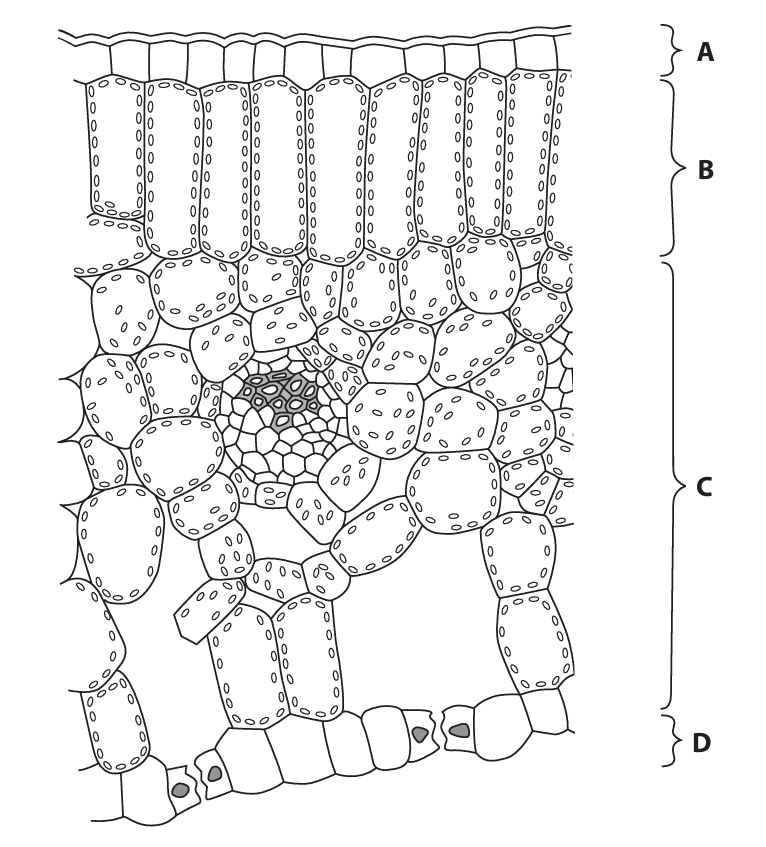
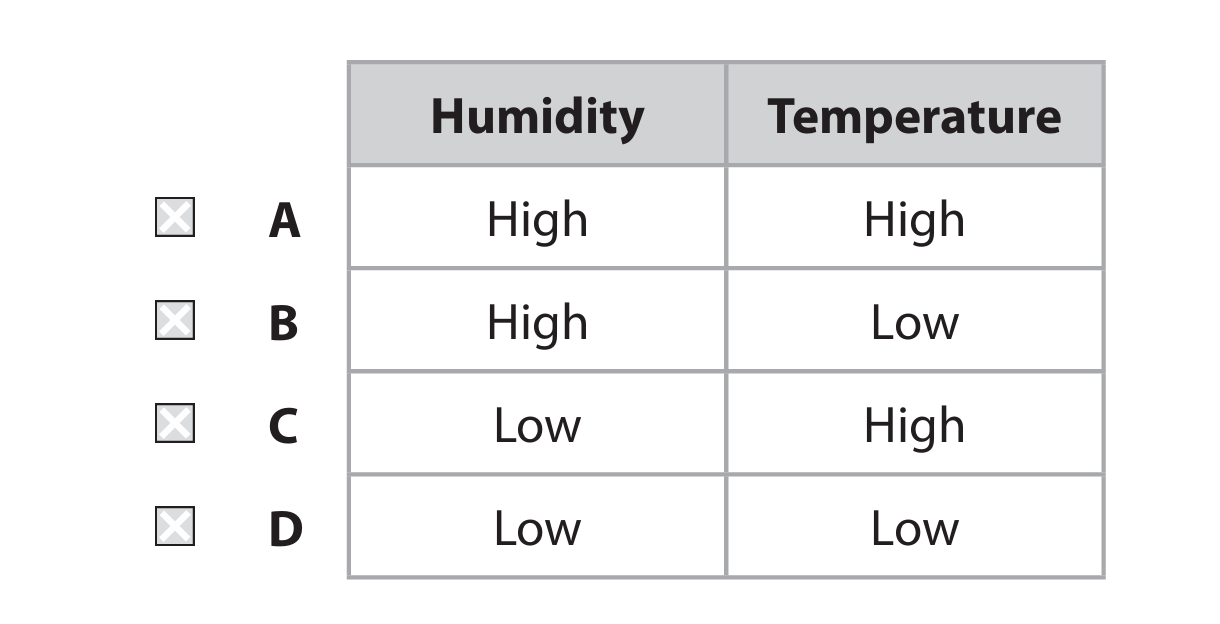
Question

The diagram shows a cross-section through a leaf.

Leaf cross-section diagram

(a) (i) Which layer contains palisade mesophyll cells?

  • A
  • B
  • C
  • D

(ii) Which set of environmental conditions would produce the fastest rate of transpiration from this leaf?

Environmental conditions table

(b) Scientists investigate the effect of changing carbon dioxide concentration on the density of stomata of wheat plants.
They grow wheat plants from seed in different concentrations of carbon dioxide.
After three weeks, they take a leaf from each plant and calculate the mean density of stomata.

(i) State the independent variable in this investigation.

(ii) Give two abiotic variables that the scientists could control.

(iii) To calculate the mean density of stomata, leaf sections are viewed with a microscope.
The number of stomata within six circular areas of the leaf are counted.
The results for one leaf are shown in the table.

Stomata count table

The radius of each circular area is 0.40 mm.
area of circle = \(\pi r^2\)
\(\pi = 3.14\)
Calculate the mean density of stomata on the leaf surface.

(iv) The investigation shows that in increased carbon dioxide concentrations there is a lower mean density of stomata.
The scientist concludes that in hot dry areas, with increased carbon dioxide concentrations, it would be an advantage for wheat to have a lower mean density of stomata.
Discuss the scientist’s conclusion.

Most-appropriate topic codes (Edexcel IGCSE Biology):

2(e): Nutrition (Flowering plants)part (a)(i)
2(h): Transport (Flowering plants)part (a)(ii)
4(a): The organism in the environmentparts (b)(i), (b)(ii)
Appendix 4: Mathematical skillspart (b)(iii)
4(d): Human influences on the environmentpart (b)(iv)
▶️ Answer/Explanation
Solution

(a) (i) B

Explanation: The palisade mesophyll layer is typically found just below the upper epidermis in a leaf. It consists of tightly packed, columnar cells rich in chloroplasts, which are the main sites for photosynthesis. In a standard leaf cross-section diagram, this layer is labeled as B.

(a) (ii) Low humidity, High temperature

Explanation: Transpiration is the loss of water vapor from the leaves. Its rate is influenced by environmental factors. Low humidity creates a steeper concentration gradient for water vapor between the leaf’s interior and the outside air, favoring faster diffusion. High temperature increases the kinetic energy of water molecules, leading to more evaporation. Therefore, the combination of low humidity and high temperature provides the most favorable conditions for the fastest transpiration rate.

(b) (i) Concentration of carbon dioxide

Explanation: The independent variable is the factor that the scientist deliberately changes or manipulates in an experiment. Here, the scientists are growing plants in “different concentrations of carbon dioxide,” so that is the independent variable.

(b) (ii) Any two from: temperature, light, mineral ions/pH/soil, water/humidity

Explanation: Abiotic factors are the non-living chemical and physical parts of the environment. To ensure a fair test where only the independent variable (CO₂ concentration) affects the results, other abiotic factors that could influence plant growth or stomatal density must be kept constant. Examples include temperature, light intensity, water availability, humidity, and soil mineral content or pH.

(b) (iii) 140 stomata per mm²

Explanation:
First, calculate the total number of stomata counted: 68 + 72 + 66 + 75 + 76 + 63 = 420.
Next, find the mean number of stomata per circular area: 420 ÷ 6 = 70.
Then, calculate the area of one circular sampling region using the formula \(\pi r^2\). The radius \(r\) is 0.40 mm.
Area = 3.14 × (0.40)² = 3.14 × 0.16 = 0.5024 mm².
Finally, calculate the mean density: Mean number of stomata per area = 70 ÷ 0.5024 ≈ 139.3.
Rounded to a sensible figure, this gives a mean density of approximately 140 stomata per mm².

(b) (iv) Discussion points include:

  • Carbon dioxide is essential for photosynthesis.
  • Fewer stomata may reduce the uptake of CO₂, potentially limiting photosynthesis.
  • However, with increased external CO₂ concentration, the diffusion gradient is steeper, so fewer stomata might still allow sufficient CO₂ intake.
  • A major advantage of fewer stomata is a significant reduction in water loss through transpiration.
  • In hot, dry areas, conserving water is crucial to prevent wilting and maintain turgor.
  • Reduced transpiration can also mean less transport of minerals from roots to shoots and less evaporative cooling of the leaf, which could be a disadvantage.
  • The conclusion is generally supported as water conservation is often the limiting factor for survival in such environments, making the trade-off beneficial.

Explanation: The scientist’s conclusion links high CO₂, low stomatal density, and an advantage in hot, dry climates. The core of the discussion revolves around the trade-off between gas exchange (for photosynthesis) and water conservation. In high CO₂ conditions, the plant’s demand for stomatal openings for CO₂ intake might be lower because the driving force for diffusion is stronger. This allows the plant to afford having fewer stomata. The primary benefit of fewer stomata is a substantial reduction in transpirational water loss, which is a critical survival advantage in arid environments where water is scarce. While there might be minor drawbacks like reduced mineral transport or slightly lower photosynthetic rates, the overwhelming benefit of water conservation in a hot, dry habitat makes the scientist’s conclusion reasonable. The data from the investigation directly supports the first part of this chain by showing that high CO₂ leads to lower stomatal density.
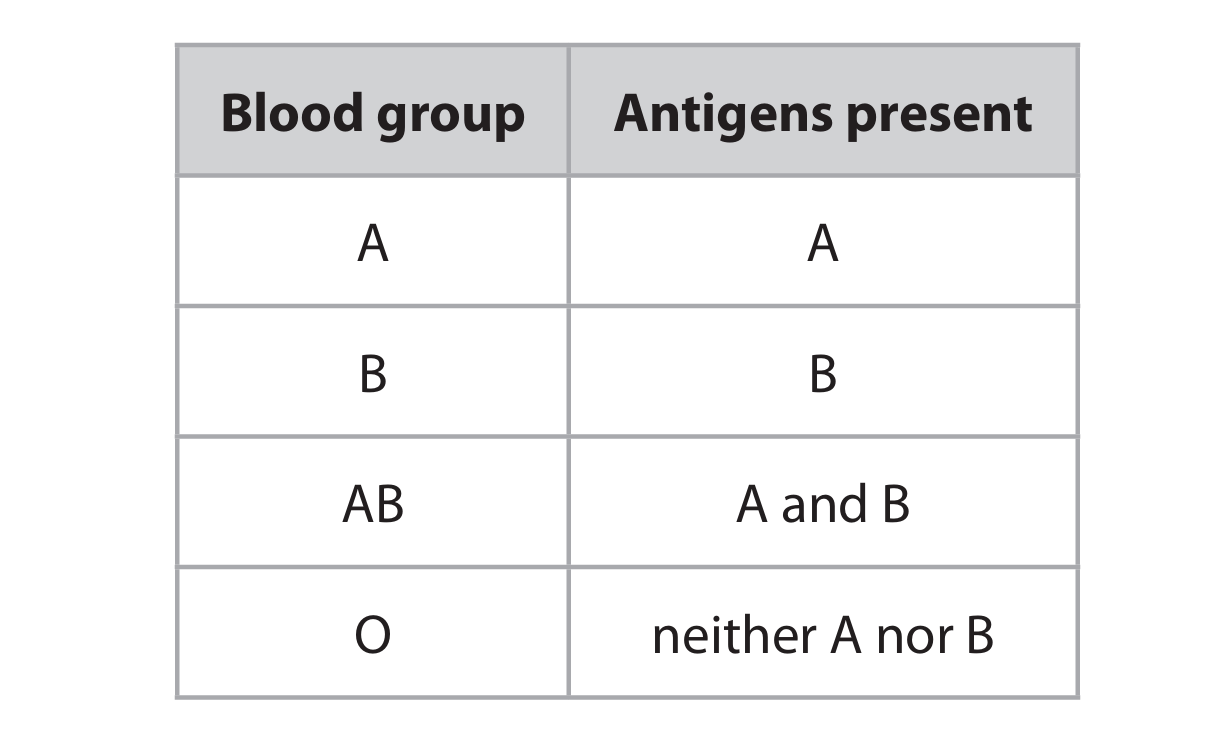
Question

Read the passage below. Use the information in the passage and your own knowledge to answer the questions that follow.

Making Enough Blood for the World

A blood transfusion is the transfer of blood from a donor into a patient. Blood transfusions are routine medical procedures that save the lives of millions of people every year.

The first successful blood transfusions were performed in the early twentieth century after scientists discovered that there are four main blood groups, A, B, AB and O. The blood groups are due to the presence of proteins, called antigens, on the surface of red blood cells. There are two main protein antigens called A and B. If a patient is given blood with antigens different to their own cells, their immune system will make antibodies against that antigen. The antigens present on the surface of red blood cells for each blood group are shown in the table.

Currently, blood transfusions are carried out with blood that has been donated by healthy people. The World Health Organisation calculates that there are 118.5 million blood donations collected globally every year. Of these donations, 40% are collected from a small group of high-income countries. This means that there is a shortage of blood in many countries so the hunt is on to find an alternative.

Scientists have found a way to make artificial red blood cells. They made spheres of cell membranes filled with haemoglobin. These artificial cells are then suspended in sodium chloride solution. These artificial red blood cells have no proteins on their surface. Another way of making red blood cells is being developed in the United Kingdom. A research team has used stem cells to produce red blood cells with blood group O. The red blood cells produced are then suspended in sodium chloride solution.

Both methods produce large quantities of safe red blood cells. There may be other advantages as well, artificial blood would always have the same concentration of solutes and will not clot when stored. Critics have pointed out that the artificial blood will only transport oxygen and that blood has many more functions.

(a) Name the type of cell that produces antibodies. (Lines 8 and 9)

(b) Human blood groups are controlled by three alleles, IA, IB and IO. The IA and IB alleles are codominant and the IO allele is recessive.

(i) State what is meant by the term codominant.

(ii) Two parents have genotypes of IAIO and IBIO. Which of these are all the possible blood groups of their children?

  • A. A and B
  • B. A, B and O
  • C. AB and O
  • D. A, B, AB and O

(c) Calculate the number of blood donations collected per year from the high-income countries. (Lines 14 and 15) Give your answer in standard form.

(d) Some scientists have suggested that spherical artificial red blood cells transport oxygen less efficiently than normal human red blood cells. Explain why the shape of the artificial red blood cells reduces the efficiency of oxygen transport compared to normal human red blood cells. (Lines 18 and 19)

(e) Suggest why artificial blood does not clot when stored. (Lines 26 and 27)

(f) Explain why the artificial red blood cells are suspended in sodium chloride solution instead of in water. (Line 20)

(g) (i) Explain why stem cells can be used to make large quantities of red blood cells. (Lines 22 and 23)

(ii) Suggest why the scientists made red blood cells with blood group O. (Lines 22 and 23)

(h) Give two substances found in blood plasma that are not present in the artificial blood. (Lines 28 and 29)

Most-appropriate topic codes (Edexcel IGCSE Biology):

2(h): Transport — blood composition and red blood cell adaptations — parts (d), (e), (f), (h)
2(b): Cell structure — cell membranes and organelles — part (f)
2(h): Immune response and antibody production — part (a)
3(b): Inheritance — codominance and multiple alleles — parts (b)(i), (b)(ii)
3(b): Genetics — stem cells and differentiation — part (g)(i)
4: Mathematical skills — standard form and percentage calculation — part (c)
▶️ Answer/Explanation
Solution

(a) Lymphocytes

Explanation: Antibodies are proteins produced by specialized white blood cells called lymphocytes as part of the immune response. When foreign antigens are detected, lymphocytes are activated to produce specific antibodies that bind to and help eliminate the foreign substances.

(b)(i) Both alleles are expressed in the phenotype.

Explanation: Codominance occurs when both alleles in a heterozygous individual are fully expressed, resulting in a phenotype that shows characteristics of both alleles simultaneously. For example, in blood groups, the IA and IB alleles are codominant, meaning an individual with genotype IAIB will have blood group AB, expressing both A and B antigens.

(b)(ii) D (A, B, AB and O)

Explanation: When crossing parents with genotypes IAIO and IBIO, we can create a Punnett square to determine the possible offspring genotypes:

The possible gametes from IAIO parent: IA and IO

The possible gametes from IBIO parent: IB and IO

Possible offspring genotypes: IAIB (blood group AB), IAIO (blood group A), IBIO (blood group B), and IOIO (blood group O). Therefore, all four blood groups are possible.

(c) 4.74 × 10⁷

Explanation: The total global blood donations are 118.5 million, which is 118,500,000. High-income countries contribute 40% of this total. To calculate: 40% of 118,500,000 = 0.40 × 118,500,000 = 47,400,000. In standard form, this is written as 4.74 × 10⁷.

(d) Artificial spherical red blood cells have a smaller surface area to volume ratio compared to normal biconcave red blood cells, reducing oxygen diffusion efficiency.

Explanation: Normal human red blood cells have a unique biconcave disc shape that maximizes their surface area to volume ratio. This specialized shape allows for more efficient gas exchange as it provides a larger surface area for oxygen to diffuse across. Spherical artificial cells have a lower surface area to volume ratio, meaning less surface is available for oxygen binding and release. Additionally, the biconcave shape of natural red blood cells allows them to flow more easily through narrow capillaries, while spherical cells might not navigate the circulatory system as efficiently.

(e) Artificial blood lacks platelets and clotting factors.

Explanation: Natural blood contains platelets and various clotting factors that work together to form clots when bleeding occurs. Artificial blood, being designed primarily for oxygen transport, doesn’t include these components. Without platelets and clotting factors like fibrinogen, the coagulation cascade cannot be initiated, preventing clot formation during storage.

(f) Sodium chloride solution maintains osmotic balance, preventing cell bursting or shrinkage.

Explanation: If artificial red blood cells were suspended in pure water, water would enter the cells by osmosis due to the higher solute concentration inside the cells. This would cause the cells to swell and potentially burst (hemolysis). Sodium chloride solution is isotonic, meaning it has the same solute concentration as the interior of the cells. This prevents net movement of water across the cell membrane, maintaining cell integrity and function during storage.

(g)(i) Stem cells can undergo mitosis to produce more cells and differentiate into specialized cell types.

Explanation: Stem cells are undifferentiated cells with two key properties: self-renewal (ability to divide and produce more stem cells through mitosis) and differentiation (ability to develop into specialized cell types). By controlling the growth conditions and providing specific signals, scientists can direct stem cells to differentiate exclusively into red blood cells, allowing for large-scale production in laboratory settings.

(g)(ii) Blood group O lacks A and B antigens, making it universally compatible.

Explanation: Blood group O red blood cells don’t have A or B antigens on their surface. This means they won’t trigger an immune response when transfused into recipients with any blood type (A, B, AB, or O). People with other blood types don’t have pre-formed antibodies against O blood cells. This universal compatibility makes blood group O particularly valuable in emergency situations when there might not be time to determine the recipient’s blood type.

(h) Any two from: urea, carbon dioxide, hormones, mineral ions, vitamins, proteins (antibodies/clotting factors), digested food (glucose/amino acids)

Explanation: Natural blood plasma contains numerous substances that artificial blood lacks. Urea is a waste product transported to the kidneys for excretion. Carbon dioxide is carried from tissues to the lungs. Hormones act as chemical messengers throughout the body. Mineral ions and vitamins serve various metabolic functions. Proteins include antibodies for immunity and clotting factors for wound healing. Digested nutrients like glucose and amino acids are transported to cells for energy and growth.
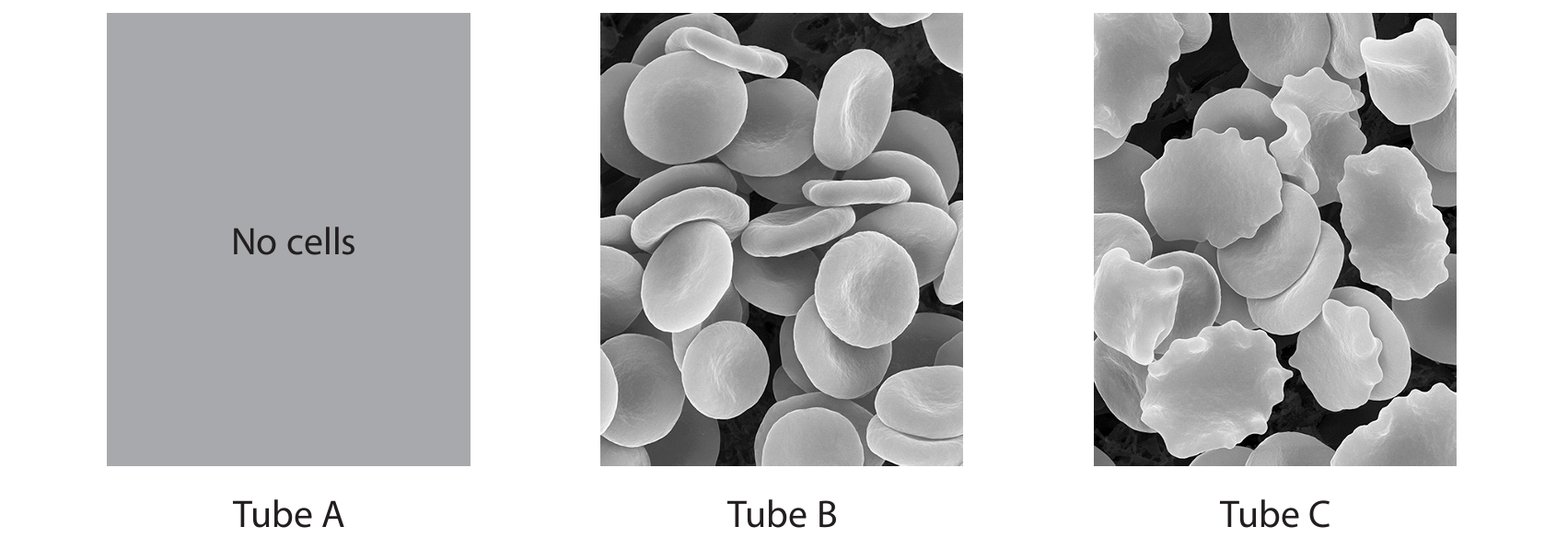
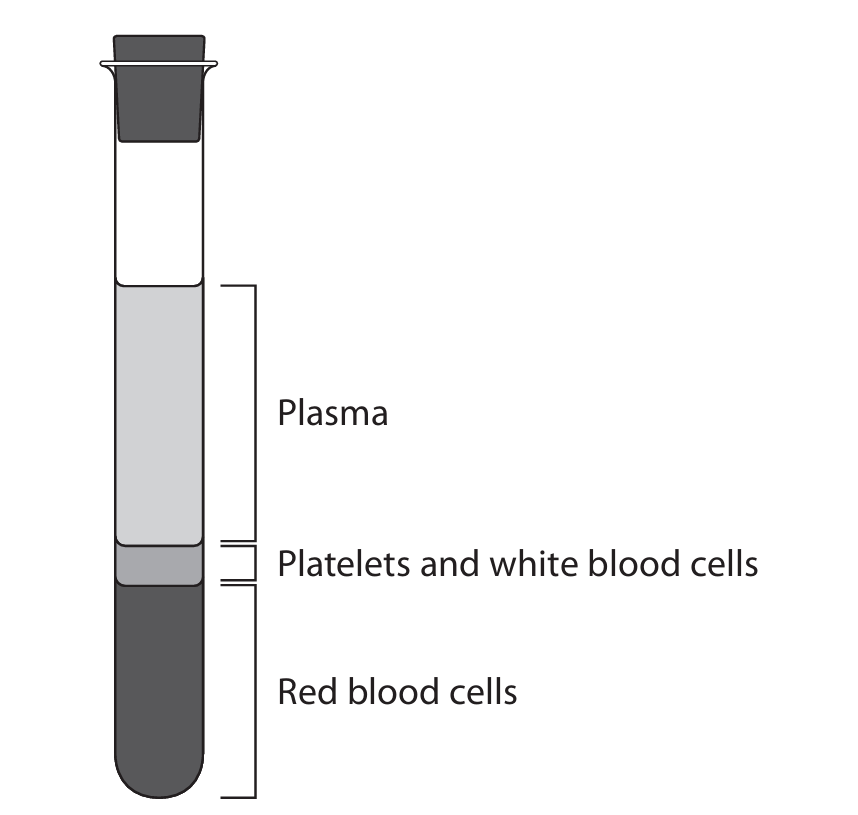
Question

A teacher carries out a demonstration to show the effect of different concentrations of salt solution on red blood cells.

This is the teacher’s method.

  • dilute a sample of blood using a salt solution that has the same concentration as blood plasma
  • place 1 cm\(^3\) of the diluted blood into each of three test tubes labelled A, B and C
  • add 10 cm\(^3\) of water to tube A
  • add 10 cm\(^3\) of 1% sodium chloride solution to tube B
  • add 10 cm\(^3\) of 5% sodium chloride solution to tube C
  • leave each tube for 5 minutes
  • compare the cloudiness of the solutions in the three test tubes
  • take a drop of liquid from each tube and put on separate microscope slides
  • observe each slide under a microscope

(a) State the independent variable in this investigation.

(b) Give one variable that the teacher controls in this investigation.

(c) After 5 minutes, these are the teacher’s observations.

  • tube A – a clear red solution
  • tube B – a cloudy red suspension
  • tube C – a cloudy red suspension

(i) Explain the differences in the teacher’s observations.

(ii) When the teacher looks down a microscope for cells on each slide, these are the teacher’s observations.

  • slide from tube A – no cells are seen
  • slide from tube B – normal biconcave red cells are seen
  • slide from tube C – red cells are seen but the cells have shrunken edges

The photographs show the teacher’s observations.

Explain the differences between the teacher’s observations of the slides from each tube. (2)

(d) Blood samples can be separated into different layers using a centrifuge.

This is a machine that spins blood at a high speed.
A new sample of blood is shown after it has been spun in a centrifuge.

Describe how the blood in tubes A, B and C from the teacher’s demonstration would look after they had been spun in a centrifuge.

Most-appropriate topic codes (Edexcel IGCSE Biology):

2(d): Movement of substances into and out of cells — parts (c)(i), (c)(ii), (d)
2(b): Cell structure — parts (a), (b), (c)(ii)
2(h): Transport — part (d)
3(a): Reproduction — indirect link to cell integrity
▶️ Answer/Explanation
Solution

(a) Salt concentration / concentration of salt solution / sodium chloride concentration / percentage sodium chloride / water potential of solution

Explanation: The independent variable is the factor that is deliberately changed by the investigator. In this experiment, the teacher is testing different concentrations of salt solution (water, 1%, and 5% sodium chloride) to see their effect on the red blood cells.

(b) Volume of (diluted) blood / volume of solution added / time solution left for / concentration of (diluted) blood sample

Explanation: A controlled variable is one that is kept constant to ensure a fair test. The teacher controls several factors, such as using the same volume of diluted blood in each tube (1 cm³), adding the same volume of different solutions (10 cm³), and leaving all tubes for the same duration (5 minutes).

(c)(i) In tube A (water), the cells burst (lyse) and release haemoglobin, creating a clear red solution. In tubes B and C (salt solutions), the cells remain mostly intact, creating a cloudy suspension.

Explanation: The cloudiness indicates the presence of intact cells scattering light. In tube A, distilled water is hypotonic relative to the red blood cells. Water enters the cells by osmosis, causing them to swell and burst (haemolysis), releasing haemoglobin into the solution and making it clear. In tubes B and C, the salt solutions are closer to isotonic (B) or hypertonic (C), so the cells do not burst and remain in suspension, making the solution cloudy.

(c)(ii) In tube A (water), water enters the red blood cells by osmosis, causing them to swell and burst, so no intact cells are seen. In tube B (1% salt), the solution is isotonic, so water enters and leaves at equal rates, and normal biconcave cells are seen. In tube C (5% salt), the solution is hypertonic, so water leaves the cells by osmosis, causing them to shrink and develop cremated (shrunken) edges.

Explanation: The differences are due to osmosis, the movement of water across the cell membrane from a region of higher water potential to a region of lower water potential. In tube A, the external water potential is higher than inside the cell, so water rushes in, bursting the cell. In tube B, the water potential is balanced, so the cell shape is maintained. In tube C, the external water potential is lower (due to high salt), so water leaves the cell, causing it to shrink.

(d) Tube A would show no red cell layer (the red color would be distributed throughout the tube). Tubes B and C would show normal layers, but the red cell layer in C might be slightly smaller.

Explanation: Centrifugation separates blood components based on density. In a normal blood sample, red blood cells form the bottom layer. In tube A, the cells have burst, so there are no intact cells to form a pellet; the haemoglobin is dissolved in the solution. In tubes B and C, the cells are intact (though shrunken in C) and will form a red cell layer at the bottom. The layer in C might be smaller if the cells have lost water and become denser.
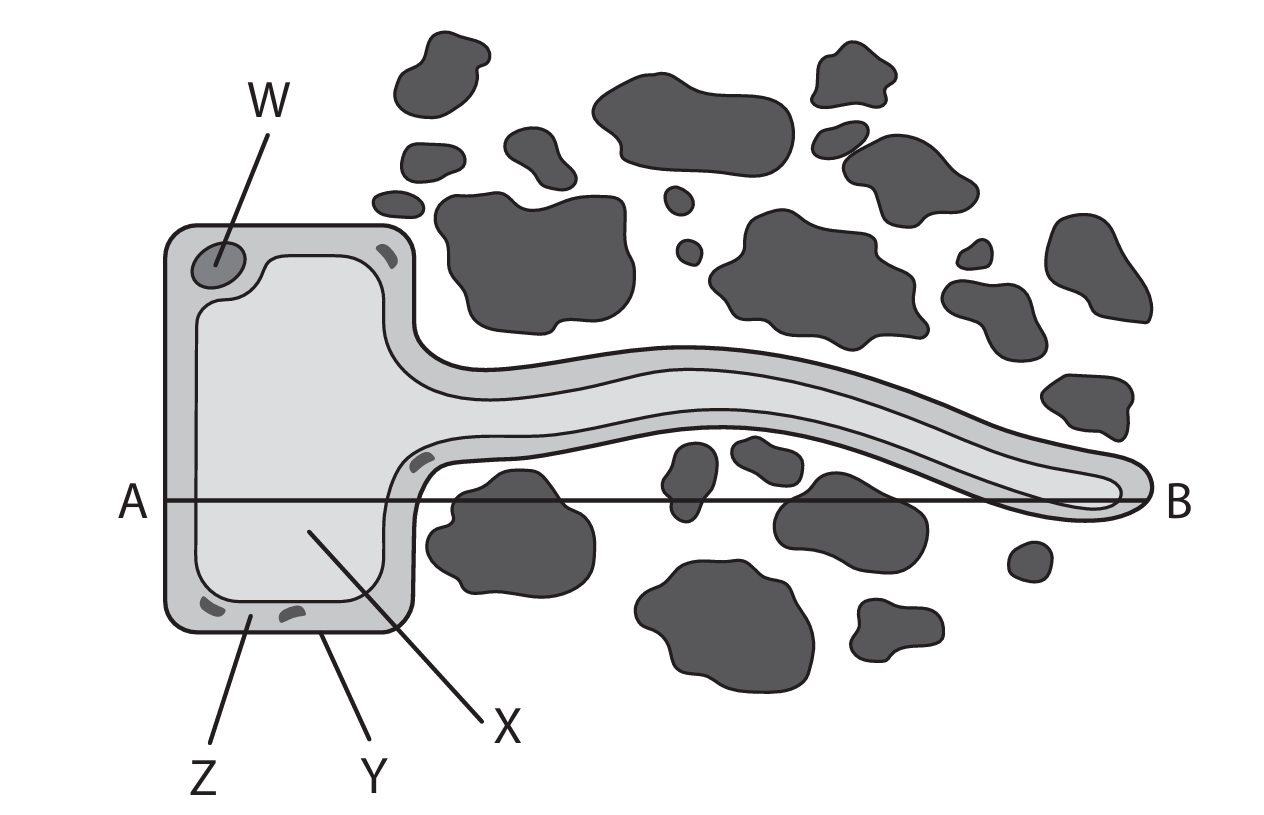
Question

The diagram shows a magnified image of a root hair cell from a young plant.

(a) Give the names of structures labelled W, X, Y and Z.

(b) The actual length of the cell, along the line between A and B, is 1000 μm.

Calculate the magnification of this drawing.

(c) (i) Explain the role of the root hair cell in absorption of water from the soil. (3)

(ii) Sometimes gardeners give their plants too much water. The water fills up the air spaces in the soil around the plant roots.

Explain how this can lead to plants failing to grow properly. (3)

Most-appropriate topic codes (Edexcel IGCSE Biology):

2(b): Cell structure — part (a)
2(h): Transport — parts (c)(i), (c)(ii)
2(d): Movement of substances into and out of cells — part (c)(i)
2(f): Respiration — part (c)(ii)
Appendix 4: Mathematical skills — part (b)
▶️ Answer/Explanation
Solution

(a)

W: Nucleus

X: Vacuole (or cell sap)

Y: Cell Wall (specifically cellulose cell wall)

Z: Cytoplasm

Explanation: In a typical plant cell, the nucleus (W) contains the genetic material and controls cell activities. The vacuole (X) is a large, fluid-filled sac that stores water, nutrients, and waste, helping maintain turgor pressure. The cell wall (Y) is a rigid outer layer made of cellulose that provides structural support and protection. The cytoplasm (Z) is the gel-like substance inside the cell where most cellular activities occur.

(b)

magnification = 80 (accept values in the range 79-82)

Explanation: To calculate magnification, we use the formula:

\[ \text{Magnification} = \frac{\text{Size of Image}}{\text{Actual Size}} \]

First, measure the length between A and B in the drawing. Let’s assume this measures 80 mm (or 8.0 cm).

Convert this measurement to micrometers (μm) to match the units of the actual size. Since 1 mm = 1000 μm, 80 mm = 80,000 μm.

The actual size is given as 1000 μm.

Now, plug the values into the formula:

\[ \text{Magnification} = \frac{80,000 \ \mu m}{1,000 \ \mu m} = 80 \]

So, the drawing is magnified 80 times.

(c) (i)

Explanation: Root hair cells are specially adapted for absorbing water from the soil. Their long, hair-like projection significantly increases the surface area of the root, allowing it to absorb more water. Water enters the root hair cell from the soil via osmosis. This process occurs because the water potential inside the root hair cell is lower (meaning it has a higher concentration of solutes like minerals) than the water potential in the soil (which is generally higher, or more dilute). Water molecules naturally move from an area of high water potential (soil) to an area of low water potential (root hair cell) across the partially permeable cell membrane. This movement of water is often driven by a water potential gradient set up in the plant as water is lost through transpiration from the leaves. The absorbed water is essential for various plant functions, including photosynthesis and maintaining turgor pressure, which keeps the plant upright.

(c) (ii)

Explanation: When too much water is added to the soil, it fills the air spaces that normally contain oxygen. Plant roots, like all living cells, require oxygen for respiration to release energy. This energy is crucial for active transport, the process by which roots absorb essential mineral ions (like nitrates and magnesium) from the soil against a concentration gradient. If the soil becomes waterlogged and oxygen is depleted, root respiration is severely reduced. Consequently, active transport cannot occur effectively, leading to a decreased uptake of vital minerals. Without sufficient nitrates, the plant cannot synthesize amino acids and proteins properly, and without magnesium, it cannot produce chlorophyll, which is essential for photosynthesis. This overall lack of energy and essential nutrients causes the plant to fail to grow properly, leading to stunted growth, yellowing leaves, and potentially plant death.
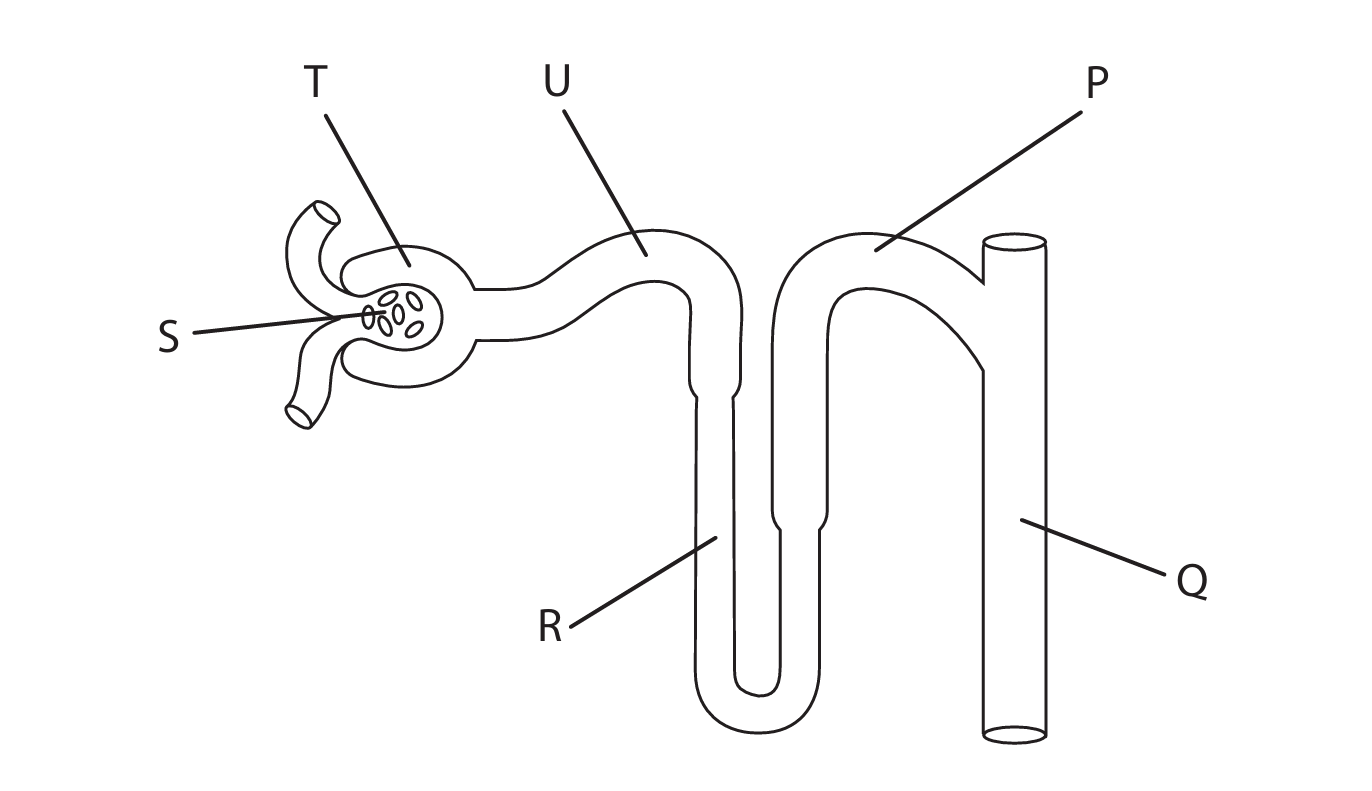
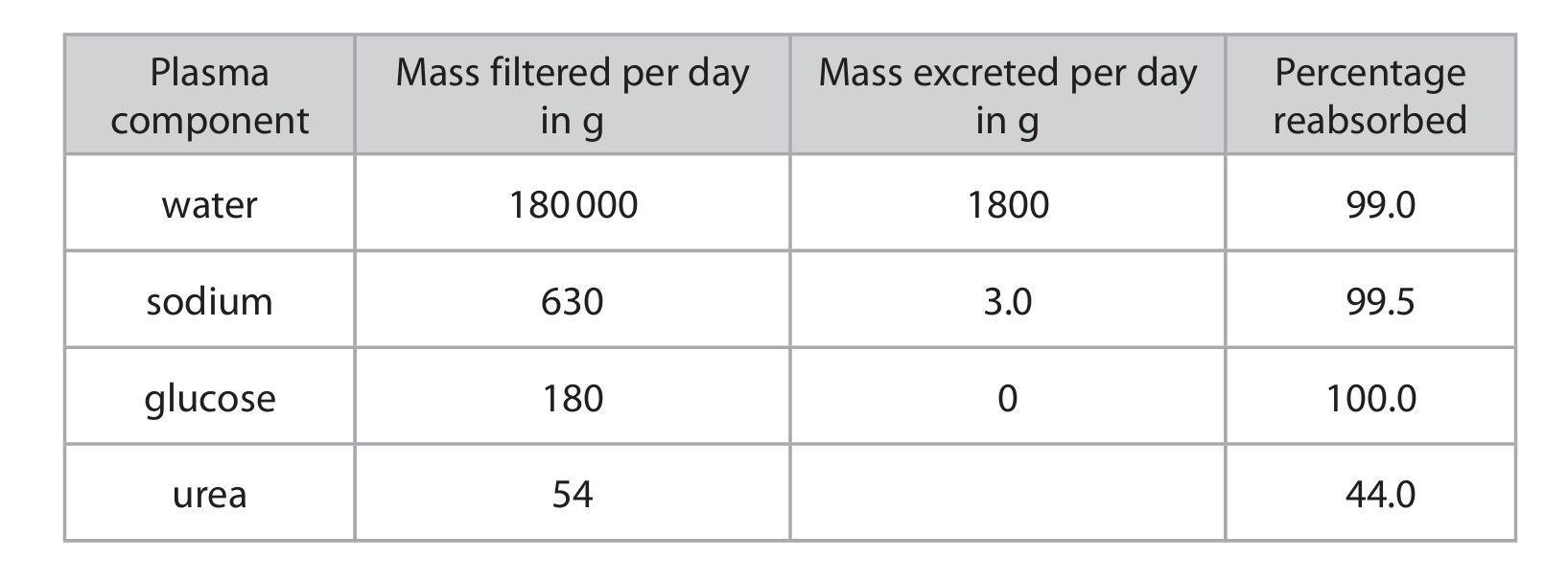
Question

The diagram shows a nephron from a human kidney.

(a) (i) From which structure does ultrafiltration take place?

  • A. P
  • B. Q
  • C. R
  • D. S

(ii) From which structure is glucose reabsorbed?

  • A. Q
  • B. R
  • C. S
  • D. U

(iii) Which structure is the loop of Henle?

  • A. P
  • B. R
  • C. S
  • D. U

(b) The table gives the mean values of mass filtered per day and excreted per day for different plasma components that are filtered and reabsorbed in the nephron.

(i) State what is meant by plasma components.

(ii) Calculate the mean mass of urea excreted per day.

(iii) Explain why glucose is reabsorbed in the nephron.

(iv) The concentration of urine is determined by the volume of water present and the mass of dissolved substances.

A person eats a meal with a high protein and salt content and drinks a small volume of water.

Comment on how this may change the values in the table and the effect it will have on urine production.

Most-appropriate topic codes (Edexcel IGCSE Biology):

2(i): Excretion — parts (a)(i), (a)(ii), (a)(iii), (b)(i), (b)(ii), (b)(iii), (b)(iv)
2(h): Transport — part (b)(iv) — linked to water balance and ADH
4(a): The organism in the environment — part (b)(iv) — linked to homeostasis and response to internal environment
▶️ Answer/Explanation
Solution

(a)(i) D S

Explanation: The structure labelled S is the glomerulus, which is a network of capillaries where ultrafiltration occurs. Blood pressure forces water, ions, and small molecules out of the blood and into the Bowman’s capsule, forming the filtrate.

(a)(ii) D U

Explanation: The structure labelled U is the proximal convoluted tubule (PCT). This is where the majority of glucose reabsorption takes place through active transport, returning this valuable nutrient to the bloodstream.

(a)(iii) B R

Explanation: The structure labelled R is the loop of Henle. This hairpin-shaped section of the nephron creates a concentration gradient in the kidney medulla, which is essential for water reabsorption and urine concentration.

(b)(i) Substances/chemicals present in solution/dissolved/carried in the liquid part of the blood/plasma.

Explanation: Plasma components refer to the various dissolved substances found in blood plasma, which is the liquid matrix of blood. These include water, electrolytes (like sodium), nutrients (like glucose), waste products (like urea), hormones, and proteins.

(b)(ii) 30.24 g

Explanation: The calculation is based on the percentage reabsorbed. If 44% of urea is reabsorbed, then 56% is excreted. The mass excreted per day is therefore 56% of the mass filtered: \( \frac{56}{100} \times 54 = 30.24 \) g.

(b)(iii) To prevent glucose from being excreted/lost from the body and to maintain blood glucose levels for respiration/energy release.

Explanation: Glucose is a vital energy source for cells. The body carefully regulates blood glucose levels. Reabsorbing glucose in the nephron ensures that this important fuel is not wasted in urine and is kept in the bloodstream to be used for cellular respiration, which releases the energy needed for all bodily functions.

(b)(iv)

Explanation: A high-protein, high-salt meal with low water intake would have several effects. The breakdown of excess protein increases urea production, leading to a higher concentration of urea in the plasma and subsequently more urea being filtered and excreted. The high salt intake increases the sodium concentration in the blood, lowering its water potential. This is detected by osmoreceptors, which signal the pituitary gland to release more Anti-Diuretic Hormone (ADH). ADH makes the walls of the collecting duct more permeable to water. As a result, more water is reabsorbed back into the blood from the filtrate, producing a smaller volume of more concentrated urine to conserve water and excrete the excess salts and urea.

Question

Beta thalassaemia is a genetic condition caused by a mutation in a gene for haemoglobin. People with beta thalassaemia produce less haemoglobin and fewer red blood cells than people without the condition.

(a) Explain why people with beta thalassaemia may experience severe tiredness.

(b) A new treatment for beta thalassaemia has been developed that edits the haemoglobin gene. These are the steps in the treatment.

  • remove blood stem cells from a patient’s bone marrow
  • put a strand of RNA and an enzyme into the blood stem cells to correct the haemoglobin gene
  • use drugs to destroy the patient’s remaining bone marrow cells
  • replace the patient’s bone marrow cells with the modified stem cells

The modified stem cells that are in the bone marrow now produce red blood cells containing sufficient haemoglobin.

(i) The strand of RNA used in this treatment is complementary to one strand of the DNA in the haemoglobin gene.

Give the base sequence of RNA that is complementary to this sequence of DNA.

(ii) Protein synthesis of the modified gene will produce haemoglobin.

Describe the stages of this protein synthesis.

(iii) The standard treatment for beta thalassaemia is a weekly blood transfusion.

The new treatment has so far been tested on two patients, with these results.

  • both patients started making large numbers of red blood cells with sufficient haemoglobin
  • both patients experienced serious side effects from the drugs used, needing to spend several months in isolation in hospital before recovering
  • 15 months after the treatment, neither patient required further blood transfusions
  • both patients were able to exercise normally without feeling tired

Evaluate the use of the new treatment compared to weekly blood transfusions.

Most-appropriate topic codes (Edexcel IGCSE Biology):

2(h): Transport — part (a)
3(b): Inheritance — parts (b)(i), (b)(ii)
5(c): Genetic modification (genetic engineering) — part (b)(i), (b)(ii)
5(d): Cloning — part (b) context
3(b): Inheritance — part (b)(iii) (evaluation of treatment)
▶️ Answer/Explanation
Solution

(a)

Answer: An explanation that makes reference to two of the following:

  • less oxygen (transported) (1)
  • to muscles (1)
  • less respiration / less ATP production / less energy release / more lactic acid / more anaerobic respiration (1)

Detailed Explanation:

People with beta thalassaemia produce less haemoglobin, which is the protein in red blood cells responsible for carrying oxygen. Since there are fewer red blood cells and less haemoglobin, the blood’s overall oxygen-carrying capacity is significantly reduced. This means that less oxygen is delivered to the body’s tissues, particularly to active muscles.

Oxygen is essential for aerobic respiration, the process that efficiently releases energy (in the form of ATP) from glucose. When oxygen is limited, cells are forced to rely more on anaerobic respiration. Anaerobic respiration releases much less energy per glucose molecule and also produces lactic acid as a waste product, which can lead to muscle fatigue and pain. The combination of reduced ATP (energy) production and the buildup of lactic acid results in the severe tiredness and weakness experienced by individuals with this condition.

(b)(i)

Answer: UUACCGCCGAGU (2)

Detailed Explanation:

To find the complementary RNA sequence, you need to remember the base pairing rules. In RNA, adenine (A) pairs with uracil (U) (instead of thymine, as in DNA), and guanine (G) pairs with cytosine (C).

Let’s go through the DNA strand base by base:

  • DNA A → RNA U
  • DNA A → RNA U
  • DNA T → RNA A
  • DNA G → RNA C
  • DNA G → RNA C
  • DNA C → RNA G
  • DNA G → RNA C
  • DNA G → RNA C
  • DNA C → RNA G
  • DNA T → RNA A
  • DNA C → RNA G
  • DNA A → RNA U

Putting it all together, the complementary RNA strand is U U A C C G C C G A G U.

(b)(ii)

Answer: A description that makes reference to four of the following:

  • transcription occurs in nucleus (1)
  • production of messenger RNA / mRNA (from DNA) (1)
  • translation occurs on ribosome / mRNA binds to ribosome / mRNA goes to ribosome (1)
  • tRNA brings / has amino acids (1)
  • codon binds to anticodon / codons are complementary to anticodons / (complementary) triplets on tRNA and mRNA bind / eq (1)
  • polypeptide produced / amino acids joined together / amino acid chain produced / eq (1)

Detailed Explanation:

Protein synthesis occurs in two main stages: transcription and translation.

1. Transcription: This first stage takes place inside the nucleus. The DNA double helix unwinds at the specific gene that codes for haemoglobin. The enzyme RNA polymerase uses one strand of the DNA as a template to build a complementary strand of messenger RNA (mRNA). This process follows base-pairing rules (A with U, T with A, G with C, C with G). Once the mRNA strand is complete, it detaches from the DNA, which rewinds, and the mRNA molecule leaves the nucleus through a nuclear pore and enters the cytoplasm.

2. Translation: This second stage occurs on ribosomes in the cytoplasm. The mRNA molecule binds to a ribosome. The ribosome reads the mRNA sequence in groups of three bases called codons. Transfer RNA (tRNA) molecules, each carrying a specific amino acid, have a three-base anticodon that is complementary to the mRNA codon. The tRNA molecules bring the correct amino acids to the ribosome in the order specified by the mRNA sequence. As the ribosome moves along the mRNA, it links the amino acids together with peptide bonds, forming a growing polypeptide chain. This chain continues to grow until a stop codon is reached on the mRNA, at which point the completed haemoglobin polypeptide is released.

(b)(iii)

Answer: An answer that makes reference to four of the following:

Pros (max 3):

  • patients produce red blood cells / can exercise / are not breathless / have more energy / eq (1)
  • independent life / transfusions not needed / better quality of life / no need to keep visiting hospitals / eq (1)
  • no rejection (1)
  • less risk of infectious disease (from blood) (1)
  • permanent treatment / long lasting / lasts a lifetime / cure / works for at least 15 months (1)

Cons (max 3):

  • need to spend long time in isolation (for treatment) / eq (1)
  • side effects (1)
  • small sample size / only tested on two people / needs further testing / more repeats / eq (1)
  • could cause mutations in DNA / cause cancers (1)
  • need to be tested for more than 15 months / for longer / eq (1)

Detailed Explanation:

Advantages of the New Treatment:

The new gene therapy treatment offers significant potential benefits. It appears to be a long-term or even permanent solution, as evidenced by patients not needing transfusions for 15 months post-treatment. This eliminates the lifelong dependency on weekly blood transfusions, freeing patients from frequent hospital visits and the associated disruptions to their daily lives. Using the patient’s own modified cells eliminates the risk of immune rejection, a common problem with organ or tissue transplants. Furthermore, it removes the risk of contracting infectious diseases from donated blood. The results showing patients could exercise normally indicate a vastly improved quality of life and physical capability.

Disadvantages and Risks of the New Treatment:

However, the treatment carries serious risks and limitations. The drugs used to destroy the existing bone marrow caused severe side effects, requiring a long and isolating hospital stay, which is physically and emotionally taxing. The sample size of only two patients is very small, making it difficult to be certain about the treatment’s effectiveness and safety for the wider population. There is a potential risk that the gene editing process could cause unintended mutations in the DNA, which might lead to other health issues, including cancer. The 15-month success period, while promising, is not long enough to confirm it is a true lifelong cure, and longer-term monitoring is essential. In contrast, while weekly transfusions are inconvenient and carry their own risks (like infection or iron overload), they are a well-established and predictable treatment.

In conclusion, the new treatment is a promising potential cure that could greatly improve quality of life, but it is currently associated with significant short-term risks and its long-term safety and efficacy are still unknown due to limited testing.
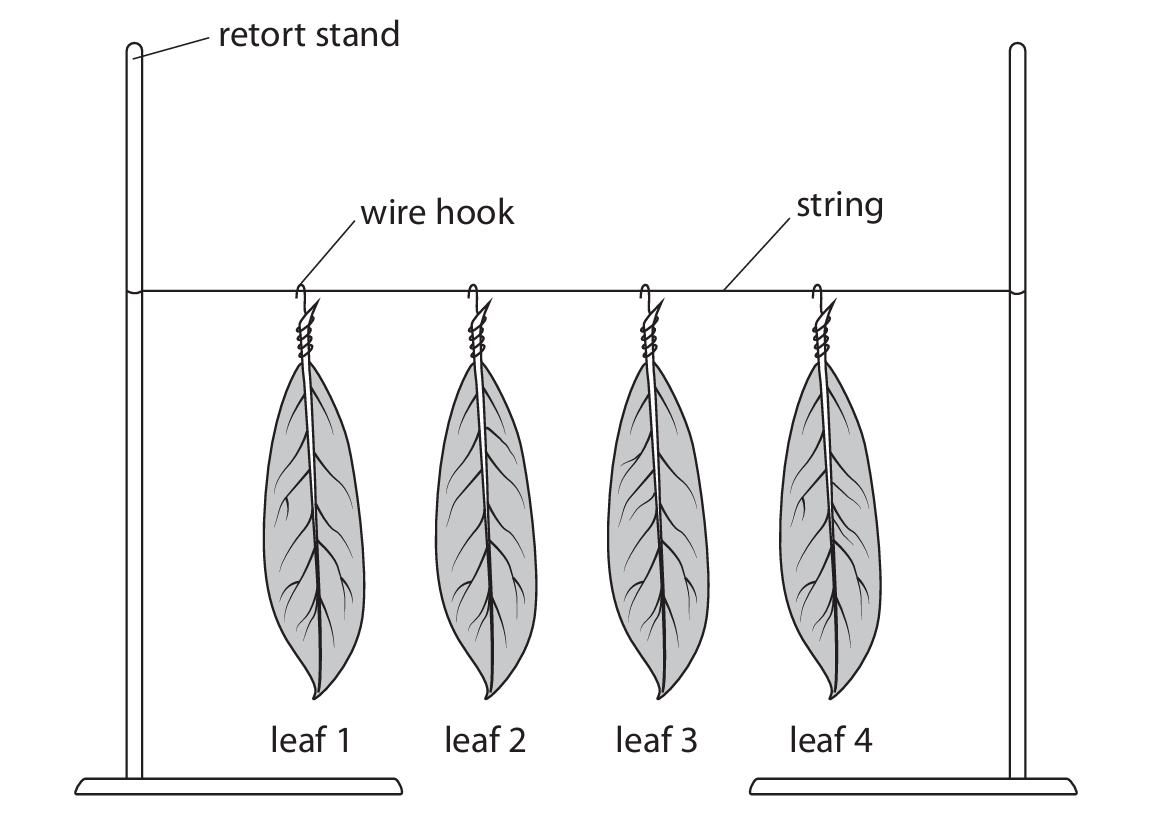
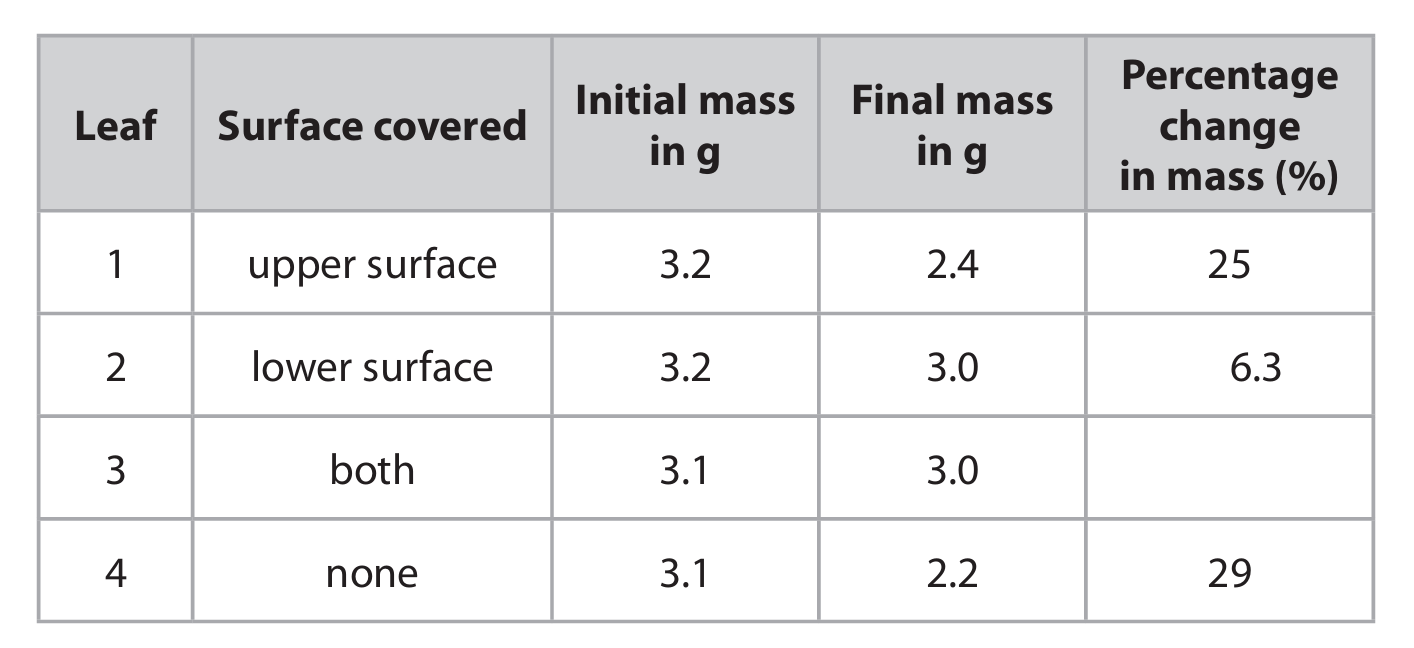
Question

A student uses this method to investigate the water loss from leaves.

  • select 4 leaves of equal size from the same species of plant
  • wrap thin wire around the leaf stalk of each leaf and use the remaining wire to produce a hook
  • cover the upper surface on leaf 1 with petroleum jelly
  • cover the lower surface on leaf 2 with petroleum jelly
  • cover the upper surface and the lower surface on leaf 3 with petroleum jelly
  • do not cover leaf 4 with petroleum jelly
  • record the mass of each leaf
  • attach the leaves, by their wire hooks, at intervals along a horizontal string
  • remove the leaves from the string after 3 hours
  • record the new mass of each leaf

(a) (i) Which of these is the independent variable in this experiment?

  • A. leaf size
  • B. leaf surface covered
  • C. mass lost
  • D. time

(a) (ii) State why leaves of the same species were selected.

(b) The table shows some of the student’s results.

(b) (i) Calculate the percentage change in mass for leaf 3.

(b) (ii) Explain the differences in water loss from the four leaves in the student’s experiment.

Most-appropriate topic codes (Edexcel IGCSE Biology):

2(h): Transport – Transpiration in flowering plants (2.56B, 2.57B)
4(a): The organism in the environment – Investigating populations and distribution (4.2, 4.4B)
Appendix 6: Suggested practical investigations – Fieldwork techniques and environmental factors
Appendix 5: Command word taxonomy – Calculate, Explain, State
▶️ Answer/Explanation
Solution

(a)(i) B (leaf surface covered)

Explanation: The independent variable is the factor deliberately changed. Here, the student varies which leaf surfaces are covered with petroleum jelly.

(a)(ii) To ensure a fair test / because different species may have different transpiration rates / different stomatal densities / eq.

Explanation: Using the same species controls for biological variation, ensuring observed differences are due to the treatment and not species-specific traits.

(b)(i) 3.2%

Explanation: Percentage change = [(Initial mass – Final mass) / Initial mass] × 100% = [(3.1 – 3.0) / 3.1] × 100% = 3.2258% ≈ 3.2%.

(b)(ii) An explanation linking water loss to stomatal location and the effect of petroleum jelly:

  • Leaf 4 (uncovered) lost most water (29%) because stomata on both surfaces were open.
  • Leaf 1 (upper covered) lost 25%, indicating many stomata are on the lower surface.
  • Leaf 2 (lower covered) lost only 6.3%, showing most stomata are on the lower surface.
  • Leaf 3 (both covered) lost least (3.2%) because petroleum jelly blocked almost all stomata.

This demonstrates that transpiration occurs mainly through stomata, which are more abundant on the lower leaf surface.
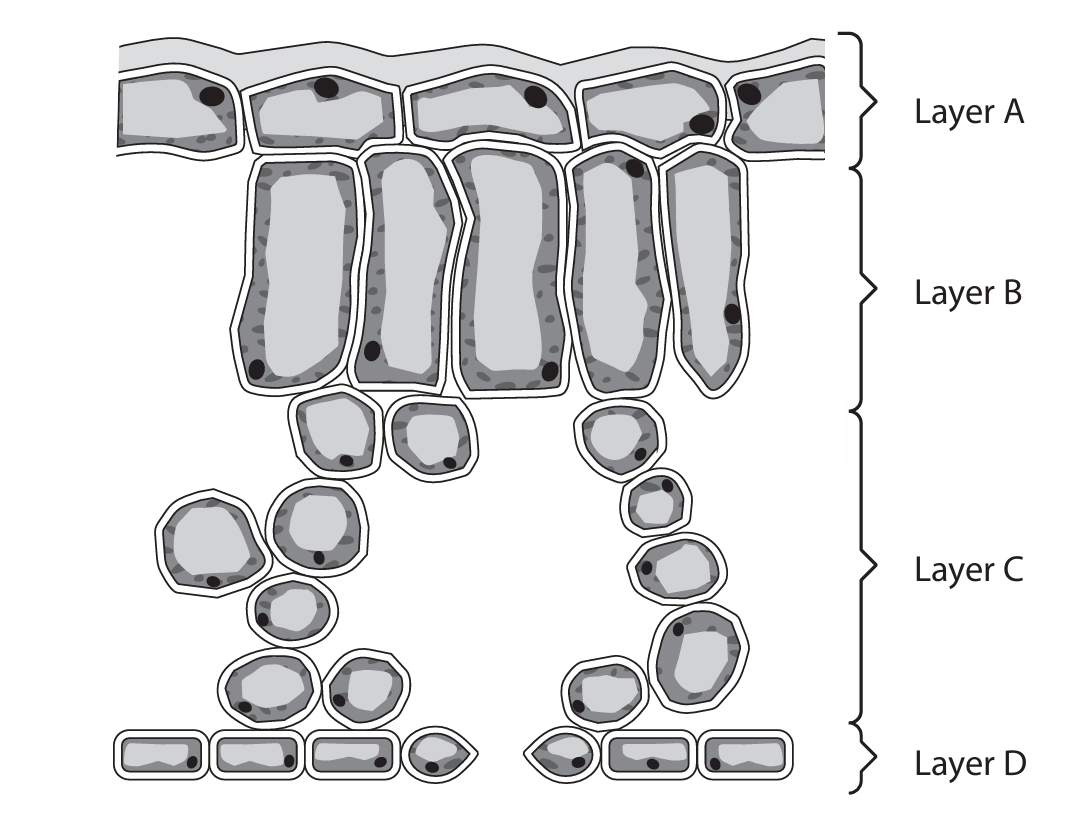
Question

The diagram shows a transverse section through a leaf.

(a) Explain how layer A is adapted for its role.

(b) Explain how layers B and C are adapted for photosynthesis and gas exchange.

(c) State the role of guard cells.

(d) Gardeners sometimes apply a spray called an anti-transpirant to plant leaves.

The spray is impermeable to water vapour but allows other gases to pass through. Discuss whether an anti-transpirant spray will promote plant growth.

Most-appropriate topic codes (Edexcel IGCSE Biology):

2(e): Nutrition in flowering plants — parts (a), (b)
2(g): Gas exchange in flowering plants — parts (b), (c)
2(h): Transport in flowering plants — part (d)
2(j): Co-ordination and response in flowering plants — part (c)
▶️ Answer/Explanation
Solution

(a) Explain how layer A is adapted for its role.

Answer: Layer A (the waxy cuticle/epidermis) is adapted by being transparent to allow light through, having a waxy coating to reduce water loss, and having few chloroplasts as it is not photosynthetic.

Detailed Explanation:
Layer A represents the upper epidermis and its waxy cuticle. This layer has several key adaptations for its protective role. First, it is transparent, allowing sunlight to pass through to the underlying palisade mesophyll cells where most photosynthesis occurs. Second, it secretes a waxy, waterproof substance called the cuticle that forms a protective barrier. This cuticle significantly reduces water loss through evaporation from the leaf surface, which is crucial for preventing the plant from wilting, especially in dry conditions. Additionally, the cells of the epidermis typically contain few or no chloroplasts since their primary function is protection rather than photosynthesis. This combination of transparency and waterproofing makes the epidermis highly efficient at protecting inner tissues while still enabling the essential process of photosynthesis to occur.

(b) Explain how layers B and C are adapted for photosynthesis and gas exchange.

Answer: Layer B (palisade mesophyll) is adapted with many chloroplasts and tightly packed cells for efficient light absorption. Layer C (spongy mesophyll) has air spaces and loosely packed cells to facilitate gas exchange.

Detailed Explanation:
Layer B is the palisade mesophyll layer, which is perfectly adapted for its role as the main photosynthetic tissue. The cells are elongated and arranged vertically in a tightly packed formation, positioned close to the upper epidermis where light intensity is highest. This arrangement maximizes light capture. Furthermore, these cells contain a high density of chloroplasts – the organelles where photosynthesis actually occurs – making them extremely efficient at converting light energy into chemical energy.

Layer C is the spongy mesophyll layer, which is specialized for gas exchange. Unlike the tightly packed palisade cells, the spongy mesophyll cells are irregularly shaped and loosely arranged, creating numerous interconnected air spaces between them. These air spaces create a large surface area for the diffusion of gases. Carbon dioxide (\(CO_2\)), which is needed for photosynthesis, can diffuse freely from the stomata through these air spaces to reach the photosynthetic cells. Simultaneously, oxygen (\(O_2\)), produced as a byproduct of photosynthesis, can diffuse out of the cells into these air spaces and eventually exit the leaf. The loose arrangement and abundant air spaces thus create an optimal environment for the efficient exchange of these vital gases.

(c) State the role of guard cells.

Answer: Guard cells control the opening and closing of stomata to regulate gas exchange and water loss.

Detailed Explanation:
Guard cells are highly specialized cells that surround each stoma (plural: stomata), which are tiny pores on the leaf surface. Their primary role is to regulate the opening and closing of these stomatal pores. When guard cells are turgid (swollen with water), they bend and create an opening between them, allowing the stoma to open. This opening enables carbon dioxide (\(CO_2\)) to enter the leaf for photosynthesis during daylight hours. Conversely, when guard cells lose water and become flaccid, they relax and close the stoma. This closure helps to conserve water by reducing transpiration (water vapor loss), particularly during hot, dry conditions or at night when photosynthesis isn’t occurring. Therefore, guard cells perform the crucial balancing act of allowing sufficient \(CO_2\) intake for photosynthesis while minimizing excessive water loss.

(d) Discuss whether an anti-transpirant spray will promote plant growth.

Answer: Anti-transpirant sprays may not consistently promote plant growth because while they reduce water loss, they may also limit carbon dioxide intake and mineral transport.

Detailed Explanation:
The effect of anti-transpirant sprays on plant growth involves a complex trade-off. On one hand, these sprays can be beneficial because they form a waterproof coating that reduces transpiration (water loss from the leaves). By conserving water, they help prevent wilting and water stress, especially during drought conditions or in windy environments. This water conservation could potentially support growth by maintaining turgor pressure and physiological processes.

However, there are significant drawbacks that may hinder growth. Although the spray allows other gases like carbon dioxide (\(CO_2\)) to pass through, it might still create an additional barrier that slightly reduces the rate of \(CO_2\) diffusion into the leaf. Since \(CO_2\) is essential for photosynthesis, any reduction in its uptake could limit the plant’s ability to produce glucose and other carbohydrates, ultimately slowing growth. Additionally, the transpiration stream plays a vital role in transporting mineral ions from the roots to the shoots. By reducing transpiration, the spray might also reduce the upward movement of these essential nutrients, potentially causing nutrient deficiencies that impair growth. Furthermore, transpiration provides a cooling effect for leaves; reducing it might lead to overheating in bright sunlight, damaging plant tissues. Therefore, whether an anti-transpirant promotes growth depends on the specific environmental conditions – it might be helpful in water-scarce situations but detrimental when water is plentiful and maximum photosynthetic rate is desired.
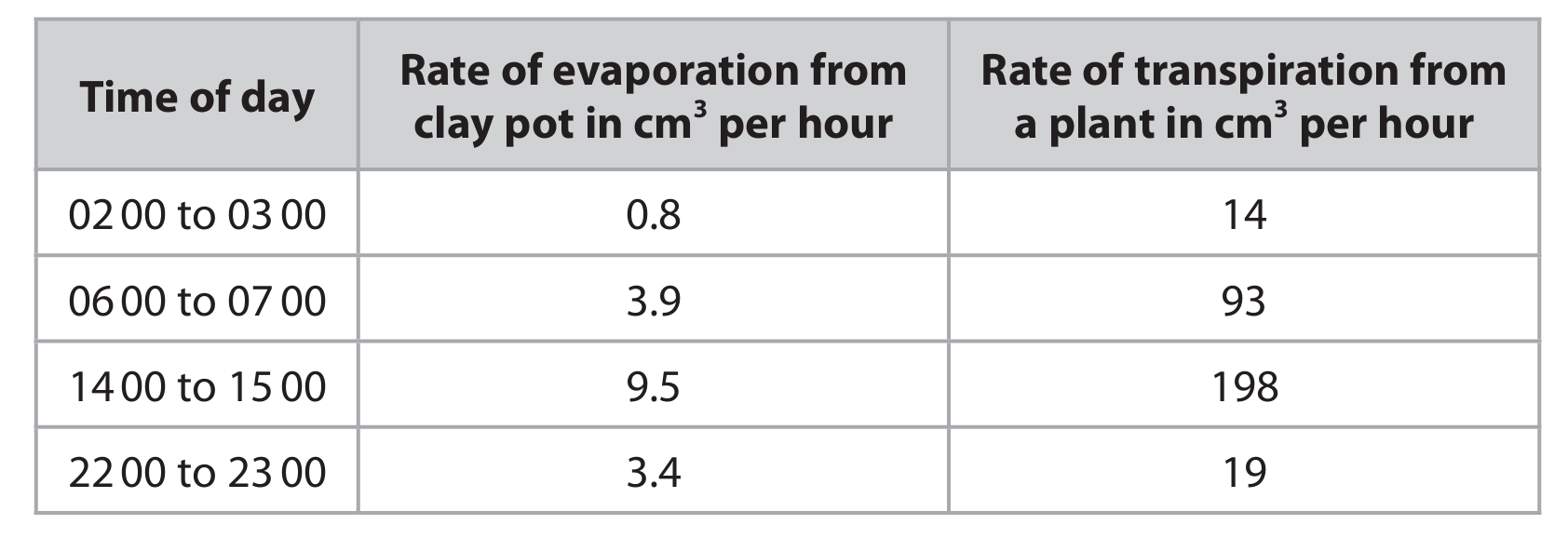
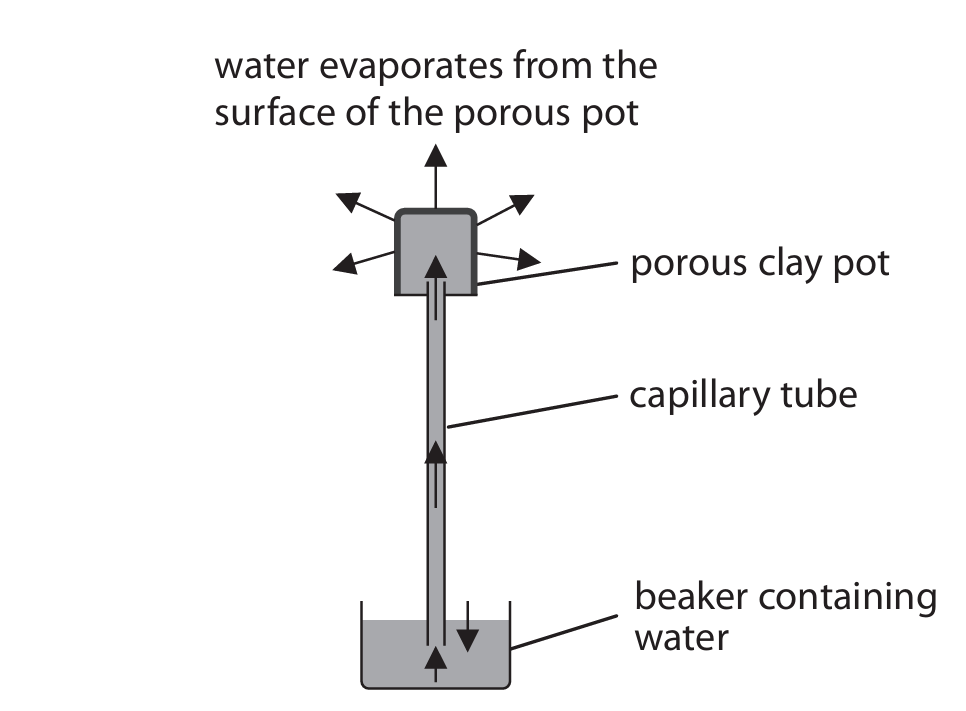
Question

A student investigates the rate of evaporation from a clay pot and the rate of transpiration by a plant. The clay pot is porous and has small holes that allow water to evaporate.

The student keeps the clay pot and the plant in the same conditions next to a closed window. He measures the rates at different times of the day.

The table shows the student’s results.

(a) The student uses this apparatus to measure the rate of evaporation from the clay pot.

(i) Explain the changes in the rate of evaporation from the clay pot. (2)

(ii) Suggest how the student could measure the rate of evaporation from the clay pot. (3)

(b) (i) Explain one factor that affects transpiration from the plant that does not affect evaporation from the clay pot. (2)

(ii) Draw a labelled diagram of the apparatus the student could use to determine the rate of transpiration by a plant. (4)

Most-appropriate topic codes (Edexcel IGCSE Biology):

2(h): Transport — part (a)(i), (a)(ii), (b)(i), (b)(ii)
4(a): The organism in the environment — part (a)(i), (b)(i)
Appendix 6: Suggested practical investigations — part (a)(ii), (b)(ii)
▶️ Answer/Explanation
Solution

(a)(i) The rate of evaporation increases when the temperature is higher and decreases when the temperature is lower. This is because higher temperatures give water molecules more kinetic energy, allowing them to escape from the liquid surface more easily and become water vapor.

Explanation: Looking at the data, the evaporation rate is lowest at night (0.8 cm³/h at 02:00-03:00) and highest in the afternoon (9.5 cm³/h at 14:00-15:00). This pattern follows the typical daily temperature cycle, where temperatures are coolest at night and warmest in the afternoon. The increased kinetic energy of water molecules at higher temperatures enables more molecules to overcome surface tension and evaporate.

(a)(ii) The student could measure the rate by: 1. Using a scale on the beaker or capillary tube to measure the volume of water lost or the distance moved by a bubble 2. Using a clock to measure the time period 3. Dividing the volume change or distance by the time to get the rate in cm³ per hour

Explanation: To measure evaporation rate quantitatively, the student would need to track how much water is lost over a specific time period. They could mark the starting water level in the beaker or capillary tube, then after a measured time interval (say one hour), check how much the water level has dropped. Alternatively, if using a bubble in the capillary tube, they could measure how far the bubble moves in a given time. The rate is then calculated as volume lost (or distance moved) divided by time.

(b)(i) Light intensity affects transpiration but not evaporation from the clay pot. Light causes stomata to open in plants, allowing more water vapor to escape, whereas the clay pot has no biological structures that respond to light.

Explanation: Plants have specialized cells called guard cells that control the opening and closing of stomata. In bright light, these cells swell with water, causing the stomata to open wider and increasing transpiration rate. The clay pot, being an inanimate object, has no such regulatory mechanism – its evaporation rate depends solely on physical factors like temperature, humidity, and air movement.

(b)(ii) The student could use a potometer. A labeled diagram should include: – A plant with its stem inserted through a seal (cork or bung) – A capillary tube with a scale/ruler – A bubble or meniscus in the capillary tube – A water reservoir

Explanation: A potometer measures water uptake by plants, which closely correlates with transpiration rate. The apparatus consists of a plant stem securely sealed into a system containing a capillary tube. As the plant transpires, it draws water through the capillary tube, and the movement of a bubble or meniscus along the scaled tube can be timed to calculate the rate of water uptake. The seal prevents water loss from anywhere except through the plant’s leaves, ensuring accurate measurement of transpiration.
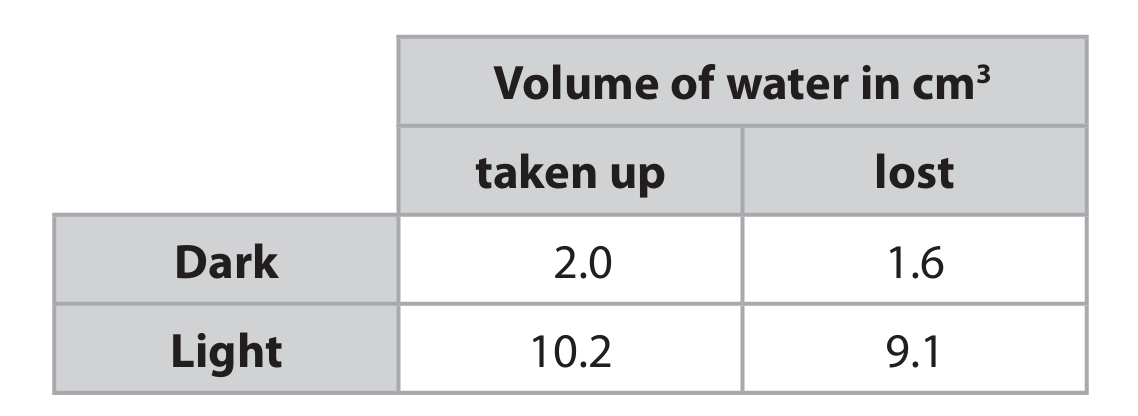
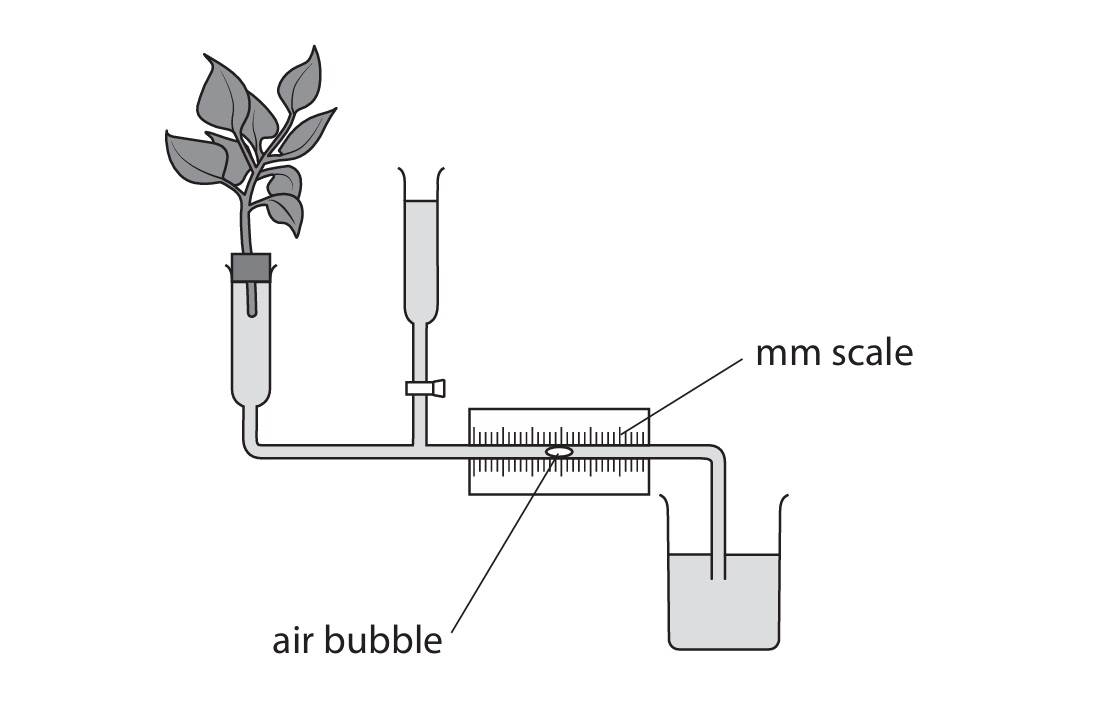
Question

Read the passage below. Use the information in the passage and your own knowledge to answer the questions that follow.

Haemolytic disease

Haemolysis is the term used to describe the bursting of red blood cells. Haemolytic disease occurs when the red blood cells burst in the body of a foetus in a pregnant woman. The bursting of the red blood cells affects the development of the foetus into a baby.

The red blood cells burst when certain antibodies from the mother pass across the placenta. The antibodies attach to protein molecules called antigens. These antigens are on the surface of the foetal red blood cells. The protein antigen is called the rhesus factor and is made using the genetic code found on the dominant allele, D, during the production of red blood cells in bone marrow.

Homozygous dominant and heterozygous individuals have cells with the antigen. These individuals have the rhesus positive blood group. Homozygous recessive individuals have cells that do not have the antigen. These individuals have the rhesus negative blood group.

During the birth of a rhesus positive baby, some red blood cells may leak into the circulatory system of the mother. This happens as the placenta pulls away from the wall of the uterus. A rhesus negative mother will make antibodies that destroy rhesus positive red blood cells. This is not a problem for the child that has just been born. However, if the mother becomes pregnant again with another rhesus positive foetus, the antibodies will harm the foetus.

Haemolytic disease can be avoided by treating a rhesus negative woman at risk of having a second rhesus positive child. This treatment involves the mother having an injection during and after pregnancy. The injection destroys rhesus positive cells in the mother’s blood before the cells can cause an immune response.

If the foetus is rhesus positive, the pregnancy is carefully monitored for signs of haemolytic disease. Monitoring includes regular ultrasound scans of the foetus and measuring the amount of antibody in the mother’s blood. A change in the concentration of the antibody in the mother’s blood, due to her secondary immune response, can lead to dangerous haemolysis. If a foetal blood test confirms a low number of red blood cells, a blood transfusion can be done in utero to replace the burst foetal red blood cells.

(a) Explain why bursting of red blood cells affects the development of a foetus.

(b) The dominant allele codes for the production of the protein that will act as an antigen.
Describe how the dominant allele leads to the production of RNA during protein synthesis.

(c) Give the reason why proteins cannot be made by red blood cells.

(d) Give one piece of evidence from the passage that shows that antibodies are smaller than red blood cells.

(e) (i) A mother who is homozygous recessive for the rhesus factor has a child with a father who is heterozygous.
Give the genotypes of the mother, the father, their gametes and the possible genotypes of the child.

(ii) Give the probability that the child will be rhesus positive.

(f) Explain why the concentration of the rhesus antibody in the mother’s blood rises quickly to harmful levels if she has a second child who is Rhesus positive.

(g) Suggest what is meant by the term in utero.

(h) A foetus with haemolytic disease can be given a blood transfusion.
Suggest the blood group of the source of the cells used for this transfusion.

Most-appropriate topic codes (Edexcel IGCSE Biology):

2(h): Transport — parts (a), (h)
3(b): Inheritance — parts (b), (e)(i), (e)(ii)
2(b): Cell structure — part (c)
2(i): Excretion and osmoregulation — part (d)
2(j): Co-ordination and response — part (f)
3(a): Reproduction — part (g)

▶️ Answer/Explanation
Solution

(a) An explanation that makes reference to two of the following points:

  • less oxygen (1)
  • (less) respiration (1)
  • (less) energy / ATP (1)

Detailed Explanation: When red blood cells burst (haemolysis), they can no longer carry oxygen effectively. Oxygen is essential for cellular respiration, which releases energy in the form of ATP. Reduced oxygen leads to less respiration and less ATP. Since foetal development requires energy for growth and cell division, a lack of ATP directly hinders development.

(b) An explanation that makes reference to three of the following points:

  • DNA unzips / separates / one strand copied (1)
  • complementary / base pairing (1)
  • template (1)
  • mRNA produced (1)
  • transcription (1)

Detailed Explanation: Transcription occurs: the DNA double helix unwinds, one strand acts as a template, RNA nucleotides pair complementarily (A-U, C-G), and mRNA is formed by RNA polymerase, carrying the code from the gene to the ribosome.

(c) no nucleus / DNA / no ribosomes / mitochondria (1)

Detailed Explanation: Mature red blood cells lack a nucleus (and therefore DNA) and ribosomes. Protein synthesis requires DNA for instructions and ribosomes for assembly, so they cannot make proteins.

(d) can pass across placenta (1)

Detailed Explanation: The passage states antibodies pass across the placenta, a selective barrier. Red blood cells cannot cross normally, indicating antibodies are smaller.

(e)(i) An answer that makes reference to the following points:

  • parent genotype dd x Dd (1)
  • gamete d (and d) and D or d (1)
  • offspring genotype Dd and dd (1)

Detailed Explanation: Mother: dd, Father: Dd. Gametes: mother → d only; father → D or d. Possible offspring: Dd (Rhesus positive) or dd (Rhesus negative).

(e)(ii) 50% / 0.5 / half / 50:50 (1)

Detailed Explanation: From a Punnett square, 2 out of 4 possibilities are Dd (Rhesus positive), so probability = ½ or 50%.

(f) An explanation that makes reference to three of the following points:

  • memory cells (1)
  • remain in mother’s blood (1)
  • recognise / identify antigen / binds with antigen (1)
  • more antibodies produced / produced faster / sooner (1)
  • secondary immune response (1)

Detailed Explanation: During the first pregnancy, memory cells are made. In a second pregnancy, these memory cells quickly recognise the Rhesus antigen and trigger a rapid, strong secondary immune response, producing large amounts of antibody quickly.

(g) in the uterus / womb (1)

Detailed Explanation: “In utero” means inside the uterus (womb), referring to procedures performed on the foetus before birth.

(h) (adult) (rhesus) negative / negative (1)

Detailed Explanation: The foetus is being attacked by anti-Rhesus antibodies. Transfusing Rhesus negative blood (lacking the antigen) ensures the new cells are not attacked, allowing them to survive and carry oxygen.

Question

Plant root hair cells absorb water from the soil by osmosis.

(a) (i) Explain how the structure of a root hair cell is adapted to absorb water.

(ii) Give one difference between osmosis and diffusion.

(b) A student investigates the effect of light on the volume of water taken up and lost by a plant shoot in one hour.
The table shows the student’s results.

(i) Explain these results.

(ii) Give two abiotic variables the student should control.

(c) Another student uses this apparatus and a stop clock to find the mean (average) rate of water taken up by a plant shoot.

(i) Name the apparatus used by the student.

(ii) Describe how the student could use this apparatus to find the mean rate of water taken up by the plant.

Most-appropriate topic codes (Edexcel IGCSE Biology):

2(d): Movement of substances into and out of cells — parts (a)(i), (a)(ii)
2(h): Transport in flowering plants — parts (a)(i), (b)(i), (c)(i), (c)(ii)
4(a): The organism in the environment — part (b)(ii)
2(c): Biological molecules — part (b)(i) [water transport linked to plant metabolism]
▶️ Answer/Explanation
Solution

(a)(i) The root hair cell has a long, thin extension (root hair) that increases its surface area, allowing for more efficient absorption of water from the soil.

Explanation: Root hair cells are specialized for absorption. Their elongated, hair-like projections significantly increase the surface area in contact with the soil water. This larger surface area maximizes the rate at which water can be absorbed via osmosis.

(a)(ii) Osmosis specifically involves the movement of water molecules, while diffusion can involve the movement of any type of molecule or ion.

Explanation: The key distinction is the substance being moved. Osmosis is a special case of diffusion that is exclusively concerned with the passive movement of water molecules across a partially permeable membrane from a region of higher water potential to a region of lower water potential. Diffusion, on the other hand, refers to the net movement of any particles (like oxygen, carbon dioxide, or ions) from a region of higher concentration to a region of lower concentration, and it may or may not involve a membrane.

(b)(i) In the light, both water uptake and water loss are much greater than in the dark. More water is taken up than is lost in both conditions.

Explanation: In the light, the plant’s stomata are open to allow gas exchange for photosynthesis. This opening also increases the rate of transpiration (water loss) from the leaves. The loss of water by transpiration creates a transpiration pull, which draws more water up through the xylem from the roots, leading to the higher uptake. The small difference between uptake and loss (e.g., 10.2 – 9.1 = 1.1 cm³ in light) represents water used for processes like photosynthesis and maintaining cell turgor. In the dark, stomata are mostly closed, drastically reducing both transpiration and, consequently, water uptake.

(b)(ii) 1. Temperature
2. Humidity

Explanation: To ensure a fair test and that the results are solely due to the change in light intensity, other abiotic (non-living) factors that affect transpiration and water uptake must be kept constant. Temperature influences the rate of evaporation. Humidity affects the concentration gradient for water vapor loss; lower humidity increases transpiration. Other valid answers include air movement (wind) and the time allowed for the experiment.

(c)(i) Potometer

Explanation: The apparatus shown in the diagram, designed to measure the rate of water uptake by a plant shoot, is called a potometer. It is important to note that it actually measures the rate of water uptake, which is assumed to be closely related to the rate of transpiration.

(c)(ii) The student should introduce an air bubble into the capillary tube and use the stop clock to measure the time taken for the bubble to move a certain distance along the scale. The distance moved is converted to a volume using the known cross-sectional area of the tube. The rate is calculated as volume divided by time, and the experiment is repeated to find a mean rate.

Detailed Description:
1. Set up the potometer with the plant shoot underwater to ensure no air enters the system.
2. Introduce a single air bubble into the capillary tube.
3. Start the stop clock as the bubble passes a starting point on the scale.
4. Stop the stop clock when the bubble passes a finishing point, and record the time taken.
5. Measure the distance the bubble traveled along the scale.
6. Since the capillary tube has a uniform diameter, the volume of water taken up is equal to the distance moved multiplied by the cross-sectional area of the tube (volume = πr² × distance, where r is the radius).
7. Calculate the rate of water uptake for that single run using: Rate = Volume / Time.
8. Reset the bubble using the reservoir (if available) and repeat the process several times.
9. Calculate the mean (average) rate of water uptake from all the repeat readings to improve reliability.
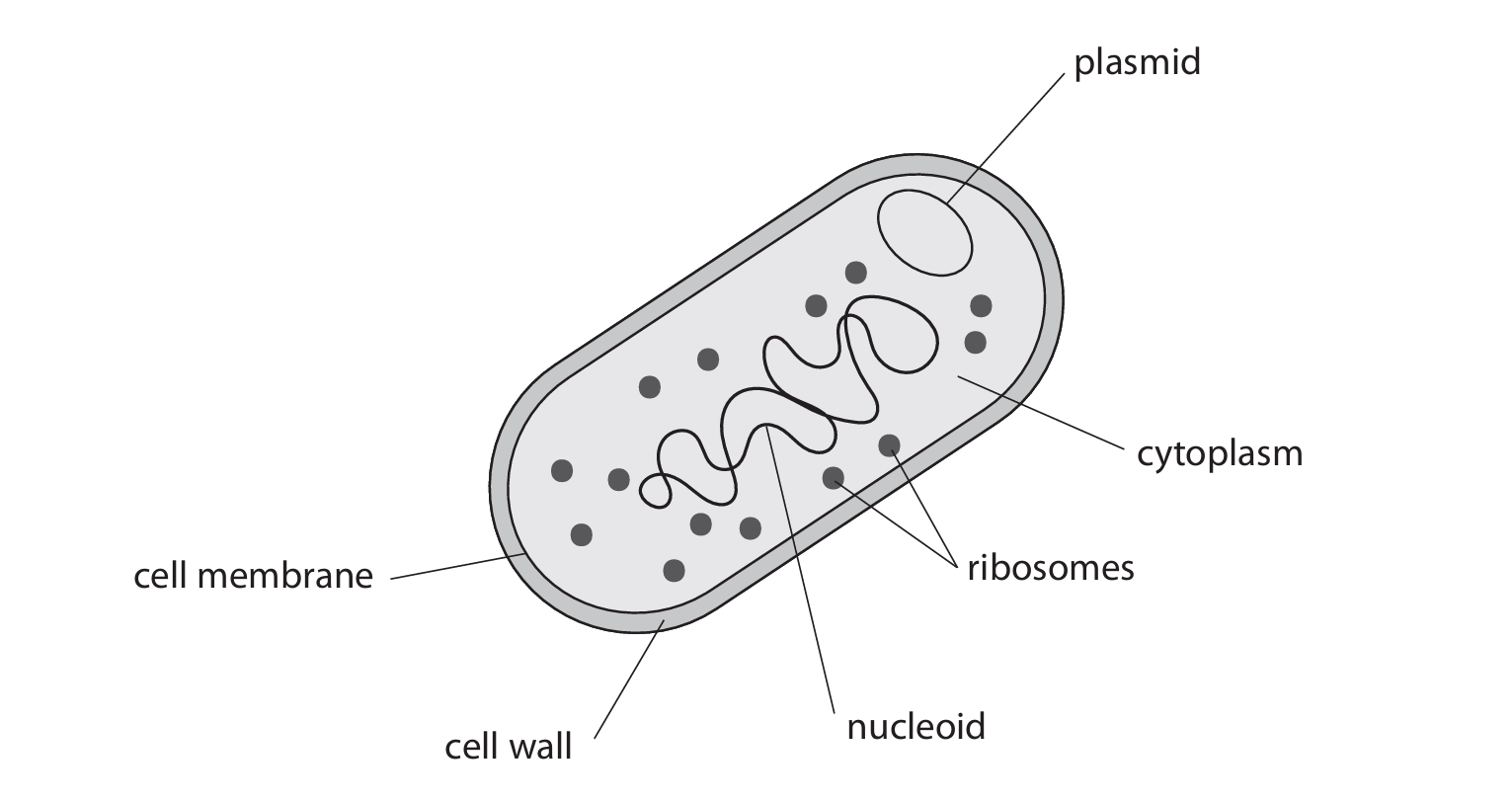
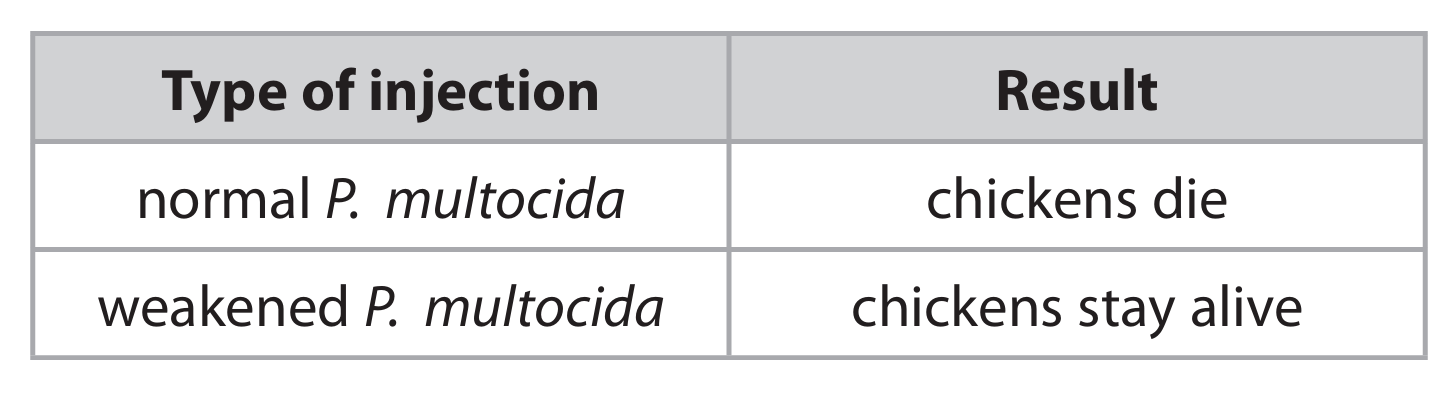
Question

P. multocida is a bacterium that causes cholera in chickens.

The diagram shows the bacterium.

(a) Give two structures in this bacterium that are also found in all eukaryotic cells.

(b) Scientists investigated the survival of chickens injected with normal P. multocida or with weakened P. multocida.

The table shows the scientists’ results.

(i) What is a correct conclusion about P. multocida from these results?

  • A. they are decomposers
  • B. they are pathogens
  • C. they are microscopic
  • D. they are non-living

(ii) The scientists took the living chickens that had been injected with weakened P. multocida and then injected them with normal P. multocida.

The chickens did not die, as they were now immune.

Explain why these chickens did not die.

Most-appropriate topic codes (Edexcel IGCSE Biology):

1(b): Variety of living organisms — part (a)
1.3: Prokaryotic organisms (bacteria) — part (a)
1.4: Pathogens — part (b)(i)
2(h): Transport — part (b)(ii) – Immune response
2.62/2.63B: Immune response and vaccination — part (b)(ii)
▶️ Answer/Explanation
Solution

(a) 1. Cell membrane
2. Ribosomes
(Also accept: Cytoplasm)

Explanation: Prokaryotic cells, like this bacterium, and eukaryotic cells share some fundamental structures necessary for basic life functions. The cell membrane is a universal feature, acting as a semi-permeable barrier that controls the movement of substances in and out of the cell. Ribosomes are also found in both, as they are essential for protein synthesis, although bacterial ribosomes are slightly smaller. Cytoplasm is another correct answer, as it is the gel-like substance that fills the cell and houses the organelles and other cellular components.

(b)(i) B they are pathogens

Explanation: The results show that the normal form of the bacterium causes disease (chickens die), while the weakened form does not. An organism that causes disease is defined as a pathogen. While the bacteria are likely decomposers and microscopic, these specific results do not provide direct evidence for those conclusions. The results definitively show they are living organisms capable of causing disease.

(b)(ii)

Explanation: The initial injection with weakened P. multocida acted as a vaccination. These weakened bacteria contained the same antigens (specific proteins on their surface) as the normal, harmful bacteria. When injected, the chicken’s immune system recognized these antigens as foreign and mounted a primary immune response. This involved the production of specific antibodies to fight the infection and, crucially, the creation of memory cells. When the chickens were later injected with the normal, pathogenic bacteria, these memory cells recognized the antigens immediately. This triggered a much faster and stronger secondary immune response, producing a large number of the correct antibodies very quickly to destroy the bacteria before they could cause disease and kill the chicken.
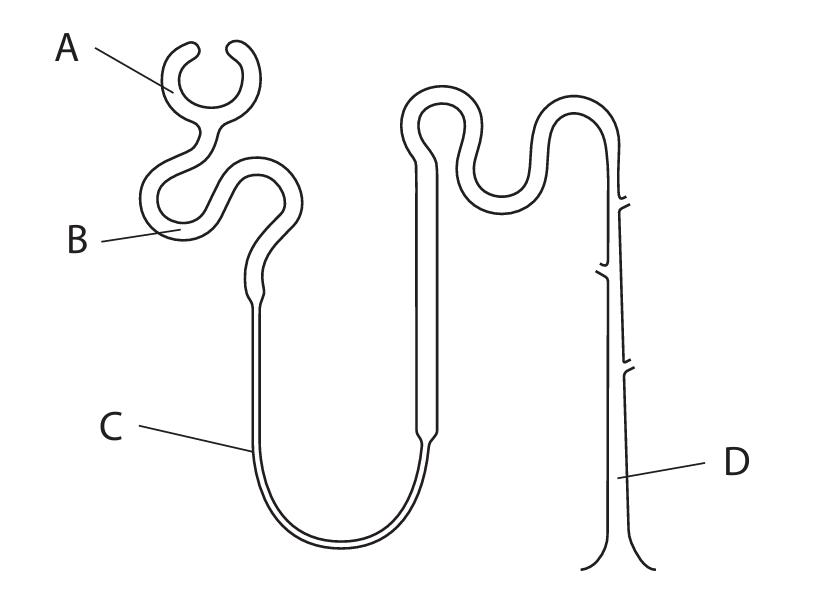
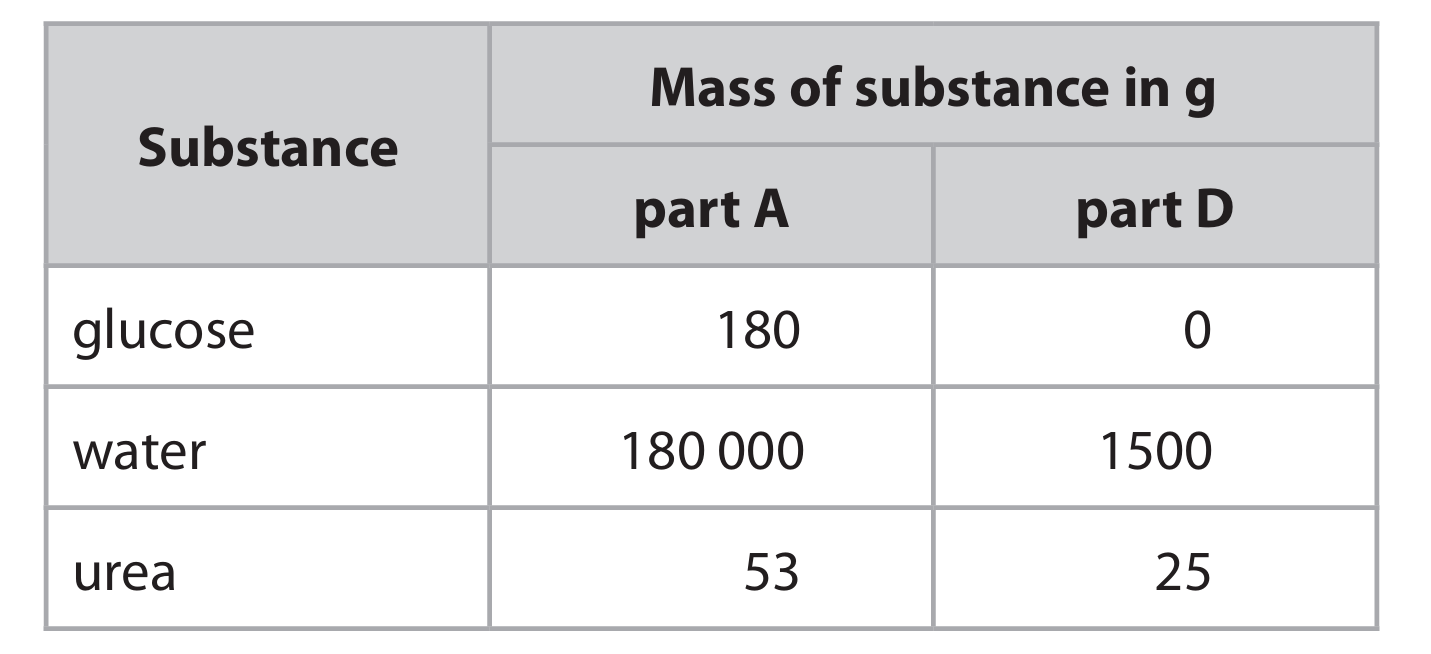
Question

The kidney contains nephrons involved in osmoregulation and excretion.

The diagram shows a nephron.

(a) Which part is the Bowman’s capsule?

  • A
  • B
  • C
  • D

(b) The table gives the mass of three substances transported in part A and in part D for all kidney nephrons during one day.

(i) Explain the change in the mass of glucose from part A to part D.

(ii) Calculate the percentage reabsorption of water by kidney nephrons.

(iii) A substance containing nitrogen is broken down in the liver to produce urea.

Which substance is broken down to produce urea?

  • A. fat
  • B. glucose
  • C. protein
  • D. water

(c) A drug called MDMA increases the secretion of ADH.

Explain how this increase affects urine production.

Most-appropriate topic codes (Edexcel IGCSE Biology):

2(i): Excretion — parts (a), (b)(i), (b)(ii), (b)(iii), (c)
2(h): Transport — part (b)(i), (b)(ii)
2(b): Cell structure — part (a)
2(j): Co-ordination and response — part (c)
Question

Read the passage below. Use the information in the passage and your own knowledge to answer the questions that follow.

Heart transplant

A heart transplant is an operation to replace a damaged or failing heart with a healthy heart from a donor who has recently died. In the United Kingdom, 200 heart transplants are carried out each year.

A heart transplant may be considered if you have severe heart failure and medical treatments are not helping. Conditions that may eventually require a heart transplant include coronary heart disease and cardiomyopathy, where the walls of the heart have become stretched, thickened or stiff. Some people born with an abnormal heart may also benefit from a heart transplant.

A heart transplant needs to be carried out as soon as possible after a donor heart becomes available. The procedure is performed under general anaesthetic where the patient is unconscious. During the operation, a heart-lung bypass machine is used to keep the patient alive.

A cut is made in the middle of the patient’s chest. The patient’s heart is removed, leaving behind a section of the right and left atria, the two upper chambers of the heart. The new heart is connected to the aorta, the pulmonary artery, and the remaining part of the atria. The new heart is stimulated to start beating and the patient is taken off the bypass machine.

The patient will need to stay in hospital for around two or three weeks after a heart transplant. The patient will also need to take medicines called immunosuppressants for the rest of their life. Without these medicines, the transplant will not be successful.

After going home, the patient is encouraged to take part in a cardiac rehabilitation programme. This involves following an exercise plan to help regain strength and mobility. They should avoid strenuous activities such as pushing, pulling or lifting anything heavy for 6 to 12 weeks. Most people can start returning to many of their normal activities within a few months.

The patient does not usually need to have a special diet after a heart transplant. A balanced diet can ensure they stay as healthy as possible. They should not smoke and should avoid drinking alcohol.

A balanced diet may also help reduce the risk of some of the side effects of the immunosuppressant drugs including weight gain, osteoporosis and diabetes. Immunosuppressants also make the patient more vulnerable to infections, including food poisoning.

Most people can return to their normal activities after a heart transplant and experience a significant improvement in their symptoms for many years. After a heart transplant, 75% of people will live at least five years.

(a) Suggest why cardiomyopathy can cause heart failure (lines 6 to 7).

(b) During the transplant procedure the patient’s heart is removed, leaving behind a section of the right and left atria. Describe the functions of the atria in the body.

(c) Describe how the blood in the pulmonary artery differs from the blood in the aorta.

(d) Explain the function of the heart-lung bypass machine (lines 11 to 12).

(e) Explain why the patient needs to be given immunosuppressants (lines 19 to 20).

(f) Explain why patients should not smoke after their heart transplant (lines 28 to 29).

(g) State what is meant by the term balanced diet.

(h) Calculate the number of patients in the United Kingdom who have a heart transplant in one year that are still alive five years later (lines 2 to 3 and lines 35 to 36).

(i) Suggest why patients are advised to avoid strenuous activities after their heart transplant (line 24).

(j) Suggest why patients are more likely to be at risk of food poisoning after their heart transplant (lines 32 to 33).

Most-appropriate topic codes (Edexcel IGCSE Biology):

2(h): Transport — parts (b), (c), (d), (f), (i)
2(j): Co-ordination and response — part (e)
2(e): Nutrition — part (g)
2(j): Homeostasis and hormones — part (e) – immune response
Appendix 4: Mathematical skills — part (h)
4(d): Human influences on the environment — part (f) – smoking effects
2(e): Human nutrition — part (j) – infection risk
▶️ Answer/Explanation
Solution

(a) The walls of the heart are less able to contract/pump effectively.

Explanation: Cardiomyopathy causes the heart muscle to become abnormal – either stretched, thickened, or stiff. This structural change directly impairs the heart’s ability to contract forcefully and pump blood efficiently around the body. When the heart cannot pump enough blood to meet the body’s demands, it leads to heart failure.

(b) The atria receive blood and pump/push it into the ventricles. The right atrium receives deoxygenated blood from the body (via the vena cava), and the left atrium receives oxygenated blood from the lungs (via the pulmonary veins).

Explanation: The atria act as the receiving chambers and priming pumps for the heart. Their main function is to collect blood returning to the heart and then contract to push this blood into the more powerful ventricles below. This ensures the ventricles are adequately filled before they perform the major work of pumping blood out of the heart to the lungs and the rest of the body.

(c) The pulmonary artery carries deoxygenated blood, while the aorta carries oxygenated blood. The pulmonary artery carries blood away from the heart to the lungs, whereas the aorta carries blood away from the heart to the rest of the body.

Explanation: These two major arteries have completely different roles. The pulmonary artery is the only artery in the body that carries deoxygenated blood. It transports this blood from the right ventricle to the lungs to pick up oxygen. In contrast, the aorta is the body’s main artery, carrying freshly oxygenated blood from the left ventricle to supply all tissues and organs.

(d) The heart-lung bypass machine oxygenates the blood and removes carbon dioxide (acting like artificial lungs), and it pumps this oxygenated blood around the body (acting like an artificial heart). This allows the patient’s tissues and cells to continue respiring and provides the surgeon with a still, blood-free heart to operate on.

Explanation: During a heart transplant, the patient’s own heart and lungs are temporarily bypassed. This machine is crucial for life support. It takes over the function of the heart by pumping blood and the function of the lungs by adding oxygen to the blood and removing carbon dioxide. This maintains circulation and gas exchange, keeping the patient’s organs alive while the surgeon removes the old heart and attaches the new one.

(e) Immunosuppressants prevent rejection of the transplanted heart. They do this by reducing the immune response, stopping the immune system from recognizing the new heart as foreign and attacking it.

Explanation: The immune system is designed to identify and destroy foreign cells, like those from a donor organ, based on their different antigens. Immunosuppressant drugs are essential to dampen this immune response. Without them, the patient’s white blood cells would recognize the new heart as “non-self” and mount an attack, leading to transplant rejection and failure.

(f) Smoking reduces oxygen in the blood and damages artery walls. It can lead to narrowed arteries, increased risk of blood clots, and higher blood pressure, all of which are dangerous for a transplanted heart.

Explanation: Smoking is particularly harmful after a transplant. The carbon monoxide in smoke binds to haemoglobin, reducing the blood’s oxygen-carrying capacity. Chemicals in tobacco also damage the lining of arteries, promoting atherosclerosis (fatty deposits), which can narrow the coronary arteries supplying the new heart muscle. This increases the risk of heart attacks, strokes, and failure of the transplant.

(g) A diet that contains all the required nutrients/food groups in the correct proportions.

Explanation: A balanced diet isn’t about eating specific “health foods” but about consuming the right amounts and varieties from all the major food groups: carbohydrates, proteins, fats, vitamins, minerals, fibre, and water. This ensures the body gets all the essential nutrients it needs to function optimally, support the immune system, and maintain a healthy weight.

(h) number of patients = 150

Explanation: The passage states that 200 transplants are done each year and that 75% of patients live at least five years. To find the number, we calculate 75% of 200. This can be done as (75/100) × 200 = 0.75 × 200 = 150. Therefore, we can expect 150 of the 200 patients to be alive after five years.

(i) Strenuous activities put extra pressure on the heart, increasing heart rate and blood pressure, which could strain the new heart during the recovery period.

Explanation: After major surgery like a transplant, the body, and especially the new heart, needs time to heal and adapt. Strenuous activities like heavy lifting cause a sudden, significant increase in the heart’s workload. This could be too stressful for the recovering heart muscle and the surgical connections (sutures), potentially leading to complications like a heart attack or damage to the surgical site.

(j) Because their immune system is weakened by the immunosuppressant drugs, making them less able to fight off infections from pathogens in food.

Explanation: Immunosuppressants, while vital for preventing rejection, have the side effect of reducing the overall activity of the immune system. This means the body’s defences against bacteria, viruses, and other pathogens are lowered. Harmful bacteria like Salmonella or E. coli, which might be fought off by a healthy person, can more easily cause food poisoning in a transplant patient because their white blood cells are less effective at destroying the invaders.

Question

The diagram shows the path that the water takes when it is absorbed from the soil into the xylem of a plant.

(a) (i) Explain how root hair cells are adapted for efficient absorption of water. 
(ii) Explain how water is transported from the soil to the leaves. 

(b) Describe how you could determine the rate of water loss from a leafy shoot. 

Most-appropriate topic codes (Edexcel IGCSE Biology – Modular):

2(h): Transportparts (a)(i), (a)(ii)
3.5B, 3.6B, 3.7B, 3.8B: Water absorption, transpiration, and factors affecting transpiration rate — parts (a)(i), (a)(ii), (b)
▶️ Answer/Explanation
Solution

(a)(i) An explanation that makes reference to two of the following points:

  • elongated / pointed / projections / extensions (1)
  • increase surface area (1)
  • thin wall for short diffusion path (1)
  • concentrated cell sap for osmosis (1)

(a)(ii) An explanation that makes reference to four of the following points:

  • water enters (root) by osmosis (1)
  • from dilute solution to more concentrated solution / from higher water potential to lower water potential (1)
  • (water) enters / moves up xylem (1)
  • water pulled up to leaf due to transpiration / pulled along transpiration stream (1)
  • (water vapour) exits through stomata (1)

(b) A description that makes reference to four of the following points:

  • use (bubble) / (weight) potometer (1)
  • cut shoot underwater / dry leaves / place mineral oil on surface of water (1)
  • measure distance moved by bubble (in cm) / mass lost / change in volume of water (1)
  • (in set) time (1)
  • repeat / calculate mean rate (1)
Question

Blood clotting is an important process in humans. The process is controlled by enzymes.

(a) (i) Give two reasons why blood clotting is important. 

(ii) The optimum temperature for the enzymes involved in blood clotting is \(37^\circ C\). Sketch a graph to show how temperature affects the time taken for blood to clot.

(b) Some people cannot make the proteins needed for blood clotting. Cloning is used to produce large numbers of transgenic mammals. These transgenic mammals can make the human blood-clotting proteins. The human blood-clotting proteins can then be removed from the mammals’ milk and injected into people who cannot make the proteins.

(i) Explain why these mammals are described as transgenic. 
(ii) Describe how a mammal is cloned.

Most-appropriate topic codes (Edexcel IGCSE Biology):

2(h): Transport — Blood clotting (part a(i), a(ii))
2(c): Biological molecules — Enzymes (part a(ii))
5(c): Genetic modification (genetic engineering) — Transgenic organisms (part b(i))
5(d): Cloning — Cloning mammals (part b(ii))
▶️ Answer/Explanation
Solution

(a)(i) Two reasons from:

  • Prevent loss of blood / stops bleeding (1)
  • Prevent entry of pathogens / microbes / bacteria / viruses / fungi / prevent infections (1)

(a)(ii) Sketch graph showing a clear minimum (fastest clotting time) at \(37^\circ C\). The line should drop to a low point at \(37^\circ C\) and then rise on both sides.

(b)(i) An explanation that makes reference to:

  • (They have been given) genetic material / gene / allele / DNA / are genetically altered (1)
  • From human / a different species (1)

(b)(ii) An answer that makes reference to six of the following points:

  1. Use enucleated egg / empty egg / remove nucleus from egg / eq (1)
  2. Nucleus from body cell / diploid nucleus (placed into empty egg) / fuse adult cell with empty egg (1) (Ignore DNA)
  3. Use of electricity / shock (to fuse cells) (1)
  4. Cell division / mitosis (stimulated) (1)
  5. Embryo forms / develops (1)
  6. Embryo placed into uterus / womb (1)
  7. Surrogate mother (carries embryo to term) (1)

Award marks for any correct and relevant points describing the process of somatic cell nuclear transfer as used in cloning mammals (e.g., Dolly the sheep).
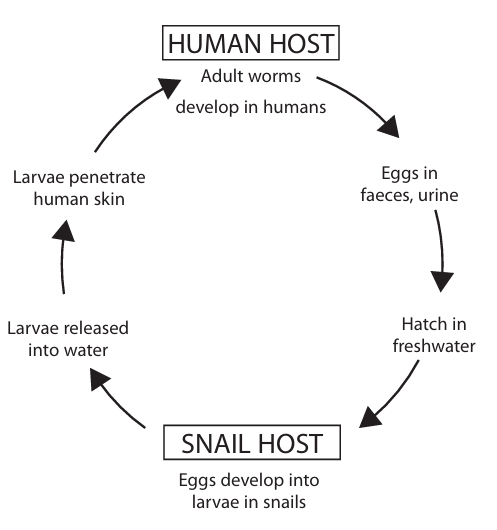
Question

Read the passage below. Use the information in the passage and your own knowledge to answer the questions that follow.

Schistosomiasis

Schistosomiasis is an infection caused by a parasitic worm called a schistosome. The immature or larvae of the worm live in rivers and lakes in tropical parts of the world. The diagram shows the life cycle of the schistosome worm.

Some people in tropical parts of the world use water from these rivers and lakes for their daily lives. These people risk infection because the larvae burrow into their skin. The larvae are then transported to other parts of the body where they damage organs such as the kidneys, intestines, lungs and brain. The larvae develop into adult worms.

The adult worms lay eggs in the human body. Some of these eggs are destroyed by the immune system, but most eggs survive. These eggs can get into water if faeces or urine from infected people pass into rivers or lakes. In the water, the eggs develop into small larvae which grow inside freshwater snails. Larvae are released from the snails and infect any person they contact. These larvae develop into adult worms inside the human body.

Doctors diagnose schistosomiasis when they find eggs in the faeces or urine of infected people. Infected people also have blood cells in their urine and antibodies for the pathogen in their blood.

At present, the drug praziquantel is used to kill the worms. A dose of \(0.040\ \text{g}\) per kg of body mass is usually effective. With no treatment, affected organs can be permanently damaged, leading to death. It is estimated that 240 million people (in the world) have schistosomiasis. Every year \(8 \times 10^{-4}\) per cent of infected people die from the disease.

A vaccine is being developed using a plasmid. The plasmid has DNA inserted that makes a protein found on the body surface of the adult schistosome worm.

In one investigation, a vaccine made using the DNA plasmid was given to a group of infected people. The results showed a mean number of 21.53 worms per person in this group. In the control group, a mean number of 40.53 worms per person was found.

(a) Which process is affected if kidneys are damaged (line 8)?

A) digestion
B) mutation
C) ultrafiltration
D) vaccination

(b) Suggest three ways to reduce the risk of being infected by schistosomes.

(c) Name two different blood cells that would be found in the urine of infected people (line 17).

(d) An infected person has a body mass of \(120\ \text{kg}\). What dose of drugs would be effective for this person (lines 19 to 20)?

A) \(0.04\ \text{mg}\)
B) \(4.8\ \text{mg}\)
C) \(40\ \text{mg}\)
D) \(4800\ \text{mg}\)

(e) Using the estimated number of people in the world who have schistosomiasis (lines 21 to 22), calculate the number of people who die each year from schistosomiasis.

(f) Which of these is the correct description of a plasmid?

A) a circle of DNA
B) a circle of mRNA
C) a circle of protein
D) a circle of tRNA

(g) Explain how a vaccine could protect people from schistosomiasis (lines 24 to 25).

(h)(i) Suggest what is given to the control group (lines 27 to 29).

(ii) A scientist claims that the investigation proves the vaccine is effective against schistosomiasis (lines 27 to 29). Comment on this claim.

Most-appropriate topic codes (Edexcel IGCSE Biology):

2(h): Transport — parts (c) [Blood composition], (g), (h)(i) [Vaccination and immune response]
2(i): Excretion — part (a) [Kidney function]
1(b): Variety of living organisms / Pathogens — context of parasitic infection
5(c): Genetic modification — part (f) [Plasmids as vectors]
Mathematical Skills (Appendix 3):parts (d), (e) [Calculations]
Experimental Skills & Evaluation (Section 4):part (h)(ii) [Evaluating an investigation]
▶️ Answer/Explanation
Solution

(a) C (ultrafiltration)
A is incorrect because digestion is not a process in the kidneys.
B is incorrect because mutation is not a process in the kidneys.
D is incorrect because vaccination is not a process in the kidneys.

(b) An answer that makes reference to three of the following points:
• treat drinking water / boil water (before drinking) / do not drink water / drink bottled water / eq (1)
• sanitation / no faeces in water / no urine in water / eq (1)
• remove snails / eq (1)
• vaccination (1)
Additional guidance: Allow “do not go in infected rivers or lakes / cover skin when in water / avoid contact with affected water / only wash in clean water”.

(c) An answer that makes reference to two of the following points:
• red blood cells / rbc (1)
• white blood cells / wbc (1)
• lymphocytes (1)
• phagocytes / macrophages (1)

(d) D (4800 mg)
Calculation: \(120\ \text{kg} \times 0.040\ \text{g/kg} = 4.8\ \text{g} = 4800\ \text{mg}\)
A is incorrect because it is the wrong value.
B is incorrect because it is the wrong value.
C is incorrect because it is the wrong value.

(e) \(1920\) people
Working:
• \(8 \times 10^{-4}\% = 0.0008\%\)
• \(0.0008\% \text{ of } 240,000,000 = 0.000008 \times 240,000,000 = 1920\)
Allow 1 mark for: \(19200000 / 1920000 / 192000 / 192200 / 192 / 19.2 / 1.92 / 0.192 / 0.0192\)
Award full marks for correct numerical answer without working.

(f) A (a circle of DNA)
B is incorrect because it is not RNA.
C is incorrect because it is not a protein.
D is incorrect because it is not RNA.

(g) An explanation that makes reference to three of the following points:
• antigen (1)
• memory cells / lymphocytes (1)
• (secondary) immune response (1)
• more antibodies / antibodies made sooner / faster / faster immune response / eq (1)

(h)(i) • (a treatment with) no plasmid / no protein / only water / saline / eq (1)
Allow placebo vaccine / a placebo / plasmid with no gene / plasmid with no DNA / different DNA.

(h)(ii) An answer that makes reference to three of the following points:
• reduced numbers / eq (1)
• by 19 or by 47% / about 50% (1)
• schistosomes / worms, still present in body (1)
• no idea of group size / needs to be repeated (1)
• no idea of age / sex / health (1)
Additional Guidance:
Allow “reduces numbers of worms / worms decrease / lower number of worms after vaccine”.
Allow “more worms in control group”.
Allow “does not completely get rid of them”.
Allow “more testing / more people tested”.

Question

Human populations are at risk from infectious disease.

(a) Describe the different types of pathogen. Refer to a disease that each type of pathogen causes in your answer.

(b) Explain how vaccination protects humans from pathogens.

Most-appropriate topic codes (Edexcel IGCSE Biology):

1(b): Variety of living organisms / Pathogens — part (a) [Describing viruses, bacteria, fungi, protocysts and related diseases]
1.4: Understand the term pathogen — part (a) [Context]
2(h): Transport — part (b) [Vaccination and immune response, memory cells]
3.13B: Understand how vaccination results in the manufacture of memory cells — part (b) [Core explanation]
▶️ Answer/Explanation
Solution

(a) A description that makes reference to six of the following points (typically three pathogen types with their descriptions and matching diseases):

  • Virus: non-living organisms / small particles / protein coat (capsid) / relies on other organisms for reproduction / eq (1)
    Disease: AIDS / Influenza / HIV (1) [Disease mark must match pathogen type. Allow plant disease e.g., Tobacco Mosaic Virus (TMV).]
  • Bacteria: microscopic single-celled / prokaryotic / no nucleus / have nucleoid / plasmids (1)
    Disease: Pneumonia / Cholera / Tuberculosis (1)
  • Fungus: not able to carry out photosynthesis / saprotrophic nutrition / single-celled or hyphal / cell wall made of chitin / eq (1)
    Disease: Athlete’s foot / Ringworm (1)
  • Protocysts (Protozoa): microscopic single-celled / eukaryotic (1)
    Disease: Malaria (caused by Plasmodium) (1)

Scoring Note: The first mark for each pathogen is for its description, the second is for naming a correct associated disease. A pair (description + disease) for one pathogen type scores 2 marks. “HIV / AIDS” scores the disease mark for a virus but not the pathogen description mark if the description is incorrect. “Virus non-living causing cholera” scores the pathogen description mark but not the disease mark (cholera is bacterial).

(b) An explanation that makes reference to three of the following points:

  • dead / weakened / harmless / attenuated pathogen / or its antigens are introduced (into the body) / eq (1) [Allow ‘weakened strain’.]
  • this stimulates the production of memory cells / lymphocytes (1)
  • this leads to a (secondary) immune response upon future infection with the actual pathogen (1)
  • antibodies are produced faster / in greater quantity / sooner (1)
Question

Plant roots absorb water from soil.

This water is transported to the leaves and then moves into the air.

(a) Which of these processes is used to absorb water from the soil?

A) active transport
B) diffusion
C) evaporation
D) osmosis

(b) Name the tissue that transports water to the leaves.

(c) Name the process that moves water vapour into the air.

(d) Which of these reduces the movement of water from the leaves into the air?

A) high light intensity
B) low air humidity
C) low air temperature
D) windy conditions

(e) Give two uses of water in a plant.

Most-appropriate topic codes (Edexcel IGCSE Biology):

2(h): Transport — parts (a), (b), (c), (d), (e)
2(d): Movement of substances into and out of cells — part (a)
2(h): Transport – Flowering plants — parts (b), (c), (d), (e)
▶️ Answer/Explanation
Solution

(a) D osmosis
The only correct answer is D osmosis.
A is not correct as it is not how plants absorb water.
B is not correct as it is not how plants absorb water.
C is not correct as it is not how plants absorb water.

(b) xylem / xylem vessels

(c) transpiration / evaporation / diffusion / evapotranspiration

(d) C low air temperature
A is not correct as it does not reduce the movement of water from the leaves into the air.
B is not correct as it does not reduce the movement of water from the leaves into the air.
D is not correct as it does not reduce the movement of water from the leaves into the air.

(e) An answer that makes reference to two of the following points:
• support / turgor / eq (1)
• photosynthesis / eq (1)
• cooling (1)
• reactions / solvent / transport of mineral ions / named mineral ion / eq (1)

Scroll to Top