
Population, Community, Habitat and Ecosystem
📝 Introduction
- Living organisms do not exist alone. They interact with other organisms and their surroundings.
- To study these interactions, biologists use terms such as population, community, habitat and ecosystem.
- These terms describe different levels of organisation in nature.
- Understanding these terms helps explain how living things survive, reproduce and depend on each other.
- These concepts form the foundation of ecology.
🌱 Levels of Ecological Organisation
- Living organisms are organised in different levels, from a single species to a complete ecosystem.
Individual Organism → Population → Community → Ecosystem
- Each level includes the one before it and becomes more complex.
👥 Population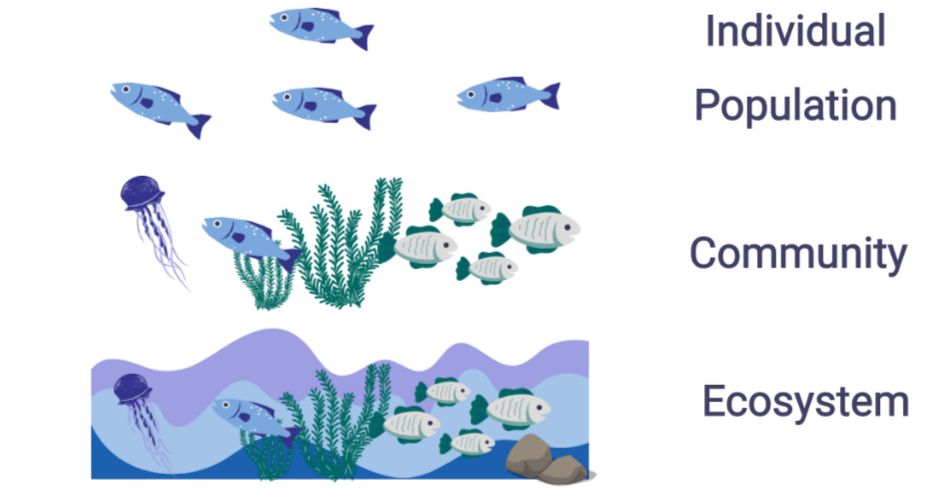
Definition
A population is all the organisms of the same species living in the same area at the same time.
Key Features
- All members belong to one species.
- They live in the same habitat or area.
- They can breed with each other and produce fertile offspring.
- The size of a population can increase or decrease over time.
Examples
- All the deer living in a forest.
- All the mango trees in an orchard.
- All the frogs living in a pond.
- All the rabbits in a grassland.
Important Point
- If different species live together, they do not form a population.
🌳 Community
Definition
A community is all the populations of different species living and interacting in the same habitat.
Key Features
- Consists of many different populations.
- Includes plants, animals, fungi and microorganisms.
- Organisms interact in many ways, such as:
- Feeding relationships.
- Competition.
- Pollination.
- Predation.
- Decomposition.
Examples
A pond community may include:
- Fish
- Frogs
- Algae
- Water plants
- Insects
- Bacteria
- Snails
Together, these different populations form one community.
Important Point
- A community contains only living organisms.
- It does not include non-living factors like water, soil or sunlight.
🏞️ Habitat
Definition
A habitat is the natural place where an organism lives. It provides everything an organism needs to survive.
A Habitat Provides
- Food
- Water
- Shelter
- Space
- Suitable temperature
- Places to reproduce
Examples
| Organism | Habitat |
|---|---|
| Camel | Desert |
| Fish | River or lake |
| Earthworm | Moist soil |
| Polar bear | Arctic region |
| Frog | Pond or wetland |
| Cactus | Desert |
Important Point
- Different species can live in the same habitat if enough resources are available.
🌍 Ecosystem
Definition
- An ecosystem is a community of living organisms together with the non-living (abiotic) environment in which they live and interact.
- An ecosystem includes both biotic and abiotic components.
Biotic Components
- Biotic components are the living parts of an ecosystem.
- They include:
- Plants
- Animals
- Fungi
- Bacteria
- Protists
- These organisms interact with one another in many ways.
Abiotic Components
- Abiotic components are the non-living parts of an ecosystem.
- Examples include:
- Sunlight
- Water
- Air
- Soil
- Temperature
- Minerals
- Humidity
- pH
- These factors affect how organisms survive and grow.
Examples of Ecosystems
- Pond ecosystem
- Forest ecosystem
- Grassland ecosystem
- Desert ecosystem
- Marine ecosystem
- Coral reef ecosystem
Each ecosystem has its own living organisms and environmental conditions.
Relationship Between the Four Terms
- These four terms are connected and represent increasing levels of organisation.
Example: Pond
- Population → All frogs living in the pond.
- Community → Frogs, fish, insects, algae, plants and bacteria living together.
- Habitat → The pond, which provides water, food and shelter.
- Ecosystem → The pond community together with water, sunlight, dissolved oxygen, soil and other non-living factors.
Why are Ecosystems Important?
- Ecosystems help to:
- Support different forms of life.
- Provide food and shelter for organisms.
- Maintain nutrient cycles.
- Balance populations through interactions.
- Keep the natural environment stable.
📊 Comparison of Population, Community, Habitat and Ecosystem
| Term | Definition | Includes | Example |
|---|---|---|---|
| Population | All organisms of the same species living in one area at the same time | One species | All rabbits in a field |
| Community | All the populations of different species living together in one area | Many species | Rabbits, grass, insects, birds and fungi in a field |
| Habitat | The natural place where an organism lives | Living place and its conditions | Pond, forest, desert |
| Ecosystem | A community and its non-living environment interacting together | Living organisms + abiotic factors | Pond ecosystem, forest ecosystem |
📝 Key Points
- A population is made up of organisms of the same species living in one area.
- A community consists of different populations living and interacting together.
- A habitat is the natural place where an organism lives.
- An ecosystem includes all living organisms and the non-living environment interacting with each other.
- Population → Community → Ecosystem represents increasing levels of ecological organisation.
- Habitat is the place where organisms live, while an ecosystem includes both the habitat and all the interactions between living and non-living components.
📝 Quick Recap
Population → one species in an area
Community → all species in an area
Habitat → home of an organism
Ecosystem → community + environment (living + non-living)