
Nitrogen Cycle
📝 Introduction
- Nitrogen is an essential element needed by all living organisms.
- It is used to make proteins, enzymes, DNA and RNA, which are important for growth and repair.
- Although about 78% of the Earth’s atmosphere is nitrogen gas (N₂), most organisms cannot use it directly.
- Nitrogen must first be changed into usable forms before plants can absorb it.
- The nitrogen cycle is the continuous movement and recycling of nitrogen between the atmosphere, soil and living organisms.
🌍 What is the Nitrogen Cycle?
Definition
- The nitrogen cycle is the continuous movement of nitrogen through the atmosphere, soil, plants, animals and microorganisms.
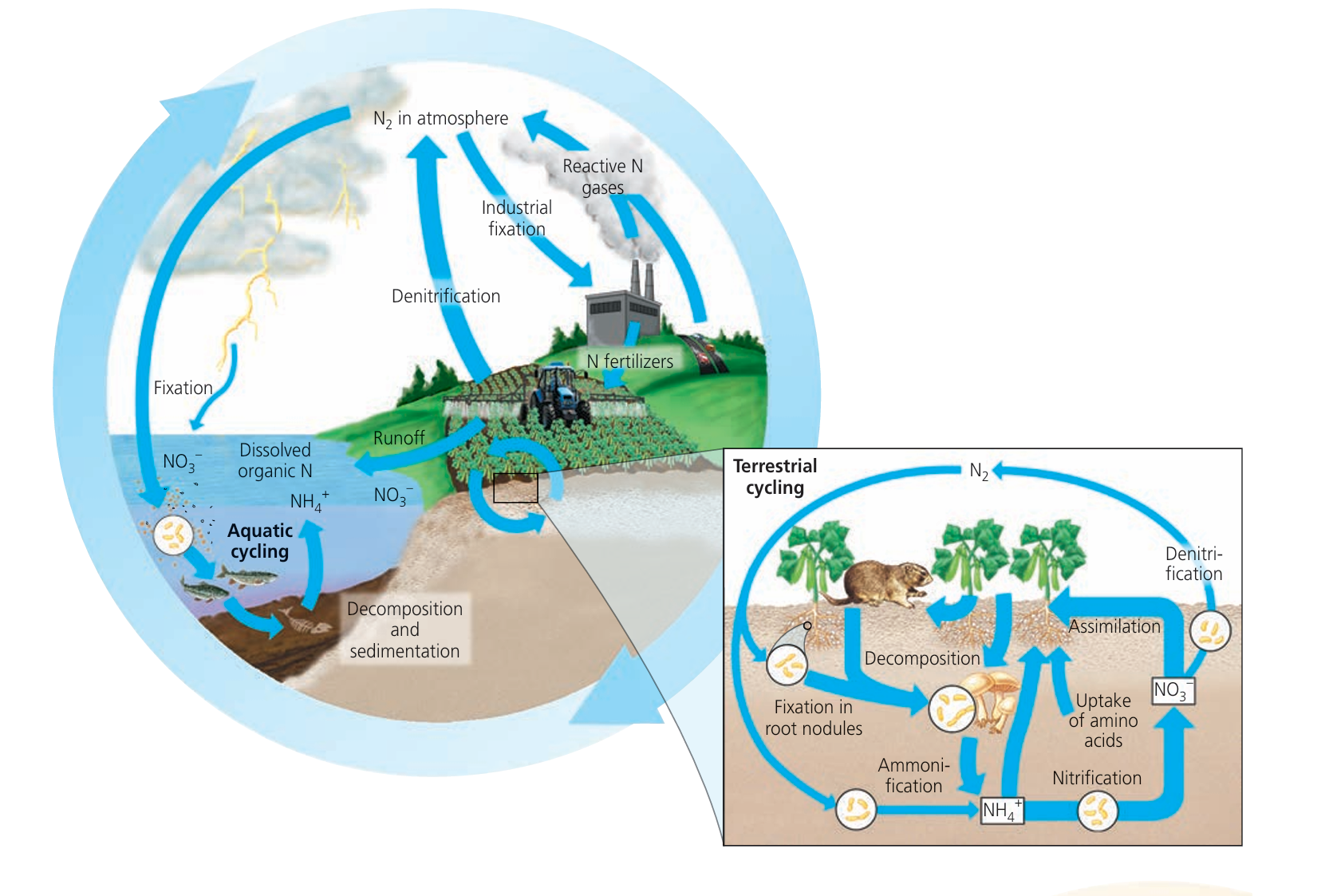
- During this cycle, different types of bacteria change nitrogen into different forms so that it can be used and recycled.
Why is Nitrogen Important?
Living organisms need nitrogen to make:
- Proteins
- Amino acids
- Enzymes
- DNA
- RNA
- New cells for growth and repair
Without nitrogen, plants cannot grow properly and animals cannot build body tissues.
Stage 1: Nitrogen in the Atmosphere
- The atmosphere contains a large amount of nitrogen gas (N₂).
- However, nitrogen gas is very stable and cannot be absorbed directly by most plants or animals.
- Before it can be used, it must be converted into nitrogen compounds in the soil.
Stage 2: Nitrogen Fixation
What is Nitrogen Fixation?
- Nitrogen fixation is the process of converting nitrogen gas (N₂) from the atmosphere into nitrogen compounds that plants can eventually use.
- This process is carried out by nitrogen-fixing bacteria.
Role of Nitrogen-Fixing Bacteria
Nitrogen-fixing bacteria:
- Live freely in the soil or inside the root nodules of certain plants (such as legumes).
- Take nitrogen gas from the atmosphere.
- Convert it into nitrogen compounds in the soil.
- Increase the amount of usable nitrogen available for plants.
Without these bacteria, plants would receive much less nitrogen.
Stage 3: Uptake of Nitrogen by Plants
- Plants absorb nitrate ions from the soil through their roots.
- The nitrate ions are then used to make:
- Amino acids
- Proteins
- Enzymes
- DNA
- RNA
These substances are needed for:
- Growth
- Cell division
- Repair of tissues
Once nitrogen enters the plant, it becomes part of the plant’s tissues.
Stage 4: Nitrogen Moves Through Food Chains
- Animals cannot absorb nitrogen directly from the soil.
- Instead, they obtain nitrogen by feeding.
How nitrogen is transferred
- Herbivores eat plants and obtain nitrogen-containing proteins.
- Carnivores eat herbivores or other animals and obtain the same nitrogen.
- Nitrogen therefore moves through food chains from one organism to another.
Stage 5: Decomposition
What Happens?
- When plants and animals die, or produce waste:
- Their bodies still contain nitrogen.
- Decomposers (mainly bacteria and fungi) break down the dead material and waste.
Role of Decomposers
Decomposers:
- Break down dead plants and animals.
- Break down animal waste.
- Release nitrogen compounds back into the soil.
- Recycle nitrogen so that it is not permanently lost from the ecosystem.
Without decomposers, dead organisms would accumulate and nitrogen would remain locked inside them.
Stage 6: Nitrification
What is Nitrification?
- Nitrification is the process in which nitrifying bacteria convert nitrogen compounds in the soil into nitrate ions.
- These nitrate ions are the main form of nitrogen absorbed by plants.
Role of Nitrifying Bacteria
Nitrifying bacteria:
- Live in the soil.
- Convert nitrogen compounds released by decomposers into nitrate ions.
- Make nitrogen available for plant uptake.
This helps complete the recycling of nitrogen in the soil.
Stage 7: Denitrification
What is Denitrification?
- Denitrification is the process in which denitrifying bacteria convert nitrate ions in the soil back into nitrogen gas.
- The nitrogen gas is then released into the atmosphere.
Role of Denitrifying Bacteria
Denitrifying bacteria:
- Live in the soil.
- Remove nitrate ions from the soil.
- Convert nitrates into nitrogen gas.
- Return nitrogen to the atmosphere.
This completes the nitrogen cycle.
🔄 How the Nitrogen Cycle Continues
The cycle repeats continuously:
- Nitrogen gas is present in the atmosphere.
- Nitrogen-fixing bacteria convert atmospheric nitrogen into nitrogen compounds.
- Nitrifying bacteria convert these compounds into nitrate ions.
- Plants absorb nitrate ions through their roots.
- Animals obtain nitrogen by eating plants or other animals.
- Decomposers break down dead organisms and waste, returning nitrogen compounds to the soil.
- Nitrifying bacteria again produce nitrate ions.
- Denitrifying bacteria convert nitrates back into nitrogen gas, which returns to the atmosphere.
The cycle then starts again.
Why is the Nitrogen Cycle Important?
The nitrogen cycle is essential because it:
- Recycles nitrogen continuously.
- Supplies plants with nitrate ions needed for growth.
- Helps plants make proteins and DNA.
- Transfers nitrogen through food chains.
- Prevents nitrogen from being permanently lost from ecosystems.
- Maintains soil fertility.
📊 Roles of Different Organisms in the Nitrogen Cycle
| Organism | Role in the Nitrogen Cycle |
|---|---|
| Nitrogen-fixing bacteria | Convert nitrogen gas from the atmosphere into nitrogen compounds in the soil. |
| Plants | Absorb nitrate ions through their roots and use them to make proteins and other important molecules. |
| Animals | Obtain nitrogen by feeding on plants or other animals. |
| Decomposers | Break down dead organisms and waste, returning nitrogen compounds to the soil. |
| Nitrifying bacteria | Convert nitrogen compounds in the soil into nitrate ions that plants can absorb. |
| Denitrifying bacteria | Convert nitrate ions back into nitrogen gas, returning it to the atmosphere. |
📝 Quick Recap
Nitrogen-fixing bacteria → N₂ → NH₄⁺ (usable for plants).
Nitrifying bacteria → NH₄⁺ → NO₂⁻ → NO₃⁻ (plants absorb).
Decomposers → dead matter/waste → NH₄⁺ (recycles nitrogen).
Denitrifying bacteria → NO₃⁻ → N₂ (returns nitrogen to air).
Nitrogen cycles continuously through soil, plants, animals, decomposers, and atmosphere, maintaining ecosystem balance.