
Micropropagation (Tissue Culture)
📝 Introduction
- Micropropagation is a method of producing many new plants from a small piece of a parent plant.
- It is carried out in a laboratory under sterile (germ-free) conditions.
- The small piece of plant used is called an explant.
- The explant is grown in vitro, which means outside the living plant in a controlled environment, usually in a nutrient culture medium.
- This method allows large numbers of genetically identical plants (clones) to be produced in a short time.
🌱 What is Micropropagation?
Definition
- Micropropagation is the process of growing new plants from a small piece of plant tissue (an explant) in a sterile nutrient medium under controlled laboratory conditions.
- It is also known as tissue culture.
🧩 Important Terms
Explant
- An explant is a small piece of tissue taken from a healthy parent plant.
- It may be taken from:
- Shoot tip
- Stem
- Leaf
- Root
- Bud
- The explant contains living cells that can divide and develop into a complete plant.
In Vitro
- In vitro means “in glass”.
- It refers to growing plant tissues outside the plant in laboratory containers such as test tubes or culture bottles.
- The growth takes place under carefully controlled conditions.
🔬 Process of Micropropagation
Step 1: Selection of the Parent Plant
- A healthy plant with desirable characteristics is chosen.
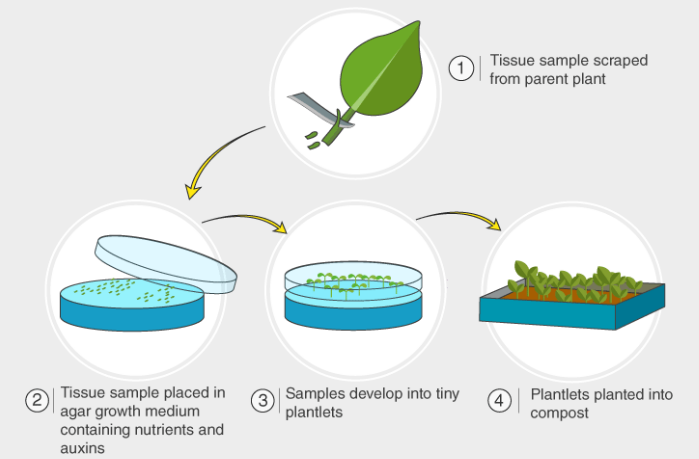 The parent plant should be free from diseases and pests.
- Healthy parent plants produce healthy offspring.
Step 2: Taking the Explant
- A small piece of tissue is removed from the parent plant.
- This tissue is called the explant.
- The explant should contain actively dividing cells.
Step 3: Sterilisation
- The explant is sterilised using suitable chemicals.
- All equipment and culture containers are also sterilised.
Why is sterilisation important?
- Prevents bacteria and fungi from growing.
- Protects the explant from contamination.
- Ensures only plant cells grow in the culture.
Step 4: Placing the Explant in Culture Medium
- The explant is placed on a sterile nutrient medium.
The culture medium contains:
- Water
- Mineral ions
- Sugar (usually glucose or sucrose)
- Vitamins
- Plant growth hormones (plant growth regulators)
These substances provide everything needed for growth.
Step 5: Cell Division and Growth
- The cells in the explant divide rapidly by mitosis.
- A mass of unspecialised cells develops.
- These cells continue growing under controlled conditions.
Step 6: Formation of Shoots and Roots
Plant growth hormones stimulate the formation of:
- Shoots
- Roots
Gradually, small complete plantlets are formed.
Step 7: Transfer to Soil
- The young plantlets are removed from the culture containers.
- They are planted in compost or soil.
- The plants are allowed to grow under suitable environmental conditions.
Eventually, they develop into mature plants.
🌿 Why are Plant Growth Hormones Used?
Plant growth hormones help to:
- Stimulate cell division.
- Encourage root formation.
- Encourage shoot formation.
- Control the development of the plantlets.
Different amounts of hormones are used depending on whether root or shoot growth is needed.
🌍 Applications of Micropropagation
Micropropagation is used in many areas of agriculture and horticulture.
Agriculture
- Produce large numbers of crop plants.
- Increase food production.
- Multiply improved crop varieties.
Horticulture
- Produce ornamental plants.
- Supply large numbers of identical flowering plants.
Forestry
- Produce large numbers of tree seedlings.
- Support commercial forestry.
Conservation
- Multiply rare or endangered plant species.
- Help preserve valuable plant varieties.
Disease-Free Plants
- Healthy explants can produce disease-free plants.
- This reduces the spread of plant diseases.
🧬 Micropropagation vs Growing Plants from Seeds
| Micropropagation | Growing from Seeds |
|---|---|
| Uses a small piece of plant tissue (explant). | Uses seeds. |
| Produces genetically identical plants (clones). | Produces genetically different offspring. |
| Very fast production of many plants. | Usually slower. |
| Maintains desirable characteristics. | Offspring may show variation. |
| Done in a laboratory under sterile conditions. | Usually done in soil under natural conditions. |
📊 Conditions Needed for Successful Micropropagation
| Condition | Importance |
|---|---|
| Sterile conditions | Prevent contamination by microorganisms. |
| Nutrient medium | Supplies minerals, sugar, vitamins and water. |
| Plant growth hormones | Stimulate root and shoot development. |
| Suitable temperature | Supports healthy cell growth. |
| Adequate light | Helps developing plantlets grow normally. |
🌟 Important Points to Remember
- Micropropagation is also called tissue culture.
- It uses a small piece of plant tissue called an explant.
- The explant is grown in vitro, meaning outside the plant in a sterile nutrient medium.
- Plant cells divide by mitosis to produce many genetically identical plants.
- Plant growth hormones control the formation of roots and shoots.
- Micropropagation is widely used to produce large numbers of healthy plants with desirable characteristics in a short time.
⚡ Quick Recap
Micropropagation = in vitro cloning of plants
Steps: Explant → Sterilization → Nutrient medium → Callus → Shoots/roots → Soil
Uses: mass production, disease-free, rare plant conservation
Key hormones: Cytokinins → shoots, Auxins → roots
Micropropagation for Commercial Plant Production
📝 Introduction
- Modern agriculture often requires thousands or even millions of identical plants with high-quality characteristics.
- Growing plants from seeds is not always suitable because the offspring may show genetic variation.
- Micropropagation (tissue culture) allows scientists and farmers to produce large numbers of genetically identical plants (clones) from a single parent plant.
- Every new plant produced has the same desirable characteristics as the original parent plant.
- This technique is widely used in commercial farming, horticulture and forestry.
🌱 Why is Micropropagation Used in Commercial Plant Production?
Commercial growers need plants that are:
- Healthy and disease-free.
- Uniform in size and quality.
- Fast-growing.
- High yielding.
- Ready for sale or planting in large numbers.
Micropropagation makes it possible to produce these plants quickly and efficiently.
🌿 What Does “Commercial Quantities” Mean?
Commercial quantities means producing very large numbers of plants for:
- Farmers
- Plant nurseries
- Garden centres
- Fruit plantations
- Forestry industries
Instead of producing only a few plants, tissue culture can produce thousands of identical plants from one parent plant within a relatively short time.
🧬 Why are the Plants Genetically Identical?
Micropropagation uses mitosis to produce new cells.
During mitosis:
- The DNA is copied accurately.
- Each daughter cell receives the same genetic information.
- No mixing of genes occurs because there is no fertilisation.
As a result:
- Every plant produced is a clone of the parent plant.
- All plants have the same inherited characteristics.
🌾 Desirable Characteristics Passed to New Plants
The parent plant is carefully selected because it has useful characteristics.
These may include:
- High crop yield.
- Large fruits or flowers.
- Good quality produce.
- Resistance to diseases.
- Resistance to insect pests.
- Drought tolerance.
- Fast growth.
- Attractive appearance (ornamental plants).
Since all the new plants are clones, these characteristics are maintained in every plant.
🔬 How Commercial Production Takes Place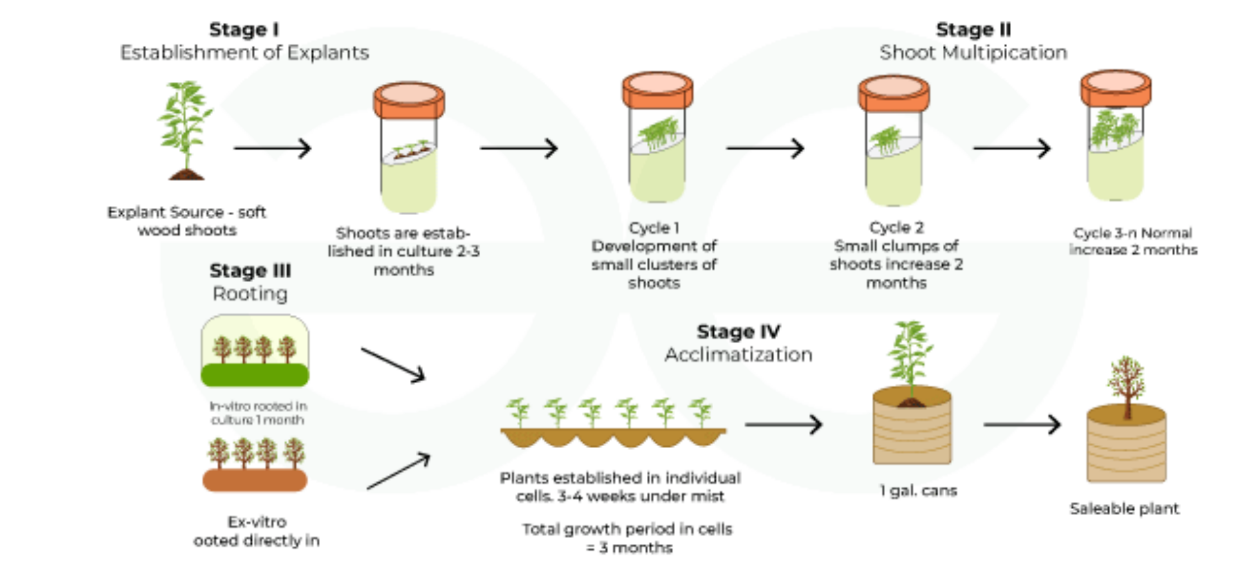
1. Selection of the Parent Plant
- A healthy plant with desirable characteristics is chosen.
- Only the best plants are used because all future plants will be identical to it.
2. Tissue Culture Begins
- A small explant is taken from the parent plant.
- It is placed on a sterile nutrient medium.
3. Rapid Cell Division
- The cells divide continuously by mitosis.
- Large numbers of young plantlets are produced.
4. Multiplication
- The newly formed plantlets can be divided again and cultured further.
- This allows the number of plants to increase rapidly.
For example:
- One explant can produce dozens of plantlets.
- Those plantlets can then be cultured again to produce hundreds or even thousands more.
5. Transfer to Soil
- Once roots and shoots have developed, the plantlets are transferred to compost or soil.
- They continue growing into mature plants ready for cultivation or sale.
🌍 Importance in Agriculture
Micropropagation helps farmers by:
- Producing large numbers of crops in a short time.
- Replacing old or diseased plants quickly.
- Establishing new plantations faster.
- Ensuring uniform growth and harvesting.
- Improving the consistency and quality of agricultural products.
🌸 Commercial Uses of Micropropagation
Fruit Crops
Examples:
- Banana
- Strawberry
- Pineapple
These crops are multiplied rapidly while maintaining good fruit quality.
Ornamental Plants
Examples:
- Orchids
- Roses
- Chrysanthemums
Large numbers of identical flowering plants can be supplied to garden centres and flower growers.
Forestry
Trees with desirable characteristics can be multiplied for:
- Timber production.
- Reforestation projects.
- Paper industries.
Medicinal Plants
Plants used to produce medicines can be grown in large numbers while maintaining their important chemical properties.
🏭 Why is Micropropagation Better for Commercial Production?
Compared with growing plants from seeds:
- Production is much faster.
- Every plant has the same quality.
- There is no variation in important characteristics.
- Harvesting becomes more uniform.
- Farmers know exactly what type of crop they will produce.
This makes crop management easier and improves productivity.
📊 Commercial Production Using Micropropagation
| Stage | What Happens | Result |
|---|---|---|
| Parent plant selected | Healthy plant with desirable characteristics is chosen | Good quality starting material |
| Explant cultured | Small piece of tissue grows in nutrient medium | Cells begin dividing |
| Rapid multiplication | Plantlets are repeatedly produced by mitosis | Large numbers of clones are formed |
| Plantlets transferred to soil | Young plants continue normal growth | Ready for farming or sale |
| Commercial cultivation | Plants are grown on a large scale | Uniform, high-quality crop production |
📊 Benefits of Producing Genetically Identical Plants
| Feature | Benefit |
|---|---|
| Same genetic makeup | All plants show the same desirable characteristics |
| Uniform growth | Plants mature at a similar rate |
| High yield | Greater food production from improved varieties |
| Disease-free parent material | Healthy crops with reduced disease spread |
| Rapid multiplication | Thousands of plants can be produced in a short time |
| Consistent quality | Fruits, flowers or vegetables are similar in size and quality |
⚡ Quick Recap
Micropropagation = cloning in vitro
Commercial use: mass production, uniform quality, disease-free plants
Benefits: time-saving, high yield, rapid supply of plants with desirable traits
Examples: orchids, bananas, potatoes, medicinal plants