
Integers (Positive, Negative and Zero)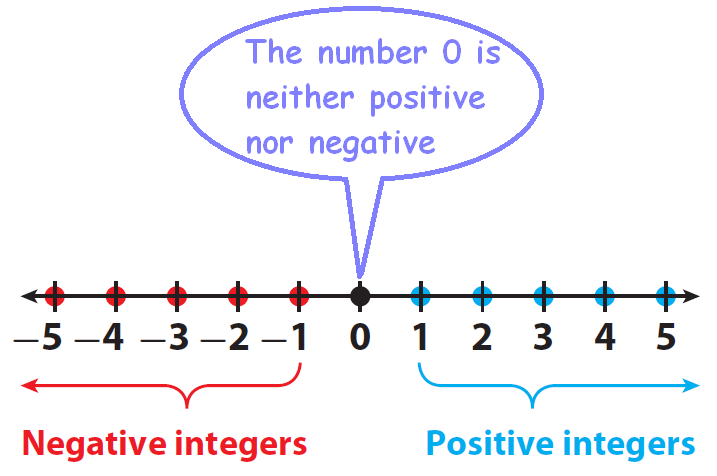
An integer is a whole number that can be positive, negative, or zero. Integers do not include fractions or decimals.
The set of integers is
\( \ldots,-5,-4,-3,-2,-1,0,1,2,3,4,5,\ldots \)
Positive Integers
Positive integers are numbers greater than zero. They are used to represent quantities such as gains, profit, height above sea level, or temperature above \( 0^\circ\mathrm{C} \).
Examples: \( 1,2,3,4,5,\ldots \)
Negative Integers
Negative integers are numbers less than zero. They are used to represent quantities such as debt, loss, depths below sea level, or temperatures below \( 0^\circ\mathrm{C} \).
Examples: \( -1,-2,-3,-4,-5,\ldots \)
Zero
Zero is neither positive nor negative. It represents the absence of quantity and lies exactly in the middle of positive and negative numbers on a number line.
Ordering Integers
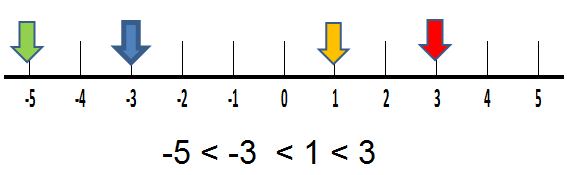
Integers can be arranged on a number line. Numbers to the right are greater, and numbers to the left are smaller.
\( -6 < -2 < 0 < 3 < 8 \)
A useful rule:
The further right a number is on the number line, the larger its value.
Opposites (Additive Inverses)
Every integer has an opposite. The opposite of a number is the same distance from zero but on the other side of the number line.
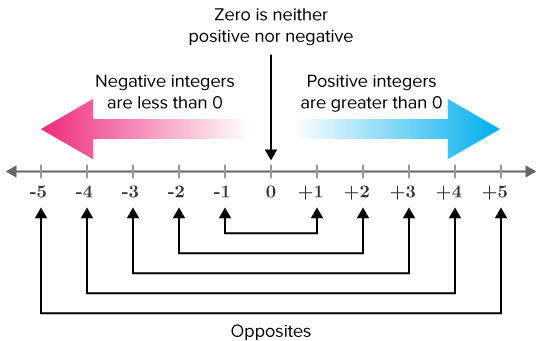
Opposite of \( 5 \) is \( -5 \)
Opposite of \( -7 \) is \( 7 \)
Adding a number and its opposite always gives zero:
\( 5 + (-5) = 0 \)
Using Integers in Context
Integers are commonly used in real-life situations:
- Bank balance: money owed is negative, money saved is positive
- Temperature: below zero is negative
- Elevation: below sea level is negative
Example 1:
Arrange the integers \( -3, 5, 0, -7, 2 \) in ascending order.
▶️ Answer/Explanation
Ascending order means smallest to largest.
Numbers further left on the number line are smaller.
\( -7,\; -3,\; 0,\; 2,\; 5 \)
Conclusion: The integers in ascending order are \( -7, -3, 0, 2, 5 \).
Example 2:
The temperature at night was \( -4^\circ\mathrm{C} \). By afternoon it rose to \( 6^\circ\mathrm{C} \). Find the temperature increase.
▶️ Answer/Explanation
Increase = final temperature − initial temperature
\( 6 – (-4) = 6 + 4 = 10 \)
Conclusion: The temperature increased by \( 10^\circ\mathrm{C} \).
Example 3:
A bank account has a balance of \( -\$250 \). After depositing \( \$400 \), find the new balance.
▶️ Answer/Explanation
New balance = current balance + deposit
\( -250 + 400 = 150 \)
Conclusion: The new balance is \( \$150 \).
Place Value
Every digit in a number has a place value. The place value tells us how much each digit is worth depending on its position.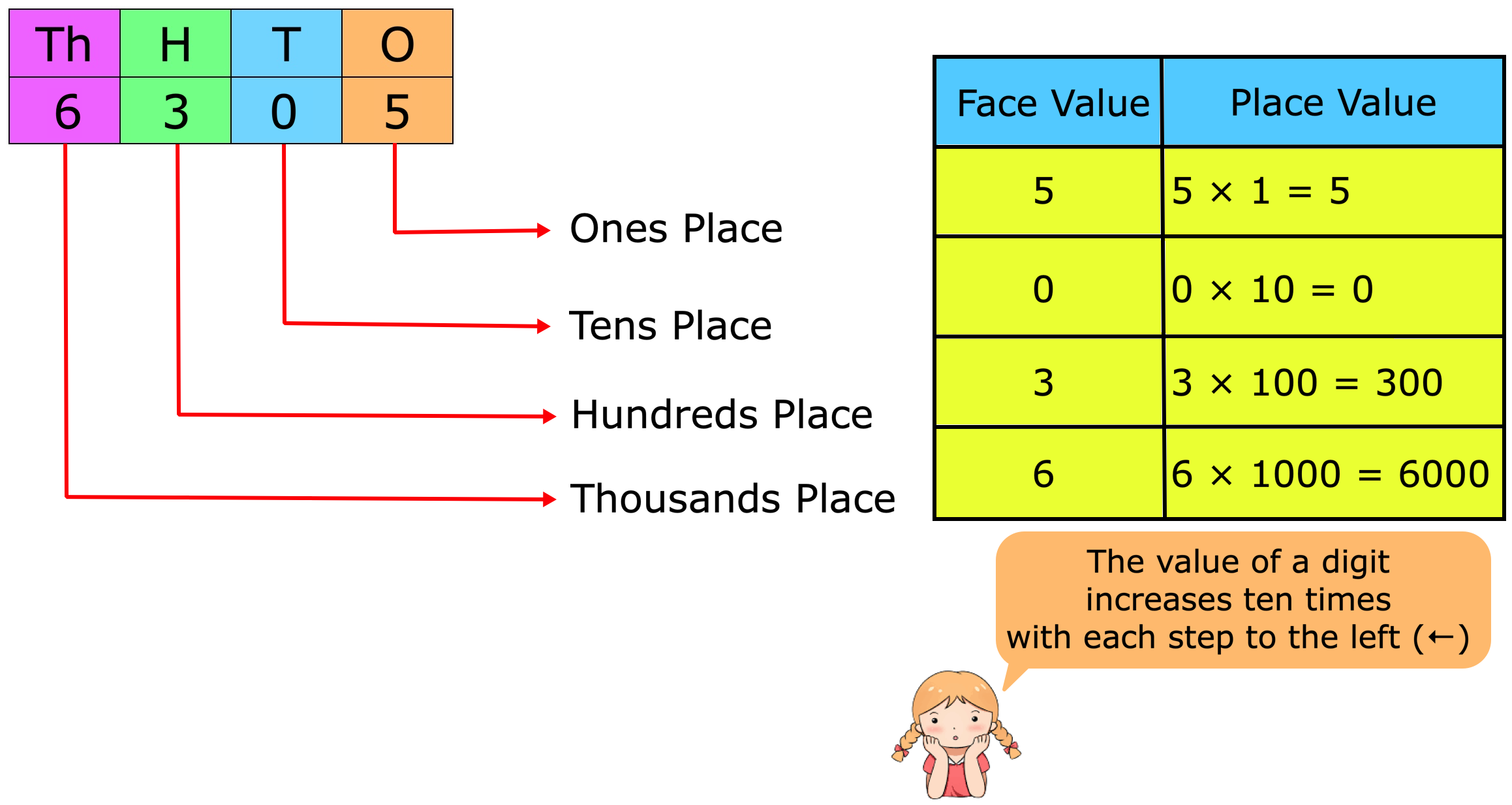
For example, in the number \( 4\,582 \):
\( 4 \) is in the thousands place
\( 5 \) is in the hundreds place
\( 8 \) is in the tens place
\( 2 \) is in the ones (units) place
So
\( 4\,582 = 4\times1000 + 5\times100 + 8\times10 + 2\times1 \)
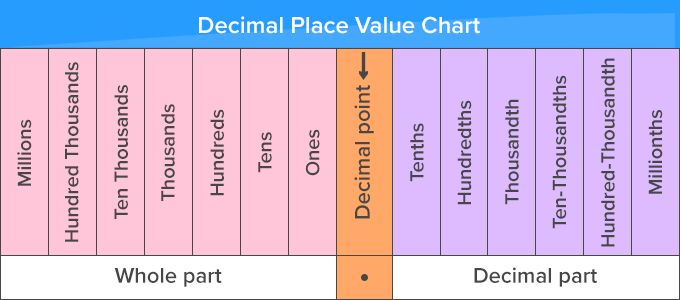
Place Value Chart
Moving one place to the left multiplies the value by 10. Moving one place to the right divides the value by 10.
Place Value with Decimals
Digits after the decimal point represent parts of a whole.
For the number \( 37.46 \):
\( 3 \) is in the tens place
\( 7 \) is in the ones place
\( 4 \) is in the tenths place \( = \dfrac{4}{10} \)
\( 6 \) is in the hundredths place \( = \dfrac{6}{100} \)
So
\( 37.46 = 3\times10 + 7\times1 + \dfrac{4}{10} + \dfrac{6}{100} \)
Expanded Form
A number can be written as the sum of the values of its digits. This is called expanded form.
\( 6\,203 = 6\times1000 + 2\times100 + 0\times10 + 3 \)
Zeros as Place Holders
Zeros are important because they keep digits in the correct place.
For example:
\( 402 \neq 42 \)
The zero shows that there are no tens.
Example 1:
Write \( 5\,308 \) in expanded form.
▶️ Answer/Explanation
\( 5\,308 = 5\times1000 + 3\times100 + 0\times10 + 8 \)
Conclusion: The expanded form is \( 5\times1000 + 3\times100 + 0\times10 + 8 \).
Example 2:
What is the value of the digit \( 7 \) in the number \( 2\,764 \)?
▶️ Answer/Explanation
The digit \( 7 \) is in the hundreds place.
Value \( = 7\times100 = 700 \)
Conclusion: The value of the digit \( 7 \) is \( 700 \).
Example 3:
Write the number represented by
\( 3\times1000 + 4\times10 + 9 \)
▶️ Answer/Explanation
\( 3\times1000 = 3000 \)
\( 4\times10 = 40 \)
\( 9 = 9 \)
\( 3000 + 40 + 9 = 3049 \)
Conclusion: The number is \( 3\,049 \).
Directed Numbers in Practical Situations (e.g. Temperatures)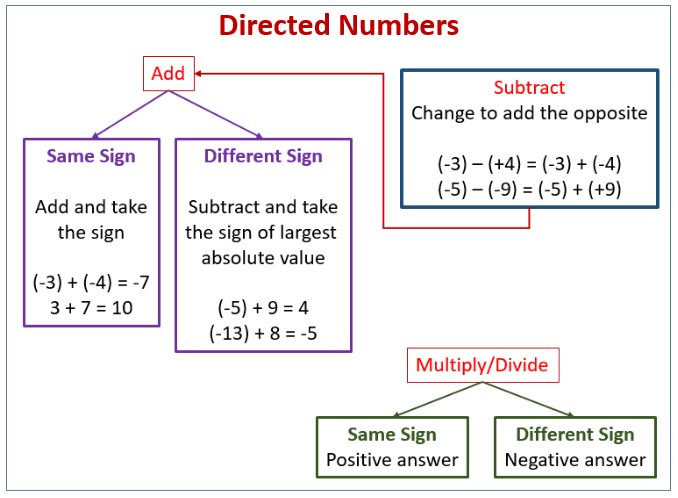
A directed number is a number with a sign. The sign shows the direction or type of change.
Positive numbers \( (+) \) represent an increase, gain, or movement upward
Negative numbers \( (-) \) represent a decrease, loss, or movement downward
Directed numbers are commonly used in real-life contexts such as temperature, bank balances, elevation, and games or scoring systems.
Temperatures
Temperatures above \( 0^\circ\mathrm{C} \) are positive, and temperatures below \( 0^\circ\mathrm{C} \) are negative.
\( 8^\circ\mathrm{C} \) means 8 degrees above zero
\( -5^\circ\mathrm{C} \) means 5 degrees below zero
Adding Directed Numbers
Adding a positive number moves to the right on a number line. Adding a negative number moves to the left.
\( 3 + 4 = 7 \)
\( 3 + (-4) = -1 \)
Subtracting Directed Numbers
Subtracting a number is the same as adding its opposite.
\( 6 – 2 = 6 + (-2) = 4 \)
\( 6 – (-2) = 6 + 2 = 8 \)
Using Directed Numbers in Context
- Temperature rise or fall
- Money gained or owed
- Floors in a building (above and below ground level)
- Height above or below sea level
Example 1:
The temperature in the morning was \( -3^\circ\mathrm{C} \). By afternoon it increased by \( 7^\circ\mathrm{C} \). Find the afternoon temperature.
▶️ Answer/Explanation
\( -3 + 7 = 4 \)
Conclusion: The afternoon temperature is \( 4^\circ\mathrm{C} \).
Example 2:
A diver is \( 6 \) m below sea level. He dives a further \( 4 \) m. Find his new position.
▶️ Answer/Explanation
Below sea level is negative.
\( -6 + (-4) = -10 \)
Conclusion: The diver is \( 10 \) m below sea level.
Example 3:
A bank account has a balance of \( \$200 \). A withdrawal of \( \$350 \) is made. Find the new balance.
▶️ Answer/Explanation
Withdrawal means subtract money.
\( 200 – 350 = -150 \)
Conclusion: The new balance is \( -\$150 \), meaning \( \$150 \) is owed.
Ordering Integers
To order integers means to arrange them from smallest to largest (ascending order) or largest to smallest (descending order).
Integers can be understood easily using a number line.
Key rule:
Numbers further to the right on the number line are greater.
This means negative numbers are always less than positive numbers, and zero lies between them.
\( -5 < -2 < 0 < 3 < 8 \)
Comparing Negative Numbers
For negative numbers, the one with the larger absolute value is actually smaller.
\( -9 < -4 \) because \( -9 \) is further left on the number line
Ascending and Descending Order
Ascending order: smallest to largest.
Example: \( -6,\,-2,\,0,\,4,\,9 \)
Descending order: largest to smallest.
Example: \( 9,\,4,\,0,\,-2,\,-6 \)
Inequality Symbols
We use inequality signs to compare integers:
\( > \) means greater than
\( < \) means less than
Example:
\( -3 < 2 \)
Absolute Value
The absolute value of a number is its distance from zero.
\( |5| = 5 \)
\( |-5| = 5 \)
Absolute value helps compare negative numbers but does not tell which number is greater on its own.
Example 1:
Arrange \( -4, 7, -1, 0, 3 \) in ascending order.
▶️ Answer/Explanation
Start from the most negative number.
\( -4,\,-1,\,0,\,3,\,7 \)
Conclusion: The integers in ascending order are \( -4, -1, 0, 3, 7 \).
Example 2:
Write \( -6 \; \square \; -2 \) using \( > \) or \( < \).
▶️ Answer/Explanation
\( -6 \) is further left on the number line.
\( -6 < -2 \)
Conclusion: The correct symbol is \( < \).
Example 3:
Arrange \( 5, -8, 2, -3 \) in descending order.
▶️ Answer/Explanation
Descending means largest to smallest.
\( 5,\,2,\,-3,\,-8 \)
Conclusion: The descending order is \( 5, 2, -3, -8 \).
The Four Rules: Addition, Subtraction, Multiplication and Division
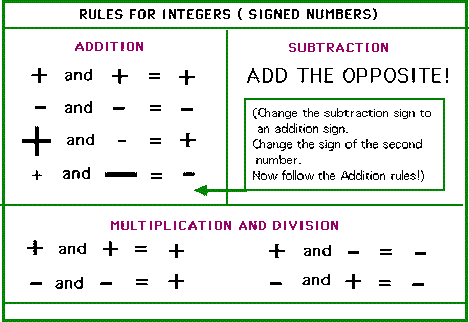
In arithmetic we use four basic operations, often called the four rules:
- Addition \( (+) \)
- Subtraction \( (-) \)
- Multiplication \( (\times) \)
- Division \( (\div) \)
These operations can be used with whole numbers, negative numbers, and decimals.
Addition
Addition combines quantities.
\( 7 + 5 = 12 \)
When adding negative numbers:
Same signs: add and keep the sign
Different signs: subtract and keep the sign of the larger number
\( -6 + (-3) = -9 \)
\( -6 + 10 = 4 \)
Subtraction
Subtraction finds the difference between numbers.
Subtracting a number is the same as adding its opposite:
\( 9 – 4 = 9 + (-4) = 5 \)
\( 9 – (-4) = 9 + 4 = 13 \)
Multiplication
Multiplication is repeated addition.
\( 4 \times 3 = 12 \)
Rules for signs:
\( (+)\times(+) = + \)
\( (-)\times(-) = + \)
\( (+)\times(-) = – \)
\( (-)\times(+) = – \)
\( -5 \times 3 = -15 \)
\( -5 \times (-3) = 15 \)
Division
Division is the inverse of multiplication.
\( 20 \div 5 = 4 \)
The same sign rules apply as multiplication:
\( (-)\div(-) = + \)
\( (+)\div(-) = – \)
\( -24 \div 6 = -4 \)
\( -24 \div (-6) = 4 \)
Checking Answers
You can check:
- Addition using subtraction
- Multiplication using division
Example 1:
Calculate \( -8 + 13 \).
▶️ Answer/Explanation
Signs are different, so subtract:
\( 13 – 8 = 5 \)
Keep the sign of the larger number (positive).
Conclusion: \( -8 + 13 = 5 \).
Example 2:
Calculate \( 9 – (-7) \).
▶️ Answer/Explanation
Subtracting a negative becomes addition:
\( 9 – (-7) = 9 + 7 = 16 \)
Conclusion: The answer is \( 16 \).
Example 3:
Calculate \( (-6) \times 4 + 24 \div (-3) \).
▶️ Answer/Explanation
Multiply and divide first:
\( (-6)\times4 = -24 \)
\( 24\div(-3) = -8 \)
Now add:
\( -24 + (-8) = -32 \)
Conclusion: The answer is \( -32 \).
Brackets and the Hierarchy of Operations
When a calculation contains more than one operation, we must follow a fixed order. This is called the hierarchy of operations (or order of operations).
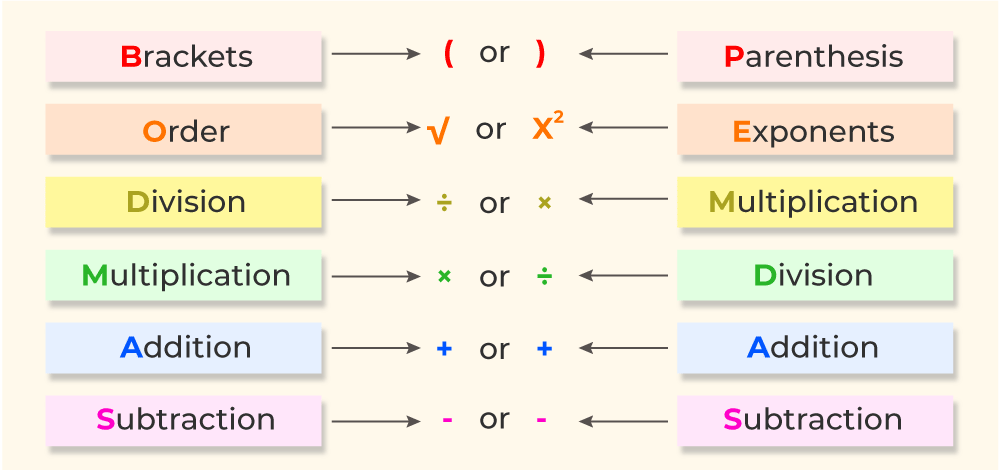
The correct order is:
- Brackets
- Powers (indices)
- Multiplication and Division (left to right)
- Addition and Subtraction (left to right)
A useful memory aid is:
BIDMAS (Brackets, Indices, Division and Multiplication, Addition and Subtraction)
Using Brackets
Anything inside brackets must be calculated first.
\( 3\times(5+2) = 3\times7 = 21 \)
Without brackets the answer changes:
\( 3\times5 + 2 = 15 + 2 = 17 \)
Multiplication and Division
Multiplication and division have equal priority. Work from left to right.
\( 24 \div 6 \times 2 = 4 \times 2 = 8 \)
Addition and Subtraction
Addition and subtraction also have equal priority. Work from left to right.
\( 10 – 3 + 2 = 7 + 2 = 9 \)
Negative Numbers and Brackets
Brackets are important when working with negative numbers.
\( 5 – (-3) = 5 + 3 = 8 \)
\( -2^2 = -(2^2) = -4 \)
\( (-2)^2 = 4 \)
Example 1:
Calculate \( 8 + 6 \times 5 \).
▶️ Answer/Explanation
Multiply first:
\( 6\times5 = 30 \)
Then add:
\( 8 + 30 = 38 \)
Conclusion: The answer is \( 38 \).
Example 2:
Calculate \( (12 – 4)^2 \).
▶️ Answer/Explanation
Work inside brackets first:
\( 12 – 4 = 8 \)
Now apply the power:
\( 8^2 = 64 \)
Conclusion: The answer is \( 64 \).
Example 3:
Calculate \( 20 – 8 \div 2 + 3 \).
▶️ Answer/Explanation
Division first:
\( 8\div2 = 4 \)
Now left to right:
\( 20 – 4 + 3 = 16 + 3 = 19 \)
Conclusion: The answer is \( 19 \).
Odd, Even, Prime Numbers, Factors and Multiples
Even Numbers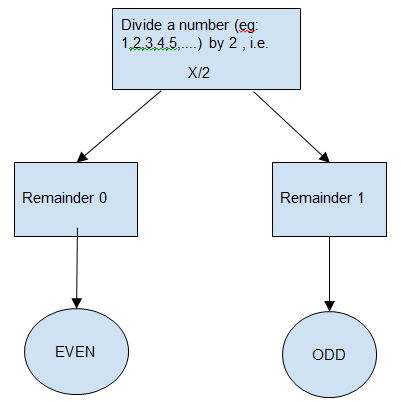
An even number is any integer that is divisible by \( 2 \).
\( 2,4,6,8,10,12,\ldots \)
Even numbers always end in \( 0,2,4,6 \) or \( 8 \).
Odd Numbers
An odd number is any integer that is not divisible by \( 2 \).
\( 1,3,5,7,9,11,\ldots \)
Odd numbers always end in \( 1,3,5,7 \) or \( 9 \).
Prime Numbers
A prime number is a number greater than \( 1 \) that has exactly two factors: \( 1 \) and itself.
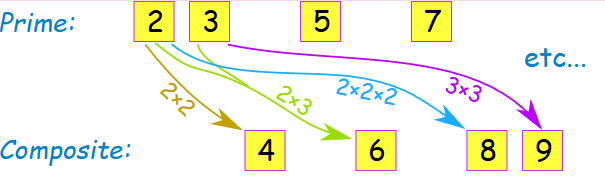
\( 2,3,5,7,11,13,17,19,\ldots \)
Important facts:
- \( 2 \) is the only even prime number
- \( 1 \) is not a prime number
Factors
A factor of a number is a whole number that divides it exactly (with no remainder).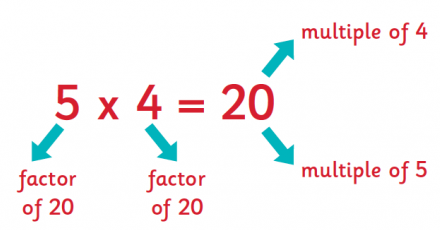
Example: Factors of \( 12 \)
\( 1,2,3,4,6,12 \)
Multiples
A multiple of a number is found by multiplying it by integers.
Multiples of \( 5 \):
\( 5,10,15,20,25,30,\ldots \)
Key Difference
Factors divide a number
Multiples are produced by a number
Example 1:
State whether \( 46 \) is odd or even.
▶️ Answer/Explanation
\( 46 \) ends in \( 6 \).
It is divisible by \( 2 \).
Conclusion: \( 46 \) is an even number.
Example 2:
Is \( 29 \) a prime number?
▶️ Answer/Explanation
Check divisibility by smaller prime numbers:
Not divisible by \( 2,3,5 \) or \( 7 \)
So it only has factors \( 1 \) and \( 29 \).
Conclusion: \( 29 \) is a prime number.
Example 3:
List all the factors of \( 18 \) and the first five multiples of \( 18 \).
▶️ Answer/Explanation
Factors
\( 1,2,3,6,9,18 \)
Multiples
\( 18,36,54,72,90 \)
Conclusion: These are the factors and multiples of \( 18 \).
Prime Factors, Common Factors and Common Multiples
Prime Factors
A prime factor is a factor of a number that is also a prime number.
We find prime factors by writing a number as a product of prime numbers. This is called prime factorisation.
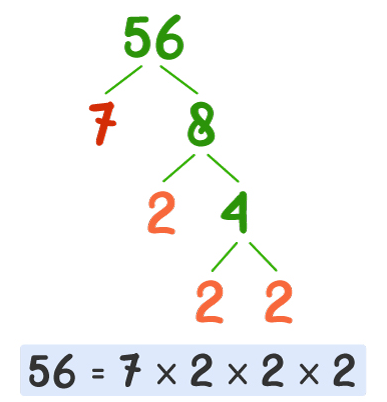
Example:
\( 12 = 2 \times 2 \times 3 = 2^2 \times 3 \)
Common Factors
Common factors are factors that two or more numbers share.
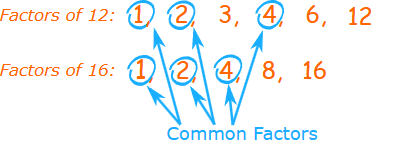
Example: factors of \( 12 \) and \( 18 \)
Factors of \( 12 \): \( 1,2,3,4,6,12 \)
Factors of \( 18 \): \( 1,2,3,6,9,18 \)
Common factors: \( 1,2,3,6 \)
The greatest common factor is called the Highest Common Factor (HCF).
\( \mathrm{HCF}(12,18)=6 \)
Common Multiples
Common multiples are multiples shared by two or more numbers.
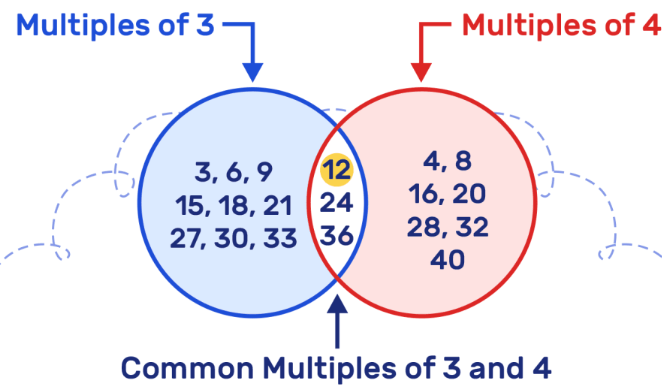
Multiples of \( 4 \):
\( 4,8,12,16,20,24,\ldots \)
Multiples of \( 6 \):
\( 6,12,18,24,30,\ldots \)
Common multiples: \( 12,24,\ldots \)
The smallest common multiple is called the Lowest Common Multiple (LCM).
\( \mathrm{LCM}(4,6)=12 \)
Using Prime Factorisation to Find HCF and LCM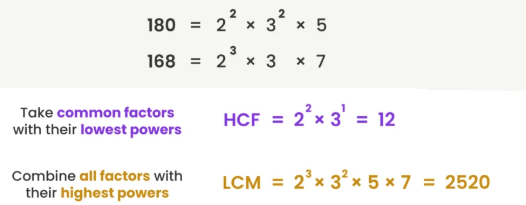
Write each number as a product of primes.
\( 12 = 2^2 \times 3 \)
\( 18 = 2 \times 3^2 \)
HCF uses the lowest powers:
\( 2^1 \times 3^1 = 6 \)
LCM uses the highest powers:
\( 2^2 \times 3^2 = 36 \)
Example 1:
Write \( 60 \) as a product of prime factors.
▶️ Answer/Explanation
\( 60 = 2\times30 = 2\times2\times15 = 2^2\times3\times5 \)
Conclusion: \( 60 = 2^2 \times 3 \times 5 \).
Example 2:
Find the HCF of \( 24 \) and \( 36 \).
▶️ Answer/Explanation
\( 24 = 2^3\times3 \)
\( 36 = 2^2\times3^2 \)
Take lowest powers:
\( 2^2\times3 = 12 \)
Conclusion: \( \mathrm{HCF}(24,36)=12 \).
Example 3:
Find the LCM of \( 15 \) and \( 20 \).
▶️ Answer/Explanation
\( 15 = 3\times5 \)
\( 20 = 2^2\times5 \)
Take highest powers:
\( 2^2\times3\times5 = 60 \)
Conclusion: \( \mathrm{LCM}(15,20)=60 \).