
Applying Number in Everyday Life
We use numbers in everyday personal, domestic and community situations.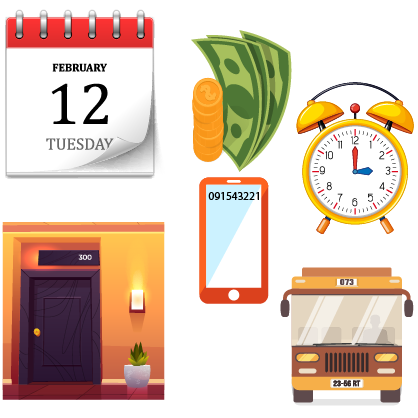
Mathematics helps us make decisions, compare values and solve real-life problems.
Common Situations
- Shopping and discounts
- Bills and budgeting
- Travel distances
- Cooking and recipes
- Sharing quantities
Personal Use
Numbers are used to manage money, calculate marks and compare prices.
Example: choosing the cheaper product.
Domestic Use
At home we use numbers in cooking, measuring ingredients and reading electricity or water usage.
Community Use
In the community numbers are used in transport fares, population data and sports scores.
Key Idea
Mathematics helps us make sensible real-world decisions.
Example 1:
A T-shirt costs ₹800. There is a discount of ₹150. Find the sale price.
▶️ Answer/Explanation
\( 800 – 150 = 650 \)
Conclusion: Sale price = ₹650.
Example 2:
A recipe needs \( 500 \) g of flour. You already have \( 320 \) g. How much more is needed?
▶️ Answer/Explanation
\( 500 – 320 = 180 \)
Conclusion: \( 180 \) g more flour is needed.
Example 3:
A bus fare is ₹35 per person. Find the total cost for 4 people.
▶️ Answer/Explanation
\( 35 \times 4 = 140 \)
Conclusion: Total cost = ₹140.
Calculations with Standard Metric Units
In everyday life we measure quantities such as length, mass, area, volume and capacity.
We use metric units. These units are based on powers of \( 10 \), so conversions are done by multiplying or dividing by \( 10,\;100,\;1000 \).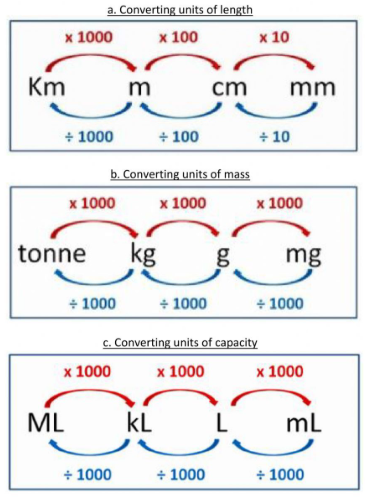
Length
\( 10 \text{ mm} = 1 \text{ cm} \)
\( 100 \text{ cm} = 1 \text{ m} \)
\( 1000 \text{ m} = 1 \text{ km} \)
Mass
\( 1000 \text{ g} = 1 \text{ kg} \)
Capacity
\( 1000 \text{ ml} = 1 \text{ L} \)
Area
\( 1 \text{ m}^2 = 10000 \text{ cm}^2 \)
Volume
\( 1 \text{ m}^3 = 1000000 \text{ cm}^3 \)
Key Idea
Convert to the same unit before calculating.
Example 1:
Convert \( 3.5 \) m to cm.
▶️ Answer/Explanation
\( 1 \text{ m} = 100 \text{ cm} \)
\( 3.5 \times 100 = 350 \)
Conclusion: \( 350 \) cm.
Example 2:
A bag has a mass of \( 2.4 \) kg. Write this in grams.
▶️ Answer/Explanation
\( 1 \text{ kg} = 1000 \text{ g} \)
\( 2.4 \times 1000 = 2400 \)
Conclusion: \( 2400 \) g.
Example 3:
A bottle contains \( 750 \) ml of water. How many litres is this?
▶️ Answer/Explanation
\( 1000 \text{ ml} = 1 \text{ L} \)
\( 750 \div 1000 = 0.75 \)
Conclusion: \( 0.75 \) L.
Calculations with Time and Money
Time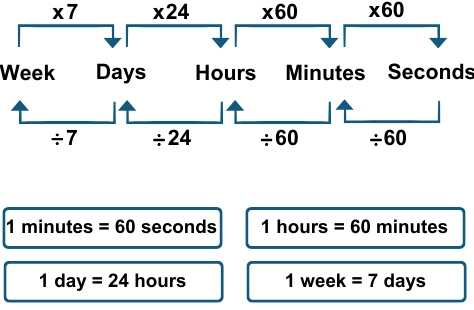
We often calculate durations, starting times and finishing times.
Key Time Facts
\( 60 \) seconds \( = 1 \) minute
\( 60 \) minutes \( = 1 \) hour
\( 24 \) hours \( = 1 \) day
Always convert to the same unit before calculating.
Money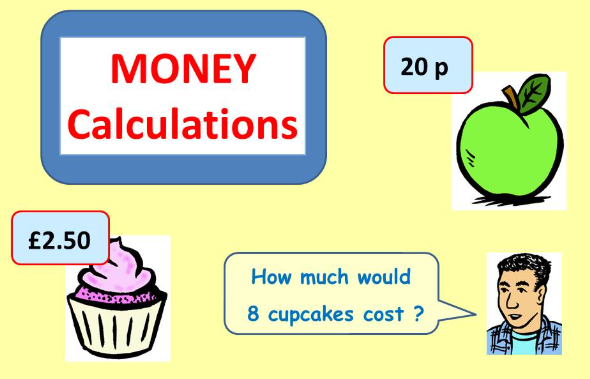
Money calculations include totals, change and budgets.
\( 100 \) paise \( = ₹1 \)
Currency Conversion
To convert currencies, multiply or divide by the exchange rate.
If \( 1 \) USD \( = ₹ 80 \)
USD to rupees → multiply
Rupees to USD → divide
Example 1:
A movie starts at 3:20 pm and ends at 5:05 pm. Find the duration.
▶️ Answer/Explanation
3:20 pm → 4:20 pm = 1 hour
4:20 pm → 5:05 pm = 45 minutes
Conclusion: \( 1 \) hour \( 45 \) minutes.
Example 2:
You buy items costing ₹ 245 and ₹ 380. How much do you pay in total?
▶️ Answer/Explanation
\( 245 + 380 = 625 \)
Conclusion: ₹625.
Example 3:
Convert ₹1600 to USD if \( 1 \) USD \( = ₹ 80 \).
▶️ Answer/Explanation
\( 1600 \div 80 = 20 \)
Conclusion: \( 20 \) USD.