
Equivalent Fractions and Simplifying Fractions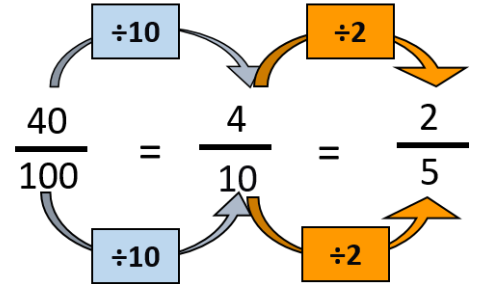
A fraction represents a part of a whole and is written as
\( \dfrac{\mathrm{numerator}}{\mathrm{denominator}} \)
The numerator shows how many parts are taken. The denominator shows how many equal parts the whole is divided into.
Equivalent Fractions
Equivalent fractions have the same value even though the numbers look different. We create them by multiplying or dividing the numerator and denominator by the same number.
\( \dfrac{1}{2} = \dfrac{2}{4} = \dfrac{3}{6} \)
Simplifying Fractions (Lowest Terms)
To simplify a fraction, divide the numerator and denominator by their highest common factor (HCF). This is also called cancelling common factors.
Example:
\( \dfrac{80}{60} \)
The HCF of \( 80 \) and \( 60 \) is \( 20 \).
\( \dfrac{80\div20}{60\div20} = \dfrac{4}{3} \)
So the fraction in its simplest form (lowest terms) is \( \dfrac{4}{3} \).
Cancelling Common Factors
You may cancel factors before multiplying:
\( \dfrac{12}{18} = \dfrac{2}{3} \) (divide both by \( 6 \))
Example 1:
Write \( \dfrac{24}{36} \) in its simplest form.
▶️ Answer/Explanation
HCF of \( 24 \) and \( 36 \) is \( 12 \).
\( \dfrac{24\div12}{36\div12} = \dfrac{2}{3} \)
Conclusion: \( \dfrac{24}{36} = \dfrac{2}{3} \).
Example 2:
Find a fraction equivalent to \( \dfrac{3}{5} \) with denominator \( 20 \).
▶️ Answer/Explanation
Multiply numerator and denominator by \( 4 \).
\( \dfrac{3\times4}{5\times4} = \dfrac{12}{20} \)
Conclusion: The equivalent fraction is \( \dfrac{12}{20} \).
Example 3:
Simplify \( \dfrac{45}{60} \).
▶️ Answer/Explanation
HCF of \( 45 \) and \( 60 \) is \( 15 \).
\( \dfrac{45\div15}{60\div15} = \dfrac{3}{4} \)
Conclusion: The simplest form is \( \dfrac{3}{4} \).
Mixed Numbers and Vulgar Fractions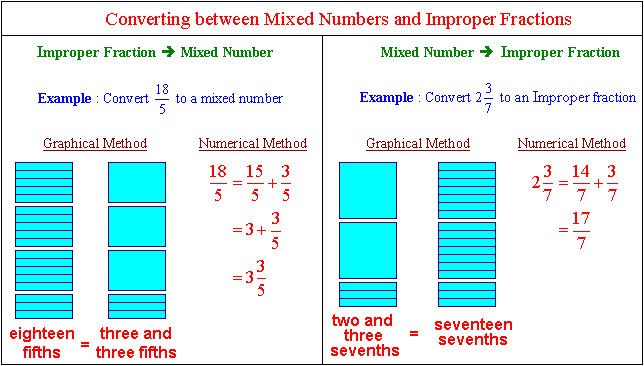
A vulgar fraction is a fraction written in the form
\( \dfrac{a}{b} \)
where the numerator may be greater than the denominator.
Examples:
\( \dfrac{3}{4},\; \dfrac{7}{5},\; \dfrac{11}{3} \)
Mixed Numbers
A mixed number contains a whole number and a fraction.
\( 2\dfrac{1}{3},\; 4\dfrac{2}{5},\; 7\dfrac{3}{8} \)
Mixed numbers are useful for showing quantities greater than one whole.
Converting a Mixed Number to an Improper (Vulgar) Fraction
Multiply the whole number by the denominator and add the numerator.
Example:
\( 2\dfrac{1}{3} = \dfrac{2\times3+1}{3} = \dfrac{7}{3} \)
Converting an Improper Fraction to a Mixed Number
Divide the numerator by the denominator.
Example:
\( \dfrac{11}{4} = 2\dfrac{3}{4} \)
because \( 11 \div 4 = 2 \) remainder \( 3 \).
Why Convert?
- Improper fractions are easier for calculations
- Mixed numbers are easier to understand in context
Example 1:
Convert \( 3\dfrac{2}{5} \) to an improper fraction.
▶️ Answer/Explanation
\( \dfrac{3\times5+2}{5} = \dfrac{17}{5} \)
Conclusion: \( 3\dfrac{2}{5} = \dfrac{17}{5} \).
Example 2:
Convert \( \dfrac{19}{6} \) to a mixed number.
▶️ Answer/Explanation
\( 19 \div 6 = 3 \) remainder \( 1 \).
\( 3\dfrac{1}{6} \)
Conclusion: \( \dfrac{19}{6} = 3\dfrac{1}{6} \).
Example 3:
A rope is \( \dfrac{9}{4} \) m long. Write its length as a mixed number.
▶️ Answer/Explanation
\( 9 \div 4 = 2 \) remainder \( 1 \).
\( 2\dfrac{1}{4} \)
Conclusion: The rope length is \( 2\dfrac{1}{4} \) m.
Common Denominators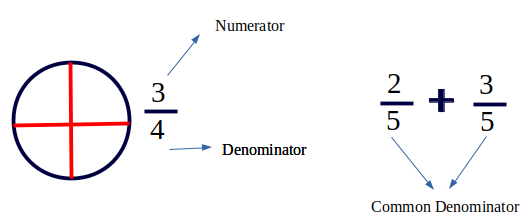
The denominator of a fraction shows how many equal parts a whole is divided into.
To compare, add, or subtract fractions, the fractions must have the same denominator. This is called a common denominator.
Why We Need a Common Denominator
Fractions represent parts of different sized wholes. We cannot combine them directly unless the parts are the same size.
\( \dfrac{1}{2} + \dfrac{1}{3} \) cannot be added immediately
We first convert them to equivalent fractions with the same denominator.
Finding a Common Denominator
The best common denominator is usually the lowest common multiple (LCM) of the denominators.
Example: \( \dfrac{1}{2} \) and \( \dfrac{1}{3} \)
LCM of \( 2 \) and \( 3 \) is \( 6 \)
Convert both fractions:
\( \dfrac{1}{2} = \dfrac{3}{6} \)
\( \dfrac{1}{3} = \dfrac{2}{6} \)
Now the fractions have a common denominator.
How to Create Equivalent Fractions
Multiply the numerator and denominator by the same number.
\( \dfrac{2}{5} = \dfrac{2\times4}{5\times4} = \dfrac{8}{20} \)
Key Idea
The value of a fraction does not change if the numerator and denominator are multiplied or divided by the same number.
Example 1:
Write \( \dfrac{3}{4} \) and \( \dfrac{5}{6} \) with a common denominator.
▶️ Answer/Explanation
LCM of \( 4 \) and \( 6 \) is \( 12 \).
\( \dfrac{3}{4} = \dfrac{9}{12} \)
\( \dfrac{5}{6} = \dfrac{10}{12} \)
Conclusion: The fractions with a common denominator are \( \dfrac{9}{12} \) and \( \dfrac{10}{12} \).
Example 2:
Find a common denominator for \( \dfrac{2}{3} \) and \( \dfrac{7}{9} \).
▶️ Answer/Explanation
LCM of \( 3 \) and \( 9 \) is \( 9 \).
\( \dfrac{2}{3} = \dfrac{6}{9} \)
Conclusion: The fractions become \( \dfrac{6}{9} \) and \( \dfrac{7}{9} \).
Example 3:
Express \( \dfrac{5}{8} \) as an equivalent fraction with denominator \( 40 \).
▶️ Answer/Explanation
Multiply numerator and denominator by \( 5 \).
\( \dfrac{5\times5}{8\times5} = \dfrac{25}{40} \)
Conclusion: The equivalent fraction is \( \dfrac{25}{40} \).
Ordering Fractions and Finding a Fraction of a Quantity
Ordering Fractions
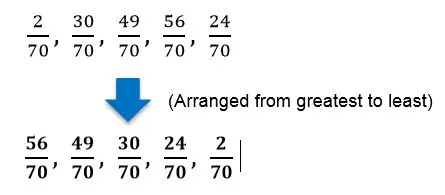
To order fractions, we must compare their sizes. Fractions cannot be compared easily when they have different denominators, so we first convert them to equivalent fractions with a common denominator
Example:
\( \dfrac{1}{2} \) and \( \dfrac{2}{3} \)
The LCM of \( 2 \) and \( 3 \) is \( 6 \).
\( \dfrac{1}{2} = \dfrac{3}{6} \)
\( \dfrac{2}{3} = \dfrac{4}{6} \)
Now we compare numerators:
\( \dfrac{3}{6} < \dfrac{4}{6} \Rightarrow \dfrac{1}{2} < \dfrac{2}{3} \)
Finding a Fraction of a Quantity
To find a fraction of an amount, divide by the denominator and then multiply by the numerator.
\( \dfrac{a}{b} \text{ of a quantity} = \text{quantity} \div b \times a \)
Example:
\( \dfrac{3}{5} \text{ of } 20 = 20 \div 5 \times 3 = 4 \times 3 = 12 \)
Key Idea
“of” in maths usually means multiply.
Example 1:
Arrange \( \dfrac{3}{4}, \dfrac{5}{6}, \dfrac{2}{3} \) in ascending order.
▶️ Answer/Explanation
LCM of \( 4,6,3 \) is \( 12 \).
\( \dfrac{3}{4} = \dfrac{9}{12} \)
\( \dfrac{5}{6} = \dfrac{10}{12} \)
\( \dfrac{2}{3} = \dfrac{8}{12} \)
Compare numerators:
\( 8/12 < 9/12 < 10/12 \)
Conclusion: \( \dfrac{2}{3}, \dfrac{3}{4}, \dfrac{5}{6} \).
Example 2:
Find \( \dfrac{3}{8} \) of \( 64 \).
▶️ Answer/Explanation
\( 64 \div 8 = 8 \)
\( 8 \times 3 = 24 \)
Conclusion: The answer is \( 24 \).
Example 3:
Find \( \dfrac{5}{6} \) of \( 48 \).
▶️ Answer/Explanation
\( 48 \div 6 = 8 \)
\( 8 \times 5 = 40 \)
Conclusion: The answer is \( 40 \).
Adding and Subtracting Fractions and Mixed Numbers
To add or subtract fractions, they must have the same denominator. This is called using a common denominator.
Fractions with the Same Denominator
Add or subtract the numerators and keep the denominator the same.
\( \dfrac{5}{9} + \dfrac{2}{9} = \dfrac{7}{9} \)
\( \dfrac{7}{11} – \dfrac{3}{11} = \dfrac{4}{11} \)
Fractions with Different Denominators
First find the lowest common multiple (LCM) of the denominators.
Example:
\( \dfrac{2}{3} + \dfrac{5}{7} \)
LCM of \( 3 \) and \( 7 \) is \( 21 \).
\( \dfrac{2}{3} = \dfrac{14}{21} \)
\( \dfrac{5}{7} = \dfrac{15}{21} \)
\( \dfrac{14}{21} + \dfrac{15}{21} = \dfrac{29}{21} = 1\dfrac{8}{21} \)
Mixed Numbers
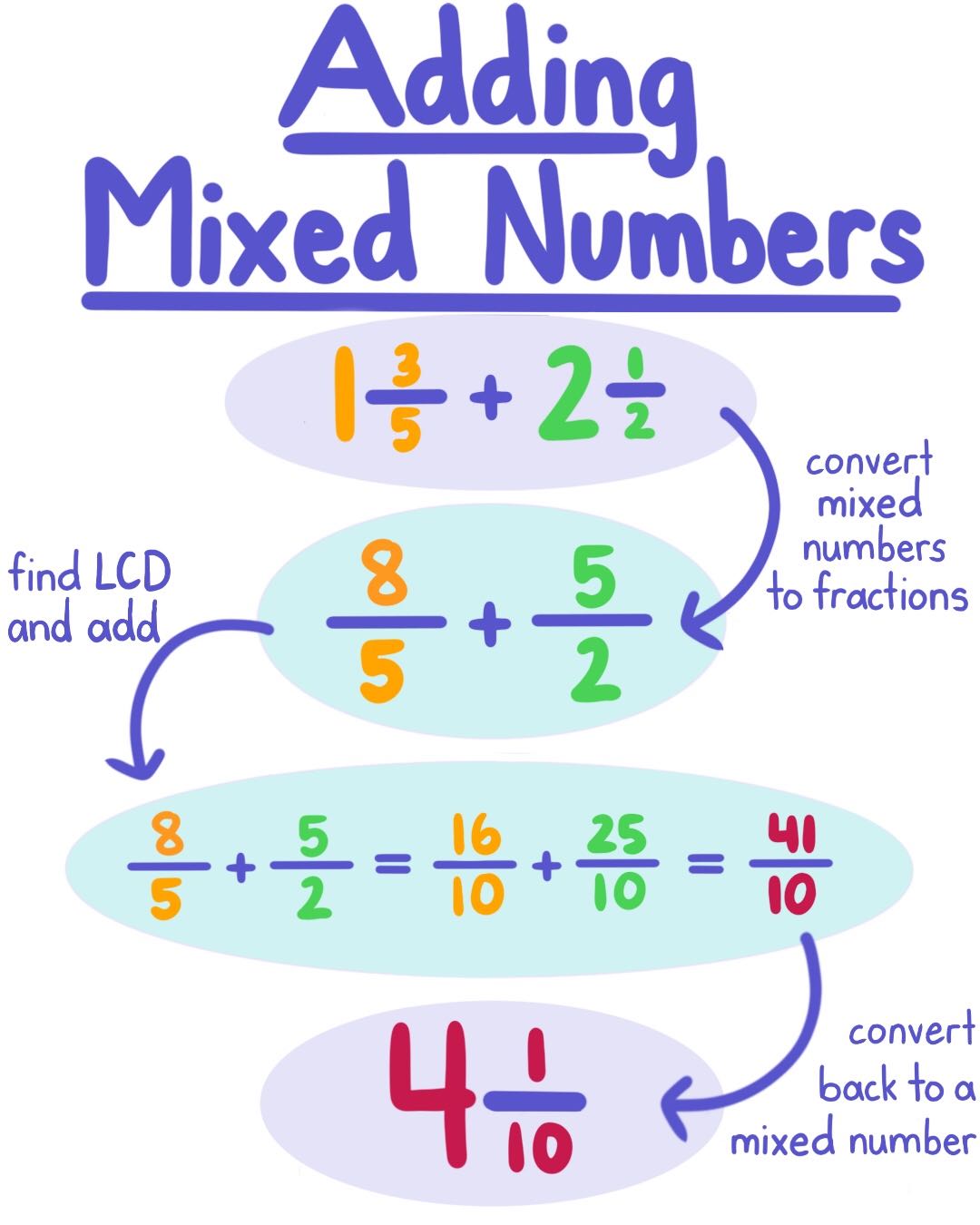
To add or subtract mixed numbers, it is usually easiest to convert them into improper fractions first.
Example:
\( 3\dfrac{1}{5} = \dfrac{16}{5} \)
\( 2\dfrac{2}{3} = \dfrac{8}{3} \)
Simplifying Answers
Always simplify the fraction and, if needed, convert back to a mixed number.
Example 1:
Calculate \( \dfrac{2}{3} + \dfrac{5}{7} \).
▶️ Answer/Explanation
LCM of \( 3 \) and \( 7 \) is \( 21 \).
\( \dfrac{2}{3} = \dfrac{14}{21} \)
\( \dfrac{5}{7} = \dfrac{15}{21} \)
\( \dfrac{14}{21} + \dfrac{15}{21} = \dfrac{29}{21} \)
\( \dfrac{29}{21} = 1\dfrac{8}{21} \)
Conclusion: \( 1\dfrac{8}{21} \).
Example 2:
Calculate \( 3\dfrac{1}{5} – 2\dfrac{2}{3} \).
▶️ Answer/Explanation
Convert to improper fractions:
\( 3\dfrac{1}{5} = \dfrac{16}{5} \)
\( 2\dfrac{2}{3} = \dfrac{8}{3} \)
LCM of \( 5 \) and \( 3 \) is \( 15 \).
\( \dfrac{16}{5} = \dfrac{48}{15} \)
\( \dfrac{8}{3} = \dfrac{40}{15} \)
\( \dfrac{48}{15} – \dfrac{40}{15} = \dfrac{8}{15} \)
Conclusion: The answer is \( \dfrac{8}{15} \).
Example 3:
Calculate \( \dfrac{7}{8} + \dfrac{3}{4} \).
▶️ Answer/Explanation
LCM of \( 8 \) and \( 4 \) is \( 8 \).
\( \dfrac{3}{4} = \dfrac{6}{8} \)
\( \dfrac{7}{8} + \dfrac{6}{8} = \dfrac{13}{8} \)
\( \dfrac{13}{8} = 1\dfrac{5}{8} \)
Conclusion: \( 1\dfrac{5}{8} \).
Converting Fractions to Decimals and Percentages
Fractions, decimals and percentages are different ways of representing the same value.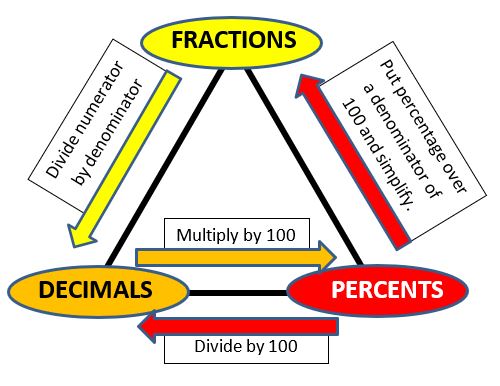
\( \dfrac{3}{5} = 0.6 = 60\% \)
Fraction to Decimal
To convert a fraction to a decimal, divide the numerator by the denominator.
Decimal \( = \) numerator \( \div \) denominator
Example:
\( \dfrac{3}{5} = 3 \div 5 = 0.6 \)
Recurring Decimals
Some fractions produce repeating (recurring) decimals.
\( \dfrac{4}{9} = 0.4444\ldots \)
Decimal to Percentage
To convert a decimal to a percentage, multiply by \( 100 \).
Percentage \( = \) decimal \( \times 100\% \)
\( 0.6 \times 100\% = 60\% \)
Fraction to Percentage
Either convert to a decimal first or make the denominator \( 100 \).
\( \dfrac{3}{5} = \dfrac{60}{100} = 60\% \)
Recurring decimals give recurring percentages:
\( \dfrac{4}{9} = 0.4444\ldots = 44.4\ldots\% \)
Key Idea
“Percent” means “out of 100”.
Example 1:
Convert \( \dfrac{7}{8} \) to a decimal and a percentage.
▶️ Answer/Explanation
\( 7 \div 8 = 0.875 \)
\( 0.875 \times 100\% = 87.5\% \)
Conclusion: \( \dfrac{7}{8} = 0.875 = 87.5\% \).
Example 2:
Convert \( \dfrac{1}{4} \) to a percentage.
▶️ Answer/Explanation
\( 1 \div 4 = 0.25 \)
\( 0.25 \times 100\% = 25\% \)
Conclusion: \( \dfrac{1}{4} = 25\% \).
Example 3:
Write \( 0.32 \) as a fraction and a percentage.
▶️ Answer/Explanation
As a fraction:
\( 0.32 = \dfrac{32}{100} = \dfrac{8}{25} \)
As a percentage:
\( 0.32 \times 100\% = 32\% \)
Conclusion: \( 0.32 = \dfrac{8}{25} = 32\% \).
Unit Fractions and Multiplicative Inverses
A unit fraction is a fraction with numerator \( 1 \).
\( \dfrac{1}{2},\; \dfrac{1}{3},\; \dfrac{1}{5},\; \dfrac{1}{10} \)
Unit fractions are important because they are used when dividing numbers.
Multiplicative Inverse (Reciprocal)
The multiplicative inverse (or reciprocal) of a number is the value that multiplies with it to give \( 1 \).
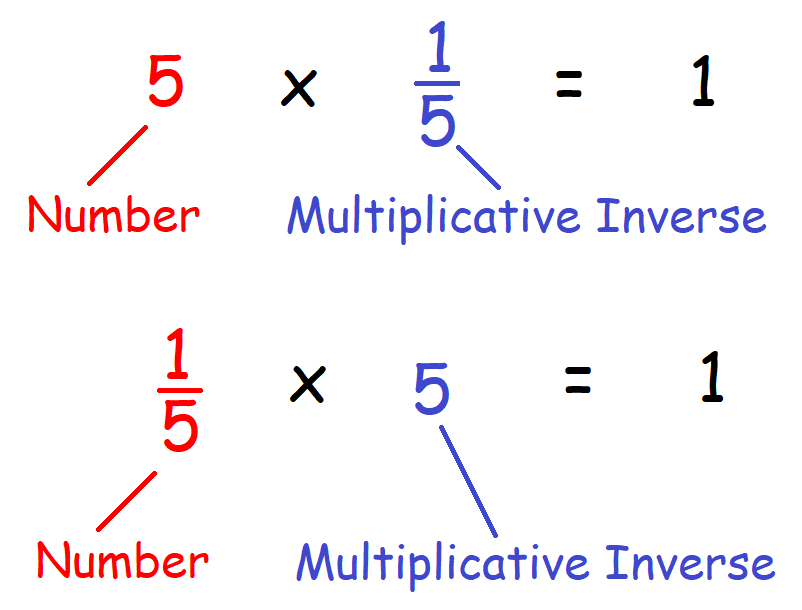
\( a \times \dfrac{1}{a} = 1 \)
For a fraction, we find the reciprocal by swapping the numerator and denominator.
Reciprocal of \( \dfrac{3}{5} \) is \( \dfrac{5}{3} \)
Reciprocal of \( 4 \) is \( \dfrac{1}{4} \)
Division Using Unit Fractions
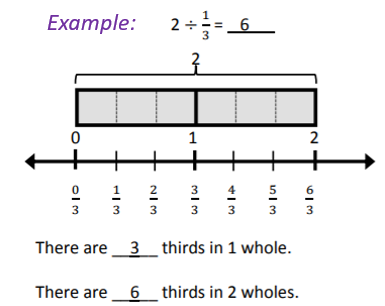
Dividing by a number is the same as multiplying by its reciprocal.
\( 3 \div 5 = 3 \times \dfrac{1}{5} \)
\( 8 \div \dfrac{2}{3} = 8 \times \dfrac{3}{2} \)
Key Idea
Division by a fraction becomes multiplication by its reciprocal.
Example 1:
Write \( 6 \div 4 \) as a multiplication using a unit fraction.
▶️ Answer/Explanation
\( 6 \div 4 = 6 \times \dfrac{1}{4} \)
Conclusion: Division by \( 4 \) becomes multiplication by \( \dfrac{1}{4} \).
Example 2:
Evaluate \( 10 \div \dfrac{5}{6} \).
▶️ Answer/Explanation
Take the reciprocal of \( \dfrac{5}{6} \): \( \dfrac{6}{5} \).
\( 10 \times \dfrac{6}{5} = \dfrac{60}{5} = 12 \)
Conclusion: The answer is \( 12 \).
Example 3:
Evaluate \( \dfrac{3}{4} \div 2 \).
▶️ Answer/Explanation
Write \( 2 \) as \( \dfrac{2}{1} \) and take its reciprocal \( \dfrac{1}{2} \).
\( \dfrac{3}{4} \times \dfrac{1}{2} = \dfrac{3}{8} \)
Conclusion: The answer is \( \dfrac{3}{8} \).
Multiplying and Dividing Fractions and Mixed Numbers
Multiplying Fractions
To multiply fractions, multiply the numerators together and multiply the denominators together.
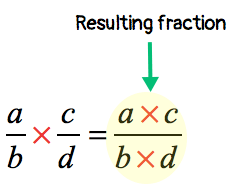
\( \dfrac{a}{b} \times \dfrac{c}{d} = \dfrac{ac}{bd} \)
Cancelling Before Multiplying
Simplify by cancelling common factors before multiplying. This makes calculations easier.
\( \dfrac{2}{3} \times \dfrac{5}{7} = \dfrac{10}{21} \)
Multiplying Mixed Numbers
First convert mixed numbers into improper fractions.
\( 2\dfrac{1}{4} = \dfrac{9}{4} \)
Then multiply as usual.
Dividing Fractions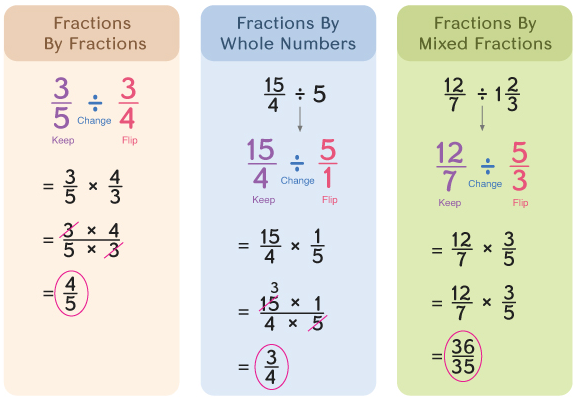
To divide fractions, multiply by the reciprocal (multiplicative inverse) of the second fraction.
\( \dfrac{a}{b} \div \dfrac{c}{d} = \dfrac{a}{b} \times \dfrac{d}{c} \)
Dividing Mixed Numbers
Convert mixed numbers to improper fractions, then multiply by the reciprocal.
Always Simplify
After multiplying or dividing, simplify the answer and convert to a mixed number if needed.
Example 1:
Calculate \( \dfrac{2}{3} \times \dfrac{5}{7} \).
▶️ Answer/Explanation
\( \dfrac{2\times5}{3\times7} = \dfrac{10}{21} \)
Conclusion: \( \dfrac{10}{21} \).
Example 2:
Calculate \( 3\dfrac{1}{5} \div 2\dfrac{2}{3} \).
▶️ Answer/Explanation
Convert to improper fractions:
\( 3\dfrac{1}{5} = \dfrac{16}{5} \)
\( 2\dfrac{2}{3} = \dfrac{8}{3} \)
Multiply by the reciprocal:
\( \dfrac{16}{5} \times \dfrac{3}{8} = \dfrac{48}{40} \)
Simplify:
\( \dfrac{48}{40} = \dfrac{6}{5} = 1\dfrac{1}{5} \)
Conclusion: \( 1\dfrac{1}{5} \).
Example 3:
Calculate \( \dfrac{4}{5} \div \dfrac{2}{3} \).
▶️ Answer/Explanation
Multiply by reciprocal:
\( \dfrac{4}{5} \times \dfrac{3}{2} = \dfrac{12}{10} \)
\( \dfrac{12}{10} = \dfrac{6}{5} = 1\dfrac{1}{5} \)
Conclusion: \( 1\dfrac{1}{5} \).