
Decimal Notation
A decimal is another way of writing fractions using a decimal point.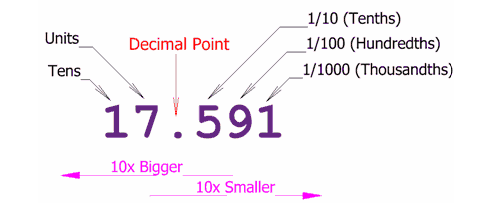
The decimal point separates whole numbers from parts of a whole.
Whole number \( \;|\; \) decimal part
Example: \( 4.7 \)
The digit \( 4 \) represents four whole units and \( 7 \) represents seven tenths.
Writing Decimals as Fractions
Each decimal place represents a fraction with denominator \( 10, 100, 1000 \) and so on.
\( 0.1 = \dfrac{1}{10} \)
\( 0.25 = \dfrac{25}{100} = \dfrac{1}{4} \)
\( 0.375 = \dfrac{375}{1000} = \dfrac{3}{8} \)
Zeros as Place Holders
Zeros are important in decimals. They keep digits in the correct place value.
\( 0.5 = 0.50 = 0.500 \)
These are equal because the value has not changed.
Reading Decimal Numbers
Decimals are read using place value.
\( 3.2 \) means three and two tenths
\( 6.45 \) means six and forty five hundredths
Key Idea
The further a digit is to the right of the decimal point, the smaller its value.
Example 1:
Write \( 0.7 \) as a fraction.
▶️ Answer/Explanation
\( 0.7 = \dfrac{7}{10} \)
Conclusion: \( \dfrac{7}{10} \).
Example 2:
Write \( 5.34 \) as a fraction.
▶️ Answer/Explanation
\( 5.34 = \dfrac{534}{100} \)
\( \dfrac{534}{100} = \dfrac{267}{50} \)
Conclusion: \( \dfrac{267}{50} \).
Example 3:
Write \( 0.05 \) as a fraction in simplest form.
▶️ Answer/Explanation
\( 0.05 = \dfrac{5}{100} \)
\( \dfrac{5}{100} = \dfrac{1}{20} \)
Conclusion: \( \dfrac{1}{20} \).
Place Value in Decimals
In a decimal number, each digit has a place value depending on its position relative to the decimal point.
Digits to the left of the decimal point represent whole numbers. Digits to the right represent parts of a whole.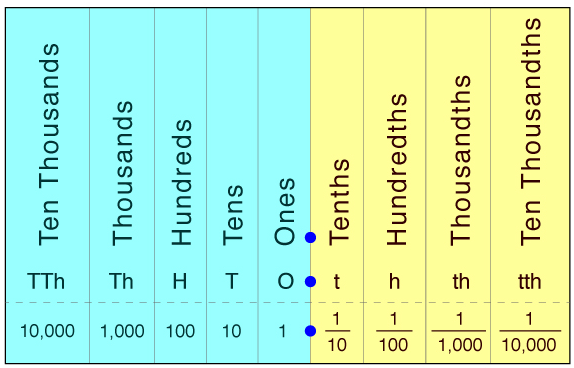
Decimal Place Values
Ones \( \;|\; \) Tenths \( \;|\; \) Hundredths \( \;|\; \) Thousandths
Example: \( 5.372 \)
\( 5 \) is in the ones place
\( 3 \) is in the tenths place \( = \dfrac{3}{10} \)
\( 7 \) is in the hundredths place \( = \dfrac{7}{100} \)
\( 2 \) is in the thousandths place \( = \dfrac{2}{1000} \)
So
\( 5.372 = 5 + \dfrac{3}{10} + \dfrac{7}{100} + \dfrac{2}{1000} \)
Important Rules
Moving one place to the right divides by \( 10 \)
Moving one place to the left multiplies by \( 10 \)
Zeros as Place Holders
Zeros keep digits in the correct position.
\( 0.5 = 0.50 = 0.500 \)
Trailing zeros do not change the value, but leading zeros do show the size of the number.
\( 0.5 \neq 5 \)
Example 1:
State the value of the digit \( 6 \) in \( 4.68 \).
▶️ Answer/Explanation
The digit \( 6 \) is in the tenths place.
Value \( = \dfrac{6}{10} = 0.6 \)
Conclusion: The value is \( 0.6 \).
Example 2:
Write \( 2.405 \) in expanded form.
▶️ Answer/Explanation
\( 2 + \dfrac{4}{10} + \dfrac{0}{100} + \dfrac{5}{1000} \)
Conclusion: \( 2 + \dfrac{4}{10} + \dfrac{5}{1000} \).
Example 3:
Which is greater: \( 0.7 \) or \( 0.65 \)?
▶️ Answer/Explanation
Write with the same number of decimal places:
\( 0.7 = 0.70 \)
Compare digits:
\( 70 \) hundredths \( > 65 \) hundredths
Conclusion: \( 0.7 \) is greater.
Ordering Decimals
To order decimals means to arrange them from smallest to largest (ascending) or largest to smallest (descending).
Decimals are compared using place value. Start comparing digits from left to right.
Making the Same Number of Decimal Places
It helps to write each decimal with the same number of digits after the decimal point. You can add zeros at the end without changing the value.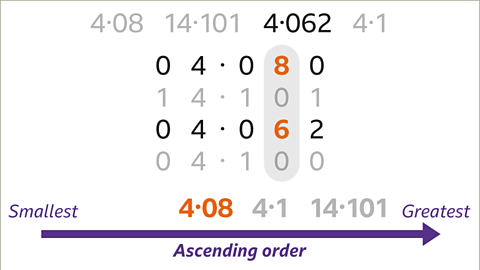
\( 0.5 = 0.50 = 0.500 \)
Example:
Compare \( 0.7 \) and \( 0.65 \)
\( 0.7 = 0.70 \)
\( 70 \) hundredths \( > 65 \) hundredths
So \( 0.7 > 0.65 \)
Comparing Whole Numbers First
Always compare the whole-number part before the decimal part.
\( 3.2 > 2.98 \) because \( 3 > 2 \)
Key Idea
More decimal places does not mean a larger number.
\( 0.5 > 0.49 \)
Example 1:
Arrange \( 0.4,\; 0.35,\; 0.405 \) in ascending order.
▶️ Answer/Explanation
Write with the same number of decimal places:
\( 0.4 = 0.400 \)
\( 0.35 = 0.350 \)
\( 0.405 = 0.405 \)
Compare digits:
\( 0.350 < 0.400 < 0.405 \)
Conclusion: \( 0.35,\; 0.4,\; 0.405 \).
Example 2:
Which is greater: \( 2.07 \) or \( 2.7 \)?
▶️ Answer/Explanation
Write with equal decimal places:
\( 2.7 = 2.70 \)
Compare:
\( 2.70 > 2.07 \)
Conclusion: \( 2.7 \) is greater.
Example 3:
Arrange \( 3.15,\; 3.105,\; 3.5 \) in descending order.
▶️ Answer/Explanation
Make the same decimal places:
\( 3.15 = 3.150 \)
\( 3.105 = 3.105 \)
\( 3.5 = 3.500 \)
Compare:
\( 3.500 > 3.150 > 3.105 \)
Conclusion: \( 3.5,\; 3.15,\; 3.105 \).
Converting a Decimal to a Fraction or a Percentage (Terminating Decimals)
A terminating decimal is a decimal that ends, for example \( 0.4,\; 0.25,\; 0.875 \).
Decimal to Fraction
Write the decimal as a fraction over \( 10,\;100,\;1000 \) depending on the number of decimal places, then simplify.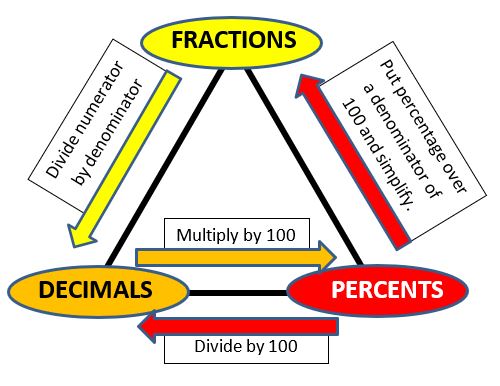
Examples:
\( 0.4 = \dfrac{4}{10} = \dfrac{2}{5} \)
\( 0.25 = \dfrac{25}{100} = \dfrac{1}{4} \)
Decimal to Percentage
Multiply the decimal by \( 100 \) and add the percent sign.
\( 0.4 \times 100\% = 40\% \)
\( 0.25 \times 100\% = 25\% \)
Decimal with Whole Number
Write the whole number and decimal part together as a fraction.
\( 1.75 = \dfrac{175}{100} = \dfrac{7}{4} = 1\dfrac{3}{4} \)
Key Idea
Number of decimal places determines the denominator.
1 decimal place → denominator \( 10 \)
2 decimal places → denominator \( 100 \)
3 decimal places → denominator \( 1000 \)
Example 1:
Convert \( 0.65 \) to a fraction and a percentage.
▶️ Answer/Explanation
\( 0.65 = \dfrac{65}{100} \)
\( \dfrac{65}{100} = \dfrac{13}{20} \)
\( 0.65 \times 100\% = 65\% \)
Conclusion: \( 0.65 = \dfrac{13}{20} = 65\% \).
Example 2:
Convert \( 0.375 \) to a fraction.
▶️ Answer/Explanation
\( 0.375 = \dfrac{375}{1000} \)
Divide by \( 125 \): \( \dfrac{375}{1000} = \dfrac{3}{8} \)
Conclusion: \( \dfrac{3}{8} \).
Example 3:
Convert \( 2.4 \) to a fraction and a percentage.
▶️ Answer/Explanation
\( 2.4 = \dfrac{24}{10} = \dfrac{12}{5} = 2\dfrac{2}{5} \)
\( 2.4 \times 100\% = 240\% \)
Conclusion: \( 2.4 = \dfrac{12}{5} = 240\% \).
Terminating Decimals as Fractions
A terminating decimal is a decimal that ends and does not continue forever.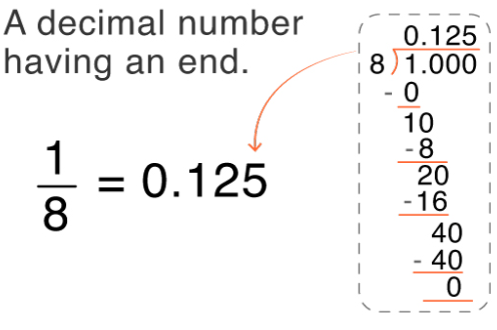
Examples: \( 0.2,\; 0.75,\; 1.45,\; 0.65 \)
Every terminating decimal can be written exactly as a fraction.
Method
1. Write the decimal as a fraction over \( 10,\;100,\;1000 \) depending on the number of decimal places.
2. Simplify the fraction.
Example:
\( 0.65 = \dfrac{65}{100} \)
Divide by \( 5 \): \( \dfrac{65}{100} = \dfrac{13}{20} \)
So
\( 0.65 = \dfrac{65}{100} = \dfrac{13}{20} \)
Why This Works
Decimal places are actually fractions with denominators that are powers of \( 10 \).
\( 0.3 = \dfrac{3}{10} \)
\( 0.25 = \dfrac{25}{100} = \dfrac{1}{4} \)
Important Fact
All terminating decimals are fractions whose denominators simplify to products of \( 2 \)s and \( 5 \)s.
Example 1:
Write \( 0.4 \) as a fraction in simplest form.
▶️ Answer/Explanation
\( 0.4 = \dfrac{4}{10} \)
Simplify: \( \dfrac{4}{10} = \dfrac{2}{5} \)
Conclusion: \( \dfrac{2}{5} \).
Example 2:
Write \( 0.125 \) as a fraction.
▶️ Answer/Explanation
\( 0.125 = \dfrac{125}{1000} \)
Divide by \( 125 \): \( \dfrac{125}{1000} = \dfrac{1}{8} \)
Conclusion: \( \dfrac{1}{8} \).
Example 3:
Write \( 1.2 \) as a fraction in simplest form.
▶️ Answer/Explanation
\( 1.2 = \dfrac{12}{10} \)
Simplify: \( \dfrac{12}{10} = \dfrac{6}{5} = 1\dfrac{1}{5} \)
Conclusion: \( \dfrac{6}{5} \) (or \( 1\dfrac{1}{5} \)).