Edexcel Mathematics (4XMAF) -Unit 1 - 1.4 Powers and Roots- Study Notes- New Syllabus
Edexcel Mathematics (4XMAF) -Unit 1 – 1.4 Powers and Roots- Study Notes- New syllabus
Edexcel Mathematics (4XMAF) -Unit 1 – 1.4 Powers and Roots- Study Notes -Edexcel iGCSE Mathematics – per latest Syllabus.
Key Concepts:
A identify square numbers and cube numbers
B calculate squares, square roots, cubes and cube roots
C use index notation and index laws for multiplication and division of positive and negative integer powers including zero
Edexcel iGCSE Mathematics -Concise Summary Notes- All Topics
Square Numbers and Cube Numbers
Square Numbers
A square number is the result of multiplying a whole number by itself.
\( n^2 = n \times n \)
Square Numbers (1 to 10)
| Number \( n \) | Square \( n^2 \) |
|---|---|
| 1 | 1 |
| 2 | 4 |
| 3 | 9 |
| 4 | 16 |
| 5 | 25 |
| 6 | 36 |
| 7 | 49 |
| 8 | 64 |
| 9 | 81 |
| 10 | 100 |
So the first few square numbers are:
\( 1,\;4,\;9,\;16,\;25,\;36,\;49,\;64,\;81,\;100 \)
Cube Numbers
A cube number is the result of multiplying a whole number by itself twice.
\( n^3 = n \times n \times n \)
Cube Numbers (1 to 10)
| Number \( n \) | Cube \( n^3 \) |
|---|---|
| 1 | 1 |
| 2 | 8 |
| 3 | 27 |
| 4 | 64 |
| 5 | 125 |
| 6 | 216 |
| 7 | 343 |
| 8 | 512 |
| 9 | 729 |
| 10 | 1000 |
So the first few cube numbers are:
\( 1,\;8,\;27,\;64,\;125,\;216,\;343,\;512,\;729,\;1000 \)
Key Difference
Square numbers come from \( \text{number} \times \text{number} \)
Cube numbers come from \( \text{number} \times \text{number} \times \text{number} \)
Example 1:
State whether \( 36 \) is a square number.
▶️ Answer/Explanation
\( 36 = 6^2 \)
Conclusion: \( 36 \) is a square number.
Example 2:
State whether \( 125 \) is a cube number.
▶️ Answer/Explanation
\( 125 = 5^3 \)
Conclusion: \( 125 \) is a cube number.
Example 3:
List all square numbers between \( 1 \) and \( 50 \).
▶️ Answer/Explanation
\( 1^2=1,\;2^2=4,\;3^2=9,\;4^2=16,\;5^2=25,\;6^2=36,\;7^2=49 \)
Conclusion: \( 1,\;4,\;9,\;16,\;25,\;36,\;49 \).
Squares, Square Roots, Cubes and Cube Roots
Squares
The square of a number is found by multiplying the number by itself.
\( n^2 = n \times n \)
\( 7^2 = 7 \times 7 = 49 \)
Square Roots
The square root of a number is the value that, when multiplied by itself, gives the original number.
\( \sqrt{49} = 7 \)
Check:
\( 7 \times 7 = 49 \)
Cubes
The cube of a number is found by multiplying the number by itself twice.
\( n^3 = n \times n \times n \)
\( 4^3 = 4 \times 4 \times 4 = 64 \)
Cube Roots
The cube root of a number is the value that, when multiplied by itself three times, gives the original number.
\( \sqrt[3]{64} = 4 \)
Check:
\( 4 \times 4 \times 4 = 64 \)
Key Idea
Squaring and square roots undo each other.
Cubing and cube roots undo each other.
Example 1:
Find \( 9^2 \) and \( \sqrt{81} \).
▶️ Answer/Explanation
\( 9^2 = 81 \)
\( \sqrt{81} = 9 \)
Conclusion: The answers are \( 81 \) and \( 9 \).
Example 2:
Evaluate \( 5^3 \) and \( \sqrt[3]{125} \).
▶️ Answer/Explanation
\( 5^3 = 125 \)
\( \sqrt[3]{125} = 5 \)
Conclusion: The answers are \( 125 \) and \( 5 \).
Example 3:
Find \( \sqrt{144} \) and \( \sqrt[3]{27} \).
▶️ Answer/Explanation
\( \sqrt{144} = 12 \)
\( \sqrt[3]{27} = 3 \)
Conclusion: The answers are \( 12 \) and \( 3 \).
Index Notation and Index Laws
Index Notation (Powers)
Index notation is a short way of writing repeated multiplication. 
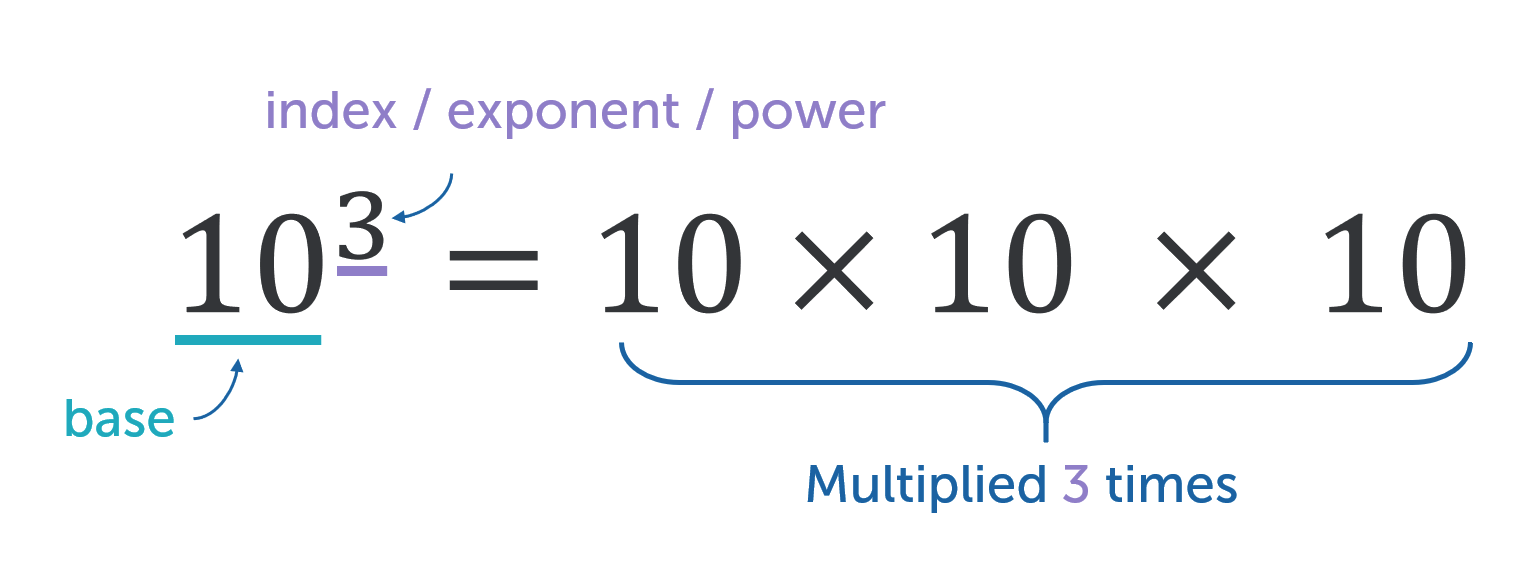
\( 2^4 = 2 \times 2 \times 2 \times 2 \)
The small raised number is called the index (or power).
\( 5^3 \) means three factors of \( 5 \)
Multiplying Powers
When multiplying powers with the same base, add the indices.
\( a^m \times a^n = a^{m+n} \)
\( 3^2 \times 3^4 = 3^{2+4} = 3^6 \)
Dividing Powers
When dividing powers with the same base, subtract the indices.
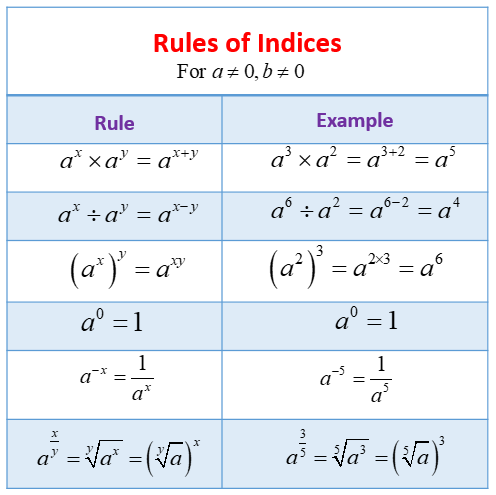
\( a^m \div a^n = a^{m-n} \)
\( 5^6 \div 5^2 = 5^{6-2} = 5^4 \)
Zero Power
Any non-zero number to the power of zero equals \( 1 \).
\( a^0 = 1 \)
\( 7^0 = 1 \)
Negative Powers
A negative index means reciprocal.
\( a^{-n} = \dfrac{1}{a^n} \)
\( 2^{-3} = \dfrac{1}{2^3} = \dfrac{1}{8} \)
Key Idea
Positive index → repeated multiplication
Negative index → reciprocal
Zero index → equals \( 1 \)
Example 1:
Simplify \( 4^3 \times 4^2 \).
▶️ Answer/Explanation
\( 4^{3+2} = 4^5 \)
Conclusion: \( 4^5 \).
Example 2:
Simplify \( 9^5 \div 9^3 \).
▶️ Answer/Explanation
\( 9^{5-3} = 9^2 \)
Conclusion: \( 9^2 \).
Example 3:
Evaluate \( 2^{-3} \) and \( 6^0 \).
▶️ Answer/Explanation
\( 2^{-3} = \dfrac{1}{2^3} = \dfrac{1}{8} \)
\( 6^0 = 1 \)
Conclusion: \( \dfrac{1}{8} \) and \( 1 \).
