
Definition of a Set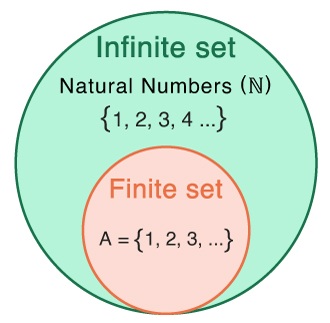
A set is a collection of distinct objects grouped together.
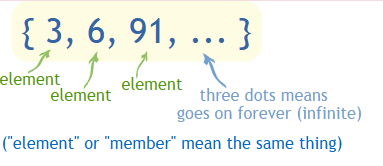
The objects in a set are called elements (or members).
Sets are usually written using curly brackets \( \{ \} \).
\( A = \{1,2,3,4,5\} \)
This means set \( A \) contains the numbers \( 1,2,3,4,5 \).
Describing Sets
A set can also be described using words.
\( B = \{\text{even numbers less than 10}\} \)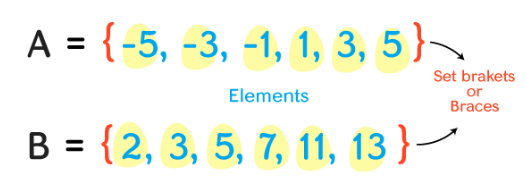
So
\( B = \{2,4,6,8\} \)
Finite and Infinite Sets
Finite set: has a limited number of elements.
\( \{1,2,3,4\} \)
Infinite set: continues forever.
Natural numbers \( \{1,2,3,4,5,\ldots\} \)
Key Idea
Each element is listed only once in a set.
Example 1:
Write the set of odd numbers less than \( 10 \).
▶️ Answer/Explanation
\( \{1,3,5,7,9\} \)
Conclusion: The set is \( \{1,3,5,7,9\} \).
Example 2:
List the elements of the set \( A = \{\text{multiples of 3 less than 15}\} \).
▶️ Answer/Explanation
\( 3,6,9,12 \)
Conclusion: \( A = \{3,6,9,12\} \).
Example 3:
State whether the set \( \{2,4,4,6\} \) is written correctly.
▶️ Answer/Explanation
Elements must not be repeated.
Correct form: \( \{2,4,6\} \)
Conclusion: The set is not written correctly.
Set Notation: \( \cup,\; \cap,\; \in,\; \notin \)
Membership of a Set
The symbol \( \in \) means “is an element of”.
If \( A = \{2,4,6,8\} \), then \( 4 \in A \)
The symbol \( \notin \) means “is not an element of”.
\( 5 \notin A \)
Union of Sets \( (\cup) \)
The union of two sets contains all elements that are in either set.
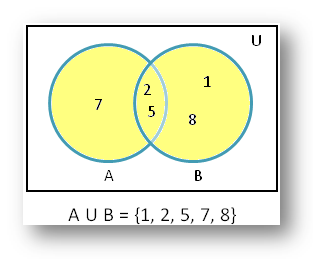
\( A \cup B \) means elements in \( A \) or \( B \) (or both)
Example:
\( A = \{1,2,3\} \)
\( B = \{3,4,5\} \)
\( A \cup B = \{1,2,3,4,5\} \)
Intersection of Sets \( (\cap) \)
The intersection of two sets contains elements common to both sets.
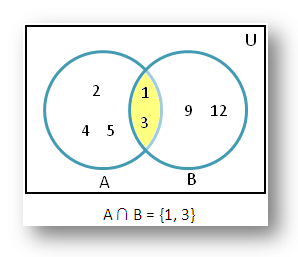
\( A \cap B \) means elements in both \( A \) and \( B \)
\( A \cap B = \{3\} \)
Key Idea
Union combines sets.
Intersection finds common elements.
Example 1:
Let \( A = \{1,3,5,7\} \). State whether \( 3 \in A \) and \( 4 \in A \).
▶️ Answer/Explanation
\( 3 \in A \)
\( 4 \notin A \)
Conclusion: \( 3 \) is in the set but \( 4 \) is not.
Example 2:
Find \( A \cup B \) if \( A = \{2,4,6\} \) and \( B = \{1,2,3\} \).
▶️ Answer/Explanation
Combine all elements without repeating:
\( A \cup B = \{1,2,3,4,6\} \)
Conclusion: \( \{1,2,3,4,6\} \).
Example 3:
Find \( A \cap B \) if \( A = \{1,2,3,4\} \) and \( B = \{3,4,5,6\} \).
▶️ Answer/Explanation
Common elements:
\( A \cap B = \{3,4\} \)
Conclusion: \( \{3,4\} \).
The Universal Set and the Empty Set
Universal Set
The universal set is the set that contains all elements being considered in a particular problem.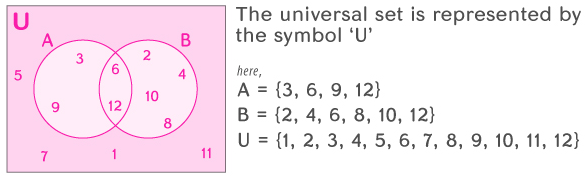
It is usually represented by the symbol \( E \).
All other sets are subsets of the universal set.
Example:
If we are only working with numbers from \( 1 \) to \( 10 \), then
\( E = \{1,2,3,4,5,6,7,8,9,10\} \)
If
\( A = \{2,4,6,8,10\} \)
then every element of \( A \) is inside the universal set \( E \).
Empty Set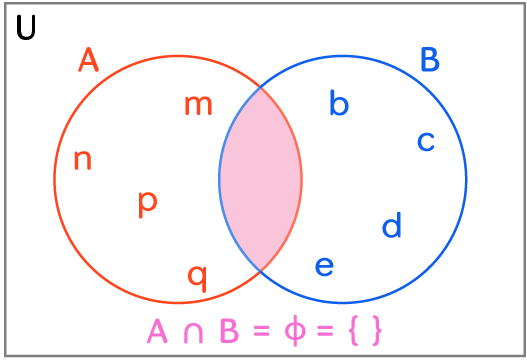
The empty set is a set that contains no elements.
It is represented by the symbol \( \varnothing \) (or \( \{\} \)).
Example:
Set of whole numbers less than \( 0 \):
\( \varnothing \)
Important Notes
The empty set is still a set.
The empty set is a subset of every set.
Example 1:
Given \( E = \{1,2,3,4,5,6,7,8,9,10\} \), state whether \( 7 \in E \).
▶️ Answer/Explanation
\( 7 \in E \)
Conclusion: \( 7 \) belongs to the universal set.
Example 2:
Write the set of prime numbers between \( 8 \) and \( 10 \).
▶️ Answer/Explanation
There are no prime numbers between \( 8 \) and \( 10 \).
\( \varnothing \)
Conclusion: The set is empty.
Example 3:
If \( E = \{1,2,3,4,5\} \) and \( A = \{2,4\} \), state whether \( A \subset E \).
▶️ Answer/Explanation
Every element of \( A \) is in \( E \).
Conclusion: \( A \) is a subset of \( E \).
Complement of a Set
The complement of a set contains all elements in the universal set that are not in the given set.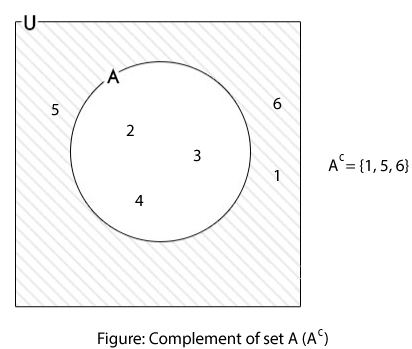
The complement of set \( A \) is written as \( A’ \).
Understanding the Idea
If the universal set is
\( E = \{1,2,3,4,5,6,7,8,9,10\} \)
and
\( A = \{2,4,6,8,10\} \)
then the complement contains all numbers in \( E \) that are not in \( A \).
\( A’ = \{1,3,5,7,9\} \)
Key Idea
Universal set = everything being considered
Complement = everything left over
Important Notes
You must always know the universal set to find a complement.
A set and its complement together make the whole universal set.
\( A \cup A’ = E \)
Example 1:
Given \( E = \{1,2,3,4,5,6\} \) and \( A = \{2,4,6\} \), find \( A’ \).
▶️ Answer/Explanation
Numbers in \( E \) but not in \( A \):
\( A’ = \{1,3,5\} \)
Conclusion: \( \{1,3,5\} \).
Example 2:
If \( E = \{1,2,3,4,5,6,7,8\} \) and \( B = \{1,2,3\} \), find \( B’ \).
▶️ Answer/Explanation
Elements not in \( B \):
\( B’ = \{4,5,6,7,8\} \)
Conclusion: \( \{4,5,6,7,8\} \).
Example 3:
Given \( E = \{a,b,c,d,e\} \) and \( C = \{b,d\} \), list the elements of \( C’ \).
▶️ Answer/Explanation
\( C’ = \{a,c,e\} \)
Conclusion: \( \{a,c,e\} \).
Venn Diagrams
A Venn diagram is a diagram used to represent sets visually.
The rectangle represents the universal set \( E \), and circles inside the rectangle represent different sets.
Each element is placed in the correct region depending on which set it belongs to.
One Set
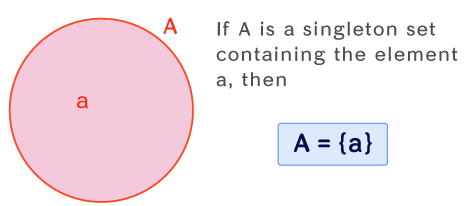
If there is only one set \( A \), all elements of \( A \) are placed inside its circle, and the remaining elements of \( E \) stay outside the circle but inside the rectangle.
Two Sets
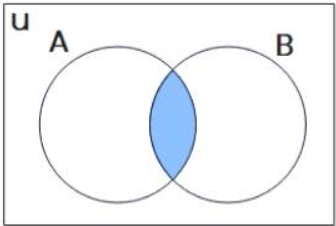
When two sets overlap, the overlapping region shows elements common to both sets. This is the intersection \( A \cap B \).
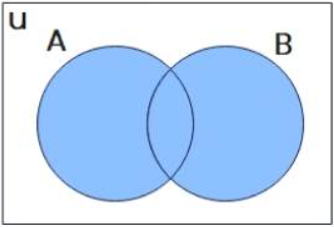
Elements in either circle (including the overlap) represent the union \( A \cup B \).
Complement on a Venn Diagram
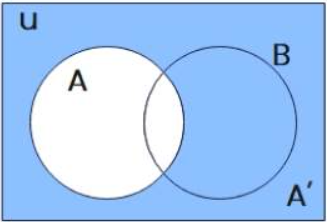
The complement \( A’ \) is the region inside the rectangle but outside the circle of \( A \).
Key Idea
- Inside circle = element belongs to the set
- Overlap = elements common to both sets
- Outside circles but inside rectangle = complement
Example 1:
Let \( E = \{1,2,3,4,5,6,7,8\} \) and \( A = \{2,4,6,8\} \). Which numbers are outside set \( A \)?
▶️ Answer/Explanation
Numbers in \( E \) but not in \( A \):
\( \{1,3,5,7\} \)
Conclusion: These form \( A’ \).
Example 2:
Given \( A = \{1,2,3,4\} \) and \( B = \{3,4,5,6\} \), list the elements in the overlap.
▶️ Answer/Explanation
Common elements:
\( \{3,4\} \)
Conclusion: This is \( A \cap B \).
Example 3:
Given \( A = \{2,4,6\} \) and \( B = \{1,2,3\} \), list all elements inside either circle.
▶️ Answer/Explanation
All elements combined:
\( \{1,2,3,4,6\} \)
Conclusion: This is \( A \cup B \).