
Rounding Integers to a Given Power of 10
Rounding to a power of \( 10 \) means rounding a number to the nearest \( 10,\;100,\;1000 \) and so on.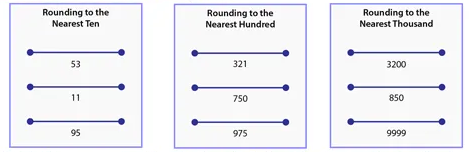
The digit to the right of the rounding place tells you whether to round up or round down.
Rounding Rule
If the next digit is \( 5 \) or more → round up
If the next digit is \( 4 \) or less → round down
Nearest 10
Look at the ones digit.
\( 47 \approx 50 \)
\( 43 \approx 40 \)
Nearest 100
Look at the tens digit.
\( 364 \approx 400 \)
\( 312 \approx 300 \)
Nearest 1000
Look at the hundreds digit.
\( 6520 \approx 7000 \)
\( 6230 \approx 6000 \)
Key Idea
Keep the rounding digit.
Change digits after it to zero.
Example 1:
Round \( 68 \) to the nearest \( 10 \).
▶️ Answer/Explanation
Ones digit is \( 8 \) (5 or more).
Round up → \( 70 \)
Conclusion: \( 70 \).
Example 2:
Round \( 432 \) to the nearest \( 100 \).
▶️ Answer/Explanation
Tens digit is \( 3 \) (less than 5).
Round down → \( 400 \)
Conclusion: \( 400 \).
Example 3:
Round \( 7854 \) to the nearest \( 1000 \).
▶️ Answer/Explanation
Hundreds digit is \( 8 \) (5 or more).
Round up → \( 8000 \)
Conclusion: \( 8000 \).
Rounding to Significant Figures and Decimal Places
Significant Figures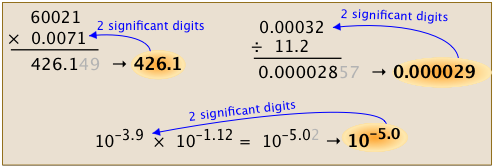
Significant figures (often written as sf) are the important digits in a number, starting from the first non-zero digit.
To round to a given number of significant figures:
1. Start counting from the first non-zero digit.
2. Look at the next digit.
3. \( 5 \) or more → round up, \( 4 \) or less → round down.
Example:
Round \( 3746 \) to \( 2 \) significant figures.
First two digits: \( 37 \)
Next digit is \( 4 \) → round down
\( 3700 \)
Decimal Places
Decimal places (dp) refer to the number of digits after the decimal point. 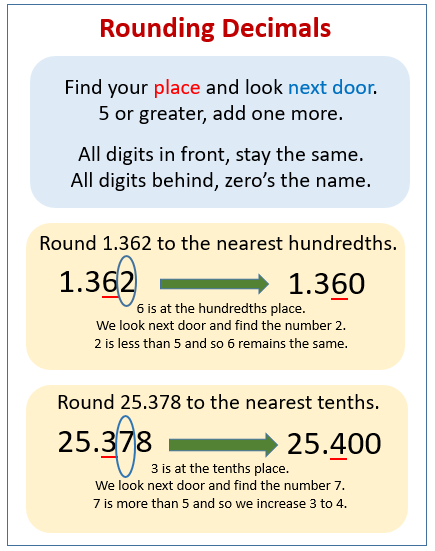
To round to decimal places, look at the digit immediately after the required decimal place.
Example: Round \( 5.376 \) to \( 2 \) decimal places.
Keep \( 5.37 \)
Next digit is \( 6 \) → round up
\( 5.38 \)
Key Difference
Significant figures start from the first non-zero digit.
Decimal places count digits after the decimal point.
Example 1:
Round \( 0.07852 \) to \( 2 \) significant figures.
▶️ Answer/Explanation
First non-zero digit is \( 7 \).
Digits: \( 7,\;8 \)
Next digit \( = 5 \) → round up
\( 0.079 \)
Conclusion: \( 0.079 \).
Example 2:
Round \( 483.267 \) to \( 1 \) decimal place.
▶️ Answer/Explanation
Keep \( 483.2 \)
Next digit \( 6 \) → round up
\( 483.3 \)
Conclusion: \( 483.3 \).
Example 3:
Round \( 6025 \) to \( 3 \) significant figures.
▶️ Answer/Explanation
First three digits: \( 6,0,2 \)
Next digit \( 5 \) → round up
\( 6030 \)
Conclusion: \( 6030 \).
Upper and Lower Bounds
When a value is rounded, the actual value is not exact. It lies within a range of possible values.
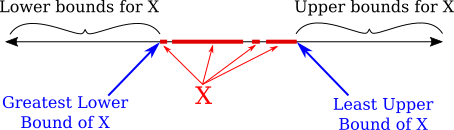
- The smallest possible value is called the lower bound.
- The largest possible value is called the upper bound.
Key Idea
Lower bound ≤ actual value < upper bound
Example Understanding
If a length is given as \( 50 \) cm to the nearest \( 10 \) cm, the true length could be slightly less or slightly more than \( 50 \).
Half of \( 10 \) is \( 5 \), so we go \( 5 \) below and \( 5 \) above.
Lower bound \( = 45 \)
Upper bound \( = 55 \)
\( 45 \le \text{length} < 55 \)
General Rule
Find half of the rounding unit and add and subtract it from the rounded value.
Nearest \( 10 \) → half is \( 5 \)
Nearest \( 100 \) → half is \( 50 \)
Nearest \( 1 \) → half is \( 0.5 \)
Example 1:
A mass is \( 80 \) kg correct to the nearest \( 10 \) kg. Find the bounds.
▶️ Answer/Explanation
Half of \( 10 = 5 \)
Lower bound \( = 80 – 5 = 75 \)
Upper bound \( = 80 + 5 = 85 \)
\( 75 \le m < 85 \)
Conclusion: \( 75 \le m < 85 \).
Example 2:
A length is \( 12 \) cm correct to the nearest \( 1 \) cm. Find the bounds.
▶️ Answer/Explanation
Half of \( 1 = 0.5 \)
Lower bound \( = 11.5 \)
Upper bound \( = 12.5 \)
\( 11.5 \le L < 12.5 \)
Conclusion: \( 11.5 \le L < 12.5 \).
Example 3:
A number is \( 300 \) correct to the nearest \( 100 \). Find the bounds.
▶️ Answer/Explanation
Half of \( 100 = 50 \)
Lower bound \( = 250 \)
Upper bound \( = 350 \)
\( 250 \le x < 350 \)
Conclusion: \( 250 \le x < 350 \).
Estimation Using 1 Significant Figure
Estimation is used to quickly approximate the value of a calculation.
We estimate by rounding each number to 1 significant figure before calculating.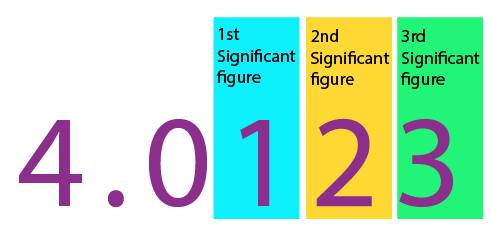
Steps
1. Round each number to 1 significant figure.
2. Perform the calculation.
3. The answer is an approximate value.
Rounding to 1 Significant Figure
\( 347 \approx 300 \)
\( 82 \approx 80 \)
\( 5.6 \approx 6 \)
Why We Estimate
Estimation helps to:
Check if a calculator answer is reasonable.
Make quick calculations mentally.
Example 1:
Estimate \( 347 + 82 \).
▶️ Answer/Explanation
\( 347 \approx 300 \)
\( 82 \approx 80 \)
\( 300 + 80 = 380 \)
Conclusion: Approximately \( 380 \).
Example 2:
Estimate \( 52 \times 19 \).
▶️ Answer/Explanation
\( 52 \approx 50 \)
\( 19 \approx 20 \)
\( 50 \times 20 = 1000 \)
Conclusion: Approximately \( 1000 \).
Example 3:
Estimate \( \dfrac{589}{6.2} \).
▶️ Answer/Explanation
\( 589 \approx 600 \)
\( 6.2 \approx 6 \)
\( 600 \div 6 = 100 \)
Conclusion: Approximately \( 100 \).