
Using Symbols to Represent Numbers (Algebra)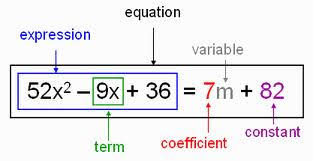
In algebra, letters are used to represent numbers.
These letters are called variables.
A variable can stand for an unknown number or a number that can change.
Expressions
An algebraic expression is a combination of numbers, variables and operations.
\( x + 5 \)
\( 3y \)
\( 2a – 7 \)
The value of the expression depends on the value of the variable.
Equations
An equation states that two expressions are equal.
\( x + 4 = 9 \)
Here \( x \) is an unknown number we need to find.
Formulae
A formula is a rule written using variables.
Area of a rectangle: \( A = lw \)
The letters represent measurable quantities.
Key Idea
Letters represent numbers.
We can substitute numbers into expressions and formulae.
Example 1:
Find the value of \( x + 7 \) when \( x = 5 \).
▶️ Answer/Explanation
Substitute \( x = 5 \)
\( 5 + 7 = 12 \)
Conclusion: \( 12 \).
Example 2:
Solve \( x + 4 = 11 \).
▶️ Answer/Explanation
Subtract \( 4 \) from both sides
\( x = 11 – 4 \)
\( x = 7 \)
Conclusion: \( x = 7 \).
Example 3:
The formula for perimeter of a rectangle is \( P = 2l + 2w \). Find \( P \) when \( l = 6 \) and \( w = 3 \).
▶️ Answer/Explanation
\( P = 2(6) + 2(3) \)
\( = 12 + 6 = 18 \)
Conclusion: \( P = 18 \).
Algebraic Expressions Follow the Rules of Arithmetic
Algebra uses the same rules as ordinary arithmetic.
Numbers can be added, subtracted, multiplied and divided. The same operations apply to variables.
Like Terms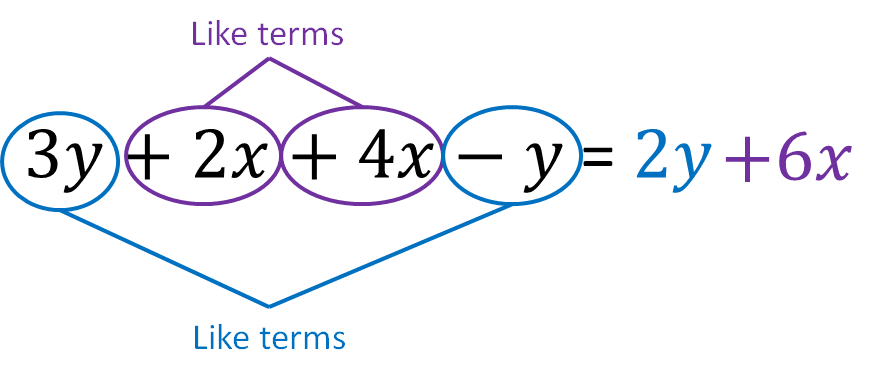
Terms with the same variable and power are called like terms.
\( 3x \) and \( 5x \) are like terms
\( 2y \) and \( 7y \) are like terms
Like terms can be added or subtracted.
\( 3x + 5x = 8x \)
Unlike terms cannot be combined.
\( 3x + 2y \) cannot be simplified further
Multiplication
A number multiplied by a variable is written together.
\( 4 \times x = 4x \)
Brackets and the Distributive Law
A number outside a bracket multiplies every term inside the bracket.
\( 3(x + 2) = 3x + 6 \)
\( 5(a – 4) = 5a – 20 \)
Key Idea
Algebra follows the same arithmetic rules, but with letters instead of numbers.
Example 1:
Simplify \( 7x + 3x \).
▶️ Answer/Explanation
Add coefficients:
\( 7x + 3x = 10x \)
Conclusion: \( 10x \).
Example 2:
Expand \( 4(a + 5) \).
▶️ Answer/Explanation
Multiply each term:
\( 4a + 20 \)
Conclusion: \( 4a + 20 \).
Example 3:
Simplify \( 5x – 2x + 6 \).
▶️ Answer/Explanation
Combine like terms:
\( 3x + 6 \)
Conclusion: \( 3x + 6 \).
Index Notation (Powers)
Index notation is a short way of writing repeated multiplication.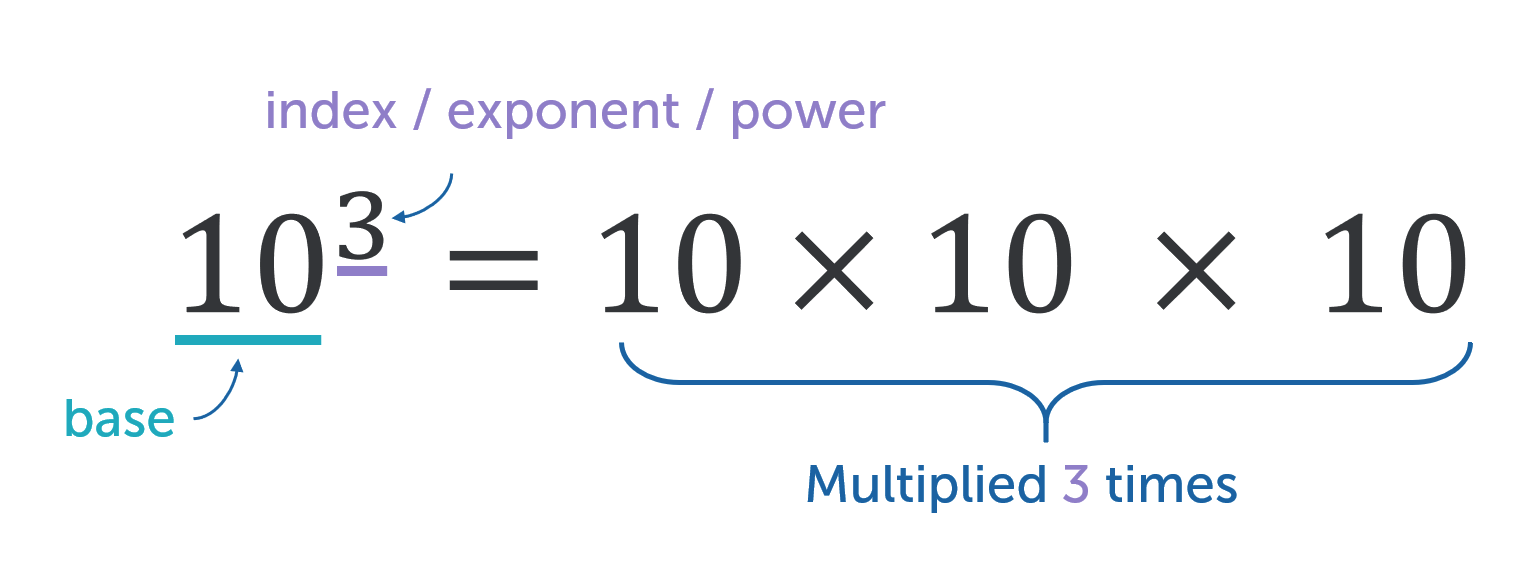
\( a \times a \times a = a^3 \)
The small raised number is called the index or power.
The number being multiplied is called the base.
Positive Powers
A positive index tells how many times the base is multiplied by itself.
\( a^2 = a \times a \)
\( a^4 = a \times a \times a \times a \)
Negative Powers
A negative power means the reciprocal.
\( a^{-1} = \dfrac{1}{a} \)
\( a^{-2} = \dfrac{1}{a^2} \)
Zero Power
Any non-zero number raised to the power \( 0 \) equals \( 1 \).
\( a^0 = 1 \)
Key Idea
Positive index → repeated multiplication
Negative index → reciprocal
Zero index → \( 1 \)
Example 1:
Write \( 5 \times 5 \times 5 \times 5 \) using index notation.
▶️ Answer/Explanation
There are four 5s multiplied.
\( 5^4 \)
Conclusion: \( 5^4 \).
Example 2:
Evaluate \( 2^{-1} \).
▶️ Answer/Explanation
\( 2^{-1} = \dfrac{1}{2} \)
Conclusion: \( \dfrac{1}{2} \).
Example 3:
Evaluate \( 7^0 \).
▶️ Answer/Explanation
Any non-zero number to the power \( 0 \) equals \( 1 \).
\( 7^0 = 1 \)
Conclusion: \( 1 \).
Index Laws
Index laws allow us to simplify expressions involving powers.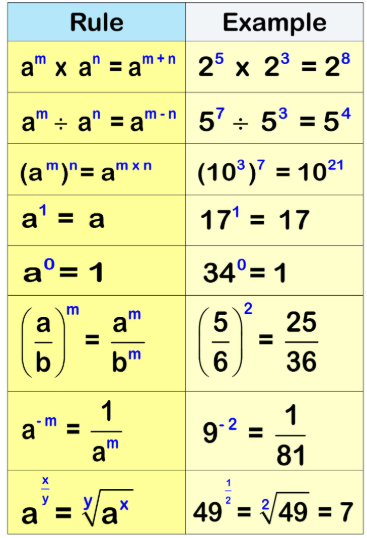
They apply when the bases are the same.
Multiplying Powers
When multiplying powers with the same base, add the indices.
\( x^m \times x^n = x^{m+n} \)
Example: \( x^3 \times x^2 = x^{5} \)
Dividing Powers
When dividing powers with the same base, subtract the indices.
\( x^m \div x^n = x^{m-n} \)
Example: \( x^6 \div x^2 = x^{4} \)
Power of a Power
When a power is raised to another power, multiply the indices.
\( (x^m)^n = x^{mn} \)
Example: \( (x^2)^3 = x^{6} \)
Key Idea
Multiply → add powers
Divide → subtract powers
Power of power → multiply powers
Example 1:
Simplify \( a^4 \times a^3 \).
▶️ Answer/Explanation
Add indices:
\( a^{4+3} = a^7 \)
Conclusion: \( a^7 \).
Example 2:
Simplify \( x^8 \div x^5 \).
▶️ Answer/Explanation
Subtract indices:
\( x^{8-5} = x^3 \)
Conclusion: \( x^3 \).
Example 3:
Simplify \( (y^2)^4 \).
▶️ Answer/Explanation
Multiply indices:
\( y^{2\times4} = y^8 \)
Conclusion: \( y^8 \).