
Substituting Values into Expressions
To evaluate an expression, replace each letter with the given number and then calculate the result.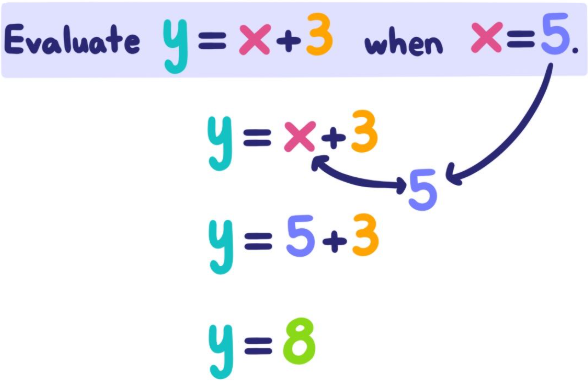
This process is called substitution.
Steps
1. Replace the variable with the given number.
2. Use brackets where necessary.
3. Follow the order of operations.
Important Note
When substituting a negative number, always place it inside brackets.
Example: \( x^2 \) with \( x = -3 \) becomes \( (-3)^2 \), not \( -3^2 \).
Example 1:
Find the value of \( 4x + 7 \) when \( x = 5 \).
▶️ Answer/Explanation
Substitute \( x = 5 \):
\( 4(5) + 7 \)
\( 20 + 7 = 27 \)
Conclusion: \( 27 \).
Example 2:
Evaluate \( 3a^2 \) when \( a = 2 \).
▶️ Answer/Explanation
\( 3(2^2) \)
\( 3(4) = 12 \)
Conclusion: \( 12 \).
Example 3:
Find the value of \( x^2 – 4x \) when \( x = -3 \).
▶️ Answer/Explanation
\( (-3)^2 – 4(-3) \)
\( 9 + 12 = 21 \)
Conclusion: \( 21 \).
Collecting Like Terms
Collecting like terms means simplifying an expression by combining terms that have the same variable and power.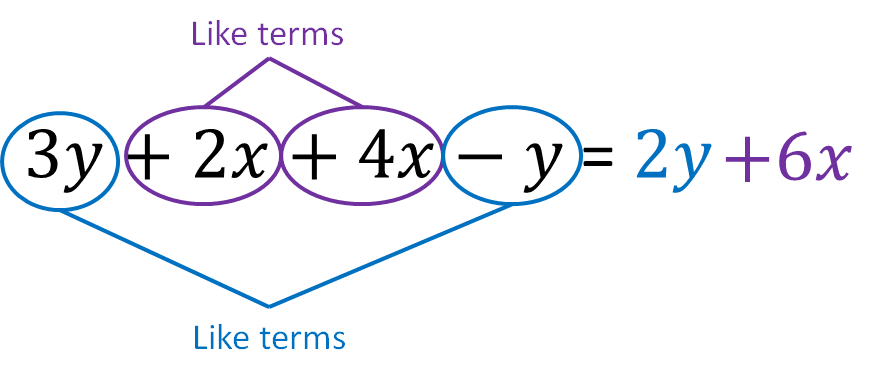
Like Terms
Terms are like terms if they contain exactly the same variables raised to the same powers.
\( 3x \) and \( 5x \) are like terms
\( 7a^2 \) and \( -2a^2 \) are like terms
Numbers without variables are also like terms.
\( 6 \) and \( -4 \) are like terms
Unlike Terms
Terms with different variables or powers cannot be combined.
\( 3x \) and \( 3y \)
\( x \) and \( x^2 \)
Method
Group like terms together.
Add or subtract their coefficients.
Example Idea
\( 2x + 5x = 7x \)
Example 1:
Simplify \( 4x + 6x \).
▶️ Answer/Explanation
Add coefficients:
\( 4x + 6x = 10x \)
Conclusion: \( 10x \).
Example 2:
Simplify \( 7a^2 – 2a^2 \).
▶️ Answer/Explanation
Subtract coefficients:
\( 5a^2 \)
Conclusion: \( 5a^2 \).
Example 3:
Simplify \( 3x + 4 + 2x – 7 \).
▶️ Answer/Explanation
Group like terms:
\( (3x + 2x) + (4 – 7) \)
\( 5x – 3 \)
Conclusion: \( 5x – 3 \).
Factorising by Taking Out Common Factors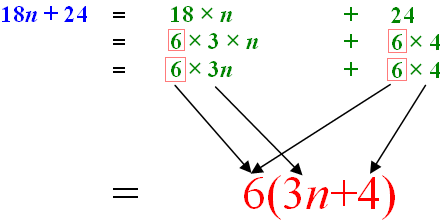
Factorising is the reverse of expanding brackets.
We write an expression as a product of factors.
Common Factor
A common factor is a number or variable that divides every term in the expression.
Steps:
1. Find the highest common factor (HCF) of the terms.
2. Take the common factor outside the bracket.
3. Divide each term by the common factor.
Example Idea
\( 6x + 9 = 3(2x + 3) \)
Factorise Fully
Always take out the largest possible common factor.
\( 8xy + 12y^2 \)
Common factor \( = 4y \)
\( 8xy + 12y^2 = 4y(2x + 3y) \)
Example 1:
Factorise \( 10x + 15 \).
▶️ Answer/Explanation
HCF of \( 10 \) and \( 15 \) is \( 5 \).
\( 5(2x + 3) \)
Conclusion: \( 5(2x + 3) \).
Example 2:
Factorise \( 12a^2 + 6a \).
▶️ Answer/Explanation
Common factor \( = 6a \).
\( 6a(2a + 1) \)
Conclusion: \( 6a(2a + 1) \).
Example 3:
Factorise fully \( 8xy + 12y^2 \).
▶️ Answer/Explanation
Common factor \( = 4y \).
\( 4y(2x + 3y) \)
Conclusion: \( 4y(2x + 3y) \).
Expanding Two Linear Expressions
When two brackets are multiplied, every term in the first bracket multiplies every term in the second bracket.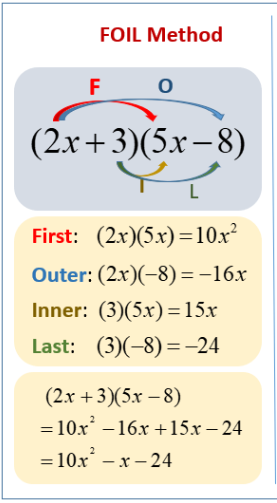
This is often called the FOIL method (First, Outer, Inner, Last).
\( (a + b)(c + d) = ac + ad + bc + bd \)
Example Idea
\( (x + 8)(x – 5) \)
\( x \times x = x^2 \)
\( x \times (-5) = -5x \)
\( 8 \times x = 8x \)
\( 8 \times (-5) = -40 \)
\( x^2 + 3x – 40 \)
Important
After expanding, collect like terms.
Example 1:
Expand \( (x + 3)(x + 4) \).
▶️ Answer/Explanation
\( x \cdot x = x^2 \)
\( x \cdot 4 = 4x \)
\( 3 \cdot x = 3x \)
\( 3 \cdot 4 = 12 \)
\( x^2 + 7x + 12 \)
Conclusion: \( x^2 + 7x + 12 \).
Example 2:
Expand \( (x – 2)(x + 5) \).
▶️ Answer/Explanation
\( x^2 + 5x – 2x – 10 \)
\( x^2 + 3x – 10 \)
Conclusion: \( x^2 + 3x – 10 \).
Example 3:
Expand \( (2x + 1)(x + 6) \).
▶️ Answer/Explanation
\( 2x \cdot x = 2x^2 \)
\( 2x \cdot 6 = 12x \)
\( 1 \cdot x = x \)
\( 1 \cdot 6 = 6 \)
\( 2x^2 + 13x + 6 \)
Conclusion: \( 2x^2 + 13x + 6 \).