
Solving Linear Equations
A linear equation is an equation where the highest power of the variable is \( 1 \).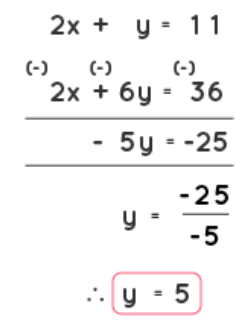
The aim is to find the value of the unknown (usually \( x \)).
Key Idea
We keep the equation balanced by doing the same operation to both sides.
Steps
1. Expand brackets if necessary.
2. Collect like terms.
3. Move terms containing \( x \) to one side.
4. Move numbers to the other side.
5. Divide to find \( x \).
Important
If a fraction appears, remove it by multiplying both sides by the denominator.
Example 1:
Solve \( 5x + 8 = 12 \).
▶️ Answer/Explanation
Subtract \( 8 \) from both sides:
\( 5x = 4 \)
Divide by \( 5 \):
\( x = \dfrac{4}{5} \)
Conclusion: \( x = \dfrac{4}{5} \).
Example 2:
Solve \( 7(x + 3) = 5x – 8 \).
▶️ Answer/Explanation
Expand:
\( 7x + 21 = 5x – 8 \)
Move \( x \) terms together:
\( 7x – 5x = -8 – 21 \)
\( 2x = -29 \)
\( x = -\dfrac{29}{2} \)
Conclusion: \( x = -\dfrac{29}{2} \).
Example 3:
Solve \( \dfrac{4x + 5}{2} = 3 \).
▶️ Answer/Explanation
Multiply both sides by \( 2 \):
\( 4x + 5 = 6 \)
Subtract \( 5 \):
\( 4x = 1 \)
\( x = \dfrac{1}{4} \)
Conclusion: \( x = \dfrac{1}{4} \).
Forming and Solving Linear Equations from Word Problems
Sometimes we are given information in words instead of an equation.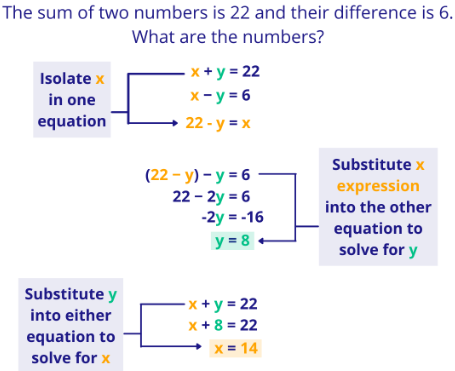
We must first set up an equation and then solve it.
Steps
1. Choose a letter for the unknown.
2. Translate the words into an algebraic expression.
3. Form an equation using known facts.
4. Solve the equation.
Important Fact
The angles in a triangle add up to \( 180^\circ \).
Example 1:
The three angles of a triangle are \( a^\circ,\; (a+10)^\circ,\; (a+20)^\circ \). Find \( a \).
▶️ Answer/Explanation
Sum of angles \( = 180^\circ \)
\( a + (a+10) + (a+20) = 180 \)
\( 3a + 30 = 180 \)
\( 3a = 150 \)
\( a = 50 \)
Conclusion: \( a = 50^\circ \).
Example 2:
A number increased by \( 7 \) equals \( 19 \). Find the number.
▶️ Answer/Explanation
Let the number be \( x \).
\( x + 7 = 19 \)
\( x = 12 \)
Conclusion: The number is \( 12 \).
Example 3:
The perimeter of a rectangle is \( 34 \) cm. The length is \( x \) cm and the width is \( x-5 \) cm. Find \( x \).
▶️ Answer/Explanation
Perimeter \( = 2l + 2w \)
\( 2x + 2(x-5) = 34 \)
\( 2x + 2x – 10 = 34 \)
\( 4x – 10 = 34 \)
\( 4x = 44 \)
\( x = 11 \)
Conclusion: \( x = 11 \) cm.