
Types of Angles
An angle measures how much a line turns.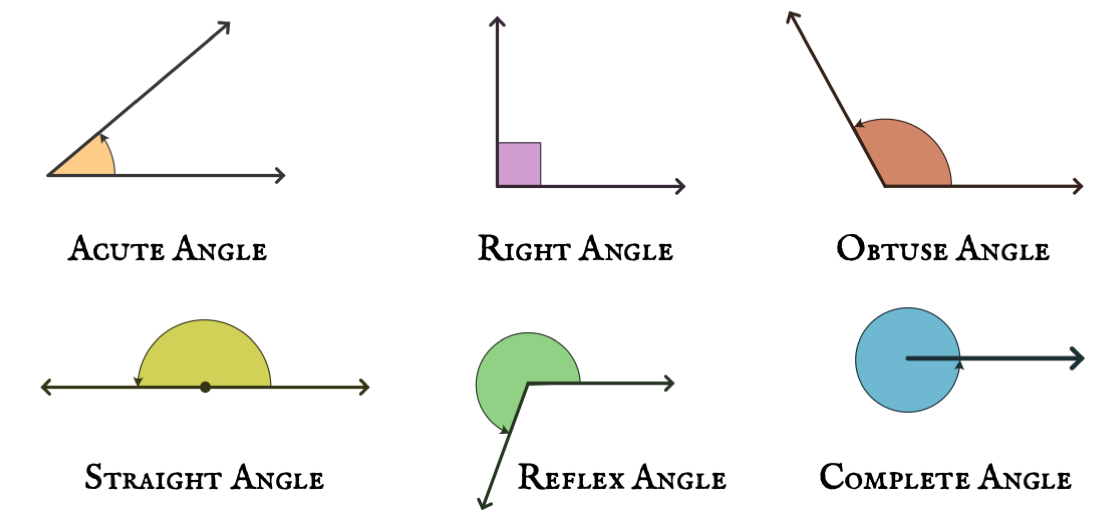
Angles are measured in degrees ( \( ^\circ \) ).
Acute Angle
An acute angle is less than \( 90^\circ \).
Right Angle
A right angle is exactly \( 90^\circ \).
Obtuse Angle
An obtuse angle is greater than \( 90^\circ \) but less than \( 180^\circ \).
Reflex Angle
A reflex angle is greater than \( 180^\circ \) but less than \( 360^\circ \).
Summary
Acute: \( 0^\circ < \theta < 90^\circ \)
Right: \( \theta = 90^\circ \)
Obtuse: \( 90^\circ < \theta < 180^\circ \)
Reflex: \( 180^\circ < \theta < 360^\circ \)
Example 1:
State the type of angle \( 35^\circ \).
▶️ Answer/Explanation
\( 35^\circ < 90^\circ \)
Conclusion: Acute angle.
Example 2:
State the type of angle \( 120^\circ \).
▶️ Answer/Explanation
Between \( 90^\circ \) and \( 180^\circ \).
Conclusion: Obtuse angle.
Example 3:
State the type of angle \( 270^\circ \).
▶️ Answer/Explanation
Greater than \( 180^\circ \).
Conclusion: Reflex angle.
Angle Properties of Lines
There are special rules for angles formed by straight lines and parallel lines. These help us calculate unknown angles.
Angles on a Straight Line
Angles on a straight line add up to \( 180^\circ \).
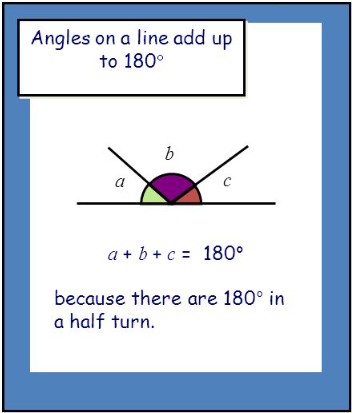
If one angle is \( 70^\circ \), the other is \( 110^\circ \).
Angles at a Point
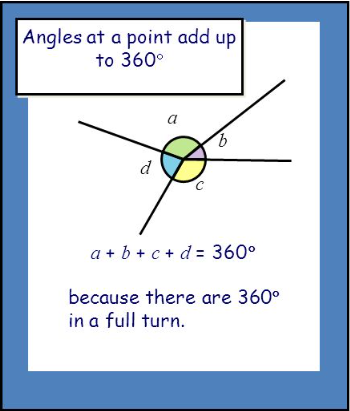
Angles around a point add up to \( 360^\circ \).
Vertically Opposite Angles
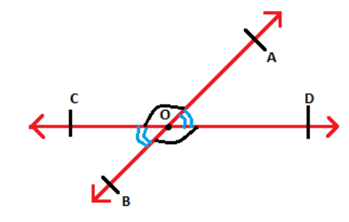
When two lines intersect, opposite angles are equal.
Parallel Lines
When a transversal crosses parallel lines: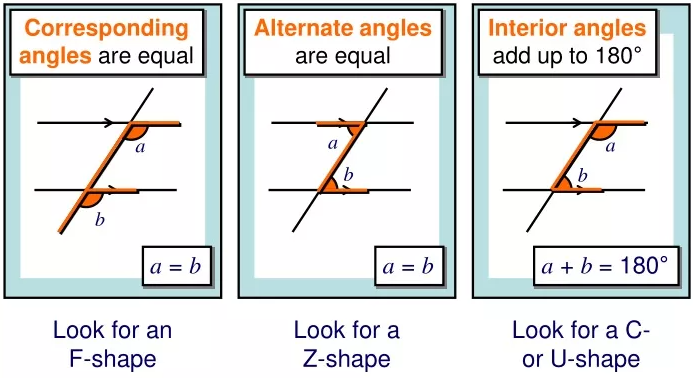
Corresponding angles are equal.
Alternate angles are equal.
Co-interior (allied) angles add to \( 180^\circ \).
Key Facts
Straight line: \( 180^\circ \)
Around a point: \( 360^\circ \)
Vertically opposite: equal
Parallel lines: corresponding and alternate equal
Example 1:
Two angles lie on a straight line. One angle is \( 65^\circ \). Find the other.
▶️ Answer/Explanation
\( 180^\circ – 65^\circ = 115^\circ \)
Conclusion: \( 115^\circ \).
Example 2:
Vertically opposite angles are formed. One angle is \( 48^\circ \). Find the opposite angle.
▶️ Answer/Explanation
Vertically opposite angles are equal.
Conclusion: \( 48^\circ \).
Example 3:
Two parallel lines are cut by a transversal. An alternate angle is \( 72^\circ \). Find the corresponding angle.
▶️ Answer/Explanation
Corresponding angles in parallel lines are equal.
Conclusion: \( 72^\circ \).
Angles in Triangles
Angle Sum of a Triangle
The three interior angles of any triangle always add up to:
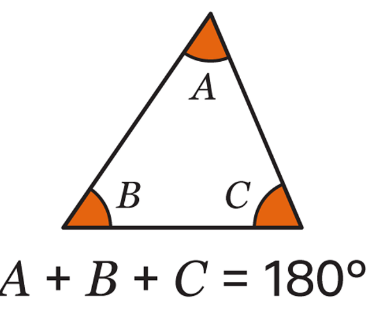
\( 180^\circ \)
This rule works for every triangle.
Exterior Angle Property
An exterior angle is formed when one side of a triangle is extended.
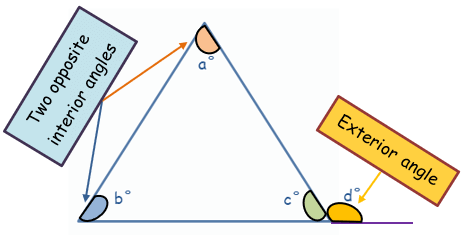
The exterior angle equals the sum of the two opposite interior angles.
Exterior angle \( = \) sum of the two remote interior angles
Key Facts
Interior angles in a triangle → \( 180^\circ \)
Exterior angle equals two opposite interior angles
Example 1:
Find the third angle of a triangle if the other two angles are \( 50^\circ \) and \( 60^\circ \).
▶️ Answer/Explanation
\( 50^\circ + 60^\circ = 110^\circ \)
\( 180^\circ – 110^\circ = 70^\circ \)
Conclusion: \( 70^\circ \).
Example 2:
An exterior angle of a triangle is \( 110^\circ \). One opposite interior angle is \( 45^\circ \). Find the other opposite interior angle.
▶️ Answer/Explanation
Exterior angle equals sum of two interior angles.
\( 110^\circ – 45^\circ = 65^\circ \)
Conclusion: \( 65^\circ \).
Example 3:
Two interior angles of a triangle are \( 2x^\circ \) and \( 3x^\circ \). The third angle is \( 40^\circ \). Find \( x \).
▶️ Answer/Explanation
\( 2x + 3x + 40 = 180 \)
\( 5x + 40 = 180 \)
\( 5x = 140 \)
\( x = 28 \)
Conclusion: \( x = 28 \).
Special Types of Triangles
Triangles can be classified according to their sides and angles.
Isosceles Triangle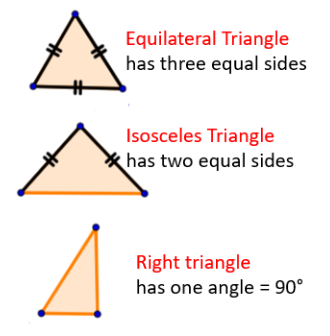
An isosceles triangle has two equal sides.
The angles opposite those equal sides are also equal.
Equal sides → equal base angles
Equilateral Triangle
An equilateral triangle has three equal sides.
All three angles are equal.
Each angle \( = 60^\circ \)
Right-Angled Triangle
A right-angled triangle contains one angle of \( 90^\circ \).
The side opposite the right angle is the hypotenuse and is the longest side.
Angle Properties
Isosceles → two equal angles
Equilateral → \( 60^\circ, 60^\circ, 60^\circ \)
Right triangle → one angle \( 90^\circ \)
Example 1:
Two angles of an isosceles triangle are \( 50^\circ \) and \( 50^\circ \). Find the third angle.
▶️ Answer/Explanation
Sum of angles \( = 180^\circ \)
\( 180^\circ – 100^\circ = 80^\circ \)
Conclusion: \( 80^\circ \).
Example 2:
Find each angle of an equilateral triangle.
▶️ Answer/Explanation
All equal and sum is \( 180^\circ \)
\( 180^\circ ÷ 3 = 60^\circ \)
Conclusion: \( 60^\circ, 60^\circ, 60^\circ \).
Example 3:
A right-angled triangle has angles \( 90^\circ \) and \( 35^\circ \). Find the third angle.
▶️ Answer/Explanation
\( 180^\circ – (90^\circ + 35^\circ) = 55^\circ \)
Conclusion: \( 55^\circ \).