
Average Speed, Distance and Time
Speed tells us how fast something travels.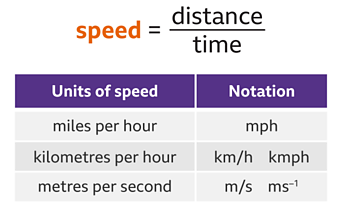
The relationship between distance, speed and time is:
\( \text{Speed} = \dfrac{\text{Distance}}{\text{Time}} \)
From this formula we can also rearrange:
\( \text{Distance} = \text{Speed} \times \text{Time} \)
\( \text{Time} = \dfrac{\text{Distance}}{\text{Speed}} \)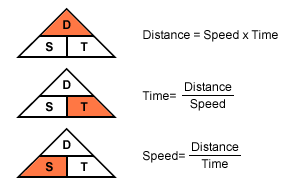
Units
Speed → km/h or m/s
Distance → km or m
Time → hours or seconds
Important
All units must match before using the formula.
Example 1:
A car travels \( 120 \) km in \( 2 \) hours. Find the speed.
▶️ Answer/Explanation
\( \text{Speed} = 120 ÷ 2 = 60 \)
Conclusion: \( 60 \) km/h.
Example 2:
A person walks at \( 5 \) km/h for \( 3 \) hours. Find the distance travelled.
▶️ Answer/Explanation
\( \text{Distance} = 5 × 3 = 15 \)
Conclusion: \( 15 \) km.
Example 3:
A train travels \( 90 \) km at \( 45 \) km/h. Find the time taken.
▶️ Answer/Explanation
\( \text{Time} = 90 ÷ 45 = 2 \)
Conclusion: \( 2 \) hours.
Compound Measures
A compound measure combines two different measurements into one quantity.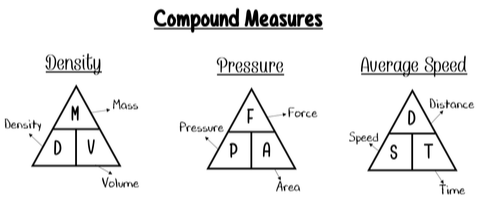
Common compound measures include density and pressure.
Density
\( \text{Density} = \dfrac{\text{Mass}}{\text{Volume}} \)
Units: kg/m³ or g/cm³
Pressure
\( \text{Pressure} = \dfrac{\text{Force}}{\text{Area}} \)
Units: N/m² (Pascal)
Key Idea
Compound measure = one quantity divided by another.
Example 1:
A runner travels \( 400 \) m in \( 50 \) s. Find the speed.
▶️ Answer/Explanation
\( 400 ÷ 50 = 8 \)
Conclusion: \( 8 \) m/s.
Example 2:
A substance has mass \( 18 \) kg and volume \( 6 \) m³. Find the density.
▶️ Answer/Explanation
\( 18 ÷ 6 = 3 \)
Conclusion: \( 3 \) kg/m³.
Example 3:
A force of \( 150 \) N acts on an area of \( 5 \) m². Find the pressure.
▶️ Answer/Explanation
\( 150 ÷ 5 = 30 \)
Conclusion: \( 30 \) N/m² (Pa).