
Pythagoras’ Theorem
Pythagoras’ theorem applies only to right-angled triangles.
The longest side of a right-angled triangle is called the hypotenuse. It is always opposite the \( 90^\circ \) angle.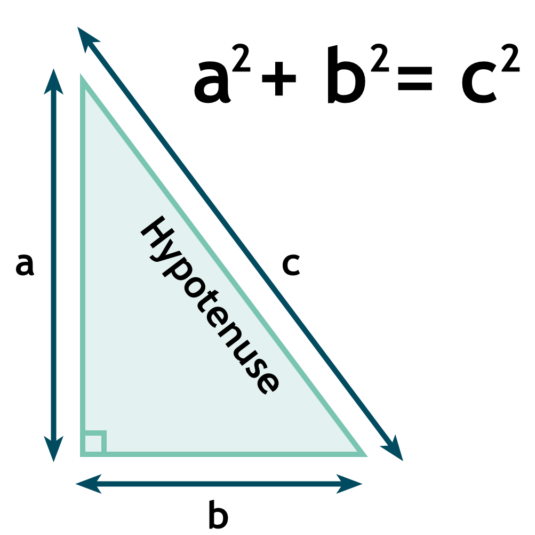
The Rule
\( a^2 + b^2 = c^2 \)
where \( c \) is the hypotenuse and \( a \) and \( b \) are the other two sides.
Finding a Missing Side
If the hypotenuse is unknown:
Add the squares, then take the square root.
If a shorter side is unknown:
Subtract from \( c^2 \), then take the square root.
Important
Always identify the hypotenuse first before using the formula.
Example 1:
A right triangle has sides \( 3 \) cm and \( 4 \) cm. Find the hypotenuse.
▶️ Answer/Explanation
\( c^2 = 3^2 + 4^2 = 9 + 16 = 25 \)
\( c = \sqrt{25} = 5 \)
Conclusion: \( 5 \) cm.
Example 2:
The hypotenuse is \( 13 \) cm and one side is \( 5 \) cm. Find the other side.
▶️ Answer/Explanation
\( a^2 = 13^2 – 5^2 = 169 – 25 = 144 \)
\( a = \sqrt{144} = 12 \)
Conclusion: \( 12 \) cm.
Example 3:
A ladder reaches \( 6 \) m up a wall and its base is \( 8 \) m from the wall. Find the ladder length.
▶️ Answer/Explanation
\( c^2 = 6^2 + 8^2 = 36 + 64 = 100 \)
\( c = \sqrt{100} = 10 \)
Conclusion: \( 10 \) m.
Trigonometric Ratios in Right-Angled Triangles
In a right-angled triangle we can use sine, cosine and tangent to find missing sides or angles.
First identify the three sides relative to the angle \( \theta \):
Hypotenuse → longest side (opposite the \( 90^\circ \) angle)
Opposite → across from the angle
Adjacent → next to the angle
The Trigonometric Ratios
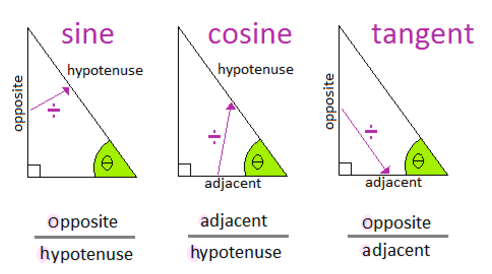
\( \sin \theta = \dfrac{\text{Opposite}}{\text{Hypotenuse}} \)
\( \cos \theta = \dfrac{\text{Adjacent}}{\text{Hypotenuse}} \)
\( \tan \theta = \dfrac{\text{Opposite}}{\text{Adjacent}} \)
Remember
SOH → \( \sin = \dfrac{O}{H} \)
CAH → \( \cos = \dfrac{A}{H} \)
TOA → \( \tan = \dfrac{O}{A} \)
Make sure your calculator is in degree mode.
Example 1:
In a right triangle, the hypotenuse is \( 10 \) cm and the opposite side to angle \( \theta \) is \( 6 \) cm. Find \( \sin\theta \).
▶️ Answer/Explanation
\( \sin\theta = \dfrac{6}{10} = 0.6 \)
Conclusion: \( \sin\theta = 0.6 \).
Example 2:
The adjacent side to an angle is \( 8 \) cm and the hypotenuse is \( 10 \) cm. Find \( \cos\theta \).
▶️ Answer/Explanation
\( \cos\theta = \dfrac{8}{10} = 0.8 \)
Conclusion: \( \cos\theta = 0.8 \).
Example 3:
The opposite side is \( 5 \) cm and the adjacent side is \( 12 \) cm. Find \( \theta \).
▶️ Answer/Explanation
\( \tan\theta = \dfrac{5}{12} \)
\( \theta = \tan^{-1}\!\left(\dfrac{5}{12}\right) \approx 22.6^\circ \)
Conclusion: \( \theta \approx 22.6^\circ \).
Applying Trigonometry to Solve Problems
Trigonometry can be used to solve real-life problems involving heights, distances and angles.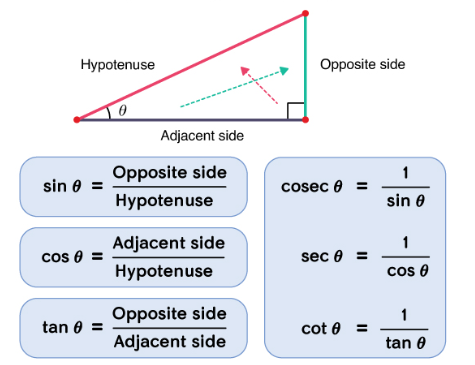
We combine:
- Pythagoras’ theorem
- Sine, cosine and tangent ratios
Choosing the Correct Ratio
Look at the sides you are given and the side you need to find.
Opposite & Hypotenuse → use sine
Adjacent & Hypotenuse → use cosine
Opposite & Adjacent → use tangent
Steps
1. Draw a right-angled triangle.
2. Label opposite, adjacent and hypotenuse.
3. Choose SOH-CAH-TOA.
4. Substitute values.
5. Solve using a calculator.
Example 1:
A ladder leans against a wall making an angle of \( 60^\circ \) with the ground. The ladder is \( 10 \) m long. How high up the wall does it reach?
▶️ Answer/Explanation
Height is opposite side and ladder is hypotenuse.
\( \sin 60^\circ = \dfrac{h}{10} \)
\( h = 10\sin 60^\circ \approx 10(0.866) = 8.66 \)
Conclusion: Height \( \approx 8.66 \) m.
Example 2:
A tower stands on horizontal ground. From a point \( 20 \) m away, the angle of elevation to the top is \( 35^\circ \). Find the height of the tower.
▶️ Answer/Explanation
Opposite and adjacent are known.
\( \tan 35^\circ = \dfrac{h}{20} \)
\( h = 20\tan 35^\circ \approx 20(0.700) = 14.0 \)
Conclusion: Height \( \approx 14.0 \) m.
Example 3:
A ramp is \( 5 \) m long and reaches a height of \( 1.5 \) m. Find the angle the ramp makes with the ground.
▶️ Answer/Explanation
Opposite and hypotenuse are known.
\( \sin\theta = \dfrac{1.5}{5} = 0.3 \)
\( \theta = \sin^{-1}(0.3) \approx 17.5^\circ \)
Conclusion: \( \theta \approx 17.5^\circ \).