
Metric Unit Conversions (Length and Area)
In mensuration, measurements must be in the same units before calculating area or perimeter.
Length Conversions
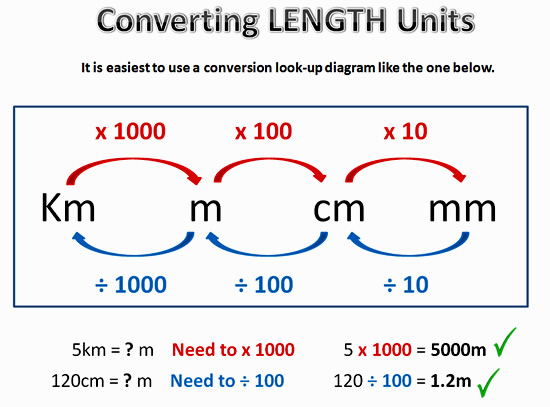
\( 10 \text{ mm} = 1 \text{ cm} \)
\( 100 \text{ cm} = 1 \text{ m} \)
\( 1000 \text{ m} = 1 \text{ km} \)
When converting length, multiply or divide by 10, 100 or 1000.
Area Conversions
Area units are squared, so the conversion factor is also squared.
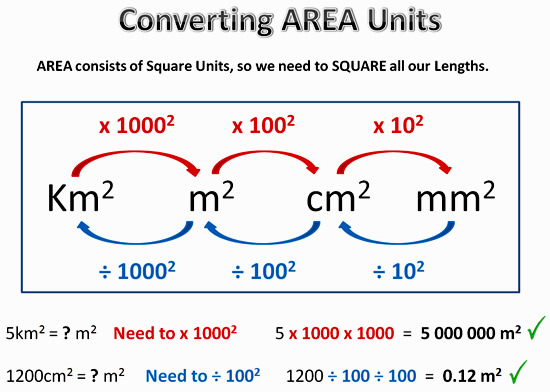
\( 1 \text{ m} = 100 \text{ cm} \)
\( 1 \text{ m}^2 = 100^2 = 10{,}000 \text{ cm}^2 \)
\( 1 \text{ cm}^2 = \dfrac{1}{10{,}000} \text{ m}^2 \)
Key Idea
Length → multiply/divide by 100
Area → multiply/divide by \( 100^2 = 10{,}000 \)
Example 1:
Convert \( 250 \) cm to metres.
▶️ Answer/Explanation
\( 250 ÷ 100 = 2.5 \)
Conclusion: \( 2.5 \) m.
Example 2:
Convert \( 3 \text{ m}^2 \) to \( \text{cm}^2 \).
▶️ Answer/Explanation
\( 1 \text{ m}^2 = 10{,}000 \text{ cm}^2 \)
\( 3 × 10{,}000 = 30{,}000 \)
Conclusion: \( 30{,}000 \text{ cm}^2 \).
Example 3:
Convert \( 45{,}000 \text{ cm}^2 \) to \( \text{m}^2 \).
▶️ Answer/Explanation
\( 45{,}000 ÷ 10{,}000 = 4.5 \)
Conclusion: \( 4.5 \text{ m}^2 \).
Perimeter of Shapes (Triangles and Rectangles)
The perimeter is the total distance around the outside of a shape.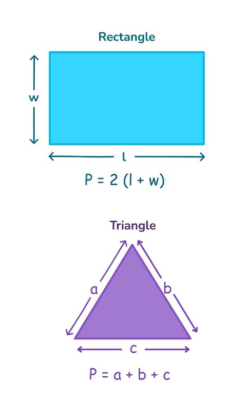
To find the perimeter, add the lengths of all the sides.
Triangle
A triangle has three sides.
Perimeter \( = a + b + c \)
Rectangle
A rectangle has two equal lengths and two equal widths.
Perimeter \( = 2(\text{length} + \text{width}) \)
Important
Make sure all sides are in the same units before adding.
Example 1:
Find the perimeter of a triangle with sides \( 5 \) cm, \( 7 \) cm and \( 9 \) cm.
▶️ Answer/Explanation
\( 5 + 7 + 9 = 21 \)
Conclusion: \( 21 \) cm.
Example 2:
A rectangle has length \( 12 \) m and width \( 5 \) m. Find the perimeter.
▶️ Answer/Explanation
\( 2(12 + 5) = 2 × 17 = 34 \)
Conclusion: \( 34 \) m.
Example 3:
A triangular garden has sides \( 8 \) m, \( 10 \) m and \( 12 \) m. How much fencing is needed?
▶️ Answer/Explanation
\( 8 + 10 + 12 = 30 \)
Conclusion: \( 30 \) m of fencing.
Area of Triangles and Rectangles
The area of a shape is the amount of space inside it.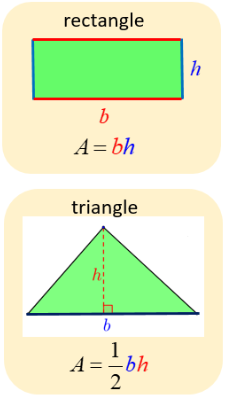
Area is measured in square units such as \( \text{cm}^2 \) or \( \text{m}^2 \).
Area of a Rectangle
\( \text{Area} = \text{length} \times \text{width} \)
Area of a Triangle
\( \text{Area} = \dfrac{1}{2} \times \text{base} \times \text{height} \)
The height must be perpendicular to the base.
Important
Use the same units for all lengths before calculating the area.
Example 1:
Find the area of a rectangle with length \( 9 \) cm and width \( 4 \) cm.
▶️ Answer/Explanation
\( 9 \times 4 = 36 \)
Conclusion: \( 36 \text{ cm}^2 \).
Example 2:
A triangle has base \( 10 \) m and height \( 6 \) m. Find the area.
▶️ Answer/Explanation
\( \dfrac{1}{2} \times 10 \times 6 = 30 \)
Conclusion: \( 30 \text{ m}^2 \).
Example 3:
A triangular field has base \( 12 \) m and perpendicular height \( 5 \) m. Find the area.
▶️ Answer/Explanation
\( \dfrac{1}{2} \times 12 \times 5 = 30 \)
Conclusion: \( 30 \text{ m}^2 \).
Area of Parallelograms and Trapezia
Area of a Parallelogram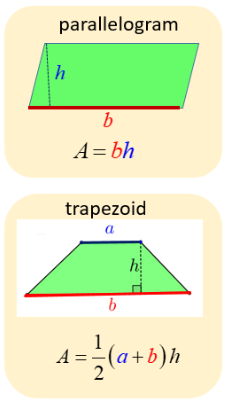
A parallelogram has opposite sides parallel.
The area is found using the base and the perpendicular height.
\( \text{Area} = \text{base} \times \text{height} \)
The height must be measured at a right angle to the base.
Area of a Trapezium
A trapezium has one pair of parallel sides.
\( \text{Area} = \dfrac{1}{2}(a + b)h \)
where \( a \) and \( b \) are the parallel sides and \( h \) is the perpendicular height.
Important
The height is not the sloping side. It must be the perpendicular distance between the parallel sides.
Example 1:
A parallelogram has base \( 12 \) cm and height \( 7 \) cm. Find the area.
▶️ Answer/Explanation
\( 12 \times 7 = 84 \)
Conclusion: \( 84 \text{ cm}^2 \).
Example 2:
A trapezium has parallel sides \( 8 \) m and \( 14 \) m and height \( 5 \) m. Find the area.
▶️ Answer/Explanation
\( \dfrac{1}{2}(8 + 14) \times 5 \)
\( \dfrac{1}{2} \times 22 \times 5 = 11 \times 5 = 55 \)
Conclusion: \( 55 \text{ m}^2 \).
Example 3:
A parallelogram has area \( 72 \text{ cm}^2 \) and base \( 9 \) cm. Find the height.
▶️ Answer/Explanation
\( \text{height} = \dfrac{72}{9} = 8 \)
Conclusion: \( 8 \) cm.
Circles and Semicircles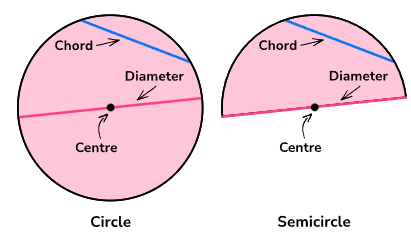
Key Parts of a Circle
Radius \( (r) \) → distance from centre to edge
Diameter \( (d) \) → distance across the circle through the centre
\( d = 2r \)
Circumference of a Circle
The circumference is the distance around the circle.
\( C = 2\pi r \)
or
\( C = \pi d \)
Area of a Circle
\( A = \pi r^2 \)
Semicircles
A semicircle is half a circle.
Area of a Semicircle
\( A = \dfrac{1}{2}\pi r^2 \)
Perimeter of a Semicircle
The perimeter includes the curved part and the diameter.
- Curved part \( = \pi r \)
- Perimeter \( = \pi r + 2r \)
Important
Use \( \pi \approx 3.14 \) unless instructed otherwise.
Example 1:
Find the circumference of a circle with radius \( 7 \) cm.
▶️ Answer/Explanation
\( C = 2\pi r = 2 \times 3.14 \times 7 = 43.96 \)
Conclusion: \( 43.96 \) cm.
Example 2:
Find the area of a circle with diameter \( 10 \) cm.
▶️ Answer/Explanation
\( r = 5 \)
\( A = \pi r^2 = 3.14 \times 25 = 78.5 \)
Conclusion: \( 78.5 \text{ cm}^2 \).
Example 3:
A semicircle has radius \( 4 \) cm. Find its perimeter.
▶️ Answer/Explanation
\( \pi r + 2r = 3.14 \times 4 + 8 = 12.56 + 8 = 20.56 \)
Conclusion: \( 20.56 \) cm.