
Prime Factorisation Using Powers
Any integer greater than 1 can be written as a product of prime numbers.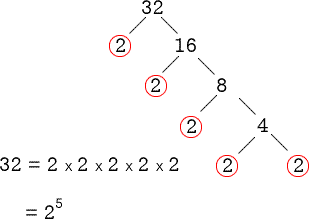
This is called prime factorisation.
To make the answer shorter and clearer, repeated primes are written using powers (indices).
Method
1. Start dividing the number by the smallest prime number (2).
2. Continue dividing until no longer possible.
3. Move to the next prime (3, 5, 7…).
4. Write the final answer using powers.
Example Given
\( 720 = 2^4 \times 3^2 \times 5 \)
Important
Always write factors in ascending order of primes: \( 2, 3, 5, 7, 11… \)
Example 1:
Write \( 48 \) as a product of prime factors.
▶️ Answer/Explanation
Divide by 2 repeatedly:
\( 48 = 2 \times 24 \)
\( 24 = 2 \times 12 \)
\( 12 = 2 \times 6 \)
\( 6 = 2 \times 3 \)
\( 48 = 2^4 \times 3 \)
Conclusion: \( 48 = 2^4 \times 3 \).
Example 2:
Write \( 90 \) as a product of prime factors.
▶️ Answer/Explanation
\( 90 = 2 \times 45 \)
\( 45 = 3 \times 15 \)
\( 15 = 3 \times 5 \)
\( 90 = 2 \times 3^2 \times 5 \)
Conclusion: \( 90 = 2 \times 3^2 \times 5 \).
Example 3:
Write \( 150 \) as a product of prime factors.
▶️ Answer/Explanation
\( 150 = 2 \times 75 \)
\( 75 = 3 \times 25 \)
\( 25 = 5 \times 5 \)
\( 150 = 2 \times 3 \times 5^2 \)
Conclusion: \( 150 = 2 \times 3 \times 5^2 \).
Highest Common Factor (HCF) and Lowest Common Multiple (LCM)
Highest Common Factor (HCF)
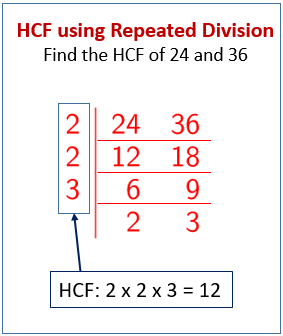
The HCF of two or more numbers is the largest number that divides exactly into all of them.
Lowest Common Multiple (LCM)
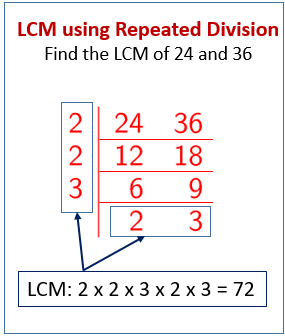
The LCM is the smallest number that is a multiple of all the given numbers.
Using Prime Factors
1. Write each number as a product of prime factors.
2. For the HCF → take the lowest power of common primes.
3. For the LCM → take the highest power of all primes.
Example Idea
HCF → what they share
LCM → everything needed to make both
Example 1:
Find the HCF and LCM of \( 12 \) and \( 18 \).
▶️ Answer/Explanation
Prime factors:
\( 12 = 2^2 \times 3 \)
\( 18 = 2 \times 3^2 \)
HCF:
Common primes → \( 2^1 \times 3^1 = 6 \)
LCM:
Highest powers → \( 2^2 \times 3^2 = 36 \)
Conclusion: HCF = 6, LCM = 36.
Example 2:
Find the HCF and LCM of \( 20 \) and \( 30 \).
▶️ Answer/Explanation
\( 20 = 2^2 \times 5 \)
\( 30 = 2 \times 3 \times 5 \)
HCF:
\( 2 \times 5 = 10 \)
LCM:
\( 2^2 \times 3 \times 5 = 60 \)
Conclusion: HCF = 10, LCM = 60.
Example 3:
Find the HCF and LCM of \( 24 \) and \( 36 \).
▶️ Answer/Explanation
\( 24 = 2^3 \times 3 \)
\( 36 = 2^2 \times 3^2 \)
HCF:
\( 2^2 \times 3 = 12 \)
LCM:
\( 2^3 \times 3^2 = 72 \)
Conclusion: HCF = 12, LCM = 72.