
Percentages as Operators
A percentage can be used as an operator. This means it tells you to multiply a number by a fraction.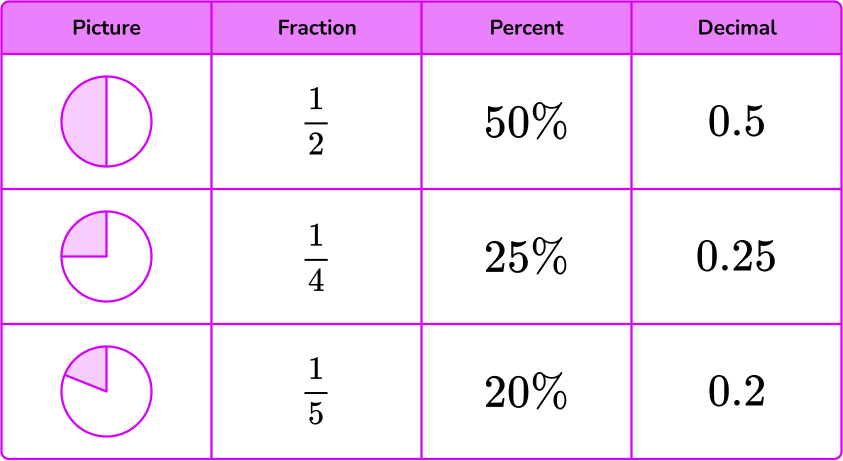
“Percent” means per 100.
\( 15\% = \dfrac{15}{100} \)
So finding a percentage of a quantity means:
\( \text{Percentage of a number} = \dfrac{\text{percentage}}{100} \times \text{number} \)
Example given
\( 15\% \text{ of } 120 = \dfrac{15}{100} \times 120 \)
Multiplier Method
We can also convert the percentage to a decimal multiplier.
\( 15\% = 0.15 \)
So \( 15\% \text{ of } 120 = 120 \times 0.15 \)
Key Idea
Percentage = multiplier that scales a number up or down.
Example 1:
Find \( 25\% \) of \( 80 \).
▶️ Answer/Explanation
\( \dfrac{25}{100} \times 80 = 20 \)
Conclusion: \( 20 \).
Example 2:
Find \( 40\% \) of \( 250 \).
▶️ Answer/Explanation
\( 0.40 \times 250 = 100 \)
Conclusion: \( 100 \).
Example 3:
Find \( 12\% \) of \( 150 \).
▶️ Answer/Explanation
\( 0.12 \times 150 = 18 \)
Conclusion: \( 18 \).
Percentage Increase and Decrease
Percentage problems often involve values going up (increase) or down (decrease).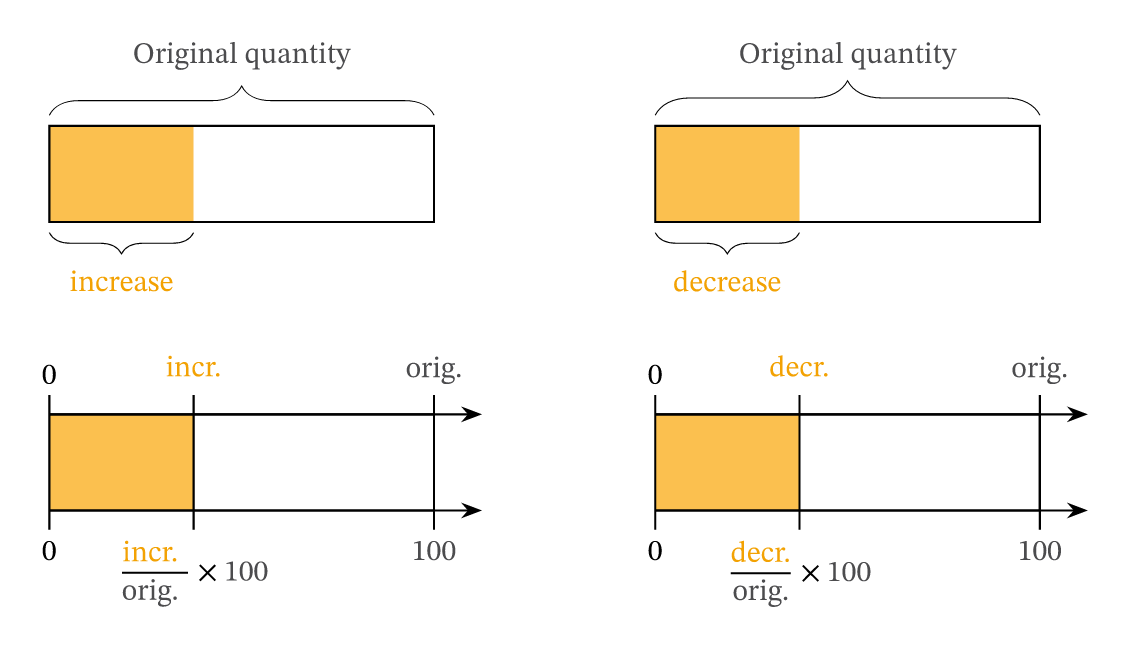
Step 1: Find the change
Change \( = \text{new value} – \text{original value} \)
Step 2: Find the percentage change
\( \text{Percentage change} = \dfrac{\text{change}}{\text{original value}} \times 100\% \)
Multiplier Method (Very Important)
Instead of doing two steps, we often use a multiplier.
Increase by \( p\% \Rightarrow \times (1 + \dfrac{p}{100}) \)
Decrease by \( p\% \Rightarrow \times (1 – \dfrac{p}{100}) \)
Examples of Multipliers
Increase 20% → multiply by \( 1.20 \)
Decrease 20% → multiply by \( 0.80 \)
Example 1:
A shirt costs £40. The price increases by 10%. Find the new price.
▶️ Answer/Explanation
Multiplier:
\( 1.10 \)
\( 40 \times 1.10 = 44 \)
Conclusion: £44.
Example 2:
A phone costs £500. It is reduced by 15%. Find the sale price.
▶️ Answer/Explanation
Multiplier:
\( 0.85 \)
\( 500 \times 0.85 = 425 \)
Conclusion: £425.
Example 3:
A car value increases from £8,000 to £8,800. Find the percentage increase.
▶️ Answer/Explanation
Change:
\( 8800 – 8000 = 800 \)
Percentage change:
\( \dfrac{800}{8000} \times 100 = 10\% \)
Conclusion: 10% increase.
Reverse Percentages
Sometimes we are given the final value after a percentage increase or decrease and need to find the original value.
This is called a reverse percentage.
Key Idea
Instead of multiplying by a percentage multiplier, we divide by the multiplier.
Multipliers
Increase \( p\% \Rightarrow \) multiplier \( = 1 + \dfrac{p}{100} \)
Decrease \( p\% \Rightarrow \) multiplier \( = 1 – \dfrac{p}{100} \)
To find the original value:
\( \text{Original value} = \dfrac{\text{Final value}}{\text{multiplier}} \)
Given Example
In a sale, prices were reduced by 30%. The sale price is £17.50.
Multiplier \( = 0.70 \)
\( \text{Original price} = \dfrac{17.50}{0.70} = £25 \)
Example 1:
After a 20% discount, a jacket costs £48. Find the original price.
▶️ Answer/Explanation
Multiplier:
\( 0.80 \)
\( 48 ÷ 0.80 = 60 \)
Conclusion: £60.
Example 2:
After a 15% increase, a salary becomes £1,380. Find the original salary.
▶️ Answer/Explanation
Multiplier:
\( 1.15 \)
\( 1380 ÷ 1.15 = 1200 \)
Conclusion: £1,200.
Example 3:
After a 25% reduction, a phone costs £300. Find the original price.
▶️ Answer/Explanation
Multiplier:
\( 0.75 \)
\( 300 ÷ 0.75 = 400 \)
Conclusion: £400.
Compound Interest and Depreciation
Some percentage changes happen repeatedly each year. This is called compound change.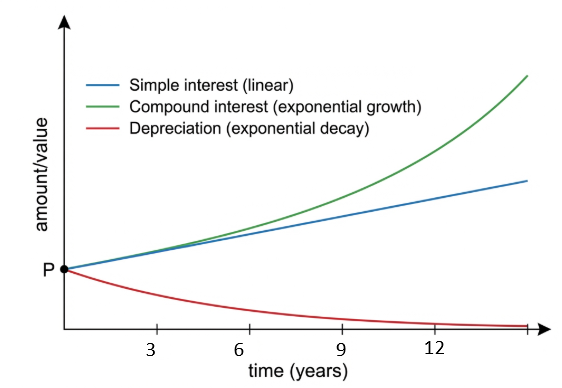
Instead of adding or subtracting the same amount each year, we multiply by a multiplier every year.
Compound Interest
Money in a bank grows because interest is added every year.
Multiplier \( = 1 + \dfrac{r}{100} \)
\( \text{Final amount} = \text{Initial amount} \times \left(1 + \dfrac{r}{100}\right)^n \)
where \( r \) = interest rate and \( n \) = number of years.
Depreciation
Some items lose value over time (cars, phones, computers).
Multiplier \( = 1 – \dfrac{r}{100} \)
\( \text{Value after } n \text{ years} = \text{Original value} \times \left(1 – \dfrac{r}{100}\right)^n \)
Key Idea
Increase → multiplier greater than 1
Decrease → multiplier less than 1
Example 1:
£500 is invested at 4% compound interest per year for 3 years. Find the final amount.
▶️ Answer/Explanation
Multiplier:
\( 1.04 \)
\( 500 \times 1.04^3 \approx 500 \times 1.125 = 562.50 \)
Conclusion: £562.50.
Example 2:
A car costs £12,000 and depreciates by 10% each year. Find its value after 2 years.
▶️ Answer/Explanation
Multiplier:
\( 0.90 \)
\( 12000 \times 0.90^2 = 12000 \times 0.81 = 9720 \)
Conclusion: £9,720.
Example 3:
£800 is invested at 5% compound interest for 4 years. Find the final amount.
▶️ Answer/Explanation
Multiplier \( = 1.05 \)
\( 800 \times 1.05^4 \approx 800 \times 1.216 = 972.80 \)
Conclusion: £972.80.