
Ratio Notation and Simplifying Ratios
A ratio compares two or more quantities.
It shows how many times one value is compared with another.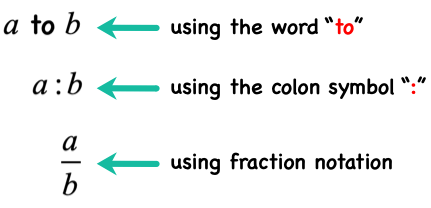
Written using a colon \( : \)
Example: \( 2:3 \)
Link Between Ratio and Fractions
A ratio can be written as a fraction.
\( a:b = \dfrac{a}{b} \)
Example:
\( 2:5 = \dfrac{2}{5} \)
Simplifying Ratios
Divide all parts of the ratio by the highest common factor (HCF).
This is called writing the ratio in its simplest form.
Form \( 1:n \)
Sometimes ratios are written so the first number is 1.
Divide both parts by the first number.
Example:
\( 4:20 = 1:5 \)
Example 1:
Simplify the ratio \( 12:18 \).
▶️ Answer/Explanation
HCF of 12 and 18 = 6
\( 12 ÷ 6 = 2 \)
\( 18 ÷ 6 = 3 \)
Conclusion: \( 2:3 \).
Example 2:
Write \( 15:60 \) in the form \( 1:n \).
▶️ Answer/Explanation
Divide both by 15:
\( 15:60 = 1:4 \)
Conclusion: \( 1:4 \).
Example 3:
Write the ratio \( 8:10 \) as a fraction in simplest form.
▶️ Answer/Explanation
\( \dfrac{8}{10} = \dfrac{4}{5} \)
Conclusion: \( \dfrac{4}{5} \).
Dividing a Quantity in a Given Ratio
Sometimes a total amount must be shared according to a ratio.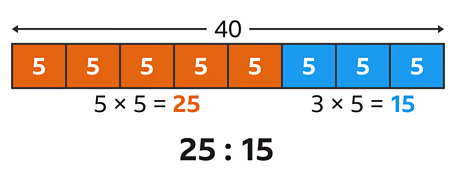
The ratio tells how many parts each person receives.
Method
1. Add the parts of the ratio.
2. Divide the total quantity by the total number of parts.
3. Multiply by each part of the ratio.
Key Idea
Each part = \( \dfrac{\text{total amount}}{\text{sum of ratio parts}} \)
Example 1:
Share £416 in the ratio \( 5:3 \).
▶️ Answer/Explanation
Total parts:
\( 5 + 3 = 8 \)
Value of one part:
\( 416 ÷ 8 = 52 \)
Shares:
First share: \( 5 × 52 = 260 \)
Second share: \( 3 × 52 = 156 \)
Conclusion: £260 and £156.
Example 2:
Share £416 in the ratio \( 4:3:1 \).
▶️ Answer/Explanation
Total parts:
\( 4 + 3 + 1 = 8 \)
Value of one part:
\( 416 ÷ 8 = 52 \)
Shares:
\( 4 × 52 = 208 \)
\( 3 × 52 = 156 \)
\( 1 × 52 = 52 \)
Conclusion: £208, £156 and £52.
Example 3:
Divide 90 sweets in the ratio \( 2:1 \).
▶️ Answer/Explanation
Total parts:
\( 2 + 1 = 3 \)
Value of one part:
\( 90 ÷ 3 = 30 \)
Shares:
\( 2 × 30 = 60 \)
\( 1 × 30 = 30 \)
Conclusion: 60 sweets and 30 sweets.
Proportionality
Two quantities are proportional if they change in the same ratio.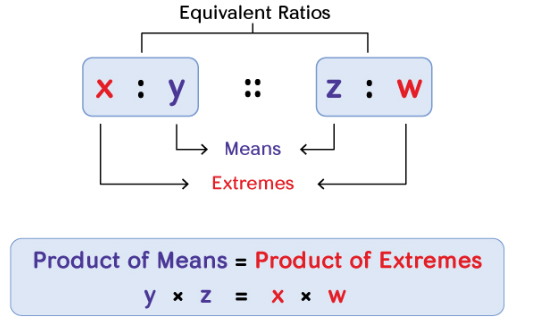
This means when one value multiplies, the other multiplies by the same factor.
Key Idea
If \( a:b = c:d \), the ratios are equal.
We can solve unknown values using equivalent ratios.
Method
1. Write as a fraction (ratio).
2. Find the scale factor.
3. Apply the same multiplier to the other quantity.
Example 1:
5 pens cost £2. Find the cost of 15 pens.
▶️ Answer/Explanation
Scale factor:
\( 15 ÷ 5 = 3 \)
Cost:
\( 2 × 3 = 6 \)
Conclusion: £6.
Example 2:
A recipe uses 200 g of flour for 4 people. How much flour is needed for 10 people?
▶️ Answer/Explanation
Scale factor:
\( 10 ÷ 4 = 2.5 \)
Flour:
\( 200 × 2.5 = 500 \)
Conclusion: 500 g.
Example 3:
8 notebooks cost £6. How many notebooks can be bought for £15?
▶️ Answer/Explanation
Scale factor:
\( 15 ÷ 6 = 2.5 \)
Notebooks:
\( 8 × 2.5 = 20 \)
Conclusion: 20 notebooks.
Direct Proportion
Two quantities are in direct proportion if one increases and the other increases at the same rate.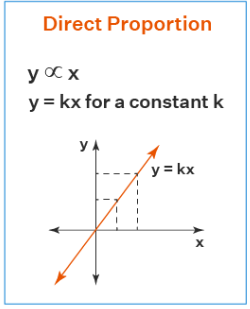
If one value doubles, the other also doubles.
We write:
\( y \propto x \)
This means:
\( y = kx \)
where \( k \) is a constant called the constant of proportionality.
Method to Find Missing Values
1. Use known values to find \( k \).
2. Substitute \( k \) into \( y = kx \).
3. Calculate the missing value.
Example 1:
\( s \) varies directly as \( t \). When \( t = 4 \), \( s = 20 \). Find \( s \) when \( t = 7 \).
▶️ Answer/Explanation
Find \( k \):
\( s = kt \)
\( 20 = 4k \)
\( k = 5 \)
Now:
\( s = 5 × 7 = 35 \)
Conclusion: \( s = 35 \).
Example 2:
\( y \propto x \). When \( x = 3 \), \( y = 12 \). Find \( y \) when \( x = 10 \).
▶️ Answer/Explanation
\( y = kx \)
\( 12 = 3k \Rightarrow k = 4 \)
\( y = 4 × 10 = 40 \)
Conclusion: \( 40 \).
Example 3:
The distance travelled varies directly with time. A car travels 90 km in 2 hours. How far will it travel in 5 hours?
▶️ Answer/Explanation
Find \( k \):
\( d = kt \)
\( 90 = 2k \Rightarrow k = 45 \)
Now:
\( d = 45 × 5 = 225 \)
Conclusion: 225 km.