Edexcel Mathematics (4XMAF) -Unit 2 - 2.3 Expressions and Formulae- Study Notes- New Syllabus
Edexcel Mathematics (4XMAF) -Unit 2 – 2.3 Expressions and Formulae- Study Notes- New syllabus
Edexcel Mathematics (4XMAF) -Unit 2 – 2.3 Expressions and Formulae- Study Notes -Edexcel iGCSE Mathematics – per latest Syllabus.
Key Concepts:
A understand that a letter may represent an unknown number or a variable
B use correct notational conventions for algebraic expressions and formulae
C substitute positive and negative integers, decimals and fractions for words and letters in expressions and formulae
Evaluate 2x − 3y when x = 4 and y = −5
D use formulae from mathematics and other real-life contexts expressed initially in words or diagrammatic form and convert to letters and symbols
E derive a formula or expression
F change the subject of a formula where the subject appears once
Make r the subject of A = πr²
Make t the subject of v = u + at
Edexcel iGCSE Mathematics -Concise Summary Notes- All Topics
Letters as Unknowns and Variables
In algebra, letters are used to represent numbers.
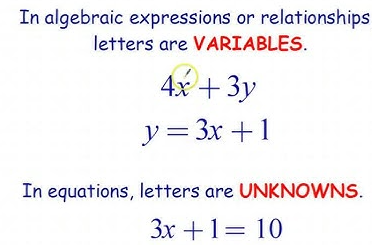
A letter may represent:
• an unknown number
• a variable (a value that can change)
Unknown Number
A letter stands for a single number we need to find.
Example: \( x + 5 = 12 \)
Here \( x \) is the unknown number.
Variable
A variable can take different values.
Example: \( y = 2x \)
As \( x \) changes, \( y \) also changes.
Important
Letters do not stand for objects. They always represent numbers.
Example 1:
In \( x + 7 = 15 \), what does \( x \) represent?
▶️ Answer/Explanation
\( x \) is the unknown number we must find.
\( x = 15 – 7 = 8 \)
Conclusion: \( x \) represents an unknown number.
Example 2:
In \( y = 3x \), explain why \( y \) is a variable.
▶️ Answer/Explanation
Because \( x \) can change, \( y \) changes too.
Conclusion: \( y \) is a variable.
Example 3:
In the formula \( A = lw \), what do the letters represent?
▶️ Answer/Explanation
\( A \), \( l \), and \( w \) all represent numbers (measurements).
Conclusion: They are variables.
Algebraic Notation Conventions
In algebra we follow standard writing rules called notation conventions.
These make expressions clear and easy to read.
1. Multiplication Signs Are Omitted
We usually do not write the multiplication symbol \( × \).
\( 3 × x = 3x \)
\( a × b = ab \)
2. Numbers Come Before Letters
Correct: \( 5x \)
Incorrect: \( x5 \)
3. Terms Are Written in Order
Terms are usually written alphabetically.
\( ab \) not \( ba \)
4. Powers Use Index Notation
\( x × x = x^2 \)
\( x × x × x = x^3 \)
5. Fractions
Fractions are written using a horizontal bar or brackets.
\( \dfrac{a}{b} \) or \( a/b \)
6. Brackets
Brackets show multiplication.
\( 3(x + 2) \) means \( 3 × (x + 2) \)
Example 1:
Write \( 4 × y \) using correct algebraic notation.
▶️ Answer/Explanation
\( 4y \)
Conclusion: Multiplication sign removed.
Example 2:
Rewrite \( x × x × x \) correctly.
▶️ Answer/Explanation
\( x^3 \)
Conclusion: Written using index notation.
Example 3:
Write “3 multiplied by (a + 5)” in algebraic form.
▶️ Answer/Explanation
\( 3(a + 5) \)
Conclusion: Brackets show multiplication.
Substituting into Expressions and Formulae
Substitution means replacing letters with given numbers and then calculating the answer.
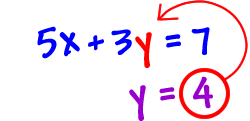
The numbers can be:
• positive integers
• negative integers
• decimals
• fractions
Important Rule
Always put negative numbers inside brackets.
Example: \( -3y \) with \( y = -2 \) becomes \( -3(-2) \)
Example Given
Evaluate \( 2x – 3y \) when \( x = 4 \), \( y = -5 \)
\( 2(4) – 3(-5) = 8 + 15 = 23 \)
Example 1:
Evaluate \( 5a + 2 \) when \( a = 3 \).
▶️ Answer/Explanation
\( 5(3) + 2 = 15 + 2 = 17 \)
Conclusion: 17.
Example 2:
Evaluate \( 4x – y \) when \( x = -2 \), \( y = 5 \).
▶️ Answer/Explanation
\( 4(-2) – 5 = -8 – 5 = -13 \)
Conclusion: \( -13 \).
Example 3:
Evaluate \( \dfrac{x}{2} + y \) when \( x = 6 \), \( y = 1.5 \).
▶️ Answer/Explanation
\( \dfrac{6}{2} + 1.5 = 3 + 1.5 = 4.5 \)
Conclusion: \( 4.5 \).
Using Formulae and Converting Words to Algebra
Many real-life relationships can be written as formulae.
A formula shows how quantities are connected using letters and symbols.
We often start with a description in words and then convert it into algebra.
Common Examples
Area of rectangle = length × width → \( A = lw \)
Distance = speed × time → \( d = st \)
Key Translations
sum → \( + \)
difference → \( – \)
product → \( × \)
quotient → \( ÷ \)
Important
Always define what each letter represents.
Example 1:
The perimeter \( P \) of a rectangle is twice the sum of its length \( l \) and width \( w \). Write a formula.
▶️ Answer/Explanation
“Sum of length and width” → \( l + w \)
“Twice” → multiply by 2
\( P = 2(l + w) \)
Conclusion: \( P = 2(l + w) \).
Example 2:
The cost \( C \) of hiring a bike is a £5 fixed charge plus £2 per hour \( h \). Write a formula.
▶️ Answer/Explanation
£2 per hour → \( 2h \)
\( C = 5 + 2h \)
Conclusion: \( C = 5 + 2h \).
Example 3:
The speed \( v \) of a journey equals distance \( d \) divided by time \( t \). Write the formula.
▶️ Answer/Explanation
“Distance divided by time”:
\( v = \dfrac{d}{t} \)
Conclusion: \( v = \dfrac{d}{t} \).
Deriving a Formula or Expression
To derive a formula means to create an algebraic rule from given information.
We use words, patterns or diagrams and turn them into an expression using letters.
Steps
1. Decide what each letter represents.
2. Translate each part of the description into algebra.
3. Combine into a single formula.
Key Words
“more than” → add
“less than” → subtract
“times” → multiply
“per” → divide
Example 1:
A number \( n \) is increased by 7. Write an expression.
▶️ Answer/Explanation
Increase by 7 → add 7
\( n + 7 \)
Conclusion: \( n + 7 \).
Example 2:
The perimeter \( P \) of a square with side \( s \).
▶️ Answer/Explanation
A square has 4 equal sides.
\( P = 4s \)
Conclusion: \( P = 4s \).
Example 3:
A taxi fare costs £3 plus £2 for each kilometre \( k \). Derive a formula for total cost \( C \).
▶️ Answer/Explanation
£2 per kilometre → \( 2k \)
\( C = 3 + 2k \)
Conclusion: \( C = 3 + 2k \).
Changing the Subject of a Formula
Changing the subject means rearranging a formula so a different letter is on its own.
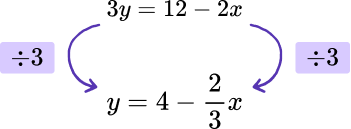
We use the same rules as solving equations.
Goal
Make the required letter alone on one side of the equation.
Important Rules
• What you do to one side, you must do to the other
• Undo operations in reverse order
Example Given
Make \( r \) the subject of:
\( A = \pi r^2 \)
Divide by \( \pi \): \( \dfrac{A}{\pi} = r^2 \)
Square root: \( r = \sqrt{\dfrac{A}{\pi}} \)
Make \( t \) the subject of:
\( v = u + at \)
Subtract \( u \): \( v – u = at \)
Divide by \( a \): \( t = \dfrac{v-u}{a} \)
Example 1:
Make \( x \) the subject of \( y = 5x \).
▶️ Answer/Explanation
Divide both sides by 5:
\( x = \dfrac{y}{5} \)
Conclusion: \( x = \dfrac{y}{5} \).
Example 2:
Make \( a \) the subject of \( b = a + 7 \).
▶️ Answer/Explanation
Subtract 7 from both sides:
\( a = b – 7 \)
Conclusion: \( a = b – 7 \).
Example 3:
Make \( h \) the subject of \( V = lh \).
▶️ Answer/Explanation
Divide both sides by \( l \):
\( h = \dfrac{V}{l} \)
Conclusion: \( h = \dfrac{V}{l} \).
