
Inequality Symbols
An inequality shows that values are not equal but one is greater or smaller than another.
Instead of an equals sign \( = \), we use inequality symbols.
Main Symbols
- \( < \) means less than
- \( > \) means greater than
- \( \le \) means less than or equal to
- \( \ge \) means greater than or equal to
Understanding the Signs
The open side faces the larger number.
\( 3 < 7 \) (7 is bigger)
\( 10 \ge 10 \) (includes equality)
Double-Ended Inequalities
A value can lie between two limits.
\( 1 < x \le 5 \)
This means:
\( x \) is greater than 1 but less than or equal to 5.
Example 1:
Which is larger: 4 or 9? Write using an inequality.
▶️ Answer/Explanation
\( 4 < 9 \)
Conclusion: 4 is less than 9.
Example 2:
Write: “\( x \) is at least 6”.
▶️ Answer/Explanation
“At least” means greater than or equal to.
\( x \ge 6 \)
Conclusion: \( x \ge 6 \).
Example 3:
Explain the meaning of \( -2 < x \le 3 \).
▶️ Answer/Explanation
\( x \) is greater than −2 and up to 3 (including 3).
Conclusion: Values between −2 and 3 inclusive of 3.
Open and Closed Intervals on a Number Line
Solutions of inequalities are often shown on a number line.
We use two types of circles to show whether an endpoint is included or not.
Open Circle
An open circle means the value is not included.

Used for \( < \) or \( > \)
Example: \( x > 3 \)
Closed Circle
A closed (filled) circle means the value is included.

Used for \( \le \) or \( \ge \)
Example: \( x \le 5 \)
Interval Meaning
The shaded line shows all possible values that satisfy the inequality.
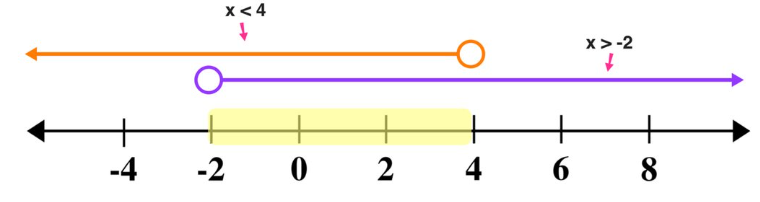
Double Inequalities
\( 1 < x \le 5 \)
Open circle at 1 and closed circle at 5, with shading between them.
Example 1:
Represent \( x > 2 \) on a number line.
▶️ Answer/Explanation
Open circle at 2 and shade to the right.
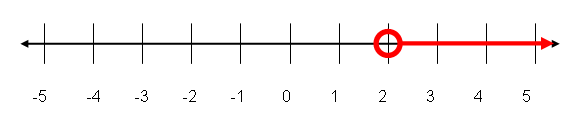
Conclusion: All values greater than 2.
Example 2:
Represent \( x \le 4 \) on a number line.
▶️ Answer/Explanation
Closed circle at 4 and shade to the left.
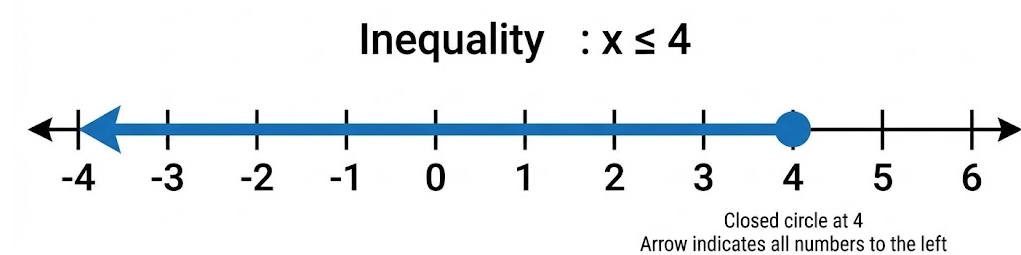
Conclusion: 4 and all smaller values.
Example 3:
Explain \( -1 < x \le 3 \) on a number line.
▶️ Answer/Explanation
Open circle at −1, closed circle at 3 and shade between them.
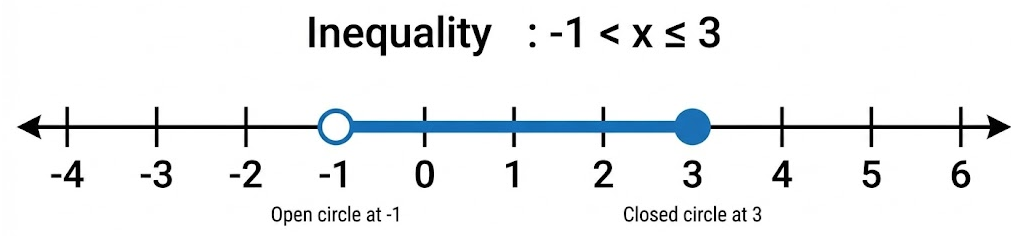
Conclusion: All numbers between −1 and 3 including 3 but not −1.
Linear Inequalities on Cartesian Graphs
Inequalities in two variables can be shown on a coordinate grid.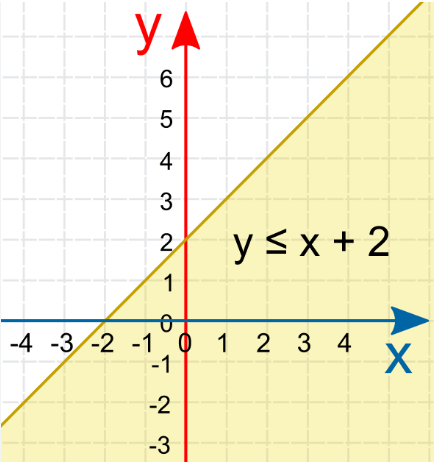
Instead of a single line, the solution is a region (area) of the graph.
Steps
1. Draw the boundary line (replace the inequality with =).
2. Choose a test point (usually \( (0,0) \)).
3. Check if the point satisfies the inequality.
4. Shade the correct side of the line.
Example Given
Shade the region defined by:
\( x \le 0 \)
\( y \le 1 \)
\( x + y \le 5 \)
You draw each boundary line and shade the area that satisfies all three inequalities at the same time.
Boundary Lines
If the inequality includes \( \le \) or \( \ge \), draw a solid line because the line is part of the solution.
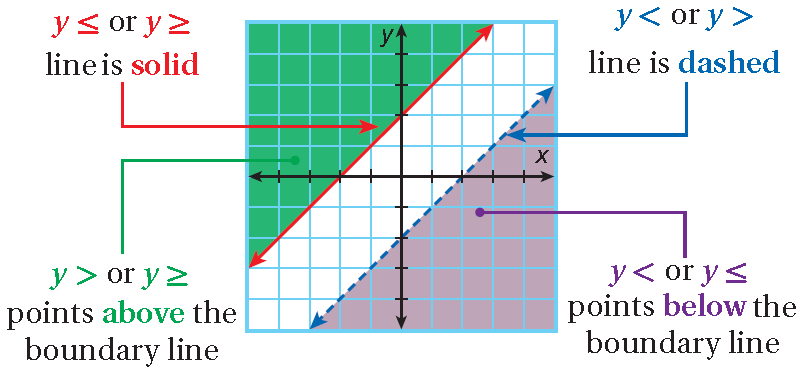
If it uses \( < \) or \( > \), draw a dashed line because the line is not included.
Example 1:
Represent \( y \le 2 \) on a graph.
▶️ Answer/Explanation
Draw the horizontal line \( y = 2 \).
Shade the region below the line.
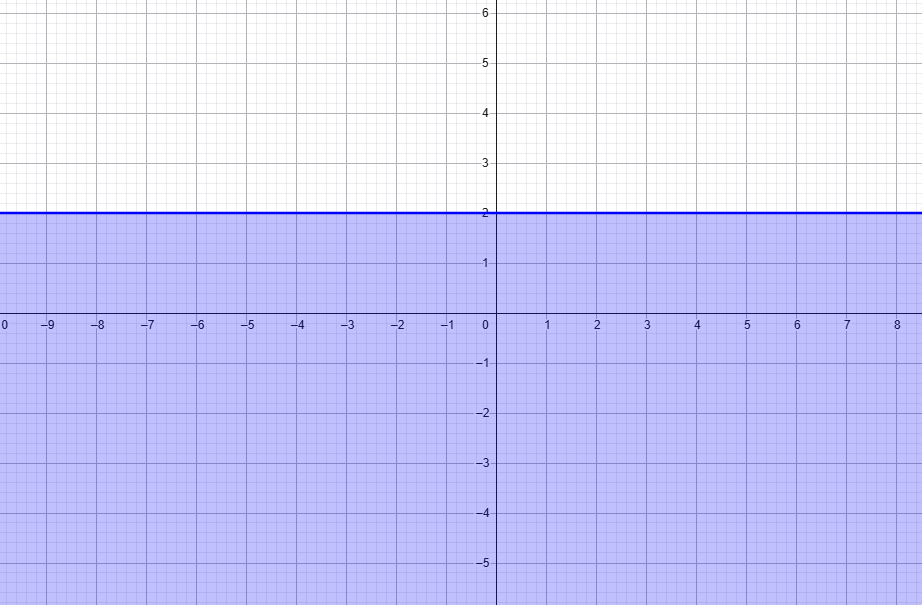
Conclusion: All points with y-values 2 or less.
Example 2:
Represent \( x \ge -1 \).
▶️ Answer/Explanation
Draw vertical line \( x = -1 \).
Shade the region to the right.
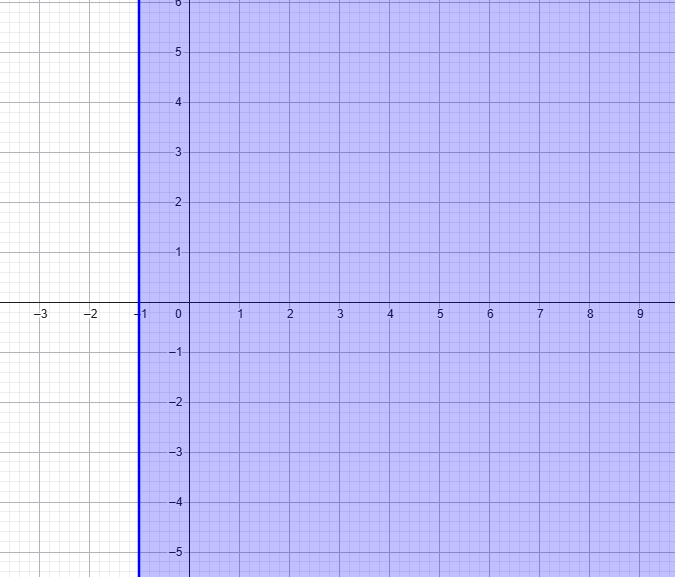
Conclusion: All points with x-values −1 or greater.
Example 3:
Represent \( x + y \le 4 \).
▶️ Answer/Explanation
Draw boundary line \( x + y = 4 \).
Test point (0,0):
\( 0 + 0 \le 4 \) ✓ true
Shade the side containing (0,0).
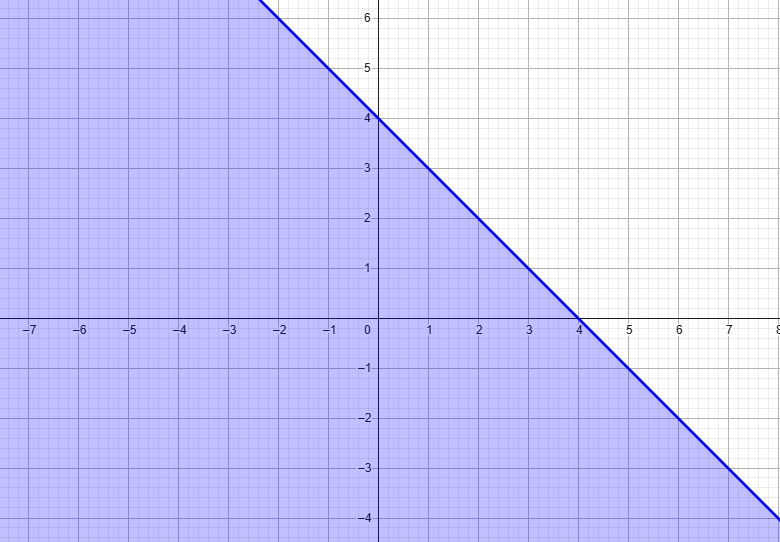
Conclusion: Region below the line.
Identifying Regions from Inequalities on Graphs
Sometimes a graph is already shaded and you must decide which inequality it represents.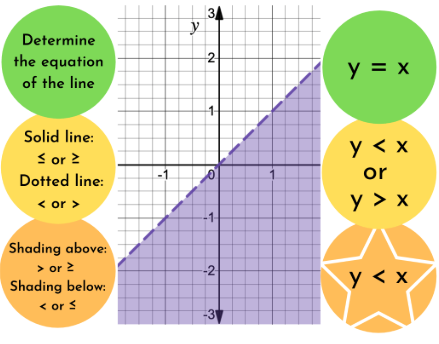
You are not drawing the graph. You are interpreting it.
Method
1. Find the equation of the boundary line.
2. Choose a point in the shaded region (often \( (0,0) \)).
3. Substitute into the equation.
4. Decide the inequality sign.
Key Idea
If the test point works, the shaded side satisfies the inequality.
Examples of Boundary Lines
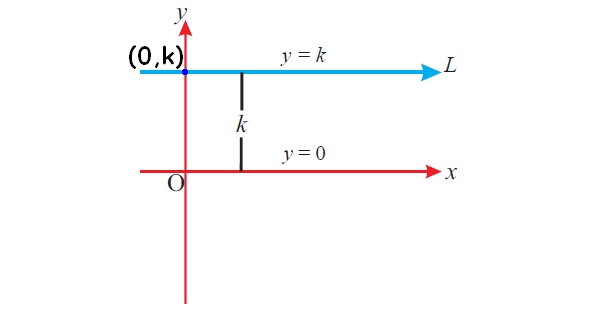
- Horizontal line → \( y = k \)

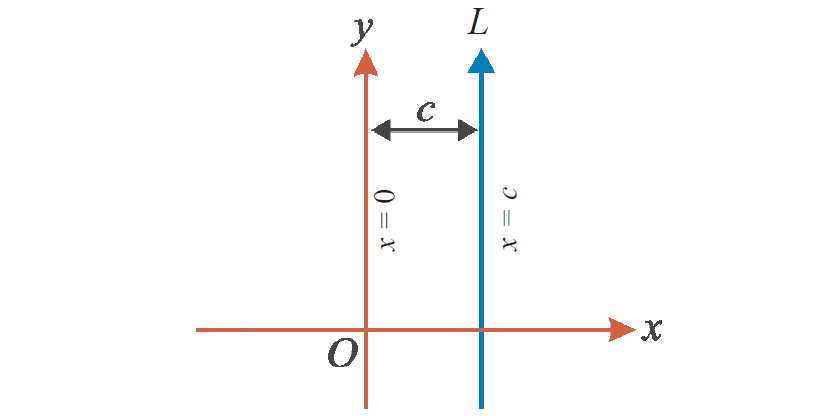
- Vertical line → \( x = c \)
- Slanted line → \( ax + by = c \)
Example 1:
The shaded region is below the line \( y = 3 \). Write the inequality.
▶️ Answer/Explanation
Points below the line have smaller y-values.
\( y < 3 \)
Conclusion: \( y < 3 \).
Example 2:
The region is to the right of the vertical line \( x = -2 \). Write the inequality.
▶️ Answer/Explanation
Right side means larger x-values.
\( x > -2 \)
Conclusion: \( x > -2 \).
Example 3:
The shaded region contains the point \( (0,0) \) and the boundary line is \( x + y = 4 \). Find the inequality.
▶️ Answer/Explanation
Substitute \( (0,0) \):
\( 0 + 0 = 0 \)
Since \( 0 < 4 \), the region satisfies:
\( x + y < 4 \)
Conclusion: \( x + y < 4 \).