
Generating Terms of a Sequence
A sequence is an ordered list of numbers that follows a pattern.
Each number is called a term.
There are two main ways to describe a sequence.
1. Term-to-Term Rule
This tells how to get the next term from the previous one.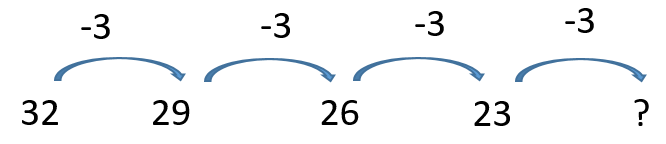
Example: add 3 each time
\( 2,\;5,\;8,\;11,\;14,\ldots \)
2. Position-to-Term Rule (nth term)
This gives a formula to calculate any term using its position \( n \).
Example: \( 2n \Rightarrow 2,\;4,\;6,\;8,\;10,\ldots \)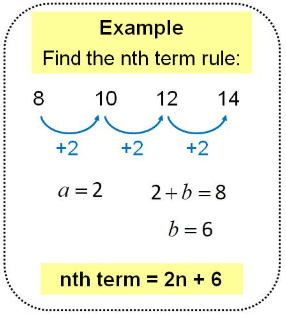
Common Types of Sequences
Odd numbers: \( 1,3,5,7,9,\ldots \)
Even numbers: \( 2,4,6,8,10,\ldots \)
Square numbers: \( 1,4,9,16,25,\ldots \)
Multiples of 5: \( 5,10,15,20,\ldots \)
Powers of 2: \( 1,2,4,8,16,\ldots \)
Example 1:
Use the rule “add 5” starting from 3 to generate the first five terms.
▶️ Answer/Explanation
3, 8, 13, 18, 23
Conclusion: First five terms are \( 3,8,13,18,23 \).
Example 2:
Write the first five terms of the sequence \( 4n \).
▶️ Answer/Explanation
Substitute \( n = 1,2,3,4,5 \)
\( 4,8,12,16,20 \)
Conclusion: Multiples of 4.
Example 3:
Find the first four square numbers using \( n^2 \).
▶️ Answer/Explanation
Substitute \( n = 1,2,3,4 \)
\( 1,4,9,16 \)
Conclusion: Square numbers sequence.
Finding the Rule of a Sequence
A sequence follows a pattern. We can continue the sequence and also describe the rule that generates it.
Step 1: Look at the difference or ratio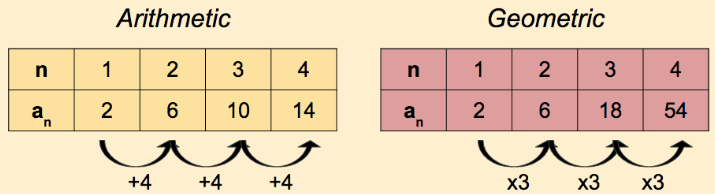
Find how each term changes to the next.
- Add the same number → arithmetic pattern
- Multiply by the same number → geometric pattern
Example Given
\( 5, 9, 13, 17, \ldots \)
Each time add 4
Another Example
\( 1, 2, 4, 8, \ldots \)
Multiply by 2 each time
Example 1:
Find the next two terms and the rule:
\( 7, 11, 15, 19, \ldots \)
▶️ Answer/Explanation
Difference:
\( +4 \)
Next terms:
23, 27
Conclusion: Add 4 each time.
Example 2:
Find the rule:
\( 3, 6, 12, 24, \ldots \)
▶️ Answer/Explanation
Each term is multiplied by 2.
Conclusion: Multiply by 2.
Example 3:
Complete and state the rule:
\( 10, 8, 6, 4, \ldots \)
▶️ Answer/Explanation
Difference:
\( -2 \)
Next terms:
2, 0
Conclusion: Subtract 2 each time.
nth Term of an Arithmetic Sequence
An arithmetic sequence is a sequence where the difference between consecutive terms is constant.
We can describe such a sequence using a formula called the nth term.
The nth term gives the value of any term in the sequence without listing all the terms.
Method to Find the nth Term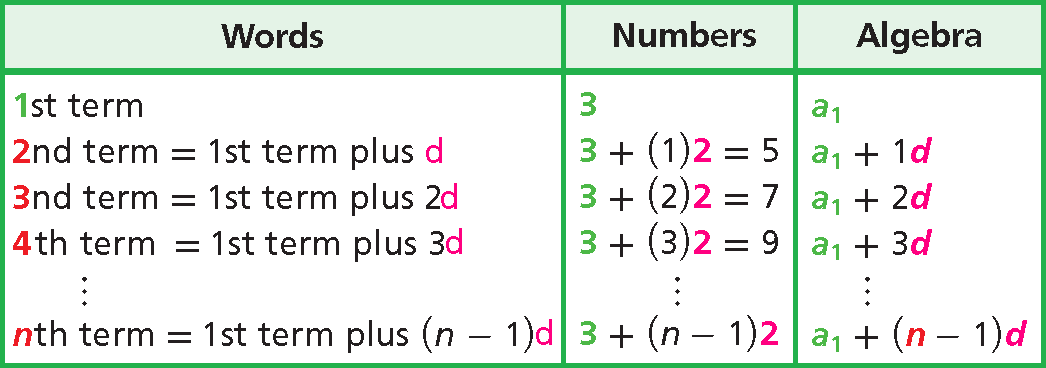
1. Find the common difference.
2. Multiply the difference by \( n \).
3. Adjust to match the first term.
Example Given
\( 1, 3, 5, 7, 9, \ldots \)
Common difference = 2
nth term = \( 2n – 1 \)
Example 1:
Find the nth term of:
\( 4, 7, 10, 13, \ldots \)
▶️ Answer/Explanation
Difference = 3
Multiples of 3:
\( 3n \)
Check first term:
When \( n=1 \), \( 3(1)=3 \)
Need 4 → add 1
nth term \( = 3n + 1 \)
Conclusion: \( 3n+1 \).
Example 2:
Write the first three terms when the nth term is \( 4n + 3 \).
▶️ Answer/Explanation
Substitute \( n=1,2,3 \)
\( 4(1)+3=7 \)
\( 4(2)+3=11 \)
\( 4(3)+3=15 \)
Conclusion: \( 7,11,15 \).
Example 3:
Find the 10th term of the sequence with nth term \( 2n – 1 \).
▶️ Answer/Explanation
Substitute \( n=10 \)
\( 2(10)-1=20-1=19 \)
Conclusion: 19.