
Surface Area of Simple 3D Shapes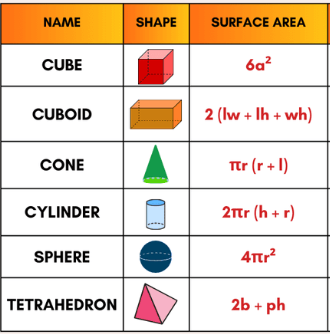
The surface area of a 3D shape is the total area of all its outer faces.
To find surface area, calculate the area of each face and then add them together.
Area Formulae Needed
Rectangle: \( \text{Area} = \text{length} \times \text{width} \)
Triangle: \( \text{Area} = \dfrac{1}{2} \times \text{base} \times \text{height} \)
Always include units such as \( \text{cm}^2 \) or \( \text{m}^2 \).
Example 1:
Find the surface area of a cube with side 4 cm.

▶️ Answer/Explanation
A cube has 6 square faces.
Area of one face \( = 4 \times 4 = 16 \text{ cm}^2 \)
Total surface area \( = 6 \times 16 = 96 \text{ cm}^2 \)
Conclusion: \( 96 \text{ cm}^2 \).
Example 2:
A triangular prism has two triangular faces each with base 6 cm and height 4 cm.
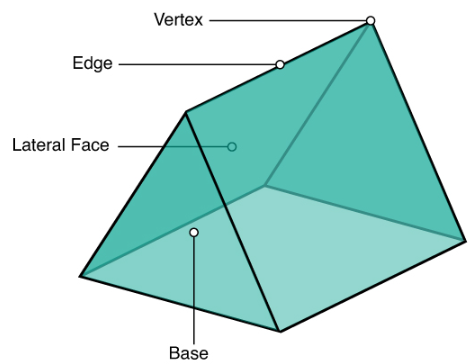
Find the area of one triangular face.
▶️ Answer/Explanation
\( \dfrac{1}{2} \times 6 \times 4 = 12 \text{ cm}^2 \)
Conclusion: \( 12 \text{ cm}^2 \).
Example 3:
A cuboid measures 5 cm × 3 cm × 2 cm.

Find the total surface area.
▶️ Answer/Explanation
Three pairs of rectangles:
\( 5 \times 3 = 15 \)
\( 5 \times 2 = 10 \)
\( 3 \times 2 = 6 \)
Total:
\( 2(15+10+6)=2(31)=62 \text{ cm}^2 \)
Conclusion: \( 62 \text{ cm}^2 \).
Surface Area of a Cylinder
A cylinder has:

- two circular ends
- one curved surface around the side
The total surface area is the area of both circles plus the curved surface.
Formula
Surface area \( = 2\pi r^2 + 2\pi rh \)
where
\( r \) = radius
\( h \) = height
The term \( 2\pi r^2 \) is the area of the two circular ends.
The term \( 2\pi rh \) is the curved surface area.
Example 1:
Find the surface area of a cylinder with radius 3 cm and height 8 cm. (Use \( \pi = 3.14 \))
▶️ Answer/Explanation
Ends:
\( 2\pi r^2 = 2 \times 3.14 \times 3^2 = 2 \times 3.14 \times 9 = 56.52 \text{ cm}^2 \)
Curved surface:
\( 2\pi rh = 2 \times 3.14 \times 3 \times 8 = 150.72 \text{ cm}^2 \)
Total:
\( 56.52 + 150.72 = 207.24 \text{ cm}^2 \)
Conclusion: \( 207.24 \text{ cm}^2 \).
Example 2:
A cylinder has radius 5 cm and height 10 cm. Find the curved surface area only. (Use \( \pi = 3.14 \))
▶️ Answer/Explanation
\( 2\pi rh = 2 \times 3.14 \times 5 \times 10 = 314 \text{ cm}^2 \)
Conclusion: \( 314 \text{ cm}^2 \).
Example 3:
The diameter of a cylinder is 12 cm and height is 7 cm. Find the total surface area. (Use \( \pi = 3.14 \))
▶️ Answer/Explanation
Radius:
\( r = 12 ÷ 2 = 6 \text{ cm} \)
Ends:
\( 2\pi r^2 = 2 \times 3.14 \times 6^2 = 2 \times 3.14 \times 36 = 226.08 \text{ cm}^2 \)
Curved surface:
\( 2\pi rh = 2 \times 3.14 \times 6 \times 7 = 263.76 \text{ cm}^2 \)
Total:
\( 226.08 + 263.76 = 489.84 \text{ cm}^2 \)
Conclusion: \( 489.84 \text{ cm}^2 \).
Volume of Prisms (Cuboids and Cylinders)
The volume of a 3D shape is the amount of space it occupies.
Volume is measured in cubic units:
\( \text{cm}^3,\; \text{m}^3 \)
General Rule for a Prism

Volume \( = \text{area of cross-section} \times \text{length (height)} \)
Cuboid
\( \text{Volume} = l \times w \times h \)
Cylinder
The cross-section is a circle.
Area of circle \( = \pi r^2 \)
Volume \( = \pi r^2 h \)
Example 1:
Find the volume of a cuboid measuring 8 cm × 5 cm × 3 cm.
▶️ Answer/Explanation
\( 8 \times 5 \times 3 = 120 \text{ cm}^3 \)
Conclusion: \( 120 \text{ cm}^3 \).
Example 2:
A triangular prism has cross-sectional area 12 cm² and length 9 cm. Find the volume.
▶️ Answer/Explanation
\( 12 \times 9 = 108 \text{ cm}^3 \)
Conclusion: \( 108 \text{ cm}^3 \).
Example 3:
Find the volume of a cylinder with radius 4 cm and height 10 cm. (Use \( \pi = 3.14 \))
▶️ Answer/Explanation
\( \pi r^2 h = 3.14 \times 4^2 \times 10 \)
\( 3.14 \times 16 \times 10 = 502.4 \text{ cm}^3 \)
Conclusion: \( 502.4 \text{ cm}^3 \).
Converting Units of Volume
Volume is measured in cubic units.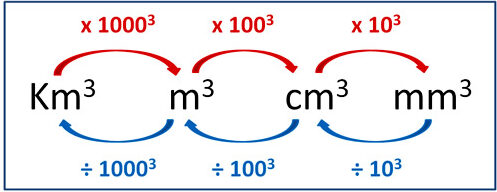
\( \text{cm}^3,\; \text{m}^3 \)
Because volume is three-dimensional, conversions use powers of 10.
Key Conversions
\( 1 \text{ m} = 100 \text{ cm} \)
Cube both sides:
\( 1 \text{ m}^3 = 100^3 \text{ cm}^3 = 1\,000\,000 \text{ cm}^3 \)
Litres
\( 1 \text{ litre} = 1000 \text{ cm}^3 \)
\( 1 \text{ m}^3 = 1000 \text{ litres} \)
Conversion Method
- cm³ → m³ : divide by 1,000,000
- m³ → cm³ : multiply by 1,000,000
- cm³ → litres : divide by 1000
- litres → cm³ : multiply by 1000
Example 1:
Convert \( 5000 \text{ cm}^3 \) to litres.
▶️ Answer/Explanation
\( 5000 ÷ 1000 = 5 \)
Conclusion: \( 5 \) litres.
Example 2:
Convert \( 0.002 \text{ m}^3 \) to \( \text{cm}^3 \).
▶️ Answer/Explanation
\( 0.002 \times 1,000,000 = 2000 \text{ cm}^3 \)
Conclusion: \( 2000 \text{ cm}^3 \).
Example 3:
Convert 3 litres to \( \text{cm}^3 \).
▶️ Answer/Explanation
\( 3 \times 1000 = 3000 \text{ cm}^3 \)
Conclusion: \( 3000 \text{ cm}^3 \).