
Similarity of Shapes
Two shapes are similar if they have the same shape but different sizes.
Properties of Similar Figures
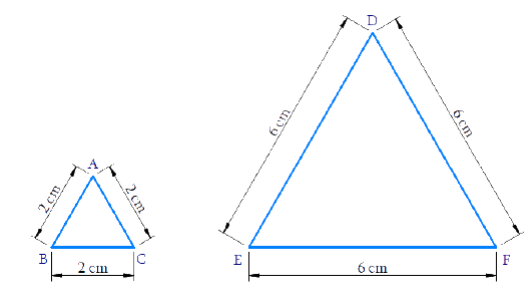
1. Corresponding angles are equal.
Angles stay the same size.
2. Corresponding sides are in the same ratio.
All lengths are multiplied by a scale factor.
Scale Factor
The scale factor tells how much bigger or smaller a shape becomes.
\( \text{Scale factor} = \dfrac{\text{length in new shape}}{\text{length in original shape}} \)
If the scale factor is greater than 1, the shape is an enlargement.
If the scale factor is less than 1, the shape is a reduction.
Important
Only shapes with equal angles and proportional sides are similar.
Example 1:
Two triangles have corresponding sides 4 cm and 8 cm. Find the scale factor.
▶️ Answer/Explanation
\( 8 ÷ 4 = 2 \)
Conclusion: Scale factor = 2.
Example 2:
A square of side 5 cm is enlarged to side 15 cm. Show the squares are similar.
▶️ Answer/Explanation
All angles in a square are \( 90^\circ \).
Side ratio:
\( 15 ÷ 5 = 3 \)
Conclusion: Equal angles and proportional sides, so similar.
Example 3:
A triangle has sides 3 cm, 4 cm, 5 cm. Another has sides 6 cm, 8 cm, 10 cm. Are they similar?
▶️ Answer/Explanation
Compare ratios:
\( 6/3 = 2 \)
\( 8/4 = 2 \)
\( 10/5 = 2 \)
All ratios equal.
Conclusion: The triangles are similar.
Maps and Scale Drawings
Maps and plans are scale drawings of real places.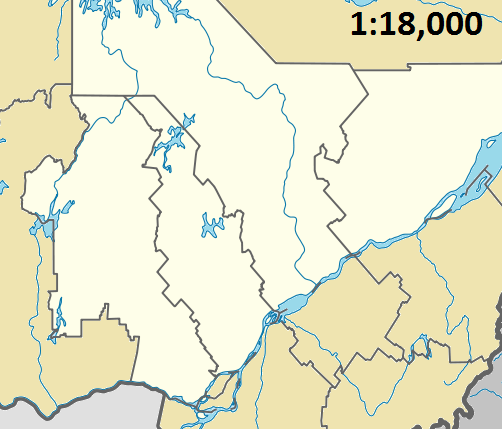
They use a scale to show large distances using small measurements.
Scale
A scale compares a distance on the drawing to the real distance.
Example: \( 1 : 50\,000 \)
This means:
1 cm on the map represents 50 000 cm in real life.
Method to Find Real Distance
1. Measure the map distance using a ruler.
2. Multiply by the scale factor.
3. Convert to suitable units (m or km).
Method to Find Map Distance
1. Convert the real distance into the same unit.
2. Divide by the scale factor.
Useful Conversions
\( 100 \text{ cm} = 1 \text{ m} \)
\( 1000 \text{ m} = 1 \text{ km} \)
Example 1:
On a map with scale \( 1 : 25\,000 \), two towns are 4 cm apart. Find the real distance.
▶️ Answer/Explanation
\( 4 \times 25\,000 = 100\,000 \text{ cm} \)
Convert to metres:
\( 100\,000 \text{ cm} = 1000 \text{ m} \)
Convert to km:
\( 1000 \text{ m} = 1 \text{ km} \)
Conclusion: 1 km.
Example 2:
A road is 3 km long in real life. Scale \( 1 : 50\,000 \). Find its length on the map.
▶️ Answer/Explanation
Convert to cm:
\( 3 \text{ km} = 3000 \text{ m} = 300\,000 \text{ cm} \)
Divide by scale:
\( 300\,000 ÷ 50\,000 = 6 \text{ cm} \)
Conclusion: 6 cm.
Example 3:
A plan shows a room 8 cm by 5 cm. Scale \( 1 : 100 \). Find the real dimensions.
▶️ Answer/Explanation
\( 8 \times 100 = 800 \text{ cm} = 8 \text{ m} \)
\( 5 \times 100 = 500 \text{ cm} = 5 \text{ m} \)
Conclusion: \( 8 \text{ m by } 5 \text{ m} \).