
Regular Polygons and Their Angles
A regular polygon is a polygon in which: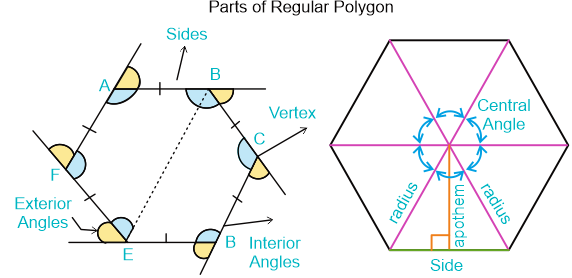
• all sides are equal
• all interior angles are equal
Examples include an equilateral triangle, a square and a regular pentagon.
Interior Angle
An interior angle is the angle inside the polygon.
For a regular polygon with \( n \) sides:
Interior angle \( = \dfrac{(n-2)\times180^\circ}{n} \)
Exterior Angle
An exterior angle is the angle outside the polygon formed by extending a side.
Exterior angle \( = \dfrac{360^\circ}{n} \)
Also:
Interior angle + Exterior angle \( = 180^\circ \)
Example 1:
Find the interior angle of a regular pentagon (\( n=5 \)).
▶️ Answer/Explanation
\( \dfrac{(5-2)\times180^\circ}{5}=\dfrac{3\times180^\circ}{5}=108^\circ \)
Conclusion: Interior angle = \( 108^\circ \).
Example 2:
Find the exterior angle of a regular octagon (\( n=8 \)).
▶️ Answer/Explanation
\( \dfrac{360^\circ}{8}=45^\circ \)
Conclusion: Exterior angle = \( 45^\circ \).
Example 3:
A regular polygon has exterior angle \( 30^\circ \). Find the number of sides.
▶️ Answer/Explanation
\( n=\dfrac{360^\circ}{30^\circ}=12 \)
Conclusion: 12 sides.
Angle Sum of Polygons
The interior angles of any polygon always add up to a fixed total depending on the number of sides.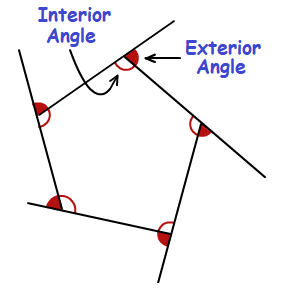
For a polygon with \( n \) sides:
Sum of interior angles \( = (n-2)\times180^\circ \)
This can also be written as:
\( (2n-4) \) right angles
(since one right angle = \( 90^\circ \))
Examples of Angle Sums
Triangle (3 sides): \( 180^\circ \)
Quadrilateral (4 sides): \( 360^\circ \)
Pentagon (5 sides): \( 540^\circ \)
Hexagon (6 sides): \( 720^\circ \)
Example 1:
Find the sum of interior angles of a heptagon (\( n=7 \)).
▶️ Answer/Explanation
\( (7-2)\times180^\circ=5\times180^\circ=900^\circ \)
Conclusion: \( 900^\circ \).
Example 2:
A polygon has 10 sides. Find the total of its interior angles.
▶️ Answer/Explanation
\( (10-2)\times180^\circ=8\times180^\circ=1440^\circ \)
Conclusion: \( 1440^\circ \).
Example 3:
Each interior angle of a regular polygon is \( 120^\circ \). Find the number of sides.
▶️ Answer/Explanation
Interior angle formula:
\( \dfrac{(n-2)180^\circ}{n}=120^\circ \)
\( 180n-360=120n \)
\( 60n=360 \Rightarrow n=6 \)
Conclusion: 6 sides (a hexagon).
Congruence
Two shapes are congruent if they have exactly the same shape and the same size.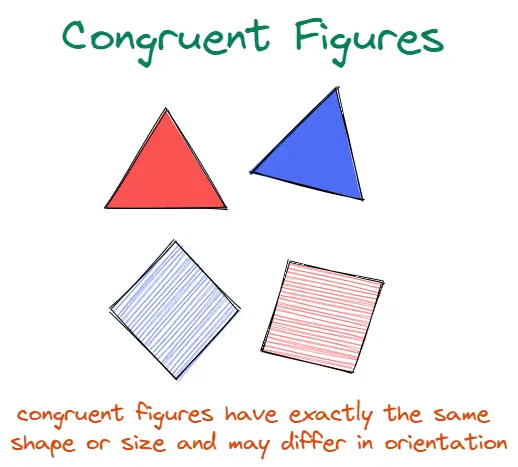
This means:
- all corresponding sides are equal
- all corresponding angles are equal
One shape may be rotated, flipped or moved, but it is still congruent if its size and shape are unchanged.
Congruence Symbol
\( \triangle ABC \cong \triangle DEF \)
This means triangle ABC is identical to triangle DEF.
Important
Shapes can look different in position but still be congruent.
Example 1:
Two triangles both have sides 3 cm, 4 cm and 5 cm. Are they congruent?
▶️ Answer/Explanation
All corresponding sides are equal.
Conclusion: The triangles are congruent.
Example 2:
Two squares both have side length 6 cm. Are they congruent?
▶️ Answer/Explanation
Same side length and same shape.
Conclusion: They are congruent.
Example 3:
A rectangle 8 cm × 5 cm and another 5 cm × 8 cm. Are they congruent?
▶️ Answer/Explanation
They have the same side lengths, only rotated.
Conclusion: The rectangles are congruent.
Congruent Polygons
Two or more polygons are congruent if they have exactly the same shape and the same size.
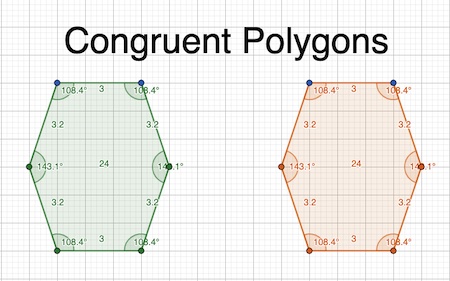
This means every side and every angle in one polygon matches the corresponding side and angle in the other polygon.
The polygons may be moved, rotated or reflected, but they are still congruent.
Key Idea
Congruent polygons are identical copies of each other.
Notation
\( ABCD \cong PQRS \)
The order shows which vertices correspond.
Important
If the size changes (enlarged or reduced), the shapes are similar, not congruent.
Example 1:
Two pentagons have all corresponding sides 5 cm and equal angles. Are they congruent?
▶️ Answer/Explanation
Same side lengths and same angles.
Conclusion: The pentagons are congruent.
Example 2:
Two triangles have equal angles but one triangle is larger. Are they congruent?
▶️ Answer/Explanation
Angles are the same but side lengths are different.
Conclusion: Not congruent (they are similar).
Example 3:
A square of side 4 cm and another square of side 4 cm turned upside down. Are they congruent?
▶️ Answer/Explanation
Rotation does not change size or shape.
Conclusion: They are congruent.