
Reading Scales on Measuring Instruments
Many measuring instruments use a scale. A scale is a set of marked divisions that show measurements.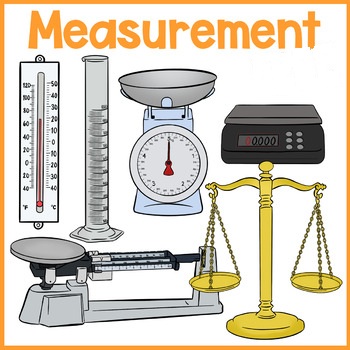
Common instruments include:
- rulers
- measuring cylinders
- thermometers
- weighing scales
Steps to Read a Scale
1. Identify the units (cm, g, ml, °C, etc.).
2. Count how many small divisions between labelled marks.
3. Find the value of each small division.
4. Read the value at the pointer or liquid level.
Important
Always read at eye level to avoid parallax error.
Example 1:
A ruler shows numbers every 1 cm and 10 small divisions between them. What is each small division worth?
▶️ Answer/Explanation
\( 1 \text{ cm} ÷ 10 = 0.1 \text{ cm} \)
Conclusion: Each small division is 0.1 cm (1 mm).
Example 2:
A measuring cylinder is marked 100 ml, 200 ml, 300 ml with 5 equal divisions between each. What is the value of one division?
▶️ Answer/Explanation
Difference between marks:
\( 200 – 100 = 100 \text{ ml} \)
Divide by 5:
\( 100 ÷ 5 = 20 \text{ ml} \)
Conclusion: Each division is 20 ml.
Example 3:
A thermometer shows −5°C to 5°C with 10 equal divisions. What is one division worth?
▶️ Answer/Explanation
Total range:
\( 5 – (-5) = 10^\circ C \)
Divide by 10:
\( 10 ÷ 10 = 1^\circ C \)
Conclusion: Each division is \( 1^\circ C \).
Time Intervals and 12-Hour & 24-Hour Clock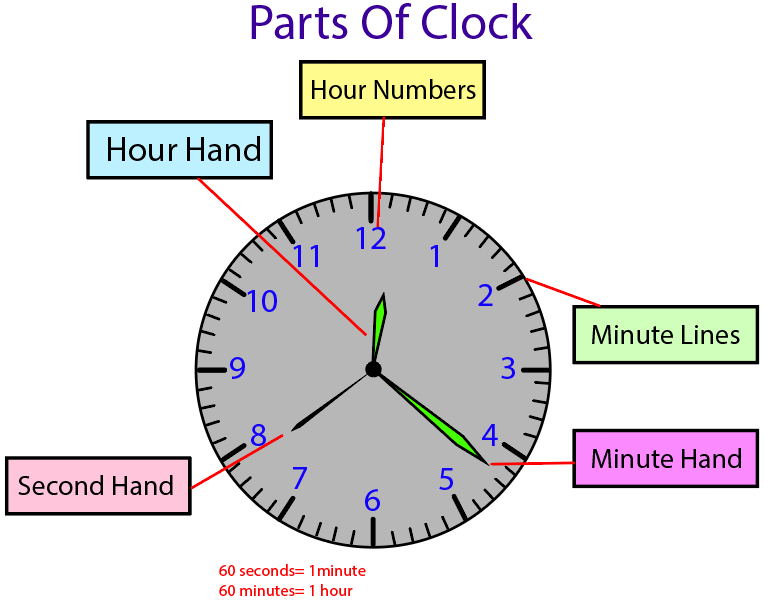
12-Hour Clock
The day is split into two parts:
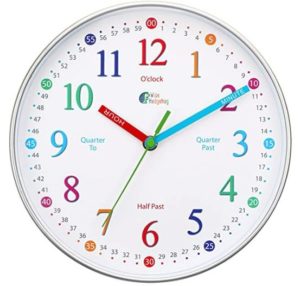
- am → midnight to noon
- pm → noon to midnight
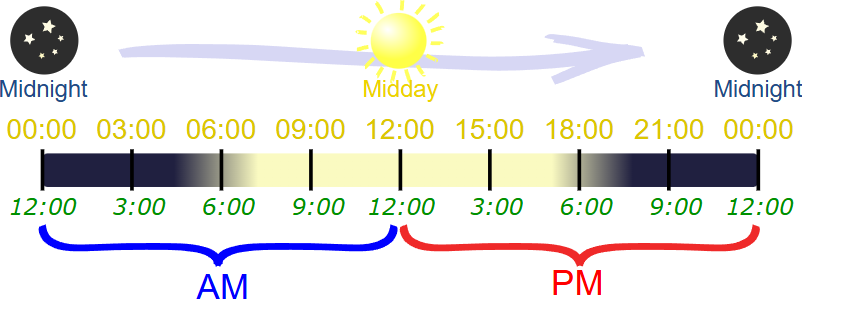
Example: 7:30 am (morning), 7:30 pm (evening)
24-Hour Clock
The day runs from 00:00 to 23:59.
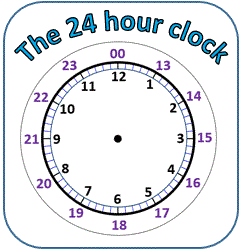
To convert pm times (except 12 pm), add 12 to the hour.
1:00 pm → 13:00
6:45 pm → 18:45
Midnight:
12:00 am → 00:00
Finding a Time Interval
Subtract the earlier time from the later time.
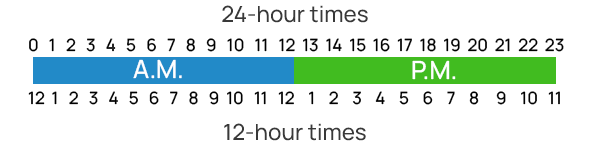
It is often easier to convert both times to the 24-hour clock first.
Example 1:
Convert 8:25 pm to the 24-hour clock.
▶️ Answer/Explanation
Add 12 to the hour:
\( 8 + 12 = 20 \)
20:25
Conclusion: 20:25.
Example 2:
A train leaves at 14:35 and arrives at 16:05. Find the journey time.
▶️ Answer/Explanation
From 14:35 to 15:35 = 1 hour
From 15:35 to 16:05 = 30 minutes
Conclusion: 1 hour 30 minutes.
Example 3:
A movie starts at 6:40 pm and finishes at 8:15 pm. How long is the movie?
▶️ Answer/Explanation
Convert to 24-hour:
6:40 pm → 18:40
8:15 pm → 20:15
18:40 → 19:40 = 1 hour
19:40 → 20:15 = 35 minutes
Conclusion: 1 hour 35 minutes.
Making Sensible Estimates of Measures
An estimate is a reasonable guess of a measurement without calculating or measuring exactly.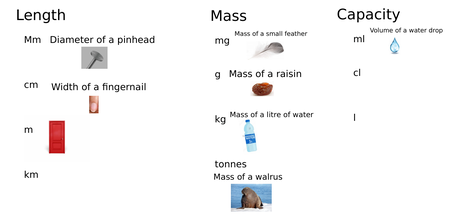
Estimation is useful to check if an answer is sensible in real life.
Common Everyday Estimates
Height of a door ≈ 2 m
Mass of a textbook ≈ 1 kg
Length of a pen ≈ 15 cm
Walking speed ≈ 5 km/h
Room temperature ≈ 20°C
Tips
Choose the correct unit (mm, cm, m, km, g, kg, ml, L).
Compare with objects you already know.
Avoid unrealistic answers.
Example 1:
Choose a sensible estimate for the mass of a watermelon:
5 g, 5 kg, 50 kg
▶️ Answer/Explanation
5 g is too small. 50 kg is far too heavy.
Conclusion: About 5 kg.
Example 2:
Choose a sensible estimate for the height of a person:
1.7 m, 17 m, 17 cm
▶️ Answer/Explanation
17 m is taller than a building. 17 cm is too small.
Conclusion: About 1.7 m.
Example 3:
Choose a sensible estimate for the capacity of a cup:
250 ml, 25 L, 2 ml
▶️ Answer/Explanation
25 L is far too large and 2 ml is too small.
Conclusion: About 250 ml.
Angle Measure and Three-Figure Bearings
Measuring Angles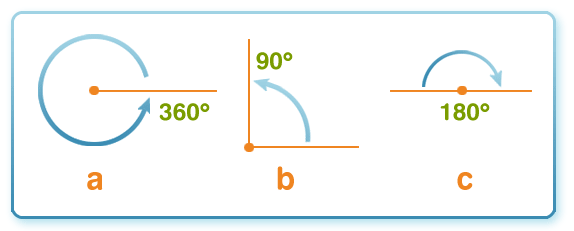
Angles are measured in degrees (°).
A full turn is:
\( 360^\circ \)
Quarter turn:
\( 90^\circ \)
Half turn:
\( 180^\circ \)
Bearings
A bearing describes direction using angles.
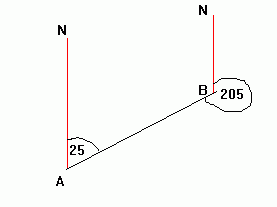
Bearings are always measured:
• clockwise
• from North
• written using three digits
Important Directions
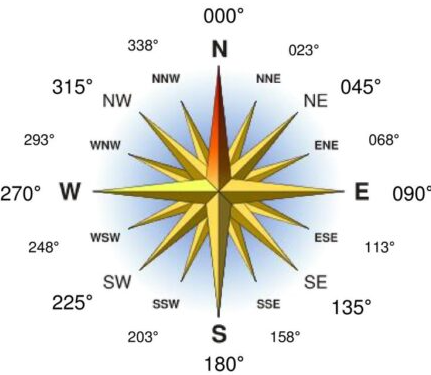
- North = \( 000^\circ \)
- East = \( 090^\circ \)
- South = \( 180^\circ \)
- West = \( 270^\circ \)
Example: North-East is about \( 045^\circ \).
Writing Bearings
Always use three figures:
\( 5^\circ \rightarrow 005^\circ \)
\( 40^\circ \rightarrow 040^\circ \)
Example 1:
What is the bearing of East?
▶️ Answer/Explanation
Measured clockwise from North.
\( 090^\circ \)
Conclusion: \( 090^\circ \).
Example 2:
A ship travels directly south. Write the bearing.
▶️ Answer/Explanation
South from North clockwise:
\( 180^\circ \)
Conclusion: \( 180^\circ \).
Example 3:
A point lies \( 60^\circ \) clockwise from North. Write the three-figure bearing.
▶️ Answer/Explanation
Write with three digits:
\( 060^\circ \)
Conclusion: \( 060^\circ \).
Measuring Angles to the Nearest Degree
Angles are measured using a protractor.
When measuring, the answer is usually given to the nearest degree.
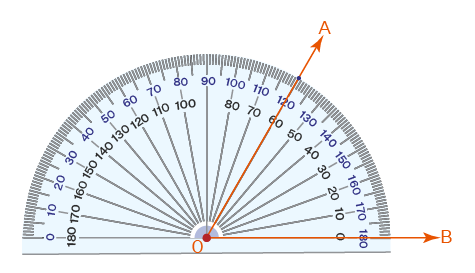
Steps to Measure an Angle
1. Place the centre of the protractor on the vertex (corner of the angle).
2. Line up one side of the angle with the zero line.
3. Read the number where the second side crosses the scale.
4. Round to the nearest degree if needed.
Rounding Rule
0.5 or more → round up
less than 0.5 → round down
Example 1:
An angle reads \( 47.6^\circ \) on the protractor. Give the angle to the nearest degree.
▶️ Answer/Explanation
0.6 ≥ 0.5 so round up.
\( 48^\circ \)
Conclusion: \( 48^\circ \).
Example 2:
An angle measures \( 92.3^\circ \). Round to the nearest degree.
▶️ Answer/Explanation
0.3 < 0.5 so round down.
\( 92^\circ \)
Conclusion: \( 92^\circ \).
Example 3:
A student measures an angle as \( 134.5^\circ \). Give the angle to the nearest degree.
▶️ Answer/Explanation
0.5 rounds up.
\( 135^\circ \)
Conclusion: \( 135^\circ \).