
Measuring and Drawing Lines to the Nearest Millimetre
In construction, accuracy is very important. Lengths are usually measured in millimetres (mm).
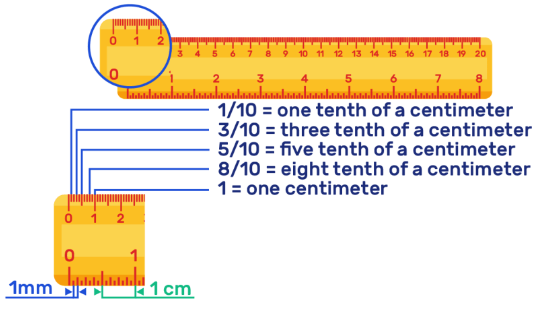
Remember:
\( 10 \text{ mm} = 1 \text{ cm} \)
A ruler has small divisions and each small mark represents 1 mm.
How to Measure a Line
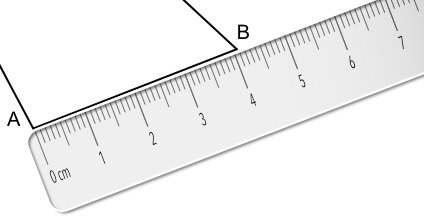
1. Place the zero mark of the ruler exactly at the start of the line.
2. Look vertically above the end of the line.
3. Read the nearest millimetre.
How to Draw a Line of a Given Length
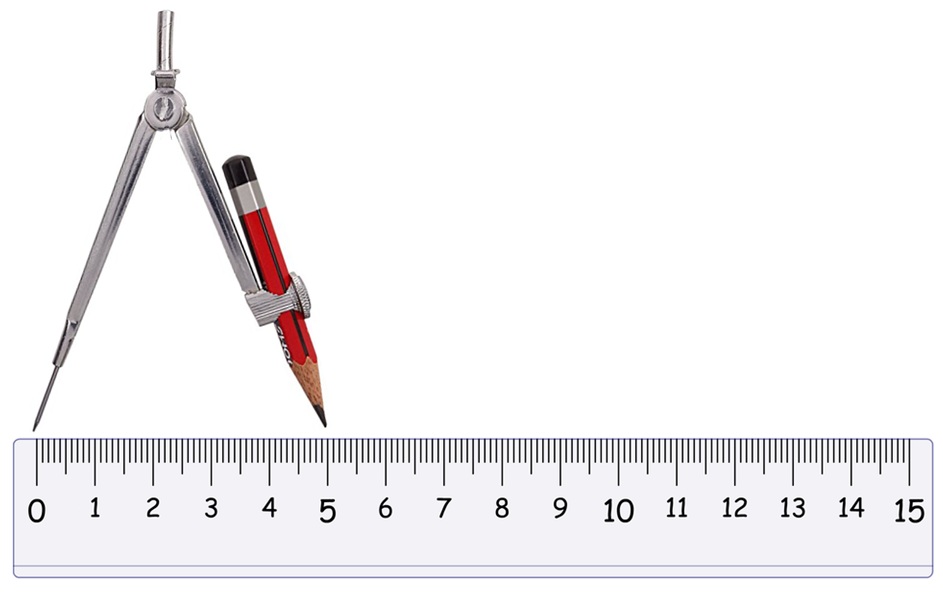
1. Mark a starting point.
2. Place the ruler with 0 on the starting point.
3. Mark the required length.
4. Join the points using the ruler.
Important
Always keep your eye directly above the scale to avoid reading errors.
Example 1:
Draw a line of length \( 56 \text{ mm} \).
▶️ Answer/Explanation
Mark a starting point.
Measure 56 small divisions from zero.
Join using a ruler.
Conclusion: Line drawn to nearest mm.
Example 2:
Measure a line that ends halfway between 7.2 cm and 7.3 cm. Give the length in millimetres.
▶️ Answer/Explanation
Halfway = 7.25 cm
\( 7.25 \text{ cm} = 72.5 \text{ mm} \)
Rounded to nearest mm:
\( 73 \text{ mm} \)
Conclusion: 73 mm.
Example 3:
A line measures 4.8 cm. Write the length in millimetres.
▶️ Answer/Explanation
\( 4.8 \times 10 = 48 \text{ mm} \)
Conclusion: 48 mm.
Constructing Triangles and 2D Shapes
Geometrical construction means drawing shapes accurately using mathematical instruments.
The main instruments are:
• ruler (for straight lines)
• protractor (for angles)
• compasses (for arcs and equal lengths)
Constructing a Triangle (Example Method)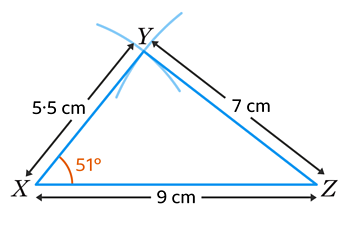
To construct a triangle when two sides and the included angle are given:
1. Draw the base line using a ruler.
2. Use a protractor to measure the required angle at one end.
3. Draw a ray at that angle.
4. Use compasses to mark the second side length.
5. Join the points to complete the triangle.
Important
Do not guess or sketch freehand. All lines and arcs must be drawn using instruments.
Example 1:
Construct a triangle with sides 6 cm and 5 cm and included angle \( 70^\circ \).
▶️ Answer/Explanation
Draw 6 cm base.
Measure \( 70^\circ \) using protractor.
Use compasses to mark 5 cm on the ray.
Join endpoints.
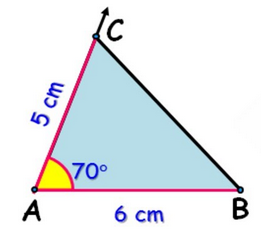
Conclusion: Triangle constructed accurately.
Example 2:
Construct an equilateral triangle of side 4 cm.
▶️ Answer/Explanation
Draw a 4 cm line.
With compasses radius 4 cm, draw arcs from both ends.
Join intersection to endpoints.
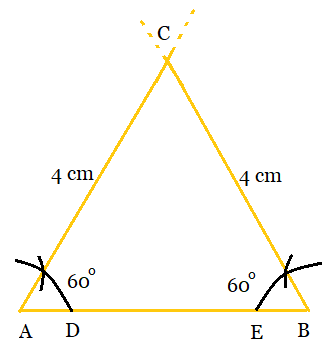
Conclusion: Equilateral triangle constructed.
Example 3:
Construct a rectangle 4 cm by 3 cm.
▶️ Answer/Explanation
Draw 4 cm base.
Construct right angles at both ends using protractor.
Measure 3 cm up each side.
Join top ends.
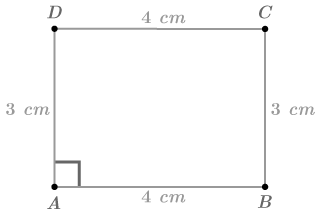
Conclusion: Rectangle constructed.
Solving Problems Using Scale Drawings
A scale drawing is a drawing that represents a real object but at a reduced or enlarged size.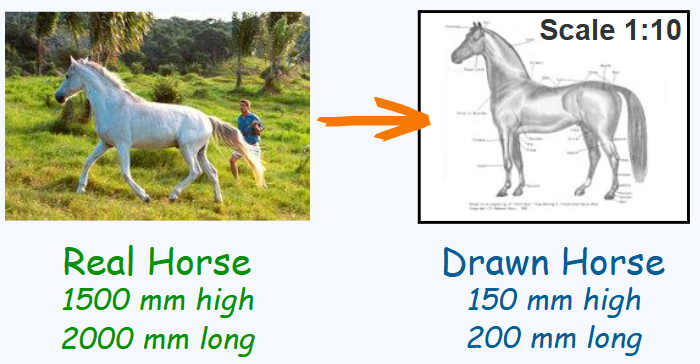
The drawing keeps the same shape and proportions as the real object.
Scale
The scale tells the relationship between the drawing and real life.
Example: \( 1 : 10 \)
This means:
1 cm on the drawing represents 100 cm (1 m) in real life.
Method
1. Measure the distance on the drawing using a ruler.
2. Multiply by the scale factor.
3. Convert units if necessary.
Important
Always write the final answer with correct real-life units (m, km, etc.).
Example 1:
A map has a scale \( 1 : 1000 \). Two towns are 6 cm apart on the map. Find the real distance.
▶️ Answer/Explanation
\( 6 \times 1000 = 6000 \text{ cm} \)
Convert to metres:
\( 6000 \text{ cm} = 60 \text{ m} \)
Conclusion: 60 m.
Example 2:
On a plan, a wall measures 4.5 cm. Scale \( 1 : 50 \). Find the real length.
▶️ Answer/Explanation
\( 4.5 \times 50 = 225 \text{ cm} \)
\( 225 \text{ cm} = 2.25 \text{ m} \)
Conclusion: 2.25 m.
Example 3:
A real road is 200 m long. Scale \( 1 : 2000 \). Find its length on the map.
▶️ Answer/Explanation
Convert to cm:
\( 200 \text{ m} = 20000 \text{ cm} \)
Divide by scale:
\( 20000 ÷ 2000 = 10 \text{ cm} \)
Conclusion: 10 cm on the map.
Constructing with a Straight Edge and Compasses
In geometrical constructions you must not measure using numbers. You only use:
• a straight edge (ruler without markings)
• a pair of compasses
(i) Perpendicular Bisector of a Line Segment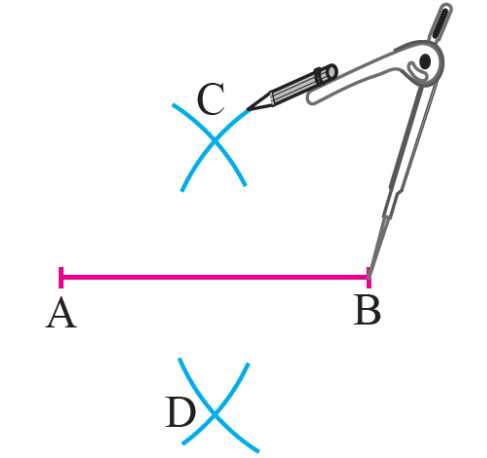
A perpendicular bisector:
• cuts the line into two equal parts
• forms a \( 90^\circ \) angle with the line
Steps
1. Draw the line segment \( AB \).
2. Place the compass at A and draw an arc above and below the line.
3. Without changing the compass width, repeat from B.
4. Join the intersection points of the arcs.
The line drawn is the perpendicular bisector.
(ii) Bisector of an Angle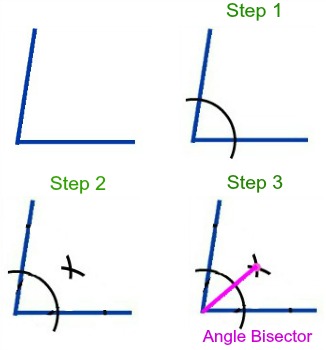
An angle bisector divides an angle into two equal angles.
Steps
1. Place the compass at the vertex and draw an arc cutting both sides of the angle.
2. From each cut point, draw arcs that intersect.
3. Join the vertex to the intersection point.
This line is the angle bisector.
Example 1:
What does a perpendicular bisector create?
▶️ Answer/Explanation
It divides the line into equal halves and forms a right angle.
Conclusion: Equal halves and \( 90^\circ \).
Example 2:
An angle is \( 80^\circ \). After bisecting, what is each angle?
▶️ Answer/Explanation
\( 80^\circ ÷ 2 = 40^\circ \)
Conclusion: \( 40^\circ \) each.
Example 3:
What is special about any point on a perpendicular bisector?
▶️ Answer/Explanation
It is the same distance from both endpoints of the line.
Conclusion: Equidistant from A and B.