
Rotations
A rotation is a transformation where a shape turns about a fixed point.
The shape does not change size or shape. Only its position and orientation change.
Centre of Rotation
The point about which the shape turns is called the centre of rotation.
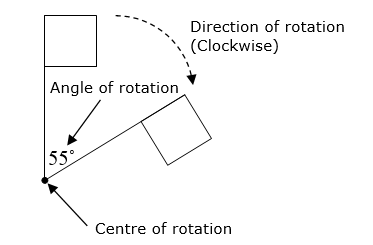
Every point on the shape stays the same distance from this centre.
Angle of Rotation
The amount of turning is measured in degrees.
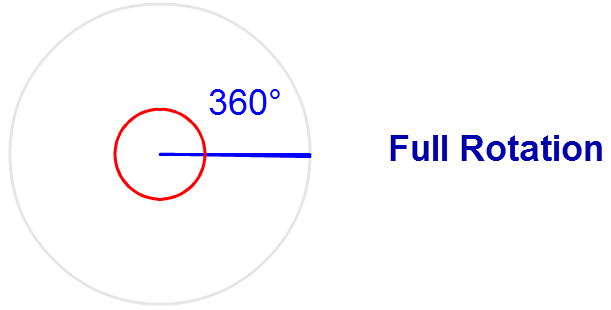
Common rotations: \( 90^\circ,\; 180^\circ,\; 270^\circ \)
Important Idea
To describe a rotation completely, you must state:
• the centre of rotation
• the angle of rotation
Without the centre, the rotation is not fully described.
Example 1:
A triangle is turned \( 90^\circ \) about the origin. Identify the centre of rotation.
▶️ Answer/Explanation
The origin is the point \( (0,0) \).
Conclusion: Centre of rotation is \( (0,0) \).
Example 2:
A square rotates around point \( (2,3) \). What information is given?
▶️ Answer/Explanation
The fixed turning point is known.
Conclusion: The centre of rotation is \( (2,3) \).
Example 3:
A shape turns \( 180^\circ \) about a point. Does its size change?
▶️ Answer/Explanation
No. Rotation does not change size.
Conclusion: Shape remains the same size and shape.
Rotating a Shape About a Point
To rotate a shape means to turn it around a fixed point called the centre of rotation.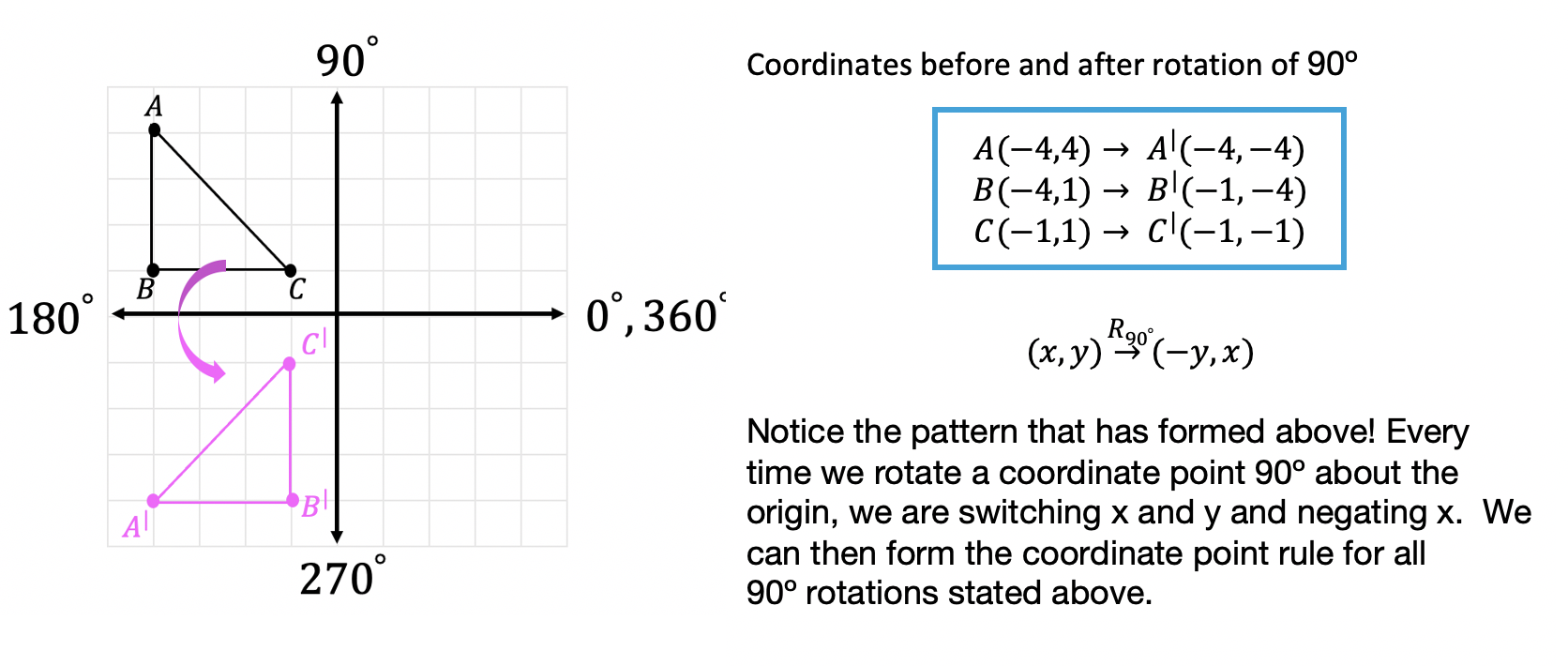
Each corner (vertex) of the shape moves along a circular path around the centre.
Key Rule
Every point stays the same distance from the centre of rotation.
Steps to Rotate a Shape
1. Mark the centre of rotation.
2. Measure the distance from the centre to each vertex.
3. Turn each point through the given angle.
4. Plot the new positions and join the points.
Special Rotations About the Origin
For a point \( (x, y) \):
\( 90^\circ \) anticlockwise → \( (-y, x) \)
\( 180^\circ \) → \( (-x, -y) \)
\( 270^\circ \) anticlockwise → \( (y, -x) \)
Example 1:
Rotate the point \( (3, 1) \) \( 90^\circ \) anticlockwise about the origin.
▶️ Answer/Explanation
Use rule \( (x, y) \rightarrow (-y, x) \)
\( (3,1) \rightarrow (-1,3) \)
Conclusion: New position \( (-1,3) \).
Example 2:
Rotate the point \( (2, -4) \) \( 180^\circ \) about the origin.
▶️ Answer/Explanation
Use rule \( (x, y) \rightarrow (-x, -y) \)
\( (2,-4) \rightarrow (-2,4) \)
Conclusion: \( (-2,4) \).
Example 3:
Rotate the point \( (5, -2) \) \( 270^\circ \) anticlockwise about the origin.
▶️ Answer/Explanation
Use rule \( (x, y) \rightarrow (y, -x) \)
\( (5,-2) \rightarrow (-2,-5) \)
Conclusion: \( (-2,-5) \).
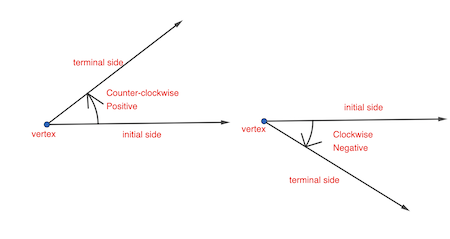
Positive and Negative Rotations
Rotations can happen in two directions.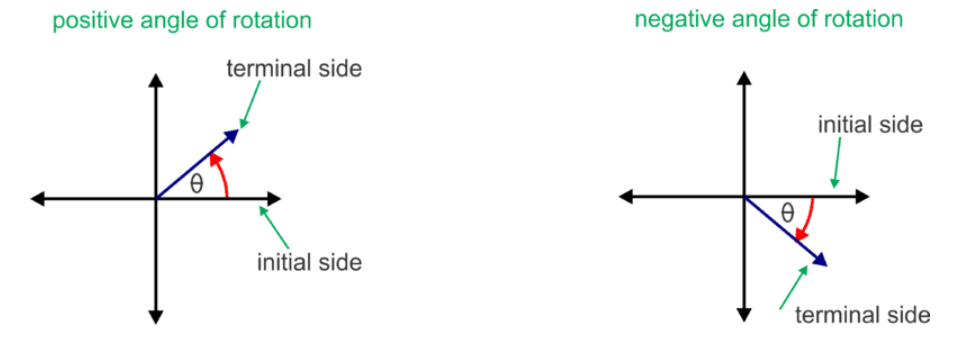
Anticlockwise Rotation
An anticlockwise turn is taken as a positive angle.
Example: \( +90^\circ,\; +180^\circ \)
Clockwise Rotation
A clockwise turn is taken as a negative angle.
Example: \( -90^\circ,\; -180^\circ \)
Important
Positive = anticlockwise Negative = clockwise
The size and shape of the figure do not change.
Example 1:
A point is rotated \( -90^\circ \) about a centre. Which direction does it move?
▶️ Answer/Explanation
Negative angles mean clockwise rotation.
Conclusion: Clockwise.
Example 2:
A triangle is rotated \( +180^\circ \). Is the rotation clockwise or anticlockwise?
▶️ Answer/Explanation
Positive angles are anticlockwise.
Conclusion: Anticlockwise.
Example 3:
A shape rotates clockwise through \( 90^\circ \). Write the rotation using a signed angle.
▶️ Answer/Explanation
Clockwise = negative.
\( -90^\circ \)
Conclusion: \( -90^\circ \).
Reflections and Mirror Lines
A reflection is a transformation that flips a shape over a line.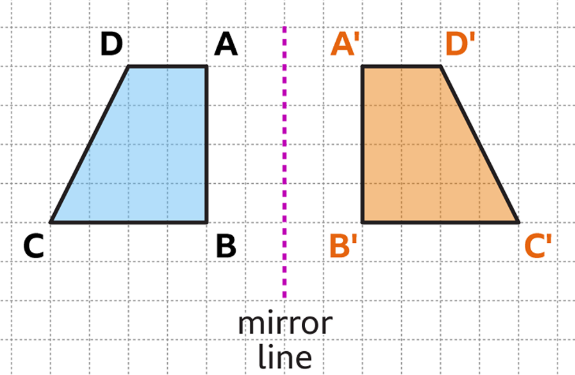
The line is called the mirror line (line of reflection).
The reflected shape is the same size and shape but reversed.
Key Rule
Every point on the image is the same distance from the mirror line as the original point.
The mirror line lies exactly halfway between corresponding points.
Common Mirror Lines
\( x = 1 \) (vertical line)
\( y = 2 \) (horizontal line)
\( y = x \)
\( y – x = 0 \) (same as \( y = x \))
Important
A reflection does not change side lengths or angles.
Example 1:
What type of line is \( x = 3 \)?
▶️ Answer/Explanation
Lines of the form \( x = \text{constant} \) are vertical lines.
Conclusion: Vertical mirror line.
Example 2:
What type of line is \( y = -2 \)?
▶️ Answer/Explanation
Lines of the form \( y = \text{constant} \) are horizontal lines.
Conclusion: Horizontal mirror line.
Example 3:
What is special about the line \( y = x \)?
▶️ Answer/Explanation
It is a diagonal mirror line passing through the origin at \( 45^\circ \).
Conclusion: Diagonal line of reflection.
Reflecting a Shape and Constructing a Mirror Line
To reflect a shape means to flip it over a mirror line.
The reflected shape is the same size and shape but appears on the opposite side of the line.
Key Rule
Each point and its image are:
• the same distance from the mirror line
• directly opposite each other
Steps to Reflect a Shape
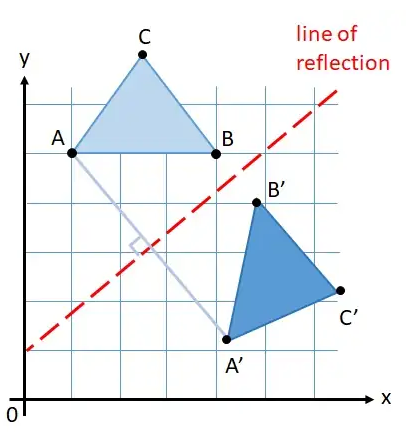
1. Draw the mirror line.
2. From each vertex, draw a perpendicular to the mirror line.
3. Measure the distance from the point to the mirror line.
4. Mark the same distance on the other side.
5. Join the new points.
Constructing the Mirror Line
If an object and its image are given, the mirror line lies halfway between corresponding points.
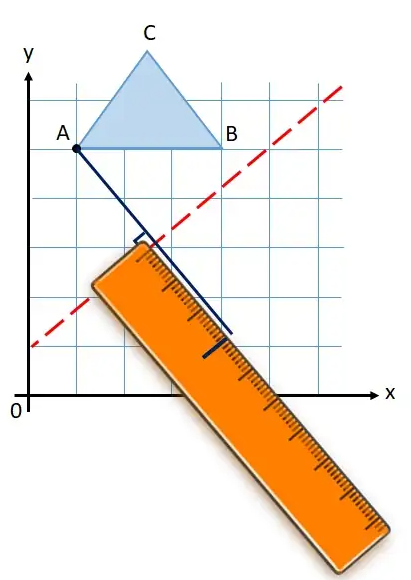
It is the perpendicular bisector of the line joining a point and its image.
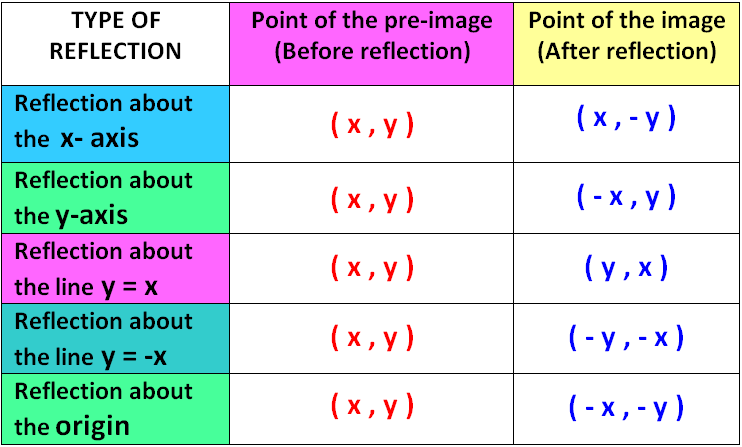
Reflection in \( y = x \)
Coordinates swap places:
\( (x, y) \rightarrow (y, x) \)
Example 1:
Reflect the point \( (3, 5) \) in the line \( y = x \).
▶️ Answer/Explanation
Swap coordinates.
\( (3,5) \rightarrow (5,3) \)
Conclusion: \( (5,3) \).
Example 2:
A point is 4 cm from the mirror line. How far is its image from the mirror line?
▶️ Answer/Explanation
Distances are equal.
Conclusion: 4 cm.
Example 3:
A point and its image are joined by a line. Where is the mirror line?
▶️ Answer/Explanation
It is the perpendicular bisector of the joining line.
Conclusion: Halfway and at \( 90^\circ \).
Translations
A translation is a transformation that slides a shape from one position to another.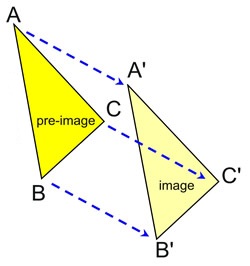
The shape does not turn or flip.
Its size, angles and orientation remain the same.
Distance and Direction
A translation must be described using:
• how far the shape moves (distance)
• which way it moves (direction)
For example:
4 units right
3 units up
Important
Every point of the shape moves the same distance in the same direction.
Example 1:
A triangle moves 5 units to the right. What type of transformation is this?
▶️ Answer/Explanation
The shape slides without turning.
Conclusion: Translation.
Example 2:
A square moves 3 units up and 2 units left. Does its size change?
▶️ Answer/Explanation
No. Translations keep the same size and shape.
Conclusion: Size unchanged.
Example 3:
A point moves 6 units down. Which direction is the movement?
▶️ Answer/Explanation
Downward direction.
Conclusion: Vertical downward translation.
Translating a Shape
To translate a shape means to slide it to a new position.
Every vertex moves the same distance in the same direction.
The shape does not rotate or reflect.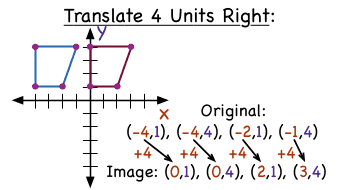
How to Translate on a Grid
- Right → increase \( x \)
- Left → decrease \( x \)
- Up → increase \( y \)
- Down → decrease \( y \)
Steps
1. Move each vertex horizontally.
2. Then move vertically.
3. Join the new points.
Example 1:
Translate the point \( (2, 3) \) 4 units right and 1 unit up.
▶️ Answer/Explanation
Right 4 → \( x = 2 + 4 = 6 \)
Up 1 → \( y = 3 + 1 = 4 \)
\( (6,4) \)
Conclusion: New point \( (6,4) \).
Example 2:
Translate the point \( (5, -2) \) 3 units left and 2 units down.
▶️ Answer/Explanation
Left 3 → \( x = 5 – 3 = 2 \)
Down 2 → \( y = -2 – 2 = -4 \)
\( (2,-4) \)
Conclusion: \( (2,-4) \).
Example 3:
Translate the point \( (-1, 4) \) 2 units right and 5 units down.
▶️ Answer/Explanation
Right 2 → \( x = -1 + 2 = 1 \)
Down 5 → \( y = 4 – 5 = -1 \)
\( (1,-1) \)
Conclusion: \( (1,-1) \).
Column Vectors in Translations
Translations can be written using a column vector.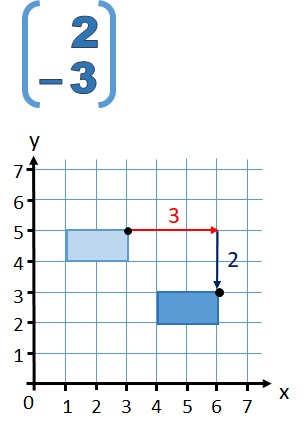
A column vector shows how far a point moves horizontally and vertically.
Form of a Column Vector
\( \begin{pmatrix} a \\ b \end{pmatrix} \)
where
- \( a \) = movement in the \( x \)-direction
- \( b \) = movement in the \( y \)-direction
Direction Rules
- Positive \( a \) → right
- Negative \( a \) → left
- Positive \( b \) → up
- Negative \( b \) → down
Applying a Translation
Add the vector to the coordinates.
New point \( = (x+a,\; y+b) \)
Example 1:
Translate point \( (2,3) \) by vector \( \begin{pmatrix} 4 \\ 1 \end{pmatrix} \).
▶️ Answer/Explanation
\( (2+4,\; 3+1) = (6,4) \)
Conclusion: \( (6,4) \).
Example 2:
Translate \( (5,-2) \) by vector \( \begin{pmatrix} -3 \\ 2 \end{pmatrix} \).
▶️ Answer/Explanation
\( (5-3,\; -2+2) = (2,0) \)
Conclusion: \( (2,0) \).
Example 3:
A point moves left 2 units and down 5 units. Write the column vector.
▶️ Answer/Explanation
Left = negative \( x \), down = negative \( y \)
\( \begin{pmatrix} -2 \\ -5 \end{pmatrix} \)
Conclusion: \( \begin{pmatrix} -2 \\ -5 \end{pmatrix} \).
Congruence and Transformations
Some transformations keep a shape exactly the same size and shape.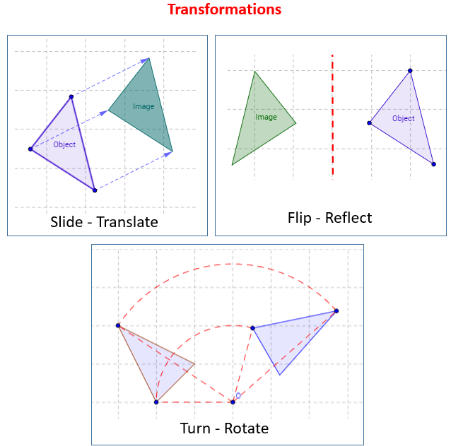
These are called isometric transformations.
Three Important Transformations
• Rotation
• Reflection
• Translation
Key Property
These transformations preserve:
• side lengths
• angles
So the new image is congruent to the original shape.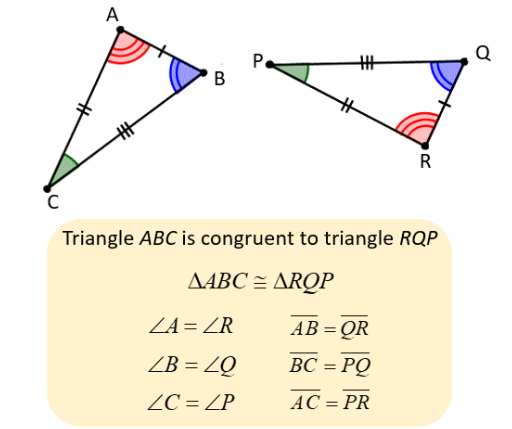
Congruent Shapes
Congruent shapes have:
- same shape
- same size
Only their position or orientation may change.
Important
Enlargements are NOT congruent because lengths change.
Example 1:
A triangle is translated 5 units right. Is the image congruent?
▶️ Answer/Explanation
No size change occurs.
Conclusion: Congruent.
Example 2:
A square is reflected in a mirror line. Are angles preserved?
▶️ Answer/Explanation
Reflection keeps all angles the same.
Conclusion: Yes.
Example 3:
A rectangle is enlarged by scale factor 2. Is it congruent?
▶️ Answer/Explanation
Side lengths change.
Conclusion: Not congruent.
Enlargements
An enlargement is a transformation that changes the size of a shape.
The shape keeps the same form but becomes bigger or smaller.
Centre of Enlargement
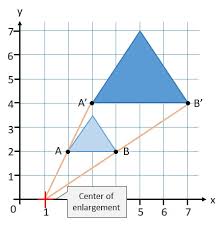
The fixed point from which the shape grows or shrinks is called the centre of enlargement.
Every vertex moves directly away from or towards this point.
Scale Factor
The scale factor tells how much the shape changes size.
\( \text{Scale factor} = \dfrac{\text{new length}}{\text{original length}} \)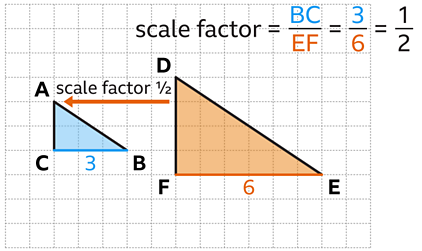
Positive scale factors only are used.
If:
Scale factor \( > 1 \) → enlargement (bigger)
Scale factor \( < 1 \) → reduction (smaller)
Important
You must state both:
• the centre of enlargement
• the scale factor
Example 1:
A triangle has side 3 cm. After enlargement the side is 9 cm. Find the scale factor.
▶️ Answer/Explanation
\( 9 ÷ 3 = 3 \)
Conclusion: Scale factor \( = 3 \).
Example 2:
A square of side 10 cm becomes 5 cm. Find the scale factor.
▶️ Answer/Explanation
\( 5 ÷ 10 = \dfrac{1}{2} \)
Conclusion: Scale factor \( = \dfrac{1}{2} \).
Example 3:
A shape doubles in size. What is the scale factor?
▶️ Answer/Explanation
Doubling means multiply by 2.
Conclusion: Scale factor = 2.
Properties of Enlargements
An enlargement changes the size of a shape but keeps its shape.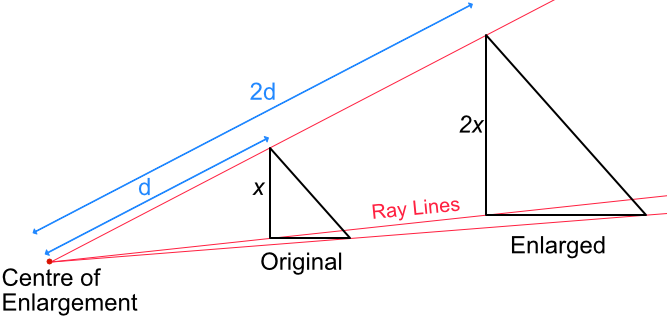
What Stays the Same
During an enlargement:
• angles remain equal
• overall shape stays the same
What Changes
• side lengths change
• perimeter changes
• area changes
So the image is similar but not congruent.
Key Idea
Angles stay the same, but lengths are multiplied by the scale factor.
Example 1:
A triangle is enlarged by scale factor 3. What happens to its angles?
▶️ Answer/Explanation
Enlargements keep angles unchanged.
Conclusion: Angles remain the same.
Example 2:
A square has side 4 cm. It is enlarged by scale factor 2. Find the new side length.
▶️ Answer/Explanation
\( 4 \times 2 = 8 \)
Conclusion: 8 cm.
Example 3:
Why is an enlargement not congruent?
▶️ Answer/Explanation
Side lengths change.
Conclusion: Not the same size.
Enlarging a Shape
To enlarge a shape means to make it bigger or smaller using a scale factor.
All distances from the centre of enlargement are multiplied by the scale factor.
Steps to Enlarge a Shape
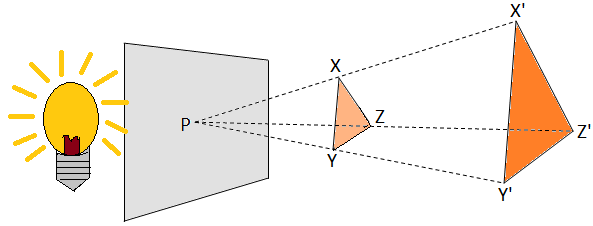
1. Mark the centre of enlargement.
2. Draw a line from the centre to each vertex.
3. Multiply the distance by the scale factor.
4. Mark the new points and join them.
Coordinate Method (centre at origin)
If the centre is \( (0,0) \) and the scale factor is \( k \):
\( (x,y) \rightarrow (kx, ky) \)
Example 1:
Enlarge the point \( (2,3) \) by scale factor 2 about the origin.
▶️ Answer/Explanation
\( (2\times2,\;3\times2)=(4,6) \)
Conclusion: \( (4,6) \).
Example 2:
Enlarge \( (5,-1) \) by scale factor \( \dfrac{1}{2} \) about the origin.
▶️ Answer/Explanation
\( (5\times\dfrac{1}{2},\;-1\times\dfrac{1}{2})=(2.5,-0.5) \)
Conclusion: \( (2.5,-0.5) \).
Example 3:
A point \( (3,4) \) is enlarged with scale factor 3. Find the new coordinates.
▶️ Answer/Explanation
\( (3\times3,\;4\times3)=(9,12) \)
Conclusion: \( (9,12) \).
Describing Transformations
To describe a transformation means giving complete information about how a shape has changed position.
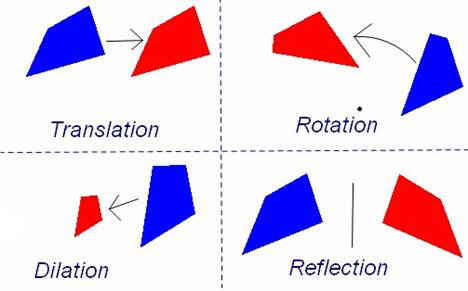
You must name the type of transformation and include all required details.
1. Translation
Describe using a column vector.
\( \begin{pmatrix} a \\ b \end{pmatrix} \)
State how many units right/left and up/down.
2. Rotation
You must give:
• angle of rotation
• direction (clockwise or anticlockwise)
• centre of rotation
3. Reflection
State the mirror line.
Examples: \( x = 2 \), \( y = -1 \), \( y = x \)
4. Enlargement
You must give:
• scale factor
• centre of enlargement
Important
Without all required information, the description is incomplete.
Example 1:
A shape moves 3 units right and 2 units up. Describe the transformation.
▶️ Answer/Explanation
Translation by
\( \begin{pmatrix} 3 \\ 2 \end{pmatrix} \)
Conclusion: Translation.
Example 2:
A triangle is flipped across the line \( x = 1 \). Describe the transformation.
▶️ Answer/Explanation
Reflection in the line \( x = 1 \).
Conclusion: Reflection.
Example 3:
A shape turns \( 90^\circ \) anticlockwise about \( (0,0) \). Describe the transformation.
▶️ Answer/Explanation
Rotation \( 90^\circ \) anticlockwise about the origin.
Conclusion: Rotation.