
Converting Recurring Decimals into Fractions
A recurring decimal is a decimal in which one or more digits repeat forever.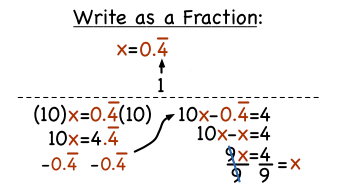
\( 0.\dot{3}=0.3333\ldots \)
\( 0.1\dot{6}=0.1666\ldots \)
\( 0.3\dot{2}=0.3222\ldots \)
All recurring decimals can be written exactly as fractions.
Method
1. Let the recurring decimal equal \( x \).
2. Multiply by a power of 10 so the recurring digits line up.
3. Subtract the two equations.
4. Solve for \( x \) and simplify.
Important Idea
The number of recurring digits determines how much you multiply by.
1 recurring digit → multiply by \( 10 \)
2 recurring digits → multiply by \( 100 \)
Example 1:
Convert \( 0.\dot{3} \) to a fraction.
▶️ Answer/Explanation
Let \( x=0.3333\ldots \)
\( 10x=3.3333\ldots \)
Subtract:
\( 10x-x=3.3333\ldots-0.3333\ldots \)
\( 9x=3 \)
\( x=\dfrac{3}{9}=\dfrac{1}{3} \)
Conclusion: \( \dfrac{1}{3} \).
Example 2:
Convert \( 0.1\dot{6} \) to a fraction.
▶️ Answer/Explanation
Let \( x=0.1666\ldots \)
\( 10x=1.6666\ldots \)
Subtract:
\( 10x-x=1.6666\ldots-0.1666\ldots \)
\( 9x=1.5 \)
\( x=\dfrac{1.5}{9}=\dfrac{15}{90}=\dfrac{1}{6} \)
Conclusion: \( \dfrac{1}{6} \).
Example 3:
Convert \( 0.3\dot{2} \) to a fraction.
▶️ Answer/Explanation
Let \( x=0.3222\ldots \)
\( 10x=3.2222\ldots \)
\( 100x=32.2222\ldots \)
Subtract:
\( 100x-10x=32.2222\ldots-3.2222\ldots \)
\( 90x=29 \)
\( x=\dfrac{29}{90} \)
Conclusion: \( \dfrac{29}{90} \).