Edexcel Mathematics (4XMAH) -Unit 1 - 1.4 Powers and Roots- Study Notes- New Syllabus
Edexcel Mathematics (4XMAH) -Unit 1 – 1.4 Powers and Roots- Study Notes- New syllabus
Edexcel Mathematics (4XMAH) -Unit 1 – 1.4 Powers and Roots- Study Notes -Edexcel iGCSE Mathematics – per latest Syllabus.
Key Concepts:
A understand the meaning of surds
Simplify: √8 + 3√32
B manipulate surds, including rationalising a denominator
Express in the form a + b√2: (3 + 5√2)²
Rationalise: 2/√8 , 1/(2 − √3)
C use index laws to simplify and evaluate numerical expressions involving integer, fractional and negative powers
Evaluate: ³√(8²) , 625¹ᐟ² , (1/25)³ᐟ²
Edexcel iGCSE Mathematics -Concise Summary Notes- All Topics
Surds
A surd is a root that cannot be written exactly as a terminating or recurring decimal.
\( \sqrt{2},\; \sqrt{3},\; \sqrt{5} \) are surds
However, some square roots are not surds because they simplify to whole numbers.
\( \sqrt{4}=2,\; \sqrt{9}=3,\; \sqrt{16}=4 \)
Simplifying Surds
To simplify a surd, take out any square number factors from inside the root.
\( \sqrt{ab}=\sqrt{a}\sqrt{b} \)
Example:
\( \sqrt{8}=\sqrt{4\times2}=2\sqrt{2} \)
\( \sqrt{32}=\sqrt{16\times2}=4\sqrt{2} \)
Adding and Subtracting Surds
Surds can only be added or subtracted if they are like terms.
\( 2\sqrt{2}+5\sqrt{2}=7\sqrt{2} \)
So always simplify first, then combine.
Example 1:
Simplify \( \sqrt{18} \).
▶️ Answer/Explanation
\( \sqrt{18}=\sqrt{9\times2}=3\sqrt{2} \)
Conclusion: \( 3\sqrt{2} \).
Example 2:
Simplify \( 5\sqrt{12} \).
▶️ Answer/Explanation
\( \sqrt{12}=\sqrt{4\times3}=2\sqrt{3} \)
\( 5\sqrt{12}=5\times2\sqrt{3}=10\sqrt{3} \)
Conclusion: \( 10\sqrt{3} \).
Example 3:
Simplify \( \sqrt{8}+3\sqrt{32} \).
▶️ Answer/Explanation
\( \sqrt{8}=2\sqrt{2} \)
\( \sqrt{32}=4\sqrt{2} \)
\( 3\sqrt{32}=12\sqrt{2} \)
\( 2\sqrt{2}+12\sqrt{2}=14\sqrt{2} \)
Conclusion: \( 14\sqrt{2} \).
Manipulating Surds and Rationalising the Denominator
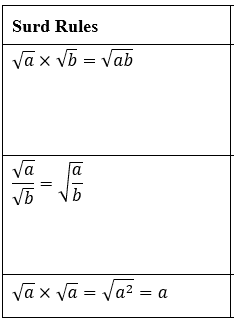
Multiplying Surds
Surds follow normal multiplication rules.
\( \sqrt{a}\times\sqrt{b}=\sqrt{ab} \)
\( \sqrt{2}\times\sqrt{8}=\sqrt{16}=4 \)
Expanding Brackets with Surds
Use ordinary algebra rules.
\( (a+b)(c+d)=ac+ad+bc+bd \)
Example:
\( (3+5\sqrt{2})(1+\sqrt{2}) \)
\( =3+3\sqrt{2}+5\sqrt{2}+10 \)
\( =13+8\sqrt{2} \)
Rationalising the Denominator
A denominator should not contain a surd. We remove it by multiplying by a suitable expression.
Single Surd in the Denominator
Multiply top and bottom by the surd.
\( \dfrac{2}{\sqrt{8}} \times \dfrac{\sqrt{8}}{\sqrt{8}} \)
\( =\dfrac{2\sqrt{8}}{8}=\dfrac{\sqrt{8}}{4}=\dfrac{2\sqrt{2}}{4}=\dfrac{\sqrt{2}}{2} \)
Binomial Surd Denominator
Multiply by the conjugate.
Conjugate of \( a-b\sqrt{c} \) is \( a+b\sqrt{c} \)
\( (a-b)(a+b)=a^2-b^2 \)
\( \dfrac{1}{2-\sqrt{3}}\times\dfrac{2+\sqrt{3}}{2+\sqrt{3}} \)
\( =\dfrac{2+\sqrt{3}}{4-3} \)
\( =2+\sqrt{3} \)
Example 1:
Express \( (3+5\sqrt{2})(1+\sqrt{2}) \) in the form \( a+b\sqrt{2} \).
▶️ Answer/Explanation
\( 3+3\sqrt{2}+5\sqrt{2}+10 \)
\( =13+8\sqrt{2} \)
Conclusion: \( 13+8\sqrt{2} \).
Example 2:
Rationalise \( \dfrac{2}{\sqrt{8}} \).
▶️ Answer/Explanation
\( \dfrac{2}{\sqrt{8}}\times\dfrac{\sqrt{8}}{\sqrt{8}}=\dfrac{2\sqrt{8}}{8} \)
\( =\dfrac{\sqrt{8}}{4}=\dfrac{2\sqrt{2}}{4}=\dfrac{\sqrt{2}}{2} \)
Conclusion: \( \dfrac{\sqrt{2}}{2} \).
Example 3:
Rationalise \( \dfrac{1}{2-\sqrt{3}} \).
▶️ Answer/Explanation
Multiply by conjugate:
\( \dfrac{1}{2-\sqrt{3}}\times\dfrac{2+\sqrt{3}}{2+\sqrt{3}} \)
\( =\dfrac{2+\sqrt{3}}{4-3}=2+\sqrt{3} \)
Conclusion: \( 2+\sqrt{3} \).
Index Laws with Integer, Fractional and Negative Powers
Fractional Powers
A fractional index represents a root.
\( a^{\frac{1}{2}}=\sqrt{a} \)
\( a^{\frac{1}{3}}=\sqrt[3]{a} \)
More generally:
\( a^{\frac{m}{n}}=\sqrt[n]{a^m} \)
Negative Powers
A negative index means reciprocal.
\( a^{-n}=\dfrac{1}{a^n} \)
This also works with fractional indices.
\( a^{-\frac{1}{2}}=\dfrac{1}{\sqrt{a}} \)
Key Idea
Fraction → root
Negative → reciprocal
Example 1:
Evaluate \( \sqrt[3]{8} \).
▶️ Answer/Explanation
\( 2\times2\times2=8 \)
\( \sqrt[3]{8}=2 \)
Conclusion: \( 2 \).
Example 2:
Evaluate \( 625^{\frac{1}{2}} \).
▶️ Answer/Explanation
\( 625^{\frac{1}{2}}=\sqrt{625} \)
\( \sqrt{625}=25 \)
Conclusion: \( 25 \).
Example 3:
Evaluate \( \left(\dfrac{1}{25}\right)^{-\frac{3}{2}} \).
▶️ Answer/Explanation
First remove the negative power (reciprocal):
\( \left(\dfrac{1}{25}\right)^{-\frac{3}{2}}=25^{\frac{3}{2}} \)
Now apply fractional power:
\( 25^{\frac{1}{2}}=5 \)
\( 25^{\frac{3}{2}}=(25^{\frac{1}{2}})^3=5^3=125 \)
Conclusion: \( 125 \).
