
Sets and Subsets
A set is a collection of distinct objects, usually numbers.
Sets are written using curly brackets.
\( A=\{1,2,3,4\} \)
Set Builder (Algebraic) Notation
Instead of listing all elements, a set can be defined using a rule.
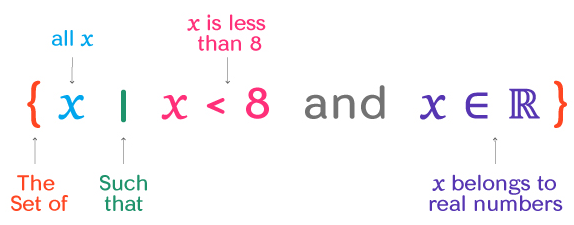
\( A=\{x\mid x\text{ is an even number less than }10\} \)
This means:
\( A=\{2,4,6,8\} \)
The symbol \( \mid \) means “such that”.
Subsets
A subset is a set whose elements are all contained in another set.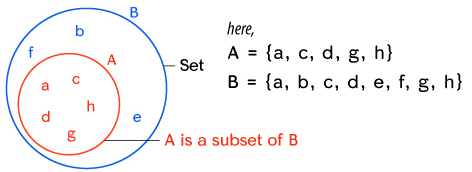
If \( A \) is a subset of \( B \), we write \( A\subset B \).
Example:
\( B=\{1,2,3,4,5,6\} \)
\( A=\{2,4,6\} \)
Every element of \( A \) is inside \( B \), so \( A\subset B \).
Important Symbols
\( \in \) means “is an element of”
\( \notin \) means “is not an element of”
\( \subset \) means “is a subset of”
Key Idea
All elements of a subset must belong to the larger set.
Example 1:
Write the set \( A=\{x\mid x\text{ is a multiple of 3 less than }10\} \) in list form.
▶️ Answer/Explanation
Multiples of 3 below 10 are \( 3,6,9 \)
Conclusion: \( A=\{3,6,9\} \).
Example 2:
Let \( B=\{1,2,3,4,5,6,7,8\} \). Is \( A=\{2,4,6\} \) a subset of \( B \)?
▶️ Answer/Explanation
All elements of \( A \) appear in \( B \).
Conclusion: Yes, \( A\subset B \).
Example 3:
Given \( C=\{x\mid x<5,\; x\in\mathbb{N}\} \), list the elements of \( C \).
▶️ Answer/Explanation
Natural numbers less than 5 are \( 1,2,3,4 \).
Conclusion: \( C=\{1,2,3,4\} \).
Venn Diagrams
A Venn diagram is used to represent sets visually.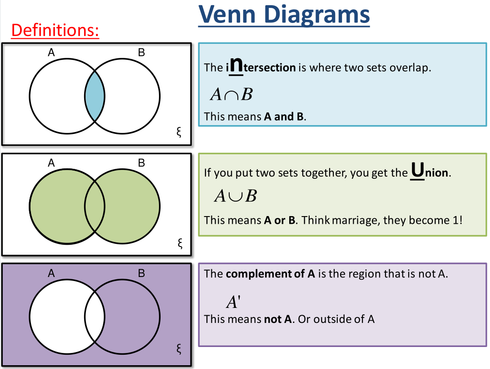
Each set is shown as a circle inside a rectangle (the universal set).
The rectangle represents all possible elements.
Universal set: \( U \)
Placing Elements in a Venn Diagram
Numbers belonging to a set go inside its circle.
Numbers outside all circles but inside the rectangle belong to the universal set only.
Intersection
The overlapping region shows elements common to both sets.
\( A\cap B \) means elements in both \( A \) and \( B \).
Union
The union contains everything in either set.
\( A\cup B \)
Number of Elements
We can count how many values are in each region of the diagram.
Each number must be written in the correct region.
Example 1:
Universal set \( U=\{1,2,3,4,5,6,7,8\} \)
\( A=\{2,4,6,8\} \) (even numbers)
\( B=\{3,6\} \) (multiples of 3)
▶️ Answer/Explanation
Common element: \( 6 \) goes in the overlap.
\( 2,4,8 \) go in set \( A \) only.
\( 3 \) goes in set \( B \) only.
\( 1,5,7 \) go outside both circles.
Conclusion: Elements are placed according to membership.
Example 2:
If 5 elements are in \( A \) only, 2 in the intersection, and 4 in \( B \) only, how many are in \( A\cup B \)?
▶️ Answer/Explanation
\( 5+2+4=11 \)
Conclusion: \( n(A\cup B)=11 \).
Example 3:
A Venn diagram shows 3 elements in the overlap, 6 in \( A \) only and 5 in \( B \) only. How many elements are in total inside the circles?
▶️ Answer/Explanation
\( 6+3+5=14 \)
Conclusion: 14 elements.
Number of Elements in a Set
The notation \( n(A) \) means the number of elements in set \( A \).
It tells us how many members the set contains.
Example:
\( A=\{2,4,6,8\} \)
\( n(A)=4 \)
Universal Set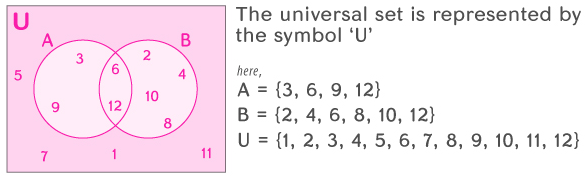
The universal set contains all possible elements and is written \( U \).
\( n(U) \) is the total number of elements in the diagram.
Intersection
Elements common to both sets are written:
\( n(A\cap B) \)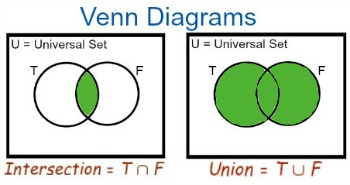
Union
All elements in either set:
\( n(A\cup B) \)
Important Rule
\( n(A\cup B)=n(A)+n(B)-n(A\cap B) \)
We subtract the intersection because it would otherwise be counted twice.
Example 1:
\( A=\{1,3,5,7\} \). Find \( n(A) \).
▶️ Answer/Explanation
There are 4 elements.
Conclusion: \( n(A)=4 \).
Example 2:
If \( n(A)=9 \), \( n(B)=7 \), and \( n(A\cap B)=3 \), find \( n(A\cup B) \).
▶️ Answer/Explanation
\( 9+7-3=13 \)
Conclusion: \( n(A\cup B)=13 \).
Example 3:
The universal set has 20 elements. If 12 are in \( A \) and 5 are outside \( A \), find \( n(A) \).
▶️ Answer/Explanation
Elements outside \( A =5 \)
So elements in \( A =20-5=15 \)
Conclusion: \( n(A)=15 \).